A change of scene

After five-and-a-half years on the Gold Coast, we have decided to move back to Melbourne. Unlike our arrival in Queensland, we have no definite address to which we’re headed back ‘home’.

So there will be a delay of some weeks before this site publishes new material.

A near-forgotten voice

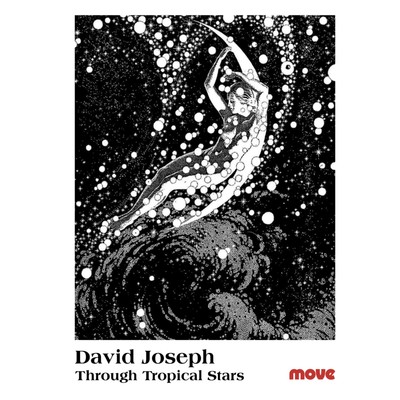
THROUGH TROPICAL STARS

David Joseph

Move Records MD 3467

There’s something enigmatic about the music of David Joseph. If it weren’t for Move Record’s initiative, I would know very little about his contribution to Australian music. As it is, any material you come across is deficient in detail. For example, the opening work on this disc, a Concertino for flute, viola and percussion dates from 1988 but doesn’t appear in the Australian Music Centre’s catalogue of Joseph’s works. Likewise, the concluding piece, The Afternoon of 1991 for piano trio, is absent from the same list. Slightly less confusing is the attribution of the title track for two flutes to 1977 on the CD, but 1978 in the AMC’s listing. Ditto for the String Trio No. 2 (CD 1991, catalogue 1990) and a Sonata for clarinet and 2 percussionists (1978 according to the CD, but 1979 in the catalogue demi-raisonne).

Not that such discrepancies will keep anyone awake at nights, but they speak of a certain slovenliness in the provision of accurate information. As for performers, the Concertino boasts members of Sydney’s Seymour Group before that ensemble ceased operations in about 2006; flute Christine Draeger, viola John Gould, percussion Ian Cleworth and Rebecca Lagos (or is it Graeme Leak{e}?) as announced on the CD’s sleeve?). Jennifer Newsome and Zdenek Bruderhans perform Through tropical stars, while Nigel Sabin clarinet and Cleworth with Ryszard Pusz present the sonata. A group appropriately called the String Trio Holland consists of violin Josje Ter Haar, viola Susanne van Els, and cello Job Ter Haar. As for the brief The Afternoon, that features the untraceable Trio Classico comprising violin Urs Walker, cello Regula Hauser Menges, and piano Stefan Fahmi.

As you can see from the dates of each work listed above – 1977 (1978), 1978 (1979),1988, 1990 (1991), 1991 – Joseph’s compositions on this CD are not fruits of the composer’s time spent in Benalla where he has worked as a lawyer for nearly the last 25 years. It would seem that his musical creativity has come to a halt – a lume spento. Nevertheless, these five tracks from the past remind us of the individual voice that Joseph spoke and the sheer attractiveness of his vocabulary. By the way, all offerings on this CD are from live performances – at the Seymour Centre, Elder Hall in the University of Adelaide, Melba Hall at the University of Melbourne, and St. Peter’s Church, Zurich.

What the Concertino offers is a garden scene, albeit a furiously active one where the bird-life approaches the manic in its opening strophes, vivified by a rapid semiquaver flute pattern and viola flutterings above campanile, vibraphone and marimba backing. Every so often, we reach a hiatus point and the motivic matter changes, if the textures remain pretty constant, as does the level of action. When you think things are slowing down (the use of quaver triplets), the flute stirs itself into fresh flights and the percussion mimics the frenzy. For all that, the atmosphere is a benign one and it is conceivable that Joseph is presenting a kind of promenade where a change of vista prompts an alteration in texture.

Still, the soundscape is a consistent one with recognizable patterns enjoying a transmutation process and the ensemble working as a well-oiled rhythmic machine, punctuated by a cadenza flight from Draeger and Gould towards the conclusion . Just when you think the piece is descending into a twilight phase, the initial energy and textures reappear, although the final bars offer a kind of placid resolution. It seems to me that Joseph is most concerned with exercising a timbral palette which he varies most obviously by changing his percussion instruments. This results in an effervescent kaleidoscope of colours to which all four participants contribute in almost equal measure.

According to the AMC site, Through tropical stars is meant to last about twelve minutes; Newsome and Bruderhans get through it in under nine. It’s not intended to be another ‘bird’ piece and in some ways it isn’t, having a wider scope than mere avian imitation. But there are passages where you can’t escape the querulous nature of bird chirrups and competing calls, circling around each other in close imitation. One player uses piccolo, concert flute and alto flute; the other sticks to concert flute throughout. While the work is a dazzling exhibition piece for its interpreters, its atmospheric character suggests a natural world abuzz with growth and light: a brilliant tandem ride of coruscations, here articulated with admirable interdependence.

Something like the Concertino, Joseph’s Sonata works hard to present textural and timbral interplay/contrast. It certainly exploits Sabin’s flexibility and rapid recovery in its initial stages where a dialogue between clarinet and marimba displays a mastery of quick-fire articulation. A chain of sustained wind notes takes us a short space away from the initial chattering, but not for long; when the clarinet is occupied with delivering a high pedal note, both marimba and xylophone indulge in a furious clash of lines.

It makes for an experience that is heavy in events. If a score were available, I’m sure the interconnections and inner references would become clearer but, as it is, you just surrender to the aural avalanche-with-recesses that prevails at the end, despite the sudden emergence of some moments of what pass for rest in this active work. Percussionists Cleworth and Howell are no shrinking violets but take over the running, occasionally drenching the clarinet in powerful mallet work as the score drives towards its affirmative conclusion.

With the string trio, despite the CD leaflet’s stipulation that it is a nature portrait similar to the Concertino, we are in a different landscape where abrasive chords serve as fulcrum points, demanding attention right from the opening. True, you hear whistles and throbbings that might represent wildlife red in tooth and claw, alternating with compulsive motor rhythms that bear witness to the ongoing influence of Stravinsky’s early years. Again, the composer utilises obsessive motives and near-splenetic bursts of repeated chords to animate his intended ambience.

As with its precedents on this CD, the trio deals with patterns that can be transformed or just repeated till the next one appears. What is different is the sense of menace as we move through a sound world that is packed with percussive-sounding bursts. The burbling and twittering has gone and we find ourselves in a world of menace and uncertainty which eventually fades to an uncertain final querulousness: the first piece on this album that ends, like Petrushka, with a question.

The last track, and the latest of Joseph’s works represented here, The Afternoon is a brief vignette that intends to acquaint the listener with the sad quietude of approaching twilight. In fact, the piece succeeds very well in following a path into quiescence, the final words given to the piano after a process that maintains Joseph’s practice of exploiting brevities, even if these ones present themselves with more angularity than we’ve heard so far.

For recordings that were made some time ago – 46 years in two cases, 34 years the most recent – the quality of these tracks is remarkably clear, in particular the final one from Zurich where Walker’s violin and Fahmi’s piano have a fine, piercing character that makes every note resonate. And it serves as an attractive envoi to this series of one-movement scores that remind us of the intellectual and emotional appeal of the music created by this remarkably gifted writer.

Amiable amalgam

JESS HITCHCOCK & PENNY QUARTET

Musica Viva Australia

Conservatorium Theatre, Griffith University

Tuesday March 4 at 7 pm

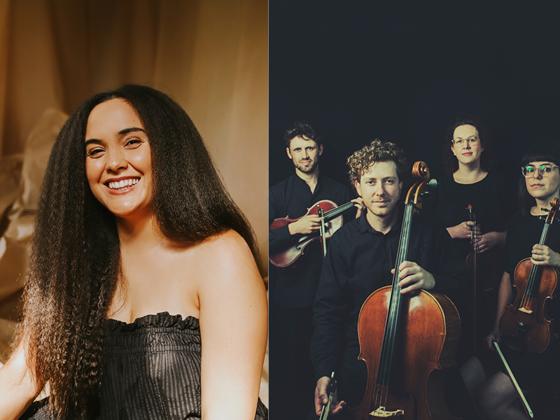
Jess Hitchcock & Penny Quartet (L to R Anthony Chataway, Jack Ward, Amy Brookman, Madeleine Jevons)

It was hard to get a handle on this recital, a rather specialized event from Musica Viva which is being heard in Perth, Adelaide (part of this year’s Festival), Brisbane,, Newcastle and Sutherland. In the program, Glenn Christensen, a former resident with the Australian Chamber Orchestra, is listed as first violin of the Penny Quartet but was he present on this night, your honour? Or has his appearance changed significantly since those halcyon ACO days? The photograph above shows the current quartet’s personnel, according to the body’s website. I didn’t recognize any of the players by sight – three males and a female – although their ensemble output impressed for its deftness.

Jess Hitchcock sang twelve of her own songs and the program included a full set of texts. But then, the organizers turned the lights right down so this information was completely useless. Mind you, the artists wended a lackadaisical way through the mixed dozen lyrics which were not performed in printed order so that you were invited to play a kind of detection game to work out what was going on. In the original concept, the program contained only eleven Hitchcock songs, all of them organized for a string quartet accompaniment by local writers. A fresh arranger – Christine Pan – attended to the additional song.

I think I got them in the right order but, as far as this singer’s work goes, there be no ignorance like unto my ignorance. I believe I heard, in sequence: Days Are Long (arr. Iain Grandage), Homeward Bound (arr. Isaac Hayward), Collide ((arr. Nicole Murphy), Soak To My Bones (arr. Harry Sdraulig), Leader of the Pack (arr. Ben Robinson), By the Sea (arr. May Lyon), On My Own (arr. Holly Harrison), Together (arr. James Mountain), Running in the Dark (arr. Matt Laing), Fight for Me (arr. Pan), Unbreakable (arr. Alex Turley), and Not a Warzone (arr. Grandage).

Apart from the songs, the program also gave an airing to American writer Caroline Shaw‘s Plan & Elevation: the Grounds of Dumbarton Oaks. This quartet was written to commission by Harvard, celebrating the 75th birthday of the university’s famous estate; further, Shaw was the original music fellow at Dumbarton Oaks in 2014-15. Now what I think happened was that the Pennies interspersed the songs with the five movements from Shaw’s work. If so, the work was subsumed into the whole experience very cleverly. I can recall some viola double stops suddenly emerging at one point, as well as some rapid Verklaerte Nacht-style arpeggios with harmonics – both identifiable from Shaw’s score. Sadly, the final effect was to make you think that one of the arrangers had included an above-average postlude or prelude, rather than transporting you to the estate’s Herbaceous Border or Cutting Garden.

Adding to the mix, Hitchcock proved to be a fan of the pre-song address, giving us information about her background, her family, her musical training, her participation in the Voice referendum, her personal relationships with people that she was singing about – all the gallimaufry that might/might not add to a listener’s appreciation of what was being offered. Certainly, this singer is involved in her work and is at some pains to tell us all about it, in the way of the young. Whether we need to hear it is another business.

To be honest, I found it hard to differentiate between many of Hitchcock’s songs. Her melodic language shows balance and general placidity; the harmonic structures are innately simple, if spiced up by her arrangers; the tempo of each song rarely ventures into any territory but the four-square. For instance, the opening Days Are Long presented as a simple melody over a pizzicato support that developed into a thudding bass line, soon turning the lyric into a bit of a chug. Immediately, you were aware that the vocalist was well amplified; after a time, it became apparent that so were her string supporters.

During the following Homeward Bound, you encountered some rhythmic irregularity to complement the loud, punchy nature of the actual content but this spike of interest didn’t seem to be part of the original matter but inserted by its arranger. And so the procedure continued with a quickening of interest before a return to the tried and true e.g. Collide where an intriguing drone effect shuffled back into a fluent chordal support. Or else the arrangement stole much of the thunder, as in By the Sea with its plain vocal line overtaken by Lyon’s ornate string support.

Contrast that with the feistiness of On My Own, an unusually fast and assertive song which brought to mind some traces of American protest songs, although the text appears to point to an inter-personal crisis rather than a recrimination aimed towards the current social order. But then, it could be both.

Nearing the end of the night, Hitchcock started playing on a keyboard at the opening to Unbreakable. Mind you, I was in such a state of identification tension that she might have been making subtle contributions before this. This song fell into the same category as several others on offer that encourage self-belief, self-determination, self-confidence, self-assertion – statements of character development that flourish in the egotism of this age. Possibly these might not have grated so much if the vocal lines offered variety, but they didn’t. All of Hitchcock’s melodic threads bore a close resemblance to each other, and all sprang from a base in the American Neo-Romanticism that has flourished in the republic for some time.

What we heard across the twelve-part cycle was pleasant music-making that cast no threatening shadows of modernity. In this reversion to a well-trodden path, the composer stayed within the limitations you can hear in Sondheim’s Into the Woods – a sampler of song construction for the contemporary writer with a disregard for recent advances in melodic design, metrical ingenuity and harmonic experimentation; when I say ‘recent’, I’m referring to anything past the first decade of the 20th century in the history of Western music. Of the original music of our country, I found no trace. Despite her Torres Strait Islander and New Guinean background/heritage, Hitchcock has been trained in her craft by serious musicians; as far as I can tell, she has yet to take up the mantle of original invention.

As a suddenly applied encore, Hitchcock and the Pennies presented a version of Sidney’s My true love hath my heart. I wasn’t able to decipher Hitchcock’s attribution of musical authorship from her preliminary remarks, but the setting rocked no boats and so was of a piece with everything that preceded it.

In this light program, the five artists collaborated to fine effect and the smaller-than-usual Musica Viva audience applauded each segment with enthusiasm. So what was missing? Perhaps a kind of emotional depth, or an aspiring ardour to lift the evening’s cosy level of engagement. You (meaning I) left the Griffith University venue with a sense that we’d heard a deft sequence of songs, thank you very much, but not much remained in the memory.

Celebrate with the tried and true

BRAHMS & BEETHOVEN

Australian Chamber Orchestra

Concert Hall, Queensland Performing Arts Centre

Monday February 17, 2024

Richard Tognetti

You could see this program as a retrograde step in the Australian Chamber Orchestra‘s ongoing path of achievement. Presenting two repertoire standards like the Brahms Violin Concerto and Beethoven’s A Major Symphony doesn’t put many demands on audiences who would/should be familiar with both masterpieces. Of course, in this case you’re bound to hear exceptional readings of these scores, the ACO being what it is – one of the country’s leading ensembles in terms of skill and interpretative talent.

This was the tenth and final expounding of this double feature, the climax of a tour that took in the three eastern state capitals with a detour to Newcastle along the way. So the accomplishment level was as good as it was going to get. Adding to sixteen core members of the orchestra, artistic director and soloist Richard Tognetti had enlisted the assistance of an extra seven violinists, four more violas, two supplementary cellos and two double bass guests. This practically doubled the string body but such reinforcement proved necessary, given that all players were using gut strings.

The recruited flutes weren’t playing metal instruments, as far as I could tell; oboes, clarinets and bassoons all looked contemporary from my seat. The trumpets appeared orthodox but at least two of the horns were employing crooks and the other one of the four that I could see had an instrument whose middle workings looked unfamiliar to me – neither valved nor crooked. So it seemed that what we heard was something of a mixed bag, although the resulting sound complex favoured the woodwind and brass (as you’d expect).

Among the guests were musicians from the Adelaide, West Australian,, Queensland, Melbourne, Dresden Festival, Age of Enlightenment and Canada’s National Arts Centre Orchestras. Thomas Chawmer from the Orava Quartet was one of the violas, and six of the other string players were from the ACO’s Emerging Artists of 2025 ranks. You’d think this made for a sort of uneasy agglomeration but the whole complex sounded highly polished and assured in its work, probably more impressive in the symphony because Tognetti spent a good deal of his time directing rather than leading his first violins.

Of course, he had his hands fuller when treating with the concerto, across which he produced one of the most refined interpretations I’ve heard live. A thoroughly seasoned performer, Tognetti knows better than most where to find a balance between assertion and reticence, even if this interpretation was pre-ordained towards the latter. Even so, that brave opening flourish from the solo after the ritornello to the first movement registered as imposingly dynamic even if you missed the steely insistence of the quasi-cadenza upward-shooting spirals before this lone voice settles into its beneficent variants on the opening theme.

As the performance continued, I tried to recall when I’d last heard the ACO and Tognetti achieving a similar sound spectrum. It’s faded in the memory but I think it must have been when they were presenting another of the great concertos where solo detailed work, especially when lodged in the lower strings, dissipated into the accompaniment which was, above all, considerate. Because of this infrequency of bite, you had to concentrate with high attention to follow the opening movement’s argument, compensating for the murmuring activity by fleshing out what you know must have been there.

It’s a marvellous expanse, that first Allegro, relieved in this performance by a departure from the usual Joachim cadenza. Tognetti put together an amalgam of his own from those supplied by Busoni, Hugo Heermann and Auer. He adopted the Busoni venture of having a timpani accompany the soloist for a fair way into the novelty, and later brought in the strings for some preliminary chords prior to the return to normal at bar 527. Whatever the traces of Heermann and Auer, I wasn’t quick (or familiar) enough to pick them up but the demonstration proved to be technically spectacular, probably more so than the original.

When it came to the Adagio, we moved onto a different place, more subtle than that usually displayed in orthodox readings. The initial 30-bar wind chorale sounded seamless, the clarinets enjoying pride of place being positioned above their woodwind peers. The soloist’s unveiling of that spine-tingling initial sentence made for an ideal representation of the composer’s lyrical genius and the movement promised a fully burnished outpouring – until some clown’s mobile phone went off, the idiotic alarm tinkling out the opening bar to Handel’s Arrival of the Queen of Sheba.

Tognetti paused, then took up the reins again without complaint, even if some of us were seething at this redneck lack of consideration or concern. Further, I suspect a few of us found it hard to re-enter the calm unfolding of this movement’s later stages without being distracted by an inner rage. For which reason, maybe, the giocoso conclusion came over as more aggressive than expected, the soloist’s line slashing and curvetting turn and turn about, the pulse fluctuating without a sign of discomfort right up to the Poco piu presto gallop to Brahms’ warm-hearted conclusion.

I’m pretty sure that the ACO has played the Beethoven symphony before and that I heard it about a decade ago in Melbourne’s Hamer Hall. As far as I can see, the ensemble hasn’t recorded it but might consider doing so, given the finely-spun detail with this group populated by many ad hoc players. As I’ve said, Tognetti spent much of his time exhorting the ensemble, mainly by indicating swathes of sound rather than bow-pointing to individuals or groups. Did he need to offer such encouragement to a set of musicians that were very well played-in to this score? The results were indubitably successful, so no argument.

But there’s not much to report. The work unfolded with very few flaws; an odd horn bleep and some not-quite-right wind group entries, plus a few moments where the strings were in danger of being out-weighed. Still, the Allegretto moved at a brisk pace, not handled as a lugubrious funeral march; the following scherzo ‘s repetitions came close to wearing out their welcome, as usual, but the players’ briskness of attack took the edge of the composer’s wearing insistence.

Finally, that jubilant Allegro con brio rort rounded off the night with elegant bravura, some novel dynamic points set out for the more jaded among us, and an irresistible drive from the strings that lasted up to Beethoven’s peremptory final bark. I, for one, left the QPAC building with feelings of gratitude and elation – a welcome change from the usual sensation of having been aurally battered into submission. After this genuflection to the tried and true, and having attracted a substantial audience, the ACO will proceed with its birthday celebrations by following more challenging paths, this double-bill definitely being the year’s most conservative Brisbane program.

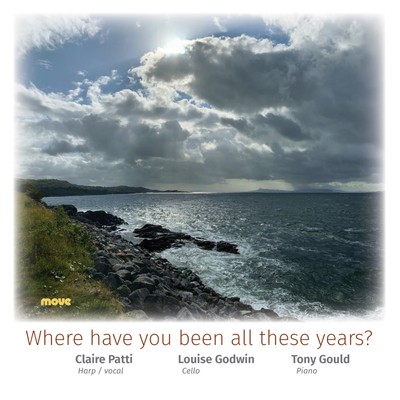
Soft blasts from the past

WHERE HAVE YOU BEEN ALL THESE YEARS?

Claire Patti, Louise Godwin, Tony Gould

Move Records MD 3469

There’s something disarming about this album which is a collection of songs/folk-songs – several of them well-known – performed as trios, duets and solos by Claire Patti (harpist and singer), Louise Godwin (cellist but not employed as much as she could have been), and Tony Gould (pianist and the heaviest participant in this amiable exercise). I say ‘well-known’, but that might only apply to that generation that boasts Gould and me (he is my senior by a few years). The Skye Boat Song, My love is like a red red rose, Londonderry Air, The Last Rose of Summer, Black is the colour of my true love’s hair and Molly Malone were standard articles of faith in my youth and all enjoy a re-working here.

As well, you will come across a few that ring bells in the memory, if not very clamorous ones: Carrickfergus, Strawberry Lane and Ae fond kiss. Gould and Co. have included an Irish lyric that I’ve never come across – Tha M’aigne fo ghuraim (This gloom upon my soul) – and an English traditional song that none of those great 19th-into-20th century collectors seems to have bothered with: Sweet Lemany. Not to mention a Scottish tune that sounds more promising than its reality in She’s sweetest when she’s naked. Then there’s Idas farval (Ida’s farewell), written by Swedish musician Ale Carr, and Jag vet en dejlig rosa (I know a rose so lovely) which is a traditional tune, also from Sweden; I suspect that both of these spring from Godwin’s interest in that Scandinavian country’s music. From left field comes A little bit of Warlock, which sets some pages from the Capriol Suite, namely the Pieds-en-l’air movement.

The ensemble beginsn with Sweet Lemany, which may have origins in Cornwall, Ireland, or Suffolk; it has certain traits that argue for an Irish genesis. But the setting is original,, first in in that Godwin maintains a one-note pedal throughout, pizzicato and keeping to a mobile rhythmic pattern. Patti sings with a light, refreshing timbre while Gould informs the piece with subtle inflections and brief comments/echoes. For all that, Patti sings four of the five verses available in most editions.

Gould takes the solo spot for William Ross’ Skye Boat Song and, apart from a winsome introduction, sticks to the well-known tune right up to the final bars where the straight melody is subsumed in a brief variant. Most interest here comes from following the executant’s chord sequences which follow an unexceptionable path throughout a mildly meandering interpretation. Gould gives brief prelude to My love is like a red red rose before Patti sings the first two stanzas. Godwin offers a cello statement, before the singer returns with the final two stanzas and an unexpectedly open concluding bar. Gould occasionally offers a high trill to complement Patti’s pure line. And the only complaint I have about the vocal line is the singer’s odd habit of taking a breath after the first few syllables of the third line in most of the stanzas.

Carr’s sweet if repetitive lyric is a sort of waltz with three-bar sentences/phrases, in this case giving the melody first to the cello, then the harp, before the cello takes back the running. The piece’s form is simple ternary and we certainly are familiar with the melody’s shape before the end. More irregularity comes in the Swedish traditional song from the 16th century with its five-line stanzas, here handled as a kind of elderly cabaret number by Patti and Gould, whose support is a supple delight beneath Patti’s somewhat sultry account of what textually should be a love song but musically sounds like a plaint.

The Warlock movement, here a piano solo, gets off to a false start and Gould can be heard saying that he’ll start again. For the most part he is content to follow the (original?) Arbeau melody line and reinforce the British arranger’s harmonization with some slightly adventurous detours along the path. A variant appears shortly before the end but the executant eventually settles back into the format and plays the final two Much slower bars with more delicacy than the original contains. Patti sings two stanzas of the three that make up the ‘standard’ version of Carrickfergus and invests the song with an infectious clarity of timbre, especially at the opening to the fifth line in each division with Gould oscillating between the unobtrusive and mimicking the singer when she moves into a high tessitura.

A harp/cello duet treats James Oswald’s She’s sweetest when she’s naked, which has been described as an Irish minuet (whatever that is). The only peculiarity comes with a change of accent to slight syncopation, first seen in bars 3 and 5 of the first strophe. Patti plays the tune through twice, then Godwin takes the lead for another run-through. Some laid-back ambling from Gould prefaces the Danny Boy reading for solo piano, with just a trace of Something’s Gotta Give before we hit the melody itself. The pianist does not cease from exploration and offers some detours to the original line, as well as a couple of sudden modulations to restatements in a refreshed harmonic setting. For all that, the Air remains perceptible across this investigation, the CD’s longest track.

Staying in Ireland, Gould gives an alluring prelude to The Last Rose of Summer before Patti starts singing Moore’s lines. Godwin has a turn at outlining the original Aisling an Oigfhear melody before the singer returns with the second stanza, then omitting the third, with Gould providing a postlude that puts the first phrase in an unexpected harmonic context. As with all the vocal items on offer, this is quiet and unobtrusive, some worlds away from the habitual thrusting treatment demonstrated by generations of Irish tenors bursting into the role of Flotow’s Lyonel.

Across the sea to Scotland’s Black is the colour of my true love’s hair which Gould opens through some sepulchral bass notes before giving the melody unadorned and unaccompanied before moving into a fantasia that harks back to its source material before resolving into another re-statement of the melody and a reappearance of the opening’s repeated tattoo. This version is comparable in colour to some of the more conscientious American folksingers who have recorded versions of this work, making a slightly unsettling celebration of what is a love-song in a minor key (mode!?) context.

Back across the sea to the island, Godwin plays Tha M’aigne fo ghuraim as a solo, punctuated by sudden turns and grace notes; at well under two minutes, the CD’ shortest track but probably its most obvious and characteristic in terms of its country of origin. Another piano solo, Gould gives us a preamble before playing Strawberry Lane through straight once, then almost doing the same thing again before following his pleasure at the end of the second stanza. Of course, he returns to the melody en plein air near the end but concludes with a reminiscence of his earlier elaboration and an unsatisfying tierce to finish.

Another Burns lyric, if a despondent one, in Ae fond kiss brings Patti’s calm delivery into play once again. She sings all the stanzas except No. 2 in the set of six. Gould offers a mid-flow interlude which, I suppose stands in for the missing lines but the song’s delivery suggests a rather odd 3/4 rhythm as opposed to the more bouncy original 6/8. But the executants’ restraint is put to happy employment throughout. Molly Malone brings up the rear and is another piano solo where Gould plays the stanzas’ sextet several times, giving less space to the three chorus lines. It’s plain sailing through this very familiar melody, the pianist content to follow the air’s contour.

Not everything on this diverting disc works ideally. Some of Gould’s chords sound like abrupt breaks in an otherwise placid flow, some notes don’t sound, and Godwin’s cello seems uncomfortable on one track. Still, you’ll find plenty of material here to entertain and over which you can reminisce – which is clearly (for me, at least) the whole point of the exercise.

Diary March 2025

VIVALDI VESPERS

Brisbane Chamber Choir/Chamber Players

Queensland Conservatorium, Griffith University

Sunday March 2 at 3 pm

This has me beat: I can’t find a mention in the composer’s catalogue of any Vespers setting. But there they are on YouTube – a Vespers for St. Mark from which comes the well-known Beatus vir setting; and a Vespers for the Blessed Virgin with a friendly Domine ad adiuvandum. You can get a recording (presumably of one of them) from the Ex Cathedra ensemble. There’s even a putative vespers available of how an imaginary service for the Feast of the Assumption might have sounded if Venetian composers had clubbed together for such a celebration. Whatever the foundation for this event, the Brisbane Chamber Choir and Brisbane Chamber Players (who are they?) will work together under the choral body’s founding director Graeme Morton with two soloists taking front-and-centre: soprano Sara Macliver and countertenor Michael Burden (know the former, of course; looked up the latter who is a Sydney product, it seems). Well, it could be a revelation but, I suspect, mainly for those of us who know only the Magnificat and Gloria. Students can attend for $15; if you’re under 30, it’s $50; with your concession card, the price is $70; the cost for a full adult is $90. Whatever category you fall into, there’s the extraordinary bonus of no booking/handling fee.

JESS HITCHCOCK & PENNY QUARTET

Musica Viva Australia

Queensland Conservatorium, Griffith University

Tuesday March 4 at 7 pm

This combination is new to me and, I suspect, won’t be familiar to Musica Viva audiences, although the Penny Quartet members are well-known quantities as individuals: violins Amy Brookman and Madeleine Jevons, viola Anthony Chataway, and cello Jack Ward. Vocalist Jess Hitchcock hasn’t come my way before, but she’s one of those multi-discipline musicians who sings opera and jazz, as well as writing her own music. Indeed, she appears in this recital as singer and song-writer but, to give it a twist, she is giving us arrangements of eleven of her own songs as organized by a bevy of young Australian composers. Tack on to that a composition by Caroline Shaw, the Pulitzer Prize-winning American composer who is here represented by Plan and Elevation: The Grounds of Dumbarton Oaks: a musical depiction for string quartet of five aspects/features in the famous estate. As for the song arrangers, they are Ben Robinson, Matt Laing, May Lyon, James Mountain, Iain Grandage, Harry Sdraulig, Holly Harrison, Isaac Hayward, Alex Turley and Nicole Murphy. I don’t know any of the songs but wait for their unveiling with high expectations. Entry prices range from $49 to $125 and there’s a transaction fee of $7, which I don’t believe was the practice in previous years but someone has finally hit on the usual way to screw the consumer.

LA CENERENTOLA

Opera Queensland

Concert Hall, Queensland Performing Arts Centre

Tuesday March 4 at 7 pm

To my mind, this is a stand-out Rossini work which appeared as a transient jewel in the national company’s repertoire many years ago and which I saw at the Vienna Opera sometime around 1982 – one of the few unalloyed pleasures I’ve experienced in that city’s opera house. It’s a sparkling construct, capped off with the heroine’s finely graduated Non piu mesta with the Ramiro/Dandini Zitto, zitto, piano, piano duet a true delight. We have here a concert version, I think, because of the venue but a director (Laura Hansford), costumiers (Karen Cochet and Bianca Bulley) and a lighting designer (Christine Felmingham) are included in the performance personnel. Richard Mills conducts a partly unfamiliar cast: Mara Gaudenzi (Angelina), Petr Nekoranec (Don Ramiro), Samuel Dundas (Dandini; well I know this baritone and believe I’ve seen him in this role), James Roser (Don Magnifico), Shaun Brown (Alidoro), Sarah Crane (Clorinda), and Hayley Sugars (Tisbe). The Queensland Symphony Orchestra appears, as does the Opera Queensland Chorus. Full adult tickets range from $75 to $149; the concession rate is small and students pay the same. Never forget the $7.50 charge for the organizers being unable to handle credit cards without smashing the consumer around the head.

This performance will be repeated on Saturday March 8 at 1:30 pm.

THE BIRTH OF BEL CANTO

Opera Queensland

City Tabernacle Baptist Church

Wednesday March 5 at 7 pm

You get few indications of what exactly will be presented from the Opera Queensland site. You get much more information on the website of One Equal Music, the choral ensemble that is at work on this occasion. Apparently, bel canto begins with Renaissance madrigals by Monteverdi, Gesualdo, Strozzi (the recently discovered and extravagantly lauded female composer of the Baroque) ‘and others’ who, according to the OEM pages, are Verdelot, Lotti, Luzzaschi, Fresobaldi, de Wert, d’India and De Monte. From the organization’s ten or eleven members, we have six singers participating, sopranos Louise Prickett and Cara Fox , alto Eleanor Adeney, tenor Tomasz Holownia, bass James Fox. The ensemble, founded and directed by husband-and-wife team Adeney and Holownia, will be accompanied by an unnamed cellist and harpsichordist. A full adult admission is $65, with a reduction of $6 – count them – for concession card holders and students; children get in for about half-price. Still, as far as I can see, there’s no booking fee; must be the venue which is warding off that ever-menacing mammon of iniquity.

PETITE MESSE SOLENELLE

Opera Queensland and The University of Queensland

St Stephen’s Cathedral, 249 Elizabeth St.

Friday March 7 at 7 pm

It’s anything but little, as the composer well knew. When he got around to orchestrating it, the truth came out as the forces employed were very substantial. But this appears to be the original version for four soloists who emerge from the choir of twelve, two pianos and a harmonium. As this is a collaboration with the University of Queensland, the pianists are two of that institution’s staff: Anna Grinberg and Liam Viney. But it doesn’t stop there: the singers come from the University of Queensland Chamber Singers, the UQ Singers, and the Lumens Chamber Choir – which seems a lot to populate a chorale force of a dozen strong. Graeme Morton will play the organ (the cathedral doesn’t run to the more humdrum instrument?) and the whole will be conducted by Richard Mills. Recorded performances range from a bit over an hour to 80-85 minutes; lots of interpretative leeway, one would guess, but this reading is scheduled for 90 minutes uninterrupted. Ticketing follows the same process as for the Bel Canto recital: adults need $65, concession and student entrance is $59, a child gets in for $33. There’s no booking fee but it costs you $1.15 if you want your ticket)s) mailed.

RED DIRT HYMNS

Opera Queensland

Opera Queensland Studio, 140 Grey St., South Bank

Saturday March 8 at 7:30 pm

With this opus, composer Andrew Ford is providing us with secular hymns; I don’t know how many or specifically who is going to perform them. The poets involved are Sarah Holland-Batt, John Kinsella, and Ellen van Neerven. As for the performers, all that you can glean from Opera Queensland is that students are involved, and they come from the Jazz Department of the Queensland Conservatorium at Griffith University. Still, I’m puzzled by the genre promoted by Ford. A hymn is a song of praise, at bottom. It’s usually addressed to God or a deity of some kind. What we have here are praises of the everyday – ‘the shape of a vase or desire by a river bank at dusk’ are two projections from the OQ website. So the term has been distorted just a tad. When this kind of re-appraisal comes up, I automatically think of Brahms and the German Requiem where the Latin format is ignored and the composer sets a plethora of Biblical texts to do with death. But the construct doesn’t ignore the fundamental requirements for a requiem. I can imagine someone writing encomia to the things of this world, but hymns? Still, we’re in for a hefty dose of Australiana, if the red dirt descriptor is any indication. Anyway, Patrick Nolan is directing the event, so there’ll be a certain amount of staging involved, and the music director is Steve Newcomb who is, among other things, the Head of Jazz at the Queensland Conservatorium. The evening lasts for 80 minutes without interval and admission prices follow the same path as for previous OQ recitals across this month: $65 full adult, $59 concession and student, $33 a child, with no extra fees bar $1.15 if you want your ticket(s) mailed.

BARBER & PROKOFIEV

Queensland Symphony Orchestra

Concert Hall, Queensland Performing Arts Centre

Friday March 14 at 11 am

One of our favourite violinists, Canadian James Ehnes returns to Australia where he’s playing the 1939 Barber concerto: a suitable choice, just before the performer’s country becomes the 51st state, Mind you, Brisbane is the only city on Ehnes’ tour where he plays this work; the rest of the time, it’s Brahms pretty much all the way with a few Vivaldi and Mozart detours in Melbourne and Ballarat. All very nice, even if the American concerto isn’t long; but that leaves more time for encores, doesn’t it? The concert begins with conductor Jessica Cottis directing Matthew Hindson‘s Speed from 1997 which could be giving us a musical image of a racing car meet, or possibly the sensation of just driving quickly, or it could be an imaginative foray into the world of drug-taking. The frenetic pulse coming from a ‘synthetic’ drum-kit, this piece lasts for about 18 minutes, according to its publisher. Which makes it double the length of the Australian composer’s better-known Rush from 1999. Finishing this presentation comes the first movement of Prokofiev’s Symphony No. 5, the only one of the seven that is potentially familiar these days to a discerning concert-goer. I’ve heard the No. 1 Classical all too often, and this one rarely. The others? Never. I suppose the reason behind having only the one movement played this morning is because this event forms part of the QSO’s Education series – and a little learning is more than enough in this era of ignorance. Adult prices for tickets range from $80 to $115, with the usual sliding scale for concession, student and child entry. You’ve still got to pay the $7.50 fee for broaching the Concert Hall doors.

This program will be repeated on Saturday March 15 at 7:30 pm, the only difference being that the QSO will play all of Prokofiev’s symphony. Full prices here move between $100 and $140, which means that three movements of Prokofiev are worth $20/$25 on the current Queensland market. And the $7.50 booking slug still applies.

JAMES ROSER & ALEX RAINERI – AN DIE MUSIK – SCHUBERT’S ART OF SONG

Opera Queensland

Opera Queensland Studio, 140 Grey St., South Bank

Friday March 14 at 7 pm.

These musicians won’t be hard-pressed for material. Fresh from his appearances as Don Magnifico in the company’s La Cenerentola , baritone James Roser takes on a selection of Schubert lieder, accompanied by Opera Queensland’s go-to accompanist, Alex Raineri. From the promotional material, we are hinted towards Wohin?, Der Lindenbaum, Rast, and ‘the harmonic pangs of unrequited love’ – which last covers a hell of a lot of Schubert territory. As well, patrons are probably justified in expecting the recital title’s setting of Franz von Schober’s verses. As for the rest of this hour-long program, you just have to trust to the discernment of the performers. I’m not that crazy about placing faith in many musicians who are faced with a white program slate, but I think that Raineri would have enough discretion to balance the well-known with some rarities. Ticket prices follow the same path as for the other recitals this month: $65 full adult, $59 concession and student, $33 per child – with the bonus of not having to front up the cash for any extra charges, except for $1.15 if you want your ticket(s) mailed.

This program will be repeated on Saturday March 15 at 2 pm.

TREE OF LIFE

Collectivo

Thomas Dixon Centre, 406 Montague Rd., West End

Saturday March 15 at 1:30 pm

The Collectivo ensemble is a mobile group, its participants moving in and out according to programmatic requirements. This first recital for the year features the Sydney Symphony Orchestra’s concertmaster Andrew Haveron, oboe Tania Frazer (Collectivo’s artistic director), soprano Eden Shifroni, piano Vatche Jambazian, and cello Rachel Siu They’re beginning with Arvo Part‘s Fratres of 1977, probably played in the violin/piano combination. Then Shifroni sings two well-known arias: Lascia ch’io pianga from Handel’s 1711 opera Rinaldo, and Mozart’s Ach, ich fuhl’s lament from Pamina in Mozart’s The Magic Flute of 1791. Frazer comes on board with Schumann’s Romance No. 1 from the Op. 94 group of three, written in 1849. Just before interval, Shifroni returns for a selection of Debussy songs. So far, so varied; Yggdrasil would be pleased. No rest for the singer when we return as she says goodbye with Caccini’s (Vavilov’s) 1970 Ave Maria, just before Haveron and Jambazian combine for Franck’s epic Violin Sonata of 1886. The exercise concludes with a piece by Argentinian/Israeli clarinettist Giora Feidman called The Klezmer’s Freilach, released in 1998 and a brilliant sample of this branch of Jewish popular music; I’m assuming all the instrumentalists will join in this work to provide a rousing finale. It’s a regular two-hour recital with an interval and tickets cost a flat $74.50; there’s a transaction fee of $5 which is better than some but much worse than others.

LISZT & VERDI

Brisbane Chorale

St. John’s Cathedral, 373 Ann St.

Sunday March 30 at 2:30 pm

Conducted by Emily Cox, the Brisbane Chorale works through four gems of the repertoire, accompanied by organist Christopher Wrench. First up comes Liszt’s Via Crucis, a musical Stations of the Cross for soloists, four-part choir and organ written in 1878/9. This is a solid sing, lasting about an hour. We change from the funereal to the celebratory with Verdi’s Te Deum from the Quattro pezzi sacri, this extract dating from 1895/6 and lasting about 15 minutes (Verdi allowed for 12 only). It asks for two four-part choirs with a short soprano solo and you’d have to guess that Wrench will substitute for the original’s orchestra. Brahms’ Geistliches Lied of 1856 calls for a four-part choir with organ support. At a little over five minutes long, the piece interests for its contrapuntal severity and a combination of warmth and gloom. Finally, the Chorale contributes another five minute-plus delight with Faure’s Cantique de Jean Racine from 1864/5 when the composer was a student at the Ecole Niedermeyer. This also follows the Brahms lied‘s pattern of asking for a four-part choir and organ. Tickets cost $60 full price, $53 Centrelink concession, and $22 for a full-time student. The add-on handling fee is only $1.25, which at least is among the more piddling rates of extortion for using a credit card.
Diary February 2025

OUR CLASSICAL FAVOURITES

Queensland Symphony Orchestra

Concert Hall, Queensland Performing Arts Centre

Saturday February 8 at 7:30 pm

Back again for another year’s endeavours in combat against the rising tide of growing irritation with high culture, the QSO goes for the popular jugular with this collection of chunky clunkies. Rather than make the audience sit through the whole thing, conductor Benjamin Northey and his musicians sweep straight into the concluding Galop from Rossini’s William Tell Overture of 1829 – the Lone Ranger bit for an audience who doesn’t know what that means. Graeme Koehne‘s Forty reasons to be cheerful fanfare follows, written for the 40th anniversary in 2013 of the Adelaide Festival Centre and comprising 7 minutes of confected jollity. A well-known lump from Prokofiev’s Romeo and Juliet ballet of 1935 emerges: the Dance of the Knights with its clever fusion of pomp and bounce. We calm down for the Nimrod dirge extracted from the 1898/9 score of Elgar’s Enigma Variations, then turn elegant for Faure’s 1887 Pavane. Raise your beers (or rums) for Bernstein’s 1944 On the Town Overture which gets off to a splendid start but moves into sentimental weltering all too soon. Two of the QSO’s principals, harp Emily Granger, and flute Alison Mitchell, combine for the middle movement of Mozart’s concerto for their two instruments, written in 1778 during his 7-month stay in Paris – an unfortunate residence that saw his mother die in that city. The program’s other soloist, violinist Eric Kim, is a Year 12 student who won last year’s QSO Young Instrumentalist Prize; here, he’s up for Sarasate’s Zigeunerweisen showcase of 1878. The soulful Adagio from soulless Khatchaturian’s Spartacus ballet of 1956 takes us into a branch of the USSR’s post-Stalin encounters with Hollywood kitsch. Then the Russian dance theme continues with the Pas de deux from Act 2 of Tchaikovsky’s 1892 Nutcracker ballet, based on that memorable descending major scale motif. A little bit more Bernstein (and choreography) with the Symphonic Dances from West Side Story (all of them? That’ll be the longest item of the night), assembled in 1960, three years after the musical’s premiere. We wind up with the Brahms Hungarian Dance No. 5 from the 1869 Book I collection. Standard prices range from $100 to $140 with the usual derisory reduction for concession holders, students and children coming off much better. The QPAC booking fee continues to impose itself this year operating at the higher level of $7.50.

This program will be two-thirds repeated on Sunday February 9 at 11:30 am. Northey and Co. leave out the Faure, both Bernstein works, and the Brahms. Tickets for adults cost between $80 and $115, the same comments on ticket costs made above still applying.

MAX RICHTER WORLD TOUR

Queensland Performing Arts Centre and TEG Dainty

Concert Hall, Queensland Performing Arts Centre

Monday February 10 at 7:30 pm

Probably everyone in the audience knows more about this composer than I do because my only exposure to his ‘work’ has been via a re-composition of Vivaldi’s Four Seasons: those defenceless and evergreen violin concertos in no apparent need of reorganization. Max Richter is presenting extracts from his album The Blue Notebooks and his latest product – In A Landscape. I’ve listened to a few extracts from both and wonder how much simplicity (or simple-mindedness) we can bear before mental implosion. You could have a few laughs at Michael Nyman tracks in the good old days when tolerance was easier to exercise. Even listening to the cyclical deserts provided by Philip Glass could keep you involved for all of three minutes at a time. But a whole two hours of Richter would turn an inquiring brain to distraction, especially one that has any acquaintance with compositional practice over the past century. The composer will be escorted along his way by the American Contemporary Music Ensemble which is, in this format, a string quintet with two cellos. If you want to hear this concert, you’ll have to wait till next time because tonight is sold out – just like Taylor Swift, although the Concert Hall only offers 1800 seats maximum.

This program will be repeated on Tuesday February 11 at 7:30 pm. This is also sold out.

CLERICI & SCHAUPP

Queensland Symphony Orchestra

Queensland Conservatorium Theatre, Griffith University

Friday February 14 at 11:30 am

This program is notable for a few elements. The most significant would have to be the world premiere of Gerard Brophy‘s migrating with swallows, a guitar concerto to sit alongside the composer’s Concerto in Blue of 2002. As you can guess from the concert’s title, the soloist will be Karin Schaupp, empress of guitar at the Queensland Conservatorium. It’s splendid to be hearing from Brophy, one of the few survivors of a highly creative epoch in Australian music-making. Bringing up the rear comes Mozart’s Symphony No. 40 in G minor which is a marvel of innovation in a tight form and one of the composer’s most athletic creations. To begin, Umberto Clerici and his orchestra play Anahita Abbasi‘s why the trees were murmuring which involves an improvising trombone and two spacialized ensembles. Written in 2020, this score by the Iranian composer now based in San Diego is going to present local audiences with challenges, especially given the prominent solo trombone role and the preponderance of percussion which seem to make up the two different groups that are spatially separate on either side of the orchestra. I can’t see any connections between these three works but is anybody meant to? If you want to get in, the full price ranges between $99 and $140, with students and children getting in for $49 and $35 respectively. Because the event is held at the Con, there’s no sign of that annoying extra charge for handling your credit card.

This program will be repeated at 7:30 pm.

AN EVENING WITH JOSEPH KECKLER

Opera Queensland

Opera Queensland Studio, South Bank

Friday February 14 at 7 pm

Here’s another one of those oddly non-specific presentations by the state opera company. Joseph Keckler is an American singer/speaker with a wide range – vocally as well as aesthetically. You can enjoy a foretaste of his work on YouTube where the narrator skills are quite evident. I don’t think much of his compositional style, if you can centralize such a concept. It occupies that well-trodden land where consonance is king and progressions take their time; rhythmic patterns are predictable and anything but angular; melodic matter has moved no further than the Romantic era. Will Keckler be accompanied by ambient pre-recorded tape or Alex Raineri’s piano or a chamber ensemble complete with synthesizers? None of this is even suggested on the OQ publicity material. Nor is anything made clear about exactly what he will be singing, although you’d have to assume it’ll be sourced from his previous work, rather than something original, and you can find examples of that on the singer’s own website – if you’re prepared to pay. Speaking of which, tickets are $65, with a ludicrous reduction for concession card holders and students of $6, but there doesn’t appear to be a booking fee.

This program will be repeated on Saturday February 15 at 2 pm.

SINGAPORE SYMPHONY ORCHESTRA

Queensland Performing Arts Centre

Concert Hall, Queensland Performing Arts Centre

Sunday February 16 at 3 pm

The Singapore Symphony Orchestra has been in existence less than fifty years, which is surprising given the nature of that city-state’s background and ambition. Here it is, at the fag end of its Australian debut after presenting concerts in Sydney and Melbourne which consist of the same program items as are being mounted here. I thought that I would know by sight some of the orchestra members, possibly a couple of graduates from the Australian National Academy of Music, but not so: there are no familiar faces to be found at the orchestra’s on-line home-page. Artistic director/conductor Hans Graf begins with a piece by 25-year-old Singaporean writer Koh Cheng Jin: Luciola singapura which was commissioned and performed by the Singapore Symphony in 2021. This work celebrates the discovery of a new bioluminescent firefly and features a role for the yangqin (a dulcimer), which instrument the composer herself plays (but will she be doing so tonight? Nobody specific is listed on the participating personnel). After this flurry of nationalistic fervour, we settle into the solid Western tradition with Brahms’ Double Concerto Op. 102, the violin soloist Chloe Chua and the cello soloist Ng Pei-Sian, this latter being the SSO’s principal. After interval comes the gloom-to-grandeur sweep of Tchaikovsky’s E minor Symphony – always a rewarding showpiece for its executants, notably the first horn at the start of the second movement. Tickets are going for between $69 and $146 full adult with a miserable reduction for concession card holders and the usual unjustifiable extraction of $7.20 for all that difficult credit card-use office work.

BRAHMS & BEETHOVEN

Australian Chamber Orchestra

Concert Hall, Queensland Performing Arts Centre

Monday February 17 at 7 pm

In existence slightly longer than the Singapore Symphony, the Australian Chamber Orchestra is this year celebrating 50 years of existence, 35 of them with Richard Tognetti as King of the Kids. To give the opening concert an extra-auspicious aspect, he will take the lead in the Brahms Violin Concerto: an unmitigated joy from first bar to last and gifted with the most exciting and luminous violin writing in all such concertos across the Romantic era. Just as pleasurable will be the Tognetti experience, chiefly because of his ability to find new facets in familiar diamonds; I have rich memories of his outstanding interpretation of the Dvorak concerto many years ago with the Melbourne Symphony Orchestra. To balance this, we hear the Beethoven Symphony No. 7, the ardent A Major which I don’t believe the ACO has recorded. But you can be sure there’ll be surprises in shaping, rhythmic emphasis and attack as this dynamic warhorse is dusted off. To hear these two big-frame works, you have to pay between $85 and $167 if you’re up for full adult admission. By some computer crack-up, you can get a $10 concession discount, but no such luck if you’re a student or Under 35: Box Office says Full Price for these last two. That can’t be right, surely. In any event, you have to pay the disturbing QPAC cover-charge, slightly increased this year to $7.50.

THE RITE OF SPRING

Queensland Symphony Orchestra

Concert Hall, Queensland Performing Arts Centre

Thursday February 20 at 7:30 pm

It’s a great ballet and a fulcrum in Western serious music. Also, it’s one of the few pieces of 20th century creativity that musicians know bar by bar. For all that, I must have heard it countless times in concert performance but have seen it danced only once, and that an amateur performance that did little credit to the dancers or the unhappy choreographer. In this version from the QSO under chief conductor Umberto Clerici, we get a new visual experience, provided by Circa, Brisbane’s own contemporary circus group that I last saw cavorting through Gluck’s Orpheus for the state opera company. I suppose the troupe might be able to make some relevant acrobatic commentary on Stravinsky’s work that deals in complex tribal dances and climaxes in a self-willed human sacrifice. To give this epoch-marking score a contemporary companion, we’ll hear, as an opening to the concert, Debussy’s Prelude a l’apres-midi d’un faune’, Written in 1894, it was taken over by Nijinsky as a (mainly) solo display of his skill in 1912, a year before he assumed the choreographer’s role for Stravinsky’s ballet. In the middle of these masterworks, violinist Kristian Winther takes on the solo line for Respighi’s Concerto gregoriano of 1921, which uses (obviously) Gregorian chant for its basic material. This is a true rarity; I can only recall one previous performance of it, headed by Leonard Dommett over 40 years ago, before he left Melbourne after his stint as concertmaster with the MSO. Full adult tickets range from $120 to $140, with a $20 reduction for concession card holders, and the usual rate of $49 for students and $35 for children – but you still have to pay the QPAC $7.50 fee for daring to darken the Concert Hall portals.

This program will be repeated on Friday February 21 at 7:30 pm, and on Saturday February 22 at 1:30 pm.

CELEBRATE!

Southern Cross Soloists

Concert Hall, Queensland Performing Arts Centre

Sunday February 23 at 3 pm

Vienna, city of so many dreams and multiple nightmares, gives us a focus for this opening 2025 foray from the Soloists with Mozart and Johann Strauss II leading the way. Soprano Alexandra Flood, well-prepared for this afternoon following her time with the Wiener Volksoper, takes centre-stage for two Mozart pieces: Ah se in ciel of 1788 to a Metastasio text, and Un moto di gioia which replaced Venite inginocchiatevi for a 1789 production in Vienna of The Marriage of Figaro. The Strauss excerpts kick off with the Emperor Waltz of 1889 as arranged by Schoenberg in 1921 for piano, string quartet and flute. Then Flood takes on the Laughing Song, Mein herr Marquis, from Die Fledermaus of 1874, and (you’d hope) Voices of Spring from 1882 which has an optional soprano part. In the middle of this program we hear Beethoven’s 1800 Septet for clarinet, bassoon, horn, violin, viola, cello and double bass; it’s a serenade that proved very popular in the composer’s lifetime, much to his chagrin. As for the program’s opening, that is a new work for didgeridoo and (unspecified) ensemble by American-based Leah Curtis and Chris Williams, permanent artist in residence with the Soloists. Williams is the only musician who is certain to appear, but I’m not sure that the organization can mount a full body for those Strauss pieces untouched by Uncle Arnold. Adult tickets go for $90, and there’s a concession rate of $80 while Under 35s can get in for $40 for 90 minutes’ worth of uninterrupted music – so the group will be playing the entire Septet. Please don’t forget the compulsory $7.50 requisition by QPAC for taking your money.

Diary January 2025

I jest.

There’s nothing happening in Brisbane to entertain serious music-lovers across this month.

And that’s been the state of play as long as I’ve experienced it in five years spent here, luxuriating in heat and indolence on the Gold Coast.

The city goes to sleep and its real musicians disappear, heading for climes unknown

It’s almost enough to make you head back to Melbourne.

Rich partnership continues

BRAHMS CELLO

Zoe Knighton and Amir Farid

Move Records MD 3451

You’ll find the cello well-represented in the Brahms catalogue. We have the bountiful Double Concerto Op. 102 as well as multiple chamber works: three definite piano trios, three piano quartets, the F minor Piano Quartet, the clarinet trio and mellifluous quintet, a string trio, three string quartets, the two string quintets and two string sextets. But when considering the instrument as a more exposed voice in Brahms’ output, we’re left with the two cello sonatas: Op. 38 n E minor and Op. 99 in F Major, written 21 years apart. Still, these stand as highpoints of the form, each score a rich repository of power and brilliance, both indispensable elements in every aspirant instrumentalist’s repertoire.

Here is the latest collaboration for Move Records from cellist Zoe Knighton and pianist Amir Farid. It’s the sixth in a sequence that began in 2010 with the complete Felix Mendelssohn product for cello and piano. This was followed a year later by an Argentine collection of odds and sods, with Constantino Gaito’s Cello Sonata of 1918 as its culminating point. Then came the complete Beethoven in 2012, followed by a French collection in 2013 where Debussy’s sonata capped a series of bagatelles and arrangements. A Russian collation came by in 2015, with the Gretchaninov and Prokofiev sonatas taking pride of place. Most recently, in 2021 we heard the ‘complete’ Schumann through the Funf Stucke im Volkston and the Fantasiestucke Op. 73 juxtaposed with arrangements of 15 lieder by the composer’s wife Clara.

Put both Brahms cello sonatas together and you have about 58 minutes’ worth of music on this particular CD. To flesh out the length, these artists have provided three lieder as makeweights. We hear the first two of the Op. 43 set of four – Von ewiger Liebe and Die Mainacht – along with the middle member of the Op 63 Lieder, Meine Liebe ist grun. All are welcome as reminders of the composer’s mastery at plumbing emotional insights, as in the eternal love statement from the maiden in the first of these, where the rhythm moves from a solid 3/4 to the more consoling 6/8 and Brahms’ tonality changes to the major while his melodic line pursues a complementary path to that urged by the worrisome lad who thinks he’s throwing down a commitment gauntlet at the end of the seventh stanza.

No such affirmation in the melancholy depression of the May night wanderer who clearly thinks the search for his lachelndes Bild is fruitless, its only outcome this perfectly posed lied which surges to a compelling ardour in Knighton’s hands at the flattened supertonic downward arpeggio in the seventh-last bar: a superlative example of poetic self-pity.

Separating both is the happy outpouring about love’s freshness and the elation of its emergence in what I assume is a young man’s voice although, in these piping times of transgenderization, nothing can be taken at face value. Knighton and Farid approach this passionate lyric through a vivid realization of its Lebhaft direction, the pianist’s hands full of syncopated middle voices across the lied’s stretch, leavening the cello’s regularly-shaped vocal line.

You’ll find so many indelible pages in Brahms’ output that have maintained their power to move, years after your first experience: the Violin Concerto’s finale opening, the gloom-piercing Ihr habt nur Traurigkeit from A German Requiem, that amiable Menuetto from the D Major Serenade,, the subterranean hugger-mugger of the finale to the Symphony No. 3, an open-handed humanity from the opening bars of the G Major Violin Sonata, the enthralling breadth of the Piano Trio in B Major’s first 44 bars – you could go on for some time.

Among these passages of unforgettable responsiveness strikes is the first movement entire of the E minor Cello Sonata. Knighton and Farid’s reading works as something like a scouring revelation to those of us who play it as a tussle for supremacy; for example, the forceful contest between bars 54 and 65, or the lurching inexorability between bars 111 and 125. In this account, the duel remains rational and disciplined, thanks to Farid’s delivery of a moderate dynamic output. You find plenty of willing power in this disc’s interpretation but the intention of the players’ output is to emphasize the muffled drive of the composer’s construct, peppered with some eloquent detailed work, such as the slight hiatus heralding a change of key at bar 50, and Knighton’s haunting, veiled line at the repeat of the exposition’s opening.

An important factor in the appeal of this movement comes with the performers’ responsiveness to each other, especially in their mirrored phrasing, best exemplified across the development section’s pages which are a model of mutual pliability. Mind you, these musicians stick to a schedule, even at the relaxation of this movement’s coda when we change to E Major for a consoling lullaby and the pace is less stringently marked. Of course, that emotional ease after pages of controlled stress is one of the joys with which Brahms delights us, if nowhere more touchingly so than here.

When it comes to the Allegretto quasi Menuetto, the performers present the movement with an easy grace, their phrasing well-balanced and congruent, Farid happy to set the running from bar 47 to bar 59 where the piano has all the action over an unexceptional bass-reinforcing cello part. Here again, you can find details that pique your attention, as in the Boskovsky-like hesitation concluding bar 70 (that recurs at the end of the pleasantly fluid Trio’s second part).

Unlike most other assaults on the final Allegro, Knighton and Farid have a rather laid-back approach where the fugal lines are given plenty of air, the ambience less fierce than you’d expect. Still, this makes sense when you consider the clarity of the writing and the uncomplicated nature of the entries while the fugue is still in operation. Knighton makes an effective splaying of those solitary cello bass notes in the polemic of bars 25 to 29, But the most noticeable factor in this version is the lucidity of mass from both players, especially in those pages that are often handled as a sweaty welter, which includes pretty much everything from bar 147, through the Piu presto, up to the concluding clincher. This interpretation dances in well-heeled shoes rather than the all-too-common galoshes.

When we come to the Sonata No. 2, the atmosphere changes completely. Its first pages are notable for a tremolando urgency in the piano underpinning a vibrant, buoyant outpouring from the cello, the complex excellently handled by Knighton and Farid as Brahms moves from exuberance to less active, more measured elation, then back again to furious action from both participants. Later, you can relish the narrative directness of the development with its sequence of compressed treatments, culminating in the reversal of roles between bars 92 and 118 where the cello is all a-flutter while the piano articulates quiet, full-bodied chords, this passage remembered in passing before the emphatic conclusion.

An attractive sentiment typifies the Adagio affettuoso and a gentle and pliant approach makes for a reading that involves you, even if it doesn’t overwhelm with emotional weight. Neither player goes for the jugular, except possibly at the emphatic start to bar 64 where Knighton’s pizzicato is unexpectedly percussive; both maintain a consistency of pace and pointed emphasis in crescendodecrescendo tides, Knighton employing a healthy vibrato while observing the decencies, rather than spilling over into ripe blather.

Once again, you could find much to admire in the following Allegro passionato, particularly Farid’s sensible handling of some very thick writing, not least those hemiolas that start in bars 17-24 and recur (in both instruments) across the movement. Later, what a welcome delight to break out of a particularly emphatic batch of them at bar 109! Then, alongside the galumphing rhythmic high-jinks, you reach a lyrical pearl in the Trio from bar 180 to bar 191, even more welcome in its glowing repeat. Again, you have to thank these performers for the aural rewards they give us in the clear delivery of texture in these pages that are often treated with more bucolic gruffness than is necessary.

We arrive at the final Allegro molto and strike a friendly enough landscape, if not a particularly long-winded one. The only feature of its plain main melody that strikes interest is the flattened leading note in bar 3; the rest of the melodic terrain makes for plain sailing. One of the few later points of interest comes with Farid’s deft account of the right hand in bar 28 where the triplets against regular quavers are enunciated with admirable ease. But then Farid is a model of care in his work, as witnessed across these two sonatas with no detail glossed over and a high degree of consideration for Knighton.

So welcome to this new CD which provides us with a fine demonstration of a partnership in full fruition, the partners’ energies and talents exercised on a brace of cello/piano masterpieces. It makes a welcome addition to the libraries of Brahms enthusiasts and a true pleasure to the ears of those who delight in experiencing chamber music at its most appealing.

New group offers a final refreshment

WAYS BY WAYS

Brisbane Music Festival

FourthWall Arts, 540 Queen St.

Saturday December 14, 2024

Alex Raineri

Stopping by for an end-of-year visit, I caught up with this festival through one recital only. It proved to be the inaugural appearance of a new trio, Ways By Ways, featuring festival director-pianist Alex Raineri, percussionist Rebecca Lloyd-Jones and flautist Tim Munro – and you have to admit that such a personnel grouping is more than a little unusual. So was its five-part program which began with a kind of structured elaboration of little material and ended with a ‘happening’ reminiscent of the 1960s (perhaps fortunately, it didn’t involve audience participation).

After the opening exercise in artistic togetherness called Collaborative New Work, Raineri gave us a harpsichord solo by Chilean-born Perth resident Pedro Álvarez, Fosforesciamo which roughly translates as ‘We are phosphorescing’ – a state that is always appealing. Both of these works enjoyed their world premieres, the latter particularly welcome as it was composed 12 years ago. A duo followed for Lloyd-Jones and Munro in Irish writer Ann Cleare‘s unable to create an offscreen world, a touching 2012 essay in non-tangibility. Back to the trio format in one-time Brisbane-resident Jodie Rottle‘s blueprint in shades of green from 2022, and the group concluded its first communal foray with Thelma Mansfield, a tribute to the Irish broadcaster-then-painter by her countrywoman Jennifer Walshe, and also the occasion’s oldest music, dating from 2008.

At the opening collaboration, Raineri started out on harpsichord, Munro on piano, and Lloyd-Jones on (I think) marimba. They enjoyed a staggered sort of entry, generating a kind of tintinnabulation, an airy chimes effect in the higher reaches of their instruments, Raineri eventually producing some variety by moving to molest the lower strings of Munro’s piano. The whole thing appeared to ring its changes by a kind of mutual arrangement, without anything printed as far as I could see, eventually petering out in a reductio ad silentium.

Alvarez’s piece for Raineri’s harpsichord opened with a chain of splayed chord-clusters that were either sustained, cut short, or disappeared leaving one note reverberating. This output changed to treble action with lavish ornamentation, the whole a set of sound flurries. More emphatic chords followed, to be succeeded by a concluding segment where a minor 2nd tremolo stood out from the general movement, with the eventual post-phosphorescent fade to dun.

Munro and Lloyd-Jones chose to perform the (b) version of Cleare’s piece with piccolo and a thunder tube (I believe) as well as a timpani and a metal sheet en passant. In line with the composer’s program, this was tentative, spasmodic in effect, the players not following each other; not actually clashing, but failing to coalesce. Such a neurasthenic atmosphere was heightened by emphasized breaths and key-taps from Munro in particular, so that listeners were kept in a state of tension that I thought might have been overdrawn but in fact became quite unnerving as the work lurched along its intentionally disjunct path.

Rottle’s work found the performers in a – for this occasion – strikingly normal situation with Munro breaking us in through a flute solo, Raineri striking a path with a prepared piano, Lloyd-Jones’ contribution eventually noticeable for a scene-stealing vibraphone (Le marteau sans maitre has so much to answer for). A mid-stream duet for piano and flute impressed for the sharp synchronicity of its delivery, even if the main feature I drew from the work was the almost continuous activity from Munro.

But it wouldn’t be a 2022 construct without the pianist eventually reaching for his own strings with a stretch of plucking and stroking that came as an unusually welcome respite from the stifled quality of the actual keyboard work. Lloyd-Jones gave us a soft upper pedal layer towards the work’s end and the last moments made a fine impression with their soft whisperings from Raineri and Munro. The composer points to her work as a celebration of fruitful friendships and I suppose you can infer such a characteristic from her amiable, approachable creation.

Of course, it wasn’t until well after the event that the juxtapositioning of Cleare’s and Rottle’s works struck me as apt: one representing a dissociation of temperaments that doesn’t amount to a definite conflict but an absence of congruity on common ground, the other a melding of personalities demonstrating a kind of affirmative pairing which is sustained by a continuous, malleable underpinning.

With Thelma Mansfield, we came upon a piece of musical theatre where what the players did distracted from the actual sounds that they generated. My notes wound up being a set of observations on action, like the rather incongruous sight of Munro shadow-boxing, or Raineri miming a rifleman and also slicing (admittedly with a stick rather than a sword or knife), while Lloyd-Jones poured a white substance (sugar? heroin?) into a bowl from a colourful container, making minimal audible impact.

As far as I could tell, the intention was to plunge us observers into a set of scenarios that might have amounted to a character sketch of the title character if only we had some kind of key. But the work became more opaque as it progressed, complicated more by the sudden emergence of a taped contribution that came from a mobile phone set into action by Raineri. To be fair, the work presented a sort of narrative structure through a monologue/address begun by Munro (and taken up by others) in which he (they) set out a slew of rules that were preceded for some time by German numbers.

After stopping for a taped downpour (harbinger of what was waiting for us outside at the recital’s end) the trio decided to sweeten the pot by singing for us – at least two hymns, in the end. To follow, all three threw scraps of paper in the air . . . and on it went: event after event in an off-beat Dada demonstration. Raineri sat at a table and dealt cards – loudly; Munro vocalized through his flute, punctuating his pseudo-singing by tapping his instrument’s keys.

One of the performers flashed number cards at us – 4, 7, 3, 5, 2 – and then the ensemble started on the verbal numbers game, now in English. Lloyd-Jones poured her white grain from one bowl into another or picked a handful up and let it dribble back, like a fey Nigella. And we were once again treated to a fizzling finale which contained isolated intervals for Raineri’s piano as one of the few coherent strictly musical memories I’ve retained from this specific exercise, which kept your attention centred on the musicians/actors, most of the focus falling on Munro.

While willing to go a fair way with composers in their search for the everlasting verities, I’m not sure that I gathered much from Walshe’s personal (I presume) salute. It brought the hour-long recital to an entertaining conclusion with its variety and the intelligibility of its discrete parts; even the air-slashing exercises that obtained in the work’s earlier stages made some kind of excoriating point, if Mansfield was in real life the sort of trenchant personality such gestures might imply.

A fortuitous welding of three talents, then, in this short exhibition. I don’t know whether there’s much repertoire for the flute/piano/percussion combination; still, Raineri has shown impressive talent at organizing programs like this one where the performers have ample room to display their talents as soloists, duettists or members of a larger ensemble. Without a doubt, he is flying a lone, brave flag for contemporary creativity in all its colours through this annual festival and I’m only sorry that I couldn’t get to more of its many parts; they are distinctive for their quality of participants and for the catholicity of presentation styles – a true music festival.