East is East and . . .

THE FOUR SEASONS

Australian Chamber Orchestra

Melbourne Recital Centre

December 9, 2015

Vivaldi_caricature
Caricature of Vivaldi Il prete rosso by Pier Leone Ghezzi                                       (1723)

In virtually identical fashion, the ACO began and ended its Melbourne year with this program built around Vivaldi’s well-worn quartet of violin concertos.  Richard Tognetti roused audience approbation for his vital interpretations of these familiar pages at both last Wednesday’s packed concert and back in the last week of February.  With characteristic mastery, he found refreshing novelties in both tutti passages and solos – heaving the line into faster or slower pace to unsettle expectations, lingering suggestively over chromatic ascents, then abruptly hurtling through whole segments in the Autumn and Winter scores with remarkable rapidity, and always finding a ready response from his associates – a string nonet of ACO regulars, Neal Peres Da Costa oscillating between harpsichord and chamber organ in performing continuo offices, Tommie Andersson also doing dual service on theorbo and guitar.

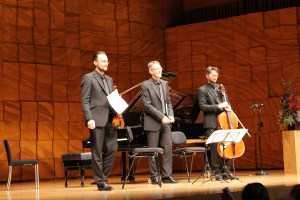
So far, so fair.  These concerts have a well-earned reputation for rattling cupboards, raising dust, turning on unfiltered lights.  Along with a re-viewing of the season-celebrating evergreens, with two isolated Vivaldi movements from other concertos and a Gabrieli sonata for extra Venetian heft, Tognetti arranged a juxtaposition of European Baroque and contemporary Egyptian through a collaboration with the Tawadros brothers, Joseph playing oud and James on the tambourine-like riq and occasionally the bendir hand-drum.  Not that this musical association is new; both Tawadros musicians have been performing with the ACO for almost 15 years.

But this program proposed a more serious aim than a mirror reflecting culturally differing musical elements.  Tognetti has been looking for a common ground between the worlds of Islam and the Venetian Republic with specific reference to music, given that the inter-relationship certainly existed in artefacts, goods and solid artistic objects, not to mention that trite descriptor of cross-cultural  pollination – cuisine.

But when it comes to music, the influences, one-sided or mutual, prove difficult to track down.  In the end, what this program offered seemed unconvincing, even more so after a second experience.  Joseph’s lute-like instrument served competently in giving an edge to the orchestra’s output, reinforcing Andersson’s timbre if with a more brusque sound-quality, less happy doubling the solo line in several concerto movements.  Joseph’s percussion underpinning, especially in the more bouncy third movements, sounded like an unnecessary adjunct, sadly reminiscent of that inane version of the first Allegro in Mozart’s Symphony No. 40 which was supplied with a drum-kit undertow.  What did the insertion of that percussive supplement add to the Mozartian experience?  Precious little, if anything.   I fear, the same applied to this Vivaldi fusion experience.

Interleaved between the Vivaldi concertos and single movements, Joseph presented seven of his own compositions, episodic constructs with occasional spotlights on ACO players – Tognetti, of course, and bass Maxime Bibeau – but the focus centred consistently on the oud, apart from one extended riq solo to begin Give or Take.   Modal melodies, sprightly metrical set-ups, plenty of unison work for the ACO strings, cadenza-type breaks all helped to create a specific sound-world although I found it hard to differentiate between most of these pieces and what I’ve heard from Turkey and Iran.  Complicating the mix, an Indian influence is inescapable, the riq’s rapidity and ability to produce rapid-fire bursts and semi-complex patterns resembling the tabla in everything but the use of the palm, while the decorative ripples from Joseph’s lute occasionally came very close to a sitar’s enunciation of a raga.

Yet, while both the orchestra and its guests entered into each other’s worlds with that confidence gained through a long-time aesthetic conversation and built on the performing security invested in the last night of a national tour taking in four state capitals,  their respective worlds, their basic languages remained discrete.  In the opening Gabrieli sonata for three violins, it seemed that an attempt was made to give lines an Eastern curve – hesitant, languorous, dynamically restrained – but when all parts were well under way, the Orient disappeared and the instrumental fabric reverted to type.   In the Tawadros pieces, the ACO players sounded as if added on, providing a sound quality that all too often sounded suggestive of an old-fashioned the dansant straight out of Death on the Nile.  When Tognetti took a prominent part, the spectre of Stephane Grappelli and his Hot Club Quintet loomed unnervingly close.   Added to this odd non-Venetian shadow of reminiscence, the works  sometimes began promisingly – the oud solo at the beginning of Point of Departure with suggestions of intriguing irregularities,  a similarly expectation-lifting start to Permission to Evaporate  – but settled for rapid-fire rushes of activity, negotiated with a palette of colours in which eventually you laboured to find points of differentiation, let alone any timbral, melodic, harmonic or rhythmic congruence with the European scores.

Perhaps I’m wrong.  Further exposure to Tawadros’ music may reveal connections with music of the European Mediterranean that are definitely discernible in several parameters.  At present, the links continue to elude. Not that this concerned the rest of the MRC audience, who were fortunate to hear these players in the clear acoustic of the Recital Centre’s Elizabeth Murdoch space rather than at the ACO’s usual theatre of operations in Hamer Hall, as was the case in February.  A well-applied amplification system helped even more in heightening accessibility, particularly during the central movement to Vivaldi’s Autumn where Da Costa filled in its 45 bars with a deftly executed  solo over the semi-static string chords.  More importantly, it put us up-close with the Tawadros brothers’ determined attack and sharp delivery right from their opening Kindred Spirits – one of the concert’s most effective demonstrations of their craft.

A triumph for magniloquence

CHRISTMAS TO CANDLEMAS: SCHUTZ AND PRAETORIUS

Ensemble Gombert

Xavier College Chapel

December 5, 2015

Ensemble Gombert

Melbourne’s finest choral force had a pretty easy time at its last concert for 2015, a by-now traditional event that can take in music dealing with the Christmas Night event as well as its Gospel postludes up to the Feast of the Purification and the Presentation of Jesus in the Temple.  On Saturday, the Gombert singers collaborated with some of Danny Lucin‘s early music experts from La Compania: a sextet of cornett, sackbuts and three strings supplementing John O’Donnell who directed each segment from a chamber organ.

Central to the program, Schutz’s Weinachtshistorie prefigures later settings of the Nativity story, the most famous being Bach’s wide-ranging Christmas Oratorio.  But where the later composer deviates from the New Testament text to interpolate introductory choruses, a sinfonia, many arias, chorales, a duet or two, some ariosi, even a trio, Schutz sticks to his last and simply tells the story as set down in the Gospels of Matthew and Luke.   Most of this task falls to an Evangelist who occupies centre-stage for much of the piece’s length, following a rather strict one-note-one-syllable recitative path with – as far as I could hear – only a couple of fanciful flights – on the word entfloh suggesting the flight to Egypt, and a final flourish at the close of the Evangelist’s contributions where he observes God’s grace in the growing child Jesus.

The full Gombert complement contributed to the work with the solid opening which promises at some length that what follows is concerned with Christ’s birth, and with the conclusion, a hymn of thanks praising God at some length.  The 18 singers also contributed to the 6-part Gloria exclamation from the angels praising God to the shepherds; this is one of eight intermedia where the text is given personalisation – the solitary angel of Katharina Hochheiser addressing the shepherds, later prompting Joseph to exile in Egypt, then ordering him home; an alto/tenor sextet for the shepherds’ response, a tenor trio for the Wise Men questioning the Child’s whereabouts, all four Gombert basses representing the priests and scribes, Michael Strasser‘s solo bass for Herod.

Vaughan McAlley‘s tenor was not over-pressed by the Evangelist’s line, which is easy-going compared to the same role in the Christmas Oratorio, not to mention the St. Matthew Passion marathon which McAlley has sung with other groups.  His voice is clear, the notes accurately centred, but the actual timbre, the vocal quality lacks assurance and comes across as studied; not tentative, as the singer knows the task in hand, yet lacking that fluency which urges the narrative forward.  Hochheiser’s first angelic address made a positive impact of agility, but for a fair while I could not distinguish any specific word: fricatives, plosives, consonants of any kind were absent from the vocal output which had only two Baroque violins vying for attention.   Better followed with the semi-recitative encouragements to Joseph and a less aggressive string support.

Still, the impression of Schutz’s score in this reading was of an often dour construct, lightened by the choral bracketing. La Compania contributed with a flawless sonic mix that could have been amplified to the fabric’s benefit, particularly with some woodwind colour like recorders or a buzzing dulcian or two.

In the night’s second part, the ensemble sang three Michael Praetorius motets: the rarely-heard Jesaia dem Propheten das geschah, and two more familiar workings of well-known melodies in the double-choir Von Himmel hoch da komm ich her and the impressive 9-part Wie schon leuchtet der Morgenstern.   Full fruits of the Venetian school and the Gabrielis’ influence, these sumptuous complexes brought a seasonal richness to the Gomberts’ celebration, balancing the spartan directness of Schutz’s bare-bones narrative with its very welcome interpolations.  Despite the body’s modest numbers, O’Donnell’s ensemble handles these grand soundscapes with more elegance and clarity than most other bodies with many times the number of participants.

O’Donnell introduced the two final anthems with a Pachelbel chorale-prelude for Von Himmel hoch and a solid Buxtehude chorale fantasia on Wir schon leuchtet; both tests of digital exactness and linear distinction.  For this music, you could not hope for a more informed and able executant.

Post-concert, the night took a turn for the bizarre when the audience found that Xavier’s security operations – with both the Ensemble Gombert and the Zelman Memorial Symphony Orchestra at work in the grounds – had closed off the gates.  It’s one way to treat your guests, I suppose, but suggests an unnerving lack of consideration for others that stands clearly in opposition to the college’s self-proclaimed aim of producing career altruists.


Light on Schubert

DIE SCHONE MULLERIN

Melbourne Art Song Collective

Salon, Melbourne Recital Centre

November 30, 2015

Michael Smallwood

Almost five months ago, baritone Florian Boesch accompanied by Malcolm Martineau performed the three Schubert song-cycles as a job lot for the Recital Centre’s Great Performers series: solid readings, eloquent in address, determinedly serious if not actually stern in their impact.  Such an interpretative approach is generally to be expected: two of the sets – Winterreise and Die Schone Mullerin – illustrate tragedies.  But both of these cycles offer combinations of light and dark, excesses of enthusiasm as well as of depression, and this alternation came over clearly in Monday night’s reading of the Mullerin sequence from tenor Michael Smallwood and pianist Eidit Golder.

One of the factors that made this recital so exceptional was Smallwood’s splendid diction; every word counted and came across with sterling precision.  Yes, it’s much easier to achieve this in the small confines of the Salon, as opposed to Boesch’s having to cope with the Murdoch Hall acoustic, but the young Australian sustained his precision of articulation from the strongly accented opening Das Wandern, to the last soft strophes of Des Baches Wiegenlied.  In between, the tenor’s operatic experience told in bracing accounts of Ungeduld, typified by a deft alternation between the nervous excitement of each verse’s first five lines and the proud assertiveness each time in the concluding Dein ist mein Herz proclamation, deludedly one-sided as it turns out to be.

While Smallwood maintained a fluent delivery in less taxing numbers like Morgengruss or the four-square patterns of Mein!, more complex structures demonstrated his facility of even output – the long phrases of Pause, the erratic intensity that permeates Die bose Farbe, the shifts in character between the various sections of Am Feierabend where the poet/singer’s fate is determined.  Dynamic gradations sparked interest in practically all of the cycle’s 20 components but just as noticeable was Smallwood’s use of his high register: at times stentorian and bold, at others mezza voce for the high-mark of a curved phrase, flautando verging on falsetto in restrained, tense moments of introspection (although what parts of this obsessive work fall outside that descriptor?).

Golder, the most considerate of accompanists, put hardly a finger wrong throughout the cycle’s length, diligently negotiating the wide-ranging elements that are exercised during the work’s progress; to my ears, the most notable being those amiable but difficult-to-phrase semiquaver flurries in Wohin?,  the circular pattern-work of Halt!, scads of gruff low-lying triplets during Die bose Farbe, and the eventually mobile but disturbingly insistent upper pedal notes of the work’s last lied.

With her instrument open on the short stick, Golder offered a chameleonic support for her singer, not fearing to take an aggressive note when the attack directive called for it, happy to take geschwind on face value for Der Jager and  Eifersucht und Stolz and observe its various modulations for other lyrics.  But the most impressive characteristic of her work was not its beneficence but her awareness of the singer’s needs. It was rare to hear a hint of rhythmic dislocation, although it would be difficult to achieve any discrepancy in something like Der Jager which these executants took at breakneck speed.

In sum, here was a light-filled version of Schubert’s compendium which sustains its underpinning of despairing innocence to the end.  While many collaborators in Die schone Mullerin can offer impressive moments, only informed intelligences like Smallwood and Golder can take you without a mis-step along the traveller’s journey, outlining with clarity and dedication each step along its slow downward gradient; an impressive partnership that contrived to make this major work both technically clean and interesting.


A generous collection of masterpieces

BASICALLY BEETHOVEN

Selby & Friends

Deakin Edge, Federation Square

November 25, 2015

Kathryn Selby

I’ve not seen or heard a Selby & Friends recital for some time; renewing acquaintance, the most obvious change has been in audience size.  From the years when numbers were thin at Melba Hall, patronage has swollen to the point where seats are at a premium because the Edge space last night was sold out.  Maybe people were attracted by an all-Beethoven program; perhaps the combination of Melbourne Symphony Orchestra co-concertmaster Dale Barltrop, the Australian Chamber Orchestra’s principal cello Timo-Veikko Valve and Selby’s brave, polished pianism made an exceptionally attractive proposition.  Those music-lovers who managed to hear this recital were treated to a bracing tour of achievement peaks from the composer’s middle period.

Putting her guests to best use, Selby programmed a sonata for each, framed by two piano trios – one that’s almost not there, the other a trail-blazing masterwork.   In terms of substance, the No. 12 Trio offers little: one movement, an Allegretto that consists of a simple minuet, soon over and leaving not much impact.  A curtain-raiser, then, but one with a muted vivacity, particularly the piano part which holds the lion’s share of the (admittedly brief) action.

Beethoven’s final violin sonata, No. 10 in G Major, comes as a relaxation of tension after its famous predecessor, the A minor Kreutzer and follows that irregular oscillating pattern of power and placidity in the composer’s output – the jocund B flat Symphony between the Eroica and No. 5 in C minor, the rollicking alla tedesca Piano Sonata No. 25 sitting between the deeply-felt A Therese and Les Adieux pieces, that amiable Op. 74 Harp String Quartet sitting between the voluble final Rasoumovsky and the terse, unsettling F minor.  For all its approachability, the last violin sonata has not appeared regularly in chamber music programs, not as often as the Spring or C minor favourites.

Commentators have found a sort of farewell to arms in this work which comes from the centre of Beethoven’s middle period but which was, as a form, ignored by the composer from then on.  Selby and Barltrop performed it with an unfussy relish, both well-matched in the question-and-response opening strophes and maintaining a calm path through even those pages that tempt most to declamation.  As with all three major works on this night, the players had searched out a mode of operating that sprang from the score’s possibilities; rather than the usual smash-and-grab display of temperament, this was a considered, mutually respectful interpretation, riveting in passages like Selby’s negotiation of the low-lying chords and octaves that support the Adagio‘s opening statements, and later in the interlocking cadenzas of the finishing Allegretto where the usual flashiness was avoided and the work’s sinewy power spoke for itself.

The most familiar of the cello sonatas, the middle No. 3 in A Major, proclaimed its intentions from the start as well.  Timo-Veikko Valve outlined the unaccompanied first melody with restraint and the two brief cadenzas that tail each sentence were made to count as integral to the preliminary statement, rather than being tossed off as flourishes. When the movement proper began, both performers set a steady pace – Allegro, but not too much, as the direction requires – and at every turn you heard something new; not necessarily unexpected, but a shift in focus like a paragraph-ending rallentando, a hitherto-unknown doubling of the bass line, weight applied sparingly and not the often-encountered mindless pounding.  More than this, the work held an unusual fluency,  best heard in the last movement where Selby in particular negotiated the octave runs with a sotto voce grace and provided Valve with a true partnership like the miraculous moment at the centre of the movement where the cello has the main theme and the piano’s accompaniment of a rolling A Major triad supports it with a balalaika-style rustling – the effect here and the detail of accomplishment at many other stages achieved through innate musicality and a fine depth of preparation by both executants.

As you’d expect after this groundwork, the Archduke realization proved exceptionally fine: determined in attack, meticulous in dynamic balance, both strings ideal in their close ensemble work, most evident in the chain of sixths and thirds at the start to the Andante cantabile and the interleaving sustained notes at the movement’s end.  But the performance was loaded with extraordinary moments, like Selby’s strong Weber-reminiscent chord/arpeggio upward bounds punctuating the Scherzo‘s trio, the precision of her rapid trills in the finale and the amiable sharing of sound-space between the musicians with every contributor audible throughout.  We may wait some time before coming across a reading as enriching, informative and spirit-lifting as this one.


Jokey American, sombre Czech

BRAVE NEW WORLDS

Sutherland Trio

Salon, Melbourne Recital Centre

November 24, 2015

Sutherland Trio

Pairing the Ives Piano Trio with Dvorak’s  F minor No. 3 presented something of a surprise in this latest recital at the MRC from an estimable ensemble of Melbourne musicians: violin Elizabeth Sellars, cello Molly Kadarauch, piano Caroline Almonte.   While the Czech composer pours out a chain of luxuriant melodies tinged if not infused with folk-song suggestions, the American’s one essay in the form leavens his love of dissonance with a strong melodic current running through its outer movements, atypically diatonic in the concluding Moderato con moto where the spectre of 19th century Romanticism looms unexpectedly large.

It wouldn’t be Ives without contrasts and the trio’s central Presto makes a relentless, eventually unnerving amalgam of non-original melodic fragments that lead to a critical climax which exhausts the ears through simple informational overload reinforced by forceful dynamic levels.  Ives might have intended a brand of levity by naming the movement TSIAJ (This Scherzo is a joke) but the humour is fierce, a case of piling Pelion upon Ossa where the references to hymns and popular tunes weld into a massive complex, extraordinarily dense given the small sound resources employed.

Dvorak’s trio  stands as one of the master’s more dramatically consistent chamber music constructs, particularly for its substantial first movement’s grandiose sweep and developmental density.  Despite many caveats, the influence of Brahms remains consistent throughout; open to a page of the first Allegro‘s development and the actual physical aspect of the score makes you look twice.  Yes, you can also point to irregular metrical structures that the older writer would not have used but the textural variety offers many grounds for complementary comparison. Further, the writing for piano is often as clangorously dominant in effect as in an early-to-mid period Brahms chamber work.

The Sutherlands made fine exponents of the Ives trio,  Kadarauch giving the first movement’s opening duo section plenty of wide-ranging eloquence, followed in similar form by Sellars when her turn to outline the 27 bars of material came around.  For that helter-skelter scherzo, the effect was of diving in with suspenseful energy, the players beavering at their responsibilities without drawing breath.  This is the Ives sound as many people find it – ignoring the lashings of broad, singing simplicity to be found in the symphonies, violin sonatas, string quartets and tone sets sitting alongside the polytonal, polyrhythmic, poly-polyphonic, multi-textural collages of the Three Pieces in New England or the jagged piano writing of the Three Page and Concord Sonatas.  Here the impetus came from Almonte’s keyboard which, as required, often threw the two strings into low relief.

Ives moves into a less frenetic world for his finale, the language kept simple and accessible with lengthy paragraphs of interwoven mesh, the whole reaching the composer’s individual vision of the transcendental in a sequence of concluding variants on Rock of Ages, a meditation here played with care and requisite placidity: a passage that you wished could go on and on.

The Dvorak trio also enjoyed more of a clenched-teeth style of interpretation,  Almonte finding plenty of resonance in the outer movements, which featured passages where Kadarauch’s cello was kept well-recessed.  Still, you would be hard to please if you found the focal Poco adagio deficient: Sellars and Kadaurach combining in the canonic melody-lines with fine sympathy, all performers at their most persuasive in the B Major middle segment where the dark tenor of the work dissipates for a time.

In fact, the main problem with this interpretation came from an underlining of its already sombre character.  While the Ives presented sonorous challenges and consolatory ease in turns, this Dvorak impressed as over-determined, so that the twists into and out of action in the concluding Allegro lacked a balance between heft and lightness, the impact  more of a relentless drive.  Dvorak was living through emotional stress at this time but I think that this interpretation hammered that historical  message with excessive vigour in the score’s two supporting outer pillars.


All the old familiar faces

A LITTLE NIGHT MUSIC

Melbourne Chamber Orchestra Virtuosi

Deakin Edge, Federation Square

November 20, 2015

A new group on the local concert-giving scene  –  well, new to me  –  the Virtuosi has spun out of the MCO ranks over the past year or two and comprises some very familiar faces.   The central organization’s artistic director, William Hennessy, heads the second violin trio, Lerida Delbridge from the Tinalley String Quartet is Virtuosi director, the violas are veterans Justin Williams (also a Tinalley member) and Merewyn Bramble, cellos Michael Dahlenburg and Paul Ghica (Bramble’s colleague in the Patronus Quartet), and the double-bass-of-all-work is the dependable Emma Sullivan.

Lerida Delbridge (mco.org,au)
                  Lerida Delbridge 

Last night’s program, to be repeated tomorrow in the Melbourne Recital Centre, impressed as a consolidation of core repertoire for a string ensemble of modest numbers. A tad circumscribed in personnel for string orchestra staples like the Bach Brandenburg Concerto No. 3 (which needs a third viola and cello) or Vaughan Williams’ Tallis Fantasia (its subdivisions require extra personnel in every section), the group still contrived to put together a successful sequence of familiar works stretching from Boccherini and Mozart, through Tchaikovsky and Holst, to a new work by Australian writer Nicholas Buc with the provocative title A Little Night Music and set alongside Mozart’s sparkling serenade of the same name.

The Virtuosi began with the expatriate Boccherini’s appreciative Night Music on the Streets of Madrid, although I missed hearing the first segment dealing with the Ave Maria bells as the performance seemed to launch straight into the Soldiers’ Drum phase, two violins doing the honours in that phase from opposite sides of the Edge’s internal walkway.  But the main segments showed a well-rehearsed body with an appropriately fluid approach to rhythm; the only question arose in the Passa Calle where Dahlenburg’s solo melody line could have been projected with more aggression, particularly as the chief accompanying texture was pretty much continuous pizzicato.

In fact, the night’s soloist was Dahlenburg who took the central role in both Tchaikovsky offerings: the Nocturne and that melting moment, the Andante cantabile from the D Major String Quartet No. 1 in Tchaikovsky’s own arrangement which moved the pitch up a semitone, it seems, but graciously gave the cello an opportunity to play the folksong-indebted theme that it alone does not get to treat in the original score.  The solo strand travelled well in the Edge’s large air-space, with only a moderate vibrato employed and a fine sensibility brought to bear that let the music speak for itself, more clearly in the Andante than the Nocturne where the accompaniment, well-intentioned and firm, was overbearing in the piece’s later, mildly decorated pages.

Both the Eine kleine Nachtmusik and Holst’s St. Paul’s Suite enjoyed sterling interpretations, the Mozart cleanly executed with loads of animating dynamic variety and supple phrasing, especially in the simple but demanding Romanze where the violins resisted its temptation to gild the melodic lily.   Later, the English suite featured fine solo work from leader Delbridge and Williams’ diplomatically understated viola in the Intermezzo that alternates languour and ardour in just a few brilliant pages.  For both of these essential scores, the musicians spoke with impressive unanimity, realizing the promise shown before interval in a high-spirited run-though of Mozart’s F Major Divertimento K. 138 – another necessity for any string orchestra to have under its belt.

Buc’s new work has few obvious problems for its interpreters.  The work’s content is neatly constructed, the phrase-lengths predictable, its atmosphere suggestive of a standard film noir accompaniment – moody but not tragic, unabashedly lyrical, high on string colour, no pretensions to depth of meaning.   Buc has constructed an amiable nocturne and the Virtuosi, with the backdrop of several regional performances behind them, gave it a confident airing.  As a commissioned foray into modern music, A Little Night Music represents a tentative enough move; now for more challenging fields – Schoenberg or Tippett, anyone?

A Musical Portrait

Ludovico’s Band

Salon, Melbourne Recital Centre

November 17, 2015

                                                                                    Ludovico’s Band 

In this final 2015 recital given by a consort notable for the high calibre of its members, the five contributing composers were producing work during England’s Caroline Era, the reign of Charles I which tore the country apart and, in the process, put much of its cultural heritage in peril; not just music, although we tend to slide past these particular decades between the brilliant ferment of Tudor composition and the brief-lived glory of British music that is Henry Purcell.  For this occasion, Ludovico’s Band comprised six instrumentalists, including the extra triple harp of Hannah Lane to partner co-director Marshall McGuire’s instrument, with guest mezzo Sally Anne Russell singing works by Nicholas Lanier and Shakespeare’s known collaborator, Robert Johnson.

The timbre melange for this brief recital, which included purely instrumental music by William Lawes, John  Jenkins and some scraps from John Playford’s Dancing Master compendium, gave top-line honours to Julia Fredersdorff‘s violin, with a fellow-string in Ruth Wilkinson’s gamba occupying a supple support role except for a D minor trio sonata by Jenkins where the pair shared the work-load with occasional harp interludes.  But for the most part, plucked instruments dominated, the harps partnered by Tommie Andersson’s alternation between theorbo and lute, Samantha Cohen also employing her theorbo but working through a good part of the night on her guitar.

The result, when all were engaged simultaneously as in the opening D minor Harp Consort by Lawes, No. 4 in the set of the eleven, made a rich tapestry, a generous buzzing brought about by an inevitable arpeggiation when harps and theorbos each play more than one note.  This work’s opening Fantazy saw the melodic burden shared between Fresersdorff and McGuire, both preserving the music’s innate stateliness right through to a noticeably vigorous, if brief, sarabande.  A less generous amplitude came in the same composer’s Duet for lute and harp, Andersson and McGuire handling with seasoned aplomb the work’s three-dance chain, the whole lasting about 4 minutes, with little variety of dynamic inflexion.

Russell’s arrival onstage brought a novel strand to the mix, largely because this singer eschews the peculiar habit adopted by some singers of works a century either side of this period; to wit, aiming for a near-genderless purity with minimal vibrato, an avoidance of dramatic possibilities and a concentration on purity of line – no swooping, no audible breaths, no distinct plosives.   Russell took her four Lanier songs as scenes, the settings of Thomas Carew’s No more shall meads and Mark how the blushful morn infused with a warm vigour of attack, reaching even more intense levels in Campion’s Fire, fire and the vivid bite of Neither sighs, nor tears, nor mourning.  The mezzo entered into each song’s emotional world and, while the effect could be over-pronounced in intensity, the works spoke clearly, each one taking the listener on a short trek as engrossing as a Schubert lied if more reminiscent of an extended recitative than a lilting folk-song.

Johnson’s setting of the Ben Jonson lyric Have you seen but a white lillie grow was the best-known piece on this program, Russell giving two verses and hence a chance to take in her security of pitch at the lyric’s climax and the flexibility of tessitura while her accompaniment was relatively thin with lute and theorbo.  Woods, rocks and mountains, possibly/probably by Shakespeare, also gained from a more direct voice, its Dowland-like downward falls and hopeless repetitions of one note speaking cogently of love’s despair in this interpretation, rather than communicating a well-bred, light soporific depression.

For O let us howl some heavy note, a rough-edged invitation from a madman in Webster’s The Duchess of Malfi, Russell took relish in the chromatic rises that illustrate the character’s unbalanced state and found plenty of room for near-onomatopoeic imitations as the air moved from ‘beasts and fatal fowl’ to some not-too-quiescent swans greeting their own extinction with placidity.  Even in the benign context of a comfortable evening recital in Melbourne’s salon, this piece holds an uncomfortable force that Russell conveyed with a full-bodied and mobile style of execution.

Concluding with five of the Playford dances, the band again illustrated its elasticity, a wealth of bass strings resonantly rhythmic and, for a bonus, Ruth Wilkinson took up her recorder to cut through the string textures, focusing your attention on the the simple but infectious brio of the tunes on which these players built a rousing harmonic ambience, a window into (musically, at least) more simple and clearer-speaking times.

Genius at one (or two) removes

MOZART & J. C. BACH

The Melbourne Musicians

St. John’s Southgate

November 15, 2015

Lawrence Dobell

Finishing their annual subscription series, director Frank Pam and his chamber orchestra paid tribute to one of the more congenial musical friendships between two great composers.  Mozart and Johann Christian Bach met in London in 1764 and became fast friends, the younger composer claiming that the English-based youngest son of Johann Sebastian had a formidable influence on his instrumental writing. Both blazing successes at moments in their careers, the two men died in penurious circumstances.

As a sign of his esteem, Mozart arranged three of the elder writer’s keyboard sonatas as concertos and performed then on his trans-European tours, providing the originals with his own orchestral framework. Taking this one step further, the notable Israeli clarinetist Yona Ettlinger re-arranged the Mozart score, changing the solo part to fit his own instrument and adding a third movement to the original two, neatly transplanting the second Allegro from Bach’s own Sonata Op. 17 in E flat.  This was the piece that the Musicians performed yesterday with soloist Lawrence Dobell, principal clarinet with the Sydney Symphony Orchestra.

As you’d expect, the reading was distinguished by a fluent, polished line from Dobell, at home with the mutated galant style that came across despite the permutations intervening between the original and this reworking published in 1974.  Easy in its melodic flow,  the concerto makes no extraordinary demands, not even in the cadenzas which Dobell dispatched  effortlessly; but then, they are brief, I suspect because there is little thematic matter to be exploited.

Appearing a little later in Mozart’s life, the Symphony No. 27 is the last of six written in 1773 and precedes the superb work in C Major of the following year, the opening phrases of which are forever associated for many of us with the Music Lovers’ Hour hosted on ABC Radio by Dr. A.E. Floyd, one-time organist/choirmaster of St. Paul’s Cathedral and a Melbourne musical institution as well as a Mozart enthusiast at a time when the composer’s works were rarities on concert programs.  Not that the G Major K. 199 suffers in comparison but the jump in assurance between the two symphonies is noticeable.

Pam’s orchestra made a hearty start to it, the violins bracing in their triple-stop chords and observing the dynamic niceties set up by their conductor.  The body was blessed by pairs of forthright flutes and horns, the latter making their presences felt in tutti passages and coping manfully with parts that rarely challenge a modern instrument.   The second movement’s progress could hardly be faulted in terms of articulation although the strings, especially when muted, sounded plump, not quite altogether on the beat.  In fact, the rhythmic factor presented the only real difficulty in all three movements; at the cross-over points before repeats, everyone seemed hesitant and the players needed to keep closer focus on Pam during the Presto-finale: a model of transparency demanding a confident and exact attack.

Appearing in another work from the teenage Mozart, young violinist Jackie Wong performed the solo part in the G Major Concerto, a light-hearted masterpiece for the most part calculated to flatter an executant’s suppleness of delivery and asking for a clear, light-coloured product.  At 14, Wong obviously sees the score as an exercise in bravura, tending to make heavy weather of her outer movements, which is understandable in passages of semiquaver figuration.  When the solo violin has the floor, however, there is little point in a weighty dynamic, particularly as Mozart kept his accompaniments discreet.  In the melting Adagio, Wong made a better impression, letting her line speak without over-insistence; a welcome contrast to the first Allegro‘s exposed cadenza where she urged so hard that the danger became one of tuning.  The Musicians coped well enough with their responsibilities, apart from a cracked horn note or two, and the trio of second violins showed an admirable consistency throughout.

To complement the woodwind concerto, Pam finished the afternoon with one of Christian Bach’s Op. 3 sinfonias, the last of the set of six and, like most of this program’s content, in the gratifying and congenial key of G Major.   Three movements in the space of ten minutes left little time for absorption except that the bookend Allegros sounded confident while the middle G minor-centred Andante found out occasional intonation problems in the top strings.  Still it made a brisk, optimistic conclusion to the year’s work from this always-ambitious body of performers.

Out one door and in another

SPANISH CONNECTIONS

La Compania

Salon, Melbourne Recital Centre

November 14, 2015

Giving its last recital at the MRC before moving next year to the glass-and-wood complex of Federation Square’s Deakin Edge, this estimable period-music ensemble  opted for an all-Hispanic program,  one that continually shot off in southern colonial directions. Director Danny Lucin‘s cornetto and an instrumental septet played a few instruments-only pieces but much of Saturday evening’s recital consisted of sung material in which La Compania supported soprano Cristina Russo.

                                                             La Compañia (image: lacompania.com.au)

This was a mini-tour in 14 segments, some of them quite short, of Spanish music at home and in the American colonies which stretched from religious music of the early 16th century to Peruvian dances constructed close to the start of the 19th.  Of course, the physical provenance of the works was reflected in their categorization, religious and secular, with a fair mixture of both.  To all of it, the Companians gave their best with crisp attack and a rousing realization of this music’s rhythmic vehemence.

To begin, the players worked through some diferencias on an anonymous theme called Las Vacas; basically, a ground bass with elaborations on top  or around its progression which gave a sample of the sound-colours on offer: Lucin’s rapid bright line, Mitchell Cross’s all-purpose dulcian (a precursor of the bassoon), the supple sackbut ((early trombone) of Glen Bardwell, David Irving‘s refined violin, and two supports in the gamba of Victoria Watts and Rosemary Hodgson‘s alternating vihuela and guitar.  Icing on this particular cake came from percussionists Denis Close and Christine Baker, both prominent contributors throughout with drums, tambours, gourds, and eventually the inevitable castanets.

Russo’s pure timbre soon became a single strand in an anonymous Dennos lecencia senores, a cachua or round dance from Peru where the whole ensemble participated, not aggressively but making enough of a sonorous edifice to background all but a powerfully projected voice.  This overpowering also took place in a villancico by Antonio de Salazar, Seville-born but a Mexican composer.   His Tarara tarara qui yo soy Antoniyo continued the Christmas theme that ran through the program but, with both sackbut and dulcian out of the mix, Russo enjoyed more exposure, her clear timbre taking prime focus and the text became decipherable.

Two pieces by Gaspar Fernandes – born in Portugal but moved to Mexico and Guatemala – showed a lively invention, if also presenting the players with a real challenge in A belen me llego, tio with its punctuating syncopations that did not quite succeed in their effectiveness when essayed by an ensemble like this one with widely differing dynamic possibilities; from what I’ve heard, the piece works much better when singers – either individual or several to a line – are involved.

A brace of Francisco Guerrero pieces succeeded more satisfactorily, Russo enjoying the backing of Hodgson alone for the opening to Virgen Sancta, another Christmas villancico with a surprisingly mobile melody line.  Moving back to Peru c. 1780, the anonymous El Congo brought to mind a late Baroque mariachi band with bright triplets and an arrangement rich in upper reeds seasoned with a catchy percussion support.

Fernandes appeared further down the program with an Assumption song, Vaya, la princesa, vaya, which might have enjoyed more impact if the vocal line had not been doubled, as was the case in No hay mas dulce alegria where three instruments took on that duty in turn.   A return to the ambience of the night’s opening, Santiago de Murcia’s Los Imposibles is a passacalle which seems to follow the same bass as the Las Vacas tune.   More familiar to me in a guitar solo setting, this made comfortable listening thanks to some deft interwoven solos.   And to conclude, the company played yet one more Peruvian anonymity: Nino il mijor, another cachua of infectious if restrained jubilation at the presence of the Christ child.

Once more, La Compania here unveiled some treasures to which it brought a distinctive approach.  If the soprano was treated as just one thread in the group’s complex, at least she remained audible, even under some assertive, full-bore output from her colleagues.   Nevertheless, many factors generate delight when hearing this company, the most significant being its unique combination of finesse and spirit, especially when the ensemble girds up its loins for one last variant.  Now for a new home and three nights of further discoveries in 2016.

Clara and Dulcie meet the Eggner boys

EGGNER TRIO

Musica Viva

Melbourne Recital Centre

November 10, 2015

                      Eggner Trio

Over a fairly short period, the Eggner Trio – comprising brothers Georg, Florian and Christoph – has become a familiar presence on Musica Viva‘s annual guest artist schedule.   After winning the Melbourne International Chamber Music Competition twelve years ago, the ensemble then visited Australia on three further occasions.  This fourth time, the programs on offer both begin with a Schumann work – one from Robert, the other composed by wife Clara – and then the nights centre on Dulcie Holland‘s 1944 Piano Trio; one of those scores more talked about and extolled in the abstract than performed.  The final offering brings matters back into the mainstream for any patrons rattled by the preceding novelties: either Dvorak’s Dumky or the magniloquent Brahms in B Major.

For their competition final, the Eggners played the major repertoire: Mendelssohn in D minor in the opening rounds, keeping the big Schubert Trio in E flat for the finals and in the process edging out the Ondine Trio who performed the same work with – I thought – a good deal more conviction.  In 2005, Schubert in B flat – the more popular one of the pair – enjoyed an urbane airing, along with Schumann in F Major and a refined version of Ross Edwards’ Trio, which had been a compulsory work for all competitors in the 1999 competition.  Three years later, the ensemble recycled their competition Mendelssohn D minor, made an ardent experience out of Debussy’s G minor trio – dismissed by some commentators as over-hyped juvenilia – and ran through Beethoven’s first work in the form.  I missed the 2011 programs, happily handing them over to another reviewer as the content looked, for once, unappealing.

Clara Schumann’s solitary chamber work has a solidity of structure and melodic straightforwardness that prove eminently satisfying, particularly when given as finished a performance as the Eggners provided.  The outer movements show a clear-eyed approach to organization, the finale intriguing for its linear interplay.  But the work picks up real interest in its Scherzo and the following Andante – simple in its turn from placidity to crisis and back again but crafted with skill and giving each player an opportunity to shine.

A major figure in Australian musical life, and not just because of her involvement with the Australian Music Examinations Board, Dulcie Holland studied in London before World War II and the Trio, written after her return to Sydney, shows obvious marks of her training.   What shouldn’t surprise, but does, is a firm individuality in the composer’s style; the writing is based on a kind of sophisticated diatonicism but with enough edge to avoid any traces of triteness.  Listening to the threatening initial theme of the opening Allegro, you can’t avoid comparisons with similar ominous passages in the work of John Ireland, Holland’s teacher, but the curves and inflexions remain Holland’s own, unnervingly reminding you of the subterranean lurching of the E minor Shostakovich Trio written in the same year.

Holland’s score has no slow movement; rather a succession of three fast segments which found amiable exponents in the Eggner players, cellist Florian a committed voice throughout, probably investing more plosive force than the piece needs.   As with the preceding Schuman, the reading’s main impact was positive thanks to the group’s warm polish, the ensemble clean and its lines balanced, if every so often violinist Georg showed traces of the reticence which has figured in some of his earlier Musica Viva appearances.

With the Brahms Trio No. 1, these musicians demonstrated a control and spacious breadth that informed each page.  Many groups have turned this masterwork into a sort of piano concerto and admittedly the keyboard writing is temptingly hefty; the competitions that come around every two years invariably have one set of ambitious executants making a sweat-soaked welter out of these bracing pages.  The Eggner approach showed remarkable restraint, the driving climaxes pronounced with weight rather than hysteria, pianist Christoph treating the high passage work in the Scherzo with unfussed celerity, all three members taking time with those slow, melting arches that distinguish the Adagio, as do  its sustained moments of dangerous exposure: a moving conclusion to an intelligent, original recital.

The Eggner Trio will play again in the Elisabeth Murdoch Hall on Saturday November 21 at 7 pm.