A deft fusion

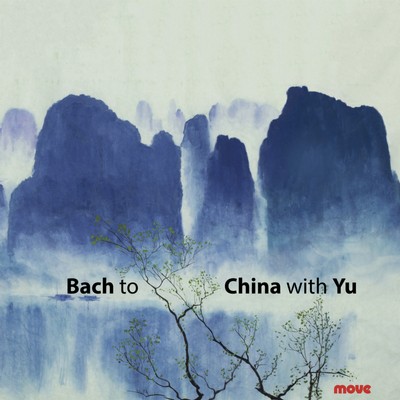
BACH TO CHINA WITH YU

Julian Yu

Move Records MD 3474

Much of this latest volume of works by Julian Yu involves clarinet, violin and cello. In fact, Robert Schubert‘s clarinet features in each of the four varied elements on the CD, as it has on two previous Move Records publications that present the composer’s chamber music involving that instrument. Also appearing here are pianist Akemi Schubert, violinist Yi Wang, and two well-known cellists in Virginia Kable and Josephine Vains.

Now, to content. The album starts and ends with Bach, whose music enfolds Yu’s arrangements of 24 Chinese Folksongs (some of which also contain Bach snippets) and two tracks of Dances from the XII Muqam, a collection of traditional Uyghur melodies. As anticipated, the longest of these four compositions is the assemblage of folksongs, but Yu fans will have heard these some years ago – 2019, to be exact – when pianist Ke Lin recorded the composer’s 50 Chinese Folk Songs. As far as I can see, Yu has revisited 22 of his original 50 and transcribed them for Schubert, Yi and Vains; the two odd-persons-out are Su Wu Tends the Sheep and Wild Lily.

As I said, there’s some Bach included in the folksongs as Yu elects to employ some of this composer’s bass-lines (and those from other composers) as supporting material for his collated melodies. Some of these interpolations are easy to find; others escaped identification by this willing listener.

Beginning with a solid slab of Western music, Yu has arranged the Chaconne in D minor from the Violin Partita BWV 1004, written sometime between 1717 and 1720. He’s not alone in this exercise and admits to drawing on transcriptions by Mendelssohn (who wrote a piano accompaniment for the piece), Schumann (who did the same), Busoni and Raff (who both did simple piano transcriptions, although the latter also made a version for full Romantic orchestra), and Brahms (a splendid version for piano left-hand). In this performance, we hear Schubert, and the string partnership of Yi and Kable for the only time on this CD.

As for the ending, we hear the organ Passacaglia in C minor for organ BWV 582 from sometime between 1706 and 1713. Yu gives us the famous bass line on the cello but has dilated the first note of each bar to a dotted minim, so the time-signature changes from 3/4 to 4/4. On top, the composer introduces scraps from arias and instrumental interludes heard at the Peking Opera; some are original, some Yu-composed. In all, we hear about twelve variations – down on Bach’s twenty – and the results prove to be disarmingly deft.

But you could say that about the whole set of 28 tracks. The arrangements are clever in conceit and clear in texture, if only rarely arresting. As you’d anticipate, the most challenging work comes first with the Chaconne. Yu begins in orthodox fashion with clarinet and cello outlining the eight bars of basic material before the piano enters discreetly with some melodic and harmonic reinforcement. All three are in operation with few signs of disturbance until we reach bar 25 where Schubert takes the melody line and elaborates it into a semiquaver pattern while clarinet and piano take on the chordal punctuation.

From here on, the central melody is shared between all three players while the re-composer begins to add flourishes, distinctly new lines, all the while indulging in some neatly dovetailing klangfarbenmelodie. We come to a slower oasis at bar 77 when the clarinet takes over from the semiquaver-addressing piano, giving us a calmer ambience which lasts up to the arpeggio direction of bar 89 which the piano takes on board and follows with a general attention to the written notes, apart from a few deviations, the whole fraught sequence winding up with a powerful bass line of striding quavers from cello and piano which is not in the score but makes a remarkably Brahmsian lead-in to the D Major reprieve at bar 133.

This is taken at a slow pavane speed and Yu recycles the opening variation of this segment as a subordinate component while gradually building up intensity with the piano adding more arpeggiated ferment, until the reversion to the minor key, at which point the piano disappears and clarinet and cello play the first two variations from this point by themselves, a few triple-stops from the original falling by the wayside. The piano gets an attack of the triplets well before they should turn up in bar 241 but by this stage we’ve been treated to so much linear displacement that the prepositioning hardly raises any eyebrows.

And so to the final peroration which is given with more late Romantic magniloquence in the best Busoni tradition. Also in something of an arranger’s tradition, Yu fleshes out that final noble single D with a full chord. So do Schumann, Mendelssohn, Raff and Busoni (who indulges himself with a tierce). The solitary exception is Brahms, who consents himself with three massive octave Ds – a man who knew when to leave well enough alone.

I heard the folksong Su Wu Tends the Sheep with more interest than most because it concerns a real person: a 2nd-to-1st BC diplomat who was detained on a mission for 19 years and put to menial work while under what amounted to imprisonment. The melody is here given mainly to the violin, the clarinet a late entry to the mix. But the message is clearly one of longing (for the homeland?) even in the middle of pastoral solitude – or so I feel about what is a warm, even sentimental lyric.

The other novelty in this collection is Wild Lily from the Shanxi province. A simple melody in four phrases, Yu sets it simply enough for violin with clarinet discordant underpinning, then again where the clarinet bears the melody while the cello accompanies in an atonal language – nothing too savage in either half, only single notes but deliberately at odds with the tune’s simplicity.

As for the other 22 elements in this collection, I refer you to my review of Ke Lin’s Move Records performances of the 50 Chinese Folksongs back in 2019. I believe I commented on all of the others treated here and have nothing new to add apart from predictable remarks about the new settings’ timbres. The same problems still apply: the arrangements are brief (eight of them are under a minute long, including Wild Lily) and, after a while, they fuse, so that it’s hard to distinguish between something as well-known as Jasmine (thanks to Puccini’s Turandot) and Willows Are New.

Fusing his Chinese melodies with the West, Yu uses a Handel bass to underpin the Mongolian melody Gada Mailin, then a Bach quotation from the B minor Mass in Picking Flowers. A more original device comes in Little Cabbage from the Hebei province where the cello picks out the vegetable’s name notes for underpinning; this probably works well because of the resultant motif’s pentatonic nature. More difficult to discern was the quotation from Brahms’ Symphony No. 4 during Lan Huahua, although Yu made it easier for us by opening A Rainy Day with the first eight bars to this symphony’s Passacaglia.

It’s back to the B minor Mass for the Sichuan tune Jagged Mountain, clarinet and cello presenting it in turn even if it tended to throw the melody into the background. An outburst of familiarity came with the Shaanxi air A Pair of Ducks and a Pair of Geese which enjoyed the bass-line on which Pachelbel constructed his mellifluous Canon in D, beloved of wedding-organizers. Also easy to pick up was the use of the left-hand to the Goldberg Variations‘ opening statement during Taihang Mountains.

But we encountered more difficulties with Willows Are New, during which Yu employed some famous Bach motifs that went straight past this bat into a no-doubt-contemptuous keeper’s gloves. But I recognized at least one of the Brahms Symphony No. 1 bursts that supported the medley of three Shanxi and Shaanxi folksongs and that was the chorale spray that climaxes the finale at bar 407. However, the impact of the German master’s rich chromaticism made the track surprisingly Western/European, a factor that also struck me in the last of the collection, Thunder a Thousand Miles Away, which seemed to be a mix of three-part invention and (limited) fantasia.

But so what? Yu’s compositional career has been informed by his homeland and further education here; the least you’d expect is a happy relationship between the two ‘schools’, as we find on this disc. Still, he strikes the same problem as most other writers when dealing with the material for his Three Dances from the Uyghur people of Xinjiang: the tunes are finite and the changes you can ring on them present challenges beyond simple repetition in new timbres. The first dance is extensive, showing a good deal of inventiveness in edging the basic material in several directions, made all the more difficult by the number of repeated notes involved, especially in the piece’s middle pages.

More surprising was the character of the melody which seemed to share characteristics with the folk music from various countries as collected by Bartok and Kodaly than with the 24 folksongs sitting alongside it on this CD. Yu grouped his second and third dances together; well, sort of: the tempo increases for the third which concludes in an almost Rossinian galop. Oddly enough, only in these dances did you come across faint cracks in the trio’s ensemble work, mainly due to slight hesitations about entries and the delivery of some pretty simple syncopations.

For organists, Bach’s big Passacaglia and Fugue are impregnable musical fortresses. You can’t really take exception to Yu’s employment of its bass progression for his own composition, but he is operating with a melodic and harmonic pair of palettes that are very limited when compared to the original. That said, you can take pleasure in Yu’s interweaving upper voices, particularly if you can keep out of your mind the monumental welter that straddles your consciousness from bar 144 to the end of the great organ construct. And, as the poet says, a man’s reach should exceed his grasp and this CD is witness to Yu’s high level of ambition.

Exemplary partnership in fluent performances

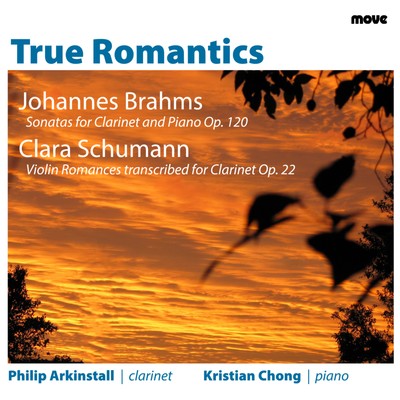
TRUE ROMANTICS

Philip Arkinstall and Kristian Chong

Move Records MCD 668

Well, you can’t argue with this CD’s descriptor. Clara Schumann and Brahms were solidly Romantic, their early lives focused around the lady’s husband, who was one of the great 19th century creators of that school alongside Chopin, Mendelssohn and Berlioz. In these latter days, Amazonian efforts have gone into foregrounding female composers, from Hildegard through Barbara Strozzi to Amy Beach and a multitude of contemporary Australians ( especially on ABC Classic radio). Schumann has enjoyed a revival of interest for decades longer than most of these writers, yet her appearance on programs must still be called – in all charity – uncommon.

The performers of one work by Schumann and two sonatas by Brahms on this disc for Move Records are Philip Arkinstall, associate principal clarinet with the Melbourne Symphony Orchestra for the last 16 years, and Kristian Chong who is an associate lecturer in piano at the Melbourne Conservatorium of Music to anchor his active life as a performer.

On this CD, these performers give us Schumann’s Three Romances of 1853, originally written for violin and piano, here enjoying a transcription by Roger Young, Arkinstall’s colleague in the MSO where he has been a violinist for 26 years. The Brahms Clarinet Sonata in F minor and his Clarinet Sonata in E flat comprise the composer’s Op. 120 and date from 1894; these are the last chamber compositions he produced before his death and they make a magniloquent pair of gifts to an until-then almost non-existent repertoire, apart from a small quiver-full of concertos.

Clara Schumann’s Romances recall her husband’s compositional aesthetic in pretty much every aspect, apparent from the first Andante molto with its ambiguity of rhythm that doesn’t become quite clear until about bar 11, not to mention its floating harmonic underpinning, an adventurous chromaticism seen in the central segment from bar 24 to bar 32, and a steadiness of emotional output that you find in the male writer at his most impressive (the lieder, the chamber works with piano).

Moving to the second romance, complete with a German direction (Mit zartem Vortrage) that might have come from the composer’s nationalistic husband, we find a more orthodox harmonic complex, its ternary form running G minor, G Major, G minor with a quietly assertive main melody that recalls some of the more sparsely textured Songs Without Words. Arkinstall observes an appropriate dynamic restraint throughout this miniature’s length while Chong shows once again a discretion that falls short of self-effacement, always contributing to the partnership as you can hear in the musicians’ sensible and sensitive account of the final twelve bars, the clarinettist even giving us the violin’s final quadruple stop.

Again with the third romance, Robert Schumann’s linguistic choice enjoys pride of place with the direction Leidenschaftlich schnell, the musicians’ collaboration as ardent as you could want, given the benign, self-assured content in another ternary shape with the composer happy to maintain her B flat Major territory in the outer segments. From the start, Arkinstall’s main lyric is supported by fluid triplets from Chong that change only for regular semiquavers in the initial 21 bars where the main material recurs. The pianist once more exercises an assertive discretion throughout, both players investing the work with a tidal ebb and flow in dynamics while the metre stays constant, Arkinstall making gentle work of the three-note pizzicato chords between bars 50 and 57.

After these novelties come two familiarities in the Brahms sonatas. The No. 1 in F minor is more familiar to most of us than its partner in E flat Major; why this is, I have no idea except that performers might find the first more satisfying to play or present, or it might be that audiences are more receptive to its flamboyant style of address. Whatever the reason, Arkinstall and Chong open it up to a remarkably clean airing, right from the opening Allegro appassionato which gives us an object lesson in nuanced shading from the clarinettist and an admirable, mud-free outline of the keyboard part where every bass note registers and Chong’s surges into action ring out clearly, especially when the going gets piano concerto-mode tough (as at the end of the development, bars 116 to 132).

Profitably for us all, the interpretation is invested with dynamic tension, but the piano conclusion starting at bar 225 gives an excellent instance of shared responsiveness where the instruments dovetail with care to make the composer’s last reminiscence of his opening phrase somehow inevitable and poignant. Which makes a fine transition to the restrained and compact Andante that takes us on a simple ternary journey with a slightly surprising chain of modulations before re-settling onto its A flat Major homestead. No surprises here from either performer as they handle this brief segment with a deft mobile lassitude.

Coming out of the A flat Major warmth of the slow movement, we strike it lucky again in the ‘scherzo‘ movement (well, A flat with lots of E flat Major getting in the way). This is an appealing landler that varies its rhythmic predictability in the trio where the piano has an almost continuously syncopated right hand melody line (apart from 12 bars in the second part). You can find some moments of quiet humour like the clarinet’s laconic quiet interpolations when the piano has the main tune in bars 9 to 16, and the woodwind’s suggestions of yodelling in bars 35 to 38. To their distinct credit, these performers find and maintain the movement’s inner bounce and bucolic grace.

Finally, we enter the realms of the Academic Festival Overture with Chong’s expounding of the central theme to this F Major rondo with that combination of strength and lightness that typifies this reading. Despite its arresting opening, the theme moves into staccato chattering in its second and third quarters, but the distinction of this performance is the pleasure you experience on each recurrence. Not to forget the St. Anthony Chorale reminiscences when we move into buoyant crotchet triplets at bar 42 and later at bar 142. Once again, these musicians show a combined delicacy of insight into the score’s energetic bravura and its simple, happy brio.

I suppose what counts against the E flat Sonata from the beginning is the sentimental nature of the opening friendly Allegro‘s first subject. Further, Brahms is not slow in presenting us with several splendid melodies – or fragments of them – while ringing some vivid dynamic changes, like the sudden burst of language from the Piano Concerto No. 2 across bars 15 to 18; this continues in sporadic eruptions like bar 39, bars 60 to 64, and later in the recapitulation. But then, the clarinet writing is so mellifluous and persuasive in its wide arcs that the wonder is these players combine with such great empathy to give us a masterful composite, graced with yet another bout of splendid warmth in the concluding twelve Tranquillo bars.

It’s about now that you appreciate the compression at work in these two works; much of the first and all of the second operate without repeats so that you are in a constant state of discovering fresh country. Even second hearings of what seems like the same matter can be deceptive by means of altered accompaniment or original transpositions and modulations. This may go some way to explaining the sense that this sonata’s second movement is brief although it follows the classic scherzo pattern. Further, Brahms breaks into his four-bar phrase patterns with some arresting interruptions.

The piano writing here suggests parts of the rhapsodies, but the intertwining of both sound sources is admirably supple, both in the ‘dying fall’ passages like bars 48 to 64 and the two noble shared chorales of the central Sostenuto trio. I’ve heard other readings where the atmosphere is darker and angst-driven, but I think Arkinstall and Chong have the right of it with their cool outlining of the controlled agitation that underpins these pages.

And then you come to the last movement which starts Andante on a set of variations that stands with the best of the composer’s more emotionally untrammelled, benign creations. Starting with an ordinary skipping tune, a lyric with a lilt, Brahms brings about a set of cadences that culminate in a satisfying plagal in bar 14. From the opening statement, we move into off-the-beat commentary from the piano, triplets alternating between the players, a demi-semiquaver duel, a variant in which the piano is continuously syncopated while the clarinet outlines a version of the theme sotto voce for the most part, then an E flat minor elegant furiant before an inconclusive Piu tranquillo, the quick allegro returning for a final burst of high spirits with some chortle-rich piano writing from bar 134 almost to the end with cross-rhythms galore against a cooperative if comparatively strait-laced clarinet.

All this comes off very well indeed without any signs of faltering in attack or pace. But that could be said about the whole disc; throughout the three scores, Arkinstall and Chong demonstrate how a chamber music partnership should function, with every phrase mirrored or duplicated, with the dynamic ebb and flow organized carefully with each other, and with every slight rallentando – no, even the big ones – carefully graduated so that entries are pointedly precise. It all speaks for the high worth of this exemplary, polished disc.

Finely balanced Italian-Spanish sojourn

SCARLATTI KEYBOARD SONATAS – INGENUITY AND DELIGHT

James Brawn in Recital Volume 3

MSR Classics MS 1829

Following the nine discs in his survey of the complete Beethoven piano sonatas, British-born musician James Brawn is keeping himself occupied with a new entry for his ‘In Recital’ series on the MSR Classics label. The first in the set, recorded in 2012, featured some Bach, Liszt, Rachmaninov and Mussorgsky’s Pictures at an Exhibition the main work. Three years later came the second in the series, a double album with a fuller scope through Scarlatti, Bach, Mozart, Beethoven, Schubert, Chopin, Liszt, Brahms, Grieg, Scriabin, Rachmaninov, Prokofiev, and Gershwin.

This year, the third of the series has appeared and the focus is pretty concentrated on Domenico Scarlatti. Brawn takes us through 21 of the 555 in the (so far?) accepted canon, two of them revenants from his 2015 marathon: K. 159 in C Major (La Caccia) and K. 380 in E Major (Le Cortege). Many of us would have made our first acquaintance with this composer through the 25 Sonate per clavicembalo edited by Alessandro Longo in a Ricordi publication that I came across in the late 1950s. Brawn plays nine of the sonatas in that volume, including the two referred to above from his ‘In Recital Volume 2’ double-album.

Tagged on at the end, he presents a small-scale sonata by Domenico’s father Alessandro – the shortest track on the disc at 1’33” – and a more substantial sonata in G minor by Pater Scarlatti’s friend, Johann Adolph Hasse. A bit of a problem is the uncertain provenance of the Alessandro Scarlatti D minor Sonata, labelled Arioso. The piece is two lines in its substance, as are many of Domenico’s works: a simple tune above a walking bass. Brawn repeats the first half but not the second, although not much is gained by hearing any of this bagatelle twice.

The Hasse work is often listed as an attribution to the composer, possibly because the composer’s other sonatas are generally not stand-alone movements like this Largo. Still, it has a more mobile bass line than the elder Scarlatti’s piece and actually gravitates towards a wealth of right-hand thirds. Brawn plays repeats of both halves and gives us a gentle, measured account of a pre-Domenico piece that a reasonably competent pianist could probably negotiate successfully at sight.

As for the CD’s major consideration, Brawn opens with No. 1 in the Kirkpatrick numbering system, a D minor here subtitled Toccata. Well, it moves briskly and you come across some of those passages where both hands touch the same note in quick succession (bars 7, 8,11, 15,17, 26 and 27) but it’s more a toccata in the sense of rapidity of manipulation – and Brawn is excellently even-handed throughout – rather than the usual Baroque idea of a series of quick flurries and contrasting sections.

Another D minor follows, K. 9 and it’s one from the Longo 25 Sonate collection, here named Pastorale, which must refer to the musette moments at the end of both halves. This is a transparent view of the work with Brawn treating it as a bit of an amble but adding a sudden pianistic interest to the second half by semi-arpeggiating the left-hand chords across bars 27 to 32 and allowing himself room to breathe after some semiquaver runs; not that any of these raise the interpretation’s placid temperature.

We’re still in the minor (B) with K. 27, which is a fine exercise in hand-over technique, where the left hand plays top note in a chord. This is reliably achieved by Brawn who efficiently skewers these isolated notes, at the same time giving some crotchet weight to notes beginning semiquaver chains of four in passages following the main gauche uppermost bars. The style is outwardly calm, with an undercurrent of mobile gravity.

Once again, we revert to D minor for K. 32, yclept Aria. This one-page sonata has a first half of 8 bars, a second section of 16 and it barely modulates: all the Cs in it but four (in a passing flirtation with F Major) are sharpened. The work proceeds with gravity, a slow minuet, but imbued with grace and without melodrama. Sticking with the same tonality, Brawn next presents K. 34, Larghetto. This is a more progressive minuet, with a first half of twelve bars which modulates to A minor, the conclusion to both halves notable for a flattened supertonic which, in this harmonic context, is a slight shock to the predicting system.

At Track 6, we hit A Major, K.96, subtitled La Caccia and another Longo album favourite. As even small-scale Scarlatti enthusiasts know, this sonata has a variety of tests: repeated notes expressly marked Mutandi i deti, 18 instances of rapid left-hand over, double octave passages in both hands, a splash of Tremolo di sopra, and some pauses that offer no respite. I felt a slight dip in bars 26, 28, 30 and 32 where Brawn appears to offer a small hesitation before the demi-semiquaver duplets in each bar; it’s as if he’s determined to observe the letter of the law and give the upward flourishes extra space to resonate. Also, he sustains the tenor A through bars 103 to 108 the first time round but doesn’t bother in the repeat, following the pattern written at the same place in the second half where the Ds are struck at the beginning of each bar. The work is buoyant enough, if dynamically restrained.

Would you believe, we return to D minor for K. 141? It sports the title Toccata with some relevance because it’s in part a study in rapidly repeated right-hand notes that features in the Longo collection although there’s no indication in my edition that you have to change your fingers while repeating those groups of six notes (Longo prescribes an alteration of 3-2-1, which I suspect Brawn follows). It also features some of those brusque left-hand chords which involve both 4th and 5th above the bass note, a strident rasgueado suggestion that Puyana delivered with incredible punch. And this piece is also distinguished by its requirement for both hands to cross in both halves. This pianist appears to miss nothing, even if the repeated notes sometimes seem on the verge of disappearing.

The A minor K. 149 is new to me and a delight for its inventiveness as Scarlatti leaves his first idea alone in the second half and deals with a figure that presents as an adjunct in the first segment. The references back to prior material demonstrate the felicity and flexibility of the composer’s thought but the sonata radiates that extraordinary combination of power and elegance that distinguished the best of these pieces.

Another favourite from Longo’s album is the K. 159, which also has here the sobriquet La Caccia and is a much easier piece to handle than K. 96 in D Major. Brawn follows some performers in omitting one of bars 14, 15 and 16 in the sonata’s first part, then one of bars 53, 54 or 55 later on, although I can’t find an edition where this liberty is edited in. He also imitates those who repeat the first half’s top note tonic triad elements that are written in all editions I can find, doing the same across bars 18 to 20 in the second half at bars 57 to 59 which I can’t find anywhere even if it is an obvious act of balance. For all that, this is an engaging negotiation of one of the composer’s most attractive keyboard canters.

Speaking of Puyana, one of the sonatas that he transformed into a percussive nightmare for the rest of us is the A minor K. 175 with its plethora of dissonant left hand chords. Brawn splays these at the opening, once again suggesting a flamenco guitar attack but his reading is controlled and light in dynamic; this lets you relish the offered contrast between determined arpeggio material at the start and an unexpectedly gentle bounce at the rapid left-hand cross that comes out of nowhere at bar 85 to provide some contrasting bouts of light-hearted euphony.

The following A Major K. 208 is labelled Cantabile (in my edition, Adagio e cantabile) and is another unknown, moving from slow crotchets, through syncopation, to semiquaver runs in its first sentence, all over a steadily insistent crotchet bass in 4/4 time. It does have a singing quality although on paper the upper line looks jerky; another welcome discovery. A further A Major, K 209, is partnered with this gentle lyric; a complete opposite in atmosphere as it’s a chattering non-stop (initially) linear dialogue, mainly in two voices but succumbing to the necessity for chords to embroider a pretty breathless impetus. Here is some delicious playing, especially in the last 17 bars of each half where the rattling along settles into a pleasurable comfort zone while staying in one uninterrupted major tonality.

I found the Sonata in E minor K. 291 mechanical, in spite of Brawn’s vigorous interpretation which dealt with some ordinary material by bathing it in dynamic contrasts. An insistence on its opening pattern of four quavers followed by six crotchets, allied to a predictable modulation sequence reminded me of Browning’s mocking, ‘Oh Galuppi, Baldassaro, this is very sad to find!’ where the note-spinning leads nowhere in the end. You might say something similar about the next, K. 322 in A Major except that the primary subject melds into further material with particular ease in a work that is essentially a simple two-line construct (and the lower a functional grave procession of subsidiary minims), graced with a stretch of nine uplifting final bars in each half that seem to come through on its own recognizances. Brawn handles this work with a muted determination that still finds the benignity across those codas to each section.

Bouree is how this pianist typifies K. 377 in B minor and it does have lashings of that driving bass mobility you can find in some of Bach’s works using that form. Once again, this is a two-line (almost completely) sonata but blessed with a bass line having a mind of its own with the occasionally-exercised ability to take over the running. The pace is steady, not inclined to give way to any inept dancers and an ideal sample of Brawn’s clarity of articulation, thanks to the absence of any deadening sustaining pedal.

Having reached K. 380 in E Major, we come across one of Scarlatti’s most famous sonatas and a favourite of every aspiring pianist. Brawn gives it an aggressive edge at the start, the ornaments in bars 2, 4, 6 and 8 a tad more martellato than usual. In fact, many another player comes to this work as to a fairly slow minuet, milking those horns of Elfland that begin in bars 19 to 21 for as many Romantic atmospherics as possible. This musician gives a suggestion of echoes but never faintly blowing, and he ploughs through the ‘working’ bars 50-56 at full steam without pulling any punches – an approach he in fact proposes in the first statement of the piece. It’s called Le Cortege on this CD: taken literally, it’d have to be being performed at one of your no-nonsense military funerals.

A fair few of us would know K. 430 in D Major from Tommasini’s ballet of 1917 for Diaghilev’s Ballets Russes: seven Scarlatti sonatas arranged under the title of The Good-Humoured Ladies. It sounds less of a flurry on the piano, in keeping with the direction on my score: Non presto ma a tempo di ballo. This reading is active enough but measured, in line with the frequent moments of rhythmic and harmonic insistence (bars 19-26, 30-38, 72-80, 84-92) and an inbuilt, frequent ‘kick’ as in the right hand’s first three notes.

Brawn goes a touch more affective for the Sonata in F minor K. 466 which has an actively participating left hand. The construct has traces of a two-part invention format, although the right hand introduces new triplet matter that is not handed to the bass until the opening of the sonata’s second part. But this musician sees the opportunity for added sensitivity and inserts small pauses before hitting the first note/chord of several bars. So it becomes a small-scale, soulful vignette with its own brand of melancholy and a reminder that this composer wasn’t ever just a dry figure, playing Toccatas, stately at the harpsichord.

Le Cortege is again the name appended to K 491 in D Major; it’s now plain that this cortege is probably referring to a stately progress in court from one room to another; rather like the movement of Prince Andrew from Royal Lodge to his new two-up/two-down residence in Luton. This also is a well-known work, notable for its triple call to arms in the opening bar and two abrupt changes of key – in the first half from a dominant-suggesting A Major to a momentary C Major setting; in the second, after the same A Major halt, an abrupt switch to F Major. Of particular note are Brawn’s parallel semiquaver thirds at the end to each half of the work – admirably even and crisp underneath the legato.

Second-last in this celebration of the great keyboard master-composer is the Pastorale in C Major, K. 513, which appears in the much-afore-mentioned 25 Sonate edited by Longo.. Brawn plays through the opening saraband deftly enough, negotiating handily the change in speed that comes with the bass G octave drones, and we enter an aristocrat’s view of the bucolics at their dance. He doesn’t repeat this set of pages but launches into the concluding 3/8 Presto with enthusiasm and does repeat that section with only a slight ponderousness across bars 47 to 49 for inexplicable reasons.

Finishing in style, Brawn plays the quicksilver E Major K. 531 which is another element in the Longo collection. He calls it Tarantella. Well, it is and it isn’t; the metre’s right but the material is too well-bred to set the piazza (or plaza) on a roar. It is given an admirable lightness, noticeable particularly in a well-positioned dynamic level for the left hand which has a significant role on the first page in sustaining the vaulting nature of this sonata’s arpeggio-rich main theme. The headlong progress is halted by several fermate but the communication of Scarlatti’s well-being and felicity sends us off, after this final expert demonstration, more than content with Brawn’s informed expertise.

Sweet and simple

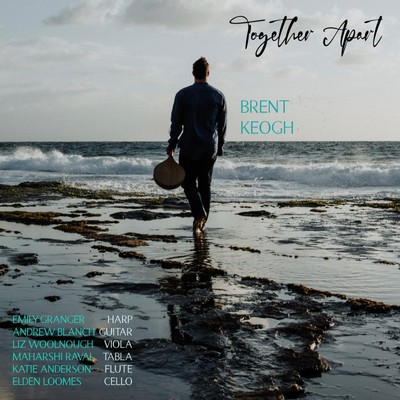
TOGETHER APART

Brent Keogh

Move Records MCD 643

I suppose that the most significant point of interest on this CD is the presence of the composer playing oud. Brent Keogh has been a student of Joseph Tawadros, who brought that Middle Eastern lute to our attention through his collaboration with the Grigoryan brothers and his several excursions alongside the Australian Chamber Orchestra. Keogh appears in all but the first four tracks of this recording, working in various ensembles with his guests. Still, it’s slim pickings as the disc comes in at a tad over 40 minutes’ playing time. Which makes this a sequence of eleven short pieces – four of them less than 3 minutes long, another four less than 4 minutes in length, one less than five minutes with one a little over that length, the longest piece lasting for 6’20”.

A further disconcerting factor is the minor research needed in trying to date the works performed. No information comes on the disc leaflet, and there’s nothing showing on the composer’s Australian Music Centre entry. When visiting Keogh’s own website, we learn that two major works here, the Hagia Sophia Suite (Emily Granger harp and Andrew Blanch guitar) and the Turimetta Suite (Katie Anderson flute, Elden Loomes cello, Maharshi Raval tabla, Keogh oud) were written in 2021. So was a brief piece for oud, viola (Elizabeth Woolnough) and tabla called Stormfront. I can’t find a composition date for The Red Candle oud solo; Rosie’s Dance for oud, cello, flute and tabla was co-written with Anderson some time before July 20, 2019 (you can see it performed on a YouTube video, although with a double bass substituting for cello). Alunir, the final track for oud and cello dates from 2020 (also found as a YouTube video but with Keogh playing oud and guitar!).

Much of this disc’s content consists of melodies that are simple and folk-inflected; you’re not hearing anything that is challenging here. Keogh sets his bar level pretty clearly in the opening Prelude to his suite on the great church-turned-mosque-turned-museum-turned mosque again. This section is for Granger’s harp alone and begins with a short motif that is minimally expanded before we hit a melody that could be Turkish, or anything. It also undergoes restatement and sits in a fixed tonality, a minor scale rather than a mode which is reinforced by the repetition of a bass note/anchor. One moment of harmonic deviation: that’s all. The atmosphere is firm, slow-stepping, ruminative rather than meditative.

The composer seems focused on giving us a hieratic setting, this musical vorspiel being in the nature of a call to prayer, I suppose. Blanch joins Granger for the following three movements, the first of which is a fast dance in which guitar and harp play a rather intricate melody line in unison to excellent effect. This is repeated in the movement’s last third/quarter while the central panel is taken over by an amplification/treatment of the harp’s opening motif. Does it bring the building to mind? Sort of, in an elegiac way and giving a good deal more picturesque an image than I remember finding in the interior some eight years ago.

In the next phase of this suite, the movement is slower, more measured and less rhythmically irregular. The guitar opens and the harp intrudes by reinforcing individual notes, but then enters fully into the partnership. You can find three melodies that are repeated with slight ornamentation and some differing antistrophes. As with the first movement, the bass note stays constant throughout (it’s the same across the three of them, I think). Unlike its predecessors, the third piece begins with a promising angularity in both instruments, but soon reverts to the minor scale/mode language that has prevailed so far. Keogh refers to major key sections radiating some relief in this not-too-sombre atmosphere: I counted one-and-a-half such breaks, and they didn’t stick around for long. The linear interplay is momentarily interesting but these pages struck me as meandering, somewhat laboured in the antiphonal moments, happier when the initial experimentation was done with.

In his three-movement opus celebrating Turimetta Beach, the composer offers musical reminiscences of three birds that he and his family encountered on their outings during the COVID epidemic’s early years. In the CD leaflet, these are identified as hawk, eagle and heron; on the Move Records website relating to this disc, they are kite, eagle and heron. As one who doesn’t know a hawk from a kite, but is determined to finish off a career spent in distinguishing a hawk from a handsaw, I found the first movement of this suite as simple as any bird. Keogh uses the flute for an initial phrase over a cello drone, even allowing the wind instrument a ‘bent’ note or six in its lyrical outpourings; the oud provides a simple Alberti bass imitation. We come to a halt and what Keogh calls the ‘alap’ is finished. He pairs flute and oud in unison on a catchy melody, eventually giving Loomes’ cello a go at it before suddenly moving everyone on to a more striking rhythmically varied thought and following that to the end of this amiable, breezy lyric refreshed by Raval’s gentle tabla patters

Keogh proposes that the second lot of matter in this movement suggests a chase; maybe, but it’s an orderly, single-minded pursuit that projects more of play than purpose. He uses a static melodic and harmonic vocabulary in which the modulations are as obvious as those in any popular music of these days. Things change when we deal with the eagle. Here, the rhythmic delineation is far more sharp as Keogh sets up a pattern of alternating time-signatures that would do his former master Tawadros proud. He allies the oud and cello in unison combination and puts the flute up as a respondent. The whole atmosphere has sort of moved from Turkey (and Australia) to India with some sustained sitar-like explosions of action in the cello, not made any less suggestive by the tabla support which promises Shankar or Ali Akbar Khan without delivering anything of those masters’ complexity.

The motion is rapid, almost headlong but the output stays disciplined, even through the last pages’ shifts in pairings. Once again, this suggestion of dynamism in flight gives the performers room for individual deftness, although the whole thing is too well-mannered to give us life in the wild, let alone on a Northern Sydney unpatrolled beach. When we get to the heron, we’re in minuet land with Anderson’s flute in control of the melody line and the oud remaining in a supporting role throughout. I found here that even the rather strait-laced creative energy in operation so far had become even less interesting as the instruments followed predictable patterns in nearly every compositional parameter.

Keogh’s disc leads into four isolated pieces via Stormfront which offers an initial theme in disjunct bars of 7/8 and 4/4 with oud and viola in unison while Raval offers slight cross-rhythms that really amount to doubling. The action is fast and repetitive, Keogh’s opening bars coming back again and again, but I find insufficient bite in the complex to give you a sense of approaching weather disruptions, although the composer might have hit on a way to outline musically what passes for a barometric drop in Sydney – not much ado about very little.

Four muffled chords begin The Red Candle, which moves to a melody that is restated several times with some interruptions from the opening chords, the whole conducted over a recurring pedal note which is either present or – in the best linguistic fashion – ‘understood’. The rhythmic pattern stays the same although the melodic direction alters about half-way through the piece, but we soon return to the opening chords (intervals, rather) and the initial melody. Finally, the melody and ostinato disappear and we’re left with another double restatement of the fulcrum chords. I’m not sure that this oud solo lives up to the composer’s intentions of the piece being symbolic of partly-revealed mysteries and a consolation that surpasses the pains of our existence. It’s simply a gently flowing cantilena which, for much of its length, maintains a single melodic strain set to a minor scale.

There’s a Gaelic side-trip in Rosie’s Dance: a mild jig in alternating 6/8 and 3/4 time – three of the former, one of the latter – which presents in ternary form, as do quite a few of Keogh’s products so far. Flute and oud play the melody line together for most of the time, the cello providing a gentle pulse-reinforcement while the tabla also stays with the prevailing rhythm for most of the short piece’s duration. Nobody gets up to any adventurousness, but that’s not this composer’s path. We are quietly entertained by a slight frippery, and that’s about all.

If any of these works is puzzling, it’s the last track. ‘Alunir means to land on the moon,’ writes Keogh who contextualises his work by a lengthy Einstein quote about humanity faced with the cosmos: we know something, but it’s nothing compared to the vastness of our incomprehension. Fair enough: we can all subscribe to that statement of affairs. Still, this piece speaks in a rather Earthy voice as it stays, for the most part, in a mode (Lydian, writes the composer) with a regular pulse, most noticeable when the oud and cello double each other. Some interludes emerge but the score ends with elaborations on and disjunctions of the modal melody, suggesting not so much the moon as cafe entertainment anywhere from Ankara to Alexandria.

Keogh is content to couch his thoughts in familiar guises, without any modernist trappings. He’s indebted to the Arabic world for the more exotic aspects of his output on this CD; you can also hear strains of this country’s folk music shining through. On the present showing, he seems content to occupy an unstressed emotional world, each work shaped with care and (for the most part) avoiding awkwardness. This is a placid voice, a gentle music that on this CD proffers an undemanding sequence of short-lived bonbons.

Clarity and calm

HAYDN REEDER SOLOS DUOS TRIOS

Move Records MCD 666

A retrospective for Haydn Reeder in some ways, this CD contains two trios – one in two parts scored for your classic piano trio; the other a single movement combining flutes, viola and harp – a pair of duos for flute and violin, then violin and cello, followed by a welter of solos, pretty much all for piano with a solitary exception for cello. One of the five keyboard solos comprises a set of six rapid studies, but the disc’s sixteen tracks are generally short: all the piano pieces come in at less than five minutes each, two of the studies not getting to sixty seconds. It’s not the slimmest collection I’ve come across on CD but at a little over 56 minutes, you’d be expecting fair quality.

Some of the performers are well-known, like cellist Rosanne Hunt, violinist Susan Pierotti, flautist Johanna Selleck, and pianist Danae Killian. Some have been local presences for several years, like violin Philip Nixon from Orchestra Victoria and violist Barbara Hornung whom I last heard three years ago on Johanna Selleck’s Becoming CD, also from Move Records. The Six Studies are entrusted to Elton Sun, winner of last year’s Young Lev Vlassenko Competition in Brisbane but information about him is hard to track down.; according to Reeder’s CD leaflet, he was 12 when recording these pieces.

As retrospectives go, this is a fairly wide-ranging one covering 25 years’ activity. The oldest of Reeder’s works we hear is the Tolling Bell Song piano solo of 1998; then skip forward eight years for the Two Pieces for Piano Trio. Sun’s readings of the studies come from 2014, while the Lines in a Landscape trio dates from 2016 and is the longest track here at 7’20”. Waxing and Waning, the violin/flute duet, was written in 2019 while everything else comes from 2021 (Rondo, piano solo), 2022 (Wheels Piece, another piano solo), or 2023 (Surrounding the Cello solo, and The Spinning and Weaving of Destiny for solo piano). Still, the first works by the composer I can trace come from 1970, so we’re hearing mature chamber music – well, middle-to-late period material.

Matters open with the two piano trio pieces. The first, Growth and Transformation, has it all in the title. It begins with piano notes which the strings take over; you’ve got to go somewhere from here. And Reeder does with increasingly more complex aphorisms, punctuated by lacunae, until we reach an instrumental interplay of pizzicato and staccato line-crossing. My only problem is that I’m not quick enough to realize what is being transformed, although the growth is apparent. This small sample of musical biology brings us Philip Nixon’s violin, Rosanne Hunt’s cello and Danae Killian’s piano, giving full voice to Reeder’s angular, atonal counterpoint.

The same artists work through Flowering of the Resonances, which opens with a series of thick chords from Killian in a sort of Donaueschingen vallee des cloches. The string instruments enter with a series of vehement brief attack-motifs and Reeder builds his piece around textures rather than any overt development I could find. Again, much of the progress is by short bursts of colour with plenty of room for tremolando and sforzando bolts from a clear sky. The results offer a series of instrumental colours, all three eventually weaving around each other softly near the end.

Selleck opens Lines in a Landscape on alto flute and ends the work on a concert instrument. The main interest here is her partnership with Hornung’s viola as their instrumental parts urge each other forward, in the early stages playing at least twice in unison. Mestrovic’s harp isn’t secondary in interest, her role coming into solitary prominence at specific points, but you couldn’t call her contribution linear. Reeder speaks of the songlines of our First Nations people and there is probably a case to be made for such an image in this music if only I could remember my Chatwin. As things stand, this trio is of a piece with its two predecessors in its calm abstraction, although the latter score is somehow more discursive, even if its setting is the horizonless Outback.

Naturally, the textural interplay is more easy to read in the Waxing and Waning duo, here performed by Selleck and Pierotti. The composer sets up his material very clearly and you can follow his intervallic and chordal workings without befuddlement, mainly because he varies the players’ attack and output with an eye for dynamic contrast, as well as living up to his title’s promise in outlining increases and decreases of activity through a transparent environment so that you are aware of every flutter and trill, no matter how faint. It’s yet another instance of Reeder’s ability to construct a scenario with simple means but maintaining your attention by not wearing out his welcome: being discreet in the best possible way.

Just as easy to comprehend is the following Wheels within Wheels for violin and cello. Pierotti and Hunt circle around each other but the movement only presents as regular in a sustained passage at the centre of the piece where the lines are simultaneous, if not congruent in their notation or direction. For most of the time, the wheels intersect but break off, the patterns momentarily circular but more suggestive of plot-lines rather than anything mechanical. It’s suggestive of a consciousness you have of parts of a complex becoming visible, then being shut off, or replaced by something similar but somehow askew. The effect is slightly unsettling but also refreshing in its open-endedness.

What follows these ensemble pieces is a chain of six solos, mainly for piano. Killian opens the sequence with the CD’s earliest piece, Tolling Bell Song, which is something of a single-minded construct comprising sustained initial sounds with arpeggio-like companion-notes radiating off from the initial stroke. Reeder offers rhythmic differentiation by alternating 2/4 bars with irregular semiquaver ‘fillers’ in 10/16 measures, for example, although even these have their initial bell-type strikes. Yet again, you’re reminded of Ravel, if in a vocabulary that is fifty years further along the historical track.

Sun’s readings of the studies are quietly competent. None of the six is particularly demonstrative or confrontational, all being interrupted, to a greater or lesser extent, by fermate or pauses in the action. As with the duos, Reeder presents his material at the outset and moves gradually (sometimes imperceptibly) into a sort of development, which could be a simple process of adding notes to a melody strand, as in No. 1, or swerving to an opposing piece of materiel, e.g. No. 4. These bagatelles are distinct in character and, to his credit, Reeder speaks in his own voice throughout, not really bringing to mind any significant precedents. And he has found a sympathetic interpreter in this young pianist who outlines each study with composed authority.

Killian opens Wheels Piece with another of the composer’s single-line patterns of five notes that rises, then falls back on itself before another line joins and we enter a now-familiar field of two-line counterpoint with caesurae. The rhythmic movement becomes more insistent and we return to the environs of the Tolling Bell Song with single resonant notes sustained while secondary arpeggio patterns radiate out from them. Then we return to the rising pattern from the opening which is now both assertive and shadowy before the rotation stops in a finishing upward flourish – the wheels have come off?

With The Weaving and Spinning of Destiny, Killian takes us immediately into Meine Ruh’ ist hin territory with a repeated simultaneous arpeggio-type pattern in both hands which moves into some by-now-familiar Reeder vocabulary with sudden stops and repetitions-with-accretions, the complex leading to abrupt bumps, both fortissimo and pianissimo, spiced by some repeated note ostinati. Some bass chords are splayed out until they are reduced to their single top note which is repeated, fading into an inaudible space. This may be the composer’s outline of a personal destiny, or it could be applied to us all but I find philosophy’s big subjects impossible to get a handle on; I’d be lost in Also sprach Zarathustra if it weren’t for Strauss’s signposts and the only dissertation/dialogue of some elevation that means much to me is Bernstein’s party-piece Serenade.

Rosanne Hunt gives a spirited performance of the solo Surrounding the Cello which contrasts a downward-moving initial motif with a set of aggressive double-stop intervals that can move in either direction. Reeder sets some technical hurdles here including (I think) sul tasto work and a moment or two or sul ponticello, your odd scrape and harmonic (I assume intentional). Nothing too outrageous, though, and all carefully compartmentalized thanks to the composer’s insertion of aural station-stops. It strikes me that it’s not so much a question of surrounding the cello but more seeing what it can do – a sort of a propos the cello.

Finally, Killian returns with Rondo, which I found the most difficult of the pieces to imbibe. It begins with shades – as the composer informs us – of Berg (the Piano Sonata opening?) and Schoenberg (Op. 11?), but moves out into more diffuse areas which pile up on top of each other. About a third of the way in, the tonality seems more ‘white-note’ than anything else in a stentorian declamation before we hear bass chords-plus-melody under high-tessitura decorative chord-sparks. The bass/middle register texture remains present for some time before a sudden burst of double-handed furioso which itself shifts into pointillistic staccato in both hands that brings the piece to an enigmatic, Scarbo-like open end.

You could call Reeder a middle voice in the development of Australian music, I feel, because he is not of the melody-rules-and-the-more-diatonic-the-better sept, nor is he part of the look-at-me-and-my-daring tribe. His language is calm, controlled and belongs to those logical, clear-headed and emotionally controlled ranks that work at composition with an awareness of responsibility to communicate with an informed band of listeners. I’m welcoming this CD as disseminating the work of a gifted contemporary writer who speaks to us with remarkable clarity.

Grim but not hopeless

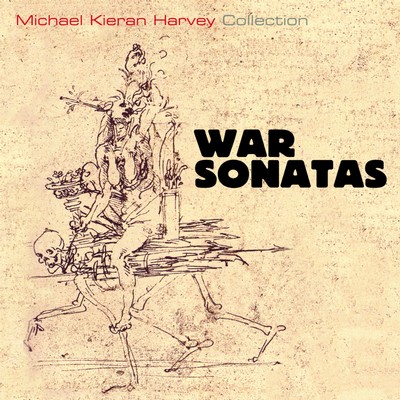
WAR SONATAS

Michael Kieran Harvey

Move Records MD 3477

Behind these three piano sonatas, Michael Kieran Harvey centres on some major crises of our age which are essentially colossal failures of action and inaction. The works operate in ways that are unfamiliar to those of us reared on the conflict portraits of Shostakovich, Nono, Penderecki and Britten; all four masters have compositions to their names that memorialize acts or states of warfare, scores that present emotional and intellectual challenges. Still, as we’re concerned with music, the underpinning principles (or lack of them) involved remain tacit as far as further elaboration is concerned.

Harvey’s Sonata No. 8 bears the title P. Singer, referring to the Australian philosopher to whom the composer is highly indebted for his findings on ethical behaviour and our treatment of the animal world. Much of the teaching of Singer would be familiar to anyone aware of his work with the Greens and his public statements while vying for parliamentary office. Can you present bio-ethical argument in musical form? Probably not but Harvey presents us with a powerful, lopsided sonata with a massive first movement and two much briefer addenda.

Actually, this emphasis on initial dissertations at some length obtains in the following two sonatas. the second entitled Sonata da Caemmerer refers to Harvey’s long-time colleague and friend Arjun von Caemmerer, while also having a bit of word play with the sonata da camera form, even if the most willing of us find it hard to figure out workable comparisons. Its opening Zappaesque lasts as long as the following Rubato and Giusto tempo combined. For Sonata No. 10, you can see the title reference on the CD cover above: Riding with Death. Leonardo’s illustration shows Envy riding on a casket, and I’m assuming that this concerns a different type of dissertation from the previous two personally dedicated sonatas as Harvey is concerned here with AI and its pernicious character in generating weapons used in conflicts across our world today. Here, the first movement lasts a little over fifteen minutes, its lone successor a little less than seven.

Apart from this tenth sonata’s monitory message against giving in to the machines, what have the other works to do that they fall under the War umbrella? The answer is to do with their environment rather than any imitation of the stuttering rifles’ rapid rattle. Harvey sees these three works as a triptych and it is unavoidable that you seek common elements in all of them, even if many of these are simply part-and-parcel of the composer’s compositional arsenal. They were all completed in a stretch of 19-20 months across 2022 and 2023, a time which saw a massive escalation in the war initiated by Russia’s invasion of Ukraine and at its end saw the opening of the Israel-Gaza conflict which has itself become an Old Testament-inspired annihilation. Despite Singer’s anti-Vietnam War stance, you have to stretch mentally to find resonances between that time so full of righteous protest and today’s oscillation of sympathies, compounded by the overtly destructive policies of Putin and Trump and the diplomatic flip-flops from leaders you ought to be able to trust.

In the second of these works, saluting von Caemmerer, the relationship with war comes from the empathy both Harvey and his colleague find in facing the soul-destroying realities of today’s partisanships and the disillusionment that every day produces as the sides in both conflicts become even more imbalanced and any trust in diplomacy proves hollow. Of the three parts to this triptych, this work presents as the least troubled, although that could be just a superficial judgement about its feisty rhythmic jaunts.

Certainly, the most enigmatic is the Riding with Death two-movement construct in which Harvey presents eight Hallucinations for a first movement – reductions to nightmarish scenarios where we waver against artificial intelligence while it weaves its multiple webs of influence and confusion. This is another large-scale essay, or series of paragraphs in which the activity level oscillates between slow angularity and fierce vitality. In the sonata’s second phase, less than half the length of the first, the lessening of humanity is entrenched, leading to a set of final pages where the aural onslaught is overwhelming as we surrender all power to mechanisms that pound us into nothingness – or worse, irrelevance.

The Singer sonata opens with an assertive Allegro giusto that emphasizes athletic leaps, and a motif consisting of a repeated note that accretes companions in an upward or downward-heading flourish, given in both hands. And abruptly, we are in the middle of a Harvey 4/4 mesh of semiquavers, syncopated accents, brief motifs, and an ardently driven energy. Relief comes in a rubato interlude that sees sustained chords wrapped in decorative foliage, the whole leading to a Lisztian climax of epic virtuosity before we return to the giusto and that obsessive wide-ranging percussiveness of the opening.

Another interlude, an A piacere, interrupts a plethora of sextuplets operating at cross-purposes before the composer presents a new chain of atmospheres by way of holding down unstruck chords with one hand and bringing their strings into voice by hammering out abrupt explosions in the other. Eventually we come to a dramatic triple forte climax and a statement of the dedicatee’s surname in complex soft chords; don’t ask me what notes represent S, I, N and R. For good measure, Harvey also gives us Singer’s name backwards in chords that largely have the same components as the originals.

A reversion to the giusto vehement drive, another dramatic a piacere and a series of fortissimo and pianissimo juxtapositions, and the movement ends on a final statement of the single-note-plus-accretions motif leading to a final bass chord of two discordant fourths. What’s next to do but propose a brief Onirico interlude, an unsettled dream that features gruff bass gruppetti and ornate right-hand arabesques while the substance lies in a chain of hefty ten-note sustained chords, the whole dissolving into a five-bar Liberamente excursion prior to folding into the final Ritmico pages.

This finale comprises six permutations and I can see some transferences between two of them but it’s probably best viewed as a set of discrete scenes that offer wide variations in rhythm and harmonic density. Which is not saying much when you look back over the rest of the sonata even if, as in this final movement, the oasis passages blend into the architecture so that the score sounds like a tapestry with consistent threads, brought together at the end by a vital restatement of the fixed-note-with-additions leitmotif.

Harvey begins his Caemmerer score with two identical bars of four double-dotted crotchets in 7/4 time, not wasting his time about submerging this simple material in syncopated cross-measures throughout a movement indebted to one of the composer’s inspirations: Frank Zappa. Disjunction is the game in play here as hefty accents bounce across the frenetic action that finds the executant oscillating between bars with irregular numbers of semiquavers so that you can’t settle into a regular toe-tapping pulse. But then you never can with Harvey who delights in establishing a rhythm that you think is formulaic but which turns out to be deceptive, the accent not where you thought it would be.

Without pause, the score moves into its second phase, Rubato, which proffers a limited meditation on the work’s opening four notes – or perhaps not. This is another set of pages that moves into lavish sound-washes that become more ornate after the movement’s staid, Satie-like opening. The splashes of sound are woven around sustained chords of remarkable complexity that build on the placid sequence initially articulated, before a small transition of about 20 bars Meno mosso breaks open the concluding Giusto tempo set in one of the composer’s most taxing rhythms: 11/16.

You hurtle here from climax through highpoint to explosion, one after another in a powerful exhibition of virtuosity which somehow emphasizes Harvey’s boundless energetic high spirits. You can recognize striding octave bass patterns that transfer to the right hand, punchy block-chords that call and respond across the instrument, hugger-mugger at-the-octave parallel passages like the most taxing five-finger exercises. The composer is here at his most ebullient, giving us some kind of representation of his friendship with von Caemmerer in a sparkling toccata that finally dwindles after a chain of dyads enjoy a diminuendo – as though the dialogue is paused, not ended.

While the first two sonatas in this sequence have been humanized by their dedicatees, the last moves into the realm of a cerebral conflict between AI and its creators. Across the first movement, Harvey offers eight scenarios, states where humans think they are in control. These vary markedly in activity level; a deftly outlined linear argument is followed by an initially calm state that is subjected to pinpricks of doubt or harassment. One of these hallucinations speaks with an updated Webernian angularity while another offers an initial calm underpinned by nervous semiquaver chains that eventually coerce the upper chords into a mirroring rapid angst.

Finally, we arrive at Hammered, relentless which offers a barrage of semiquaver chords in alternating hands with gruff chords as pivots. Harvey is wise enough, even in his anger, to vary the diet with abrupt changes of register and dynamic, not to mention those improbable time signatures that sweep your security blanket away. After some relieving pages in the more fluid ambience of triplets, the opening growling bass recurs and drives the forward motion into a maelstrom of strident chords that grow from seven, through nine to a concluding welter of insistent twelve note chords hammered martellato to an abrupt ending where the human is subsumed in the automaton.

In the end, Harvey’s latest sonatas don’t take war as their subject even if you hear emphatic bursts of energy that speak of turmoil and the suffering that large-scale conflicts bring about. More, the scores have been generated in tempore belli, a grim state that we have been inhabiting for some years, even insulated as we are in this place from the worst of its evils. The composer has been fortunate enough to find a framework for his considerations of these times in the species-broad altruism of Singer, and to hone his aesthetic in van Cammaerer’s friendship and collaboration. In the end, he faces us with the potential for inhumanity in AI and its assumption of authority. But, thanks to the brave agitation and fearlessness of his music, we can follow the best stoic directive and say not the struggle naught availeth.

No cease from exploration

FLUTE PERSPECTIVES VOLUME 4

Derek Jones, Jerry Wong, Joshua Hyde

Move Records MD 3476

Following his own particular path, flautist Derek Jones presents a fourth collection of music written for his instrument by (generally, in this instance) living local composers. His associate pianist is a carry-over from the preceding album, Jerry Wong, and the works on this particular CD cover a wide time-span. The oldest work is venerable Sydney composer Anne Boyd‘s Bali moods No. 1 of 1987; Boyd has also featured on the first and second in Jones’ Flute Perspectives discs. She is closely followed in time by Keith Humble’s five-movement Sonata for flute and piano of 1991, written four years before this notable writer’s death. Alan Holley‘s River Song and Rosella date from 1997 and 1999 respectively. Then we jump to Harry Sdraulig‘s Sonata for flute and piano of 2014, before coming to last year’s Firefly’s Dream by Linda Verrier (a writer who also featured on the previous Flute Perspectives CD) and Folding outward into traces by Joshua Hyde who features on the CD itself, escorting Jones electronically through his score.

Boyd is of the school that sees this country’s musical creativity as indebted to/part of Asia. I don’t know if this creed has maintained its former strong influence; there’s little sign of it in the current crop of younger composers, but Boyd has maintained the faith which also formed part of the inspiration for her teacher, Peter Sculthorpe. Bali rounds No. 1 is part of a triptych of flute+piano pieces that take their impetus from Indonesian sounds and modes. In form, it’s like a rondo with a gamelan-type scene-setting from the piano before the flute enters to toy with the piece’s opening pattern. This atmospheric segment recurs after two cadenzas for flute, one of them with some piano gong-chords, the whole coming to a fade-out conclusion.

As with several of Boyd’s works, this Indonesian-Balinese character is deftly accomplished in a score with a quiet attractiveness, its peaceful progress brought to stasis at the two cadenzas which sound free-form as far as rhythm is concerned. Worlds away in every respect is Humble’s sonata which is more attuned to the world of Boulez’s Sonatine pour flute et piano of 1946 in its bursts of action from both performers. You might expect suggestions of twelve-tone and you’d be right, but the disposition of the series is free-form, as far as I can make out – at least in the opening movement..

The abrupt fits and starts in an improbable rhythmic scheme dissipate near the movement’s end, which is dead slow and sombre. Much the same process occurs in the brief second movement which opens with splashes of sound that seem more formally organized than in the preceding pages. But there is a similar reduction in action to a quiet, brooding conclusion. With the third movement, you first encounter a similar landscape to those of its predecessors, if the process appears to be more prone to an even keener (or more practicable) synchronicity. The players’ mutual mobility comes to a halt for a long flute solo which again moves us into darker-hued territory with few signs of freneticism. A near-funereal coda from Wong concludes this pivotal segment of the work.

Humble’s brief fourth movement sees an ongoing juxtaposition of the leap-frogging calisthenics of post-Webern chamber music and a placid oasis or two of firm pulse and support rather than the bleep-and-commentary nature of the mise-en-scene in the score’s separate parts so far. Yet again, the final stages of these pages are more restrained, near-formal in some scale-like steps from Jones. And the not-quite-as-brief Final follows the same format with a pointillistic opening that gradually gives way to murmurs from both instruments. Not to say that all five movements are replicas of each other but the shape of each one has much in common with its fellows.

Still, this sonata shows the composer in a sharp-edged light with a more placid emotional aspect than in the handful of his works that I’ve encountered over the last near-60 years. But it speaks a European language in its active moments, as you’d expect from a writer who spent a significant amount of time and enjoyed success in France. Jolley’s two solo flute pieces are of a different heritage, one that sounds local in its suggestions of Australian Bucolic, as in River song which sets up its central motifs and more or less elaborates on them without straying too far from the originals. It’s a French-indebted work also, but more Debussy than Dutilleux and making no claims to rhythmic spasms or aggressive sound-splays.

The second of Jolley’s solos, Rosella, is just as concentrated in its material disposition with some more florid outbursts and its concentration is more noticeable as it’s less than half the length of River song. You won’t heard rosella sound transcriptions but a series of images that suggest the bird’s mercurial change of life-pattern, if delineated in a tautly stretched aural canvas. Both pieces show a solid workmanship in construction, as well as the composer’s talent at suggesting aspects of the bush and its denizens. Jones gives eloquent and sympathetic readings of these scenic pieces, engaging them both with a calm authority.

The sonata by Sdraulig is an early work, if his online catalogue is any indication as it comes from his second year of compositional operations. It’s in four movements – Prelude, Badinerie, Romanza, Finale – and the first two are brief while the last is the longest and something of a mixed bag. Nevertheless, the work has a clear shape and direct mode of address even while the composer explores his possibilities. For instance, the Prelude sets up a bitonal piano pattern of soft semiquavers in 5/8 before the flute enters with high sustained notes that acquire rapid-fire ornamentation. But despite a central complexity before reverting to the opening Moderato e molto misterioso, these pages have a firm character and ease of utterance.

The only badinerie I know is the final movement from Bach’s Orchestral Suite in B minor with its grasshopper flute line. Sdraulig applies a light fragility to his at the start with a repeated note in 6/8 (I think) to begin, skirmishing with the piano before setting out on a rapid-fire journey that offers stronger affirmations of the opening pattering and some assertive striding around for both players. Not that the performance here is forced but there are a few passages that come across as laboured and I can’t determine whether it comes from the performers’ determination or some awkwardness in Sdraulig’s writing. But the movement’s bookend pages are feather-light and deft.

Sdraulig’s Romanza presents as a slow waltz, one that meanders harmonically through the piano’s initial statement, immediately mirrored by the piano. Gradually, the intensity deepens and the movement rises to an emphatic climactic point before receding and returning to its origins in a kind of resigned leave-taking that eventually comes to a settlement. You could view it as a song, a lyric of both casualness and intensity. But the last movement is an assemblage where you can pick out some recurring features but the dynamic and emotional landscape is highly varied: fom a rapid-fire opening that recalls the Badinerie to long melodic arcs for the flute (including one exposed solo) that recall the Romanza. I think any listener can detect six or seven sections that are juxtaposed but, despite this variety, the effect is not really successful. Jones and Wong sound stodgy in some of the quick-fire passages and a lack of light touches, of sparkiness prove disappointing.

A more successful blending can be found in Linda Verrier’s piece where the atmosphere is pervasively melancholic. Where, in the summers of her youth, the composer saw fireflies galore, returning years later she finds only one. In any case, she celebrates the insect with a mobile line for alto flute, realized through plenty of trills and repeated notes to suggest a visible presence. At the same time, she seems to be lamenting its solitariness in strophes that come close to an elegy. To her credit, Verrier contrives to keep these two strands in balance in a score that taps into this instrument’s capacity for darker, chalumeau-type colours.

Hyde’s construct is the longest track on this CD, even if to my ears it splays out a limited amount of substance, some of which is extended well beyond its power to engage. Jones plays multiphonic chords or intervals while Hyde treats the given material electronically. For the first half of the work, the emphasis is on amplifying or subduing different layers of the flute/electronic construct. Sound strata come and go as lights do in an aurora. Later, additional sounds enter the mix; one sounds like a chainsaw but might only be an agglomeration of pitches; towards the end, we are hit with what sound like motorcycle exhaust noises.

Not that this welding of live and electronics is that novel a concept or practice. But there’s something endearing in Hyde’s exercise where you can hear the effort involved in his and Jones’ folding outward, taking notes and welding them into an unusual composite. Well, these days there’s not much that’s unusual but this work pursues its traces with determination and invention. In its concluding phases, Jones is subsumed into the texture, his original sounds mere trace elements in the sound environment. It’s a fine way to bring us up-to-date, concluding this latest exploration in Jones’ corner of Australian music.

Canons by the score

A THOUSAND BEAUTIFUL AND GRACEFUL INVENTIONS

The University of Queensland Chamber Singers

Move Records MCD 663

As you can see from the cover, this CD is concerned with canons from the eras when this device was integral to choral composition. What we hear comes from research conducted by Denis Collins and Jason Stoessel; both are academics with Collins an associate professor of musicology at the University of Queensland, Stoessel also an associate professor of musicology and digital humanities at the University of New England. In combination, these two are the CD’s artistic directors, even if the actual man out front is Graeme Morton, senior lecturer at Queensland University and probably the most well-credentialed choral conductor in that state.

In its display of canons, the CD holds 17 tracks. Six of these feature works by Palestrina and Agostini: first, a Sanctus and Agnus Dei from the former’s Missa Sacerdotes Domini; then, from Agostini’s Missa Pro vigiliis ac feriis in canone, the Kyrie, Sanctus, Agnus Dei and Sit nomen Domini which is a pontifical blessing that sends everybody home in high ecclesiastical spirits. Preceding these samples of canon in late Renaissance choral music, the University of Queensland Chamber Singers wend their placid way through another Kyrie and Sanctus from a 14th century manuscript found in the Cathedral of Tournai, written by anonymous hands (or a hand); the original manuscripts found between the pages of the celebrated Mass of Tournai. Then follows a group of three canonic pieces by Matteo da Perugia, Du Fay and Okeghem, a set of three chansons by Jean Mouton, before another triptych by Prioris, Josquin and Willaert.


It’s with reference to the last of these that the CD finds its title: a quote from Gioseffo Zarlino, the 16th century composer/theorist who was one of Willaert’s pupils and who wrote of his teacher in glowing terms: ‘One can hear daily many compositions by the most excellent Adrian Willaert which, in addition to being full of a thousand beautiful and graceful inventions, are eruditely and elegantly composed’. Well, you can’t say fairer than that, can you? But, as with every composer here, the emphasis is on a particular type of invention – the use of canon and the complexities that involves

Such complications start straight away. The Tournai Kyrie is for three lines but the canons are eventually sung simultaneously so that, despite the linear mesh, everybody sings the same words at the same time. It all works out neatly with nine sections – three Kyries, three Christes, three Kyries – and you can hear repetitions of patterns as the lines wind around each other, more obvious with some rapid semi-ornamental work in the final pages that is shared across the parts. When we get to the Sanctus track, your reception becomes easier as the entries into the canon are staggered (as in the Kyrie) but the canonic material is rather plain. Still, the same principle applies about the words which are (generally) sung simultaneously.

These opening tracks offer the UQ singers in exposed fashion, the Kyrie involving female singers, the Sanctus/Benedictus given to the males. Both groups are solid enough, the females having one individual whose timbre shines through at certain points, while the men have all the emotional control of a French monastery group from those mid-20th century recordings of Gregorian chant.

Matteo da Perugia’s Gloria Spiritus et alme presents as a simple section of the Common of the Mass but with interpolations at the end of certain lines which stand as praises to the Virgin; rather exceptional in the context of this extolling of the Triune God. Like a rather striking sample of conductus, this piece speaks with remarkable vivacity, clear in all its parts, but I think that might be due to the two dancing upper lines being sung by individual sopranos. Here, the canon is located in two slow-moving bass parts; for this impatient ear, you’d need a score to trace it.

Dufay’s Gloria ad modum tubae sets up two canons: the first is between two upper voices who follow each other without trickery or, for that matter, much melodic intrigue, while a pair of bass lines sing the same two notes in imitation of those promised trumpets; might have been better to use the actual instruments. But the effect is breezy and forthright: one of the quickest Glorias I’ve come across and handled with excellent pitching by the Singers’ women.

We move to the secular with Okeghem’s Prenez sur moi, a buoyant canon for three voices in which the UQ tenors acquit themselves very well, as do the sopranos, although the alto line is very restrained in volume. This is a sample of that generous well-crafted language, musical and literary, that exemplifies good old-fashioned cortoisie, if with a dose of cynicism, but expertly delivered here – twice, as it happens, as the singers repeat the piece.

Mouton’s three chansons begin with En venant de Lyon which documents a vignette – observing Robin and Marion up to some bawdy congress in a thicket. The canon is for four lines, each following the other in quick succession as though to delineate the rapid nature of the focal pair’s activities. The double canon that follows, Qui ne regrettroit on the death of fellow-composer Antoine Fevin, shows a more serious aspect, the soprano (cantus) in canon with the tenor, alto and bass pursuing each other in this calm, expressive elegy. Finally, Adieu mes amours presents another double canon, sopranos and altos dealing with one, tenors and basses with the other, all matched in a seamless web that sets forth plainly the composer/poet’s humorous farewell to life because the king hasn’t paid him.

The shadowy figure of Prioris (Johannes? Denis?) produced a brief sample of splendour in his Ave Maria setting which is an eight voice work featuring four canons. I have to admit that, while the first two canons can be followed part of the way through this brief score, the other two are almost impossible to pick out, even if you have the four Incipit phrases in front of you. For all that, the Chamber Singers invest it with a placid fervour, their output measured and finely-shaped even if the top sopranos dominate the texture.

Josquin, the master of the canon in every age, is represented in this tour d’horizon by his six-line setting of Se congie prens, which deals with a lover departing the scene before further suffering at the hands of his cold non-inamorata. The program notes speak of a canon between the two middle voices, but I can only hear one between what my score calls the Quinta Pars and the Sexta Pars, and an intermittent one between the two lowest voices (tenor and bass). The construction of his piece rewards study but in actual performance all you concentrate on is the countertenor part, here sung by some confident tenors who cope with a cruelly athletic line to fine effect showing only one sign of strain.

The mellifluous Willaert hits us with a double canon in his motet Christi virgo dilectissima; soprano and bass form one pairing, alto and tenor the other. In this performance, I think the alto line features male voices but I could be wrong, being sadly unfamiliar with the sound quality of the Queensland mezzo voice. This composer moves on from the rhythmic simplicity of his predecessors and has the lines operating in different time zones, adding contrapuntal complexity to the mixture. This is one of the more substantial tracks so far, helped in that by being divided into two segments to reflect the textual matter although both conclude with the same plea for help.

The interpretation is a strait-laced one with the dynamic range kept limited and that serves to underline the composer’s calm pace of inventiveness. Then we come to Palestrina, from whose Missa Sacerdotes Domini we hear the Sanctus and Agnus Dei. I won’t insist that we’ve come to a new plane of creativity, but it’s certainly different in its ease of utterance and the actual presence of six interdependent and independent lines. The opening sounds like a canon involving all the voices, but you could say the same about any number of Palestrina masses that open with the same scrap and then move onto their own paths that imitate details from each other without strictly following the set line.

When we reach the Pleni sunt caeli, the vocal lines cut to three and here the canon is emphatic but the male voices curvet around each other with apparent freedom, the UQ men having an amiable felicity with these pages. And you might be forgiven for seeking canons in the four-part Benedictus but it comes down to imitative entries that veer off onto individual trajectories. With the Agnus Dei, the singers give us only one of the three sentences; understandable as Palestrina apparently didn’t supply a separate dona nobis pacem setting. I think that the canon here obtains between the pairs of tenors because, while everybody takes up the initial bass phrase, several voices dip out on their own excursions by the time we come to Qui tollis.

You think its all going to be plain sailing when you arrive at Paolo Agostini’s Mass which begins with a transparent canon for four voices in its Kyrie, all the more eloquent for its brevity and the clarity of its structure. And so it proves to be with the entries just as plain in the Sanctus, Osanna, and the two settings for the Benedictus – the first without basses, the second without sopranos. As in the Palestrina, the Singers give us only the first verse of the Agnus Dei, a movement in close canonic quarters with a particularly fine amplitude effect at the miserere nobis.

The Sit nomen Domini blessing is notable for the addition of an extra bass line which operates with its partner in a rich sequence of consecutive thirds while your regulation soprano, alto and bass voices outline the canon entries on top in a brief touch of sweet harmony to finish the disc. And, with a few exceptions, that is a lasting impression – one of brevity. The length of each track is not given in the accompanying booklet but my count puts the CD’s length at 47’34”; the longest track is the Willaert motet (7’01”), followed by Palestrina’s Sanctus (6’58”), with Perugian Matteo’s Gloria coming third (5’10). Two offerings come in at under a minute, five at under two minutes, five a bit over two minutes, with the remaining two averaging four minutes between them.

What you get is a well-sung set of choral canons, most of them traceable by the ear alone. It’s a fair mixture of the sacred and profane, although the former predominate. Further, the performances are secure and controlled; full marks to an organization that escaped my notice during the years I spent in the neighbourhood.. And further congratulations to the felicitous ease with which all concerned handle what could have been a dry academic exercise.

A near-forgotten voice

THROUGH TROPICAL STARS

David Joseph

Move Records MD 3467

There’s something enigmatic about the music of David Joseph. If it weren’t for Move Record’s initiative, I would know very little about his contribution to Australian music. As it is, any material you come across is deficient in detail. For example, the opening work on this disc, a Concertino for flute, viola and percussion dates from 1988 but doesn’t appear in the Australian Music Centre’s catalogue of Joseph’s works. Likewise, the concluding piece, The Afternoon of 1991 for piano trio, is absent from the same list. Slightly less confusing is the attribution of the title track for two flutes to 1977 on the CD, but 1978 in the AMC’s listing. Ditto for the String Trio No. 2 (CD 1991, catalogue 1990) and a Sonata for clarinet and 2 percussionists (1978 according to the CD, but 1979 in the catalogue demi-raisonne).

Not that such discrepancies will keep anyone awake at nights, but they speak of a certain slovenliness in the provision of accurate information. As for performers, the Concertino boasts members of Sydney’s Seymour Group before that ensemble ceased operations in about 2006; flute Christine Draeger, viola John Gould, percussion Ian Cleworth and Rebecca Lagos (or is it Graeme Leak{e}?) as announced on the CD’s sleeve?). Jennifer Newsome and Zdenek Bruderhans perform Through tropical stars, while Nigel Sabin clarinet and Cleworth with Ryszard Pusz present the sonata. A group appropriately called the String Trio Holland consists of violin Josje Ter Haar, viola Susanne van Els, and cello Job Ter Haar. As for the brief The Afternoon, that features the untraceable Trio Classico comprising violin Urs Walker, cello Regula Hauser Menges, and piano Stefan Fahmi.

As you can see from the dates of each work listed above – 1977 (1978), 1978 (1979),1988, 1990 (1991), 1991 – Joseph’s compositions on this CD are not fruits of the composer’s time spent in Benalla where he has worked as a lawyer for nearly the last 25 years. It would seem that his musical creativity has come to a halt – a lume spento. Nevertheless, these five tracks from the past remind us of the individual voice that Joseph spoke and the sheer attractiveness of his vocabulary. By the way, all offerings on this CD are from live performances – at the Seymour Centre, Elder Hall in the University of Adelaide, Melba Hall at the University of Melbourne, and St. Peter’s Church, Zurich.

What the Concertino offers is a garden scene, albeit a furiously active one where the bird-life approaches the manic in its opening strophes, vivified by a rapid semiquaver flute pattern and viola flutterings above campanile, vibraphone and marimba backing. Every so often, we reach a hiatus point and the motivic matter changes, if the textures remain pretty constant, as does the level of action. When you think things are slowing down (the use of quaver triplets), the flute stirs itself into fresh flights and the percussion mimics the frenzy. For all that, the atmosphere is a benign one and it is conceivable that Joseph is presenting a kind of promenade where a change of vista prompts an alteration in texture.

Still, the soundscape is a consistent one with recognizable patterns enjoying a transmutation process and the ensemble working as a well-oiled rhythmic machine, punctuated by a cadenza flight from Draeger and Gould towards the conclusion . Just when you think the piece is descending into a twilight phase, the initial energy and textures reappear, although the final bars offer a kind of placid resolution. It seems to me that Joseph is most concerned with exercising a timbral palette which he varies most obviously by changing his percussion instruments. This results in an effervescent kaleidoscope of colours to which all four participants contribute in almost equal measure.

According to the AMC site, Through tropical stars is meant to last about twelve minutes; Newsome and Bruderhans get through it in under nine. It’s not intended to be another ‘bird’ piece and in some ways it isn’t, having a wider scope than mere avian imitation. But there are passages where you can’t escape the querulous nature of bird chirrups and competing calls, circling around each other in close imitation. One player uses piccolo, concert flute and alto flute; the other sticks to concert flute throughout. While the work is a dazzling exhibition piece for its interpreters, its atmospheric character suggests a natural world abuzz with growth and light: a brilliant tandem ride of coruscations, here articulated with admirable interdependence.

Something like the Concertino, Joseph’s Sonata works hard to present textural and timbral interplay/contrast. It certainly exploits Sabin’s flexibility and rapid recovery in its initial stages where a dialogue between clarinet and marimba displays a mastery of quick-fire articulation. A chain of sustained wind notes takes us a short space away from the initial chattering, but not for long; when the clarinet is occupied with delivering a high pedal note, both marimba and xylophone indulge in a furious clash of lines.

It makes for an experience that is heavy in events. If a score were available, I’m sure the interconnections and inner references would become clearer but, as it is, you just surrender to the aural avalanche-with-recesses that prevails at the end, despite the sudden emergence of some moments of what pass for rest in this active work. Percussionists Cleworth and Howell are no shrinking violets but take over the running, occasionally drenching the clarinet in powerful mallet work as the score drives towards its affirmative conclusion.

With the string trio, despite the CD leaflet’s stipulation that it is a nature portrait similar to the Concertino, we are in a different landscape where abrasive chords serve as fulcrum points, demanding attention right from the opening. True, you hear whistles and throbbings that might represent wildlife red in tooth and claw, alternating with compulsive motor rhythms that bear witness to the ongoing influence of Stravinsky’s early years. Again, the composer utilises obsessive motives and near-splenetic bursts of repeated chords to animate his intended ambience.

As with its precedents on this CD, the trio deals with patterns that can be transformed or just repeated till the next one appears. What is different is the sense of menace as we move through a sound world that is packed with percussive-sounding bursts. The burbling and twittering has gone and we find ourselves in a world of menace and uncertainty which eventually fades to an uncertain final querulousness: the first piece on this album that ends, like Petrushka, with a question.

The last track, and the latest of Joseph’s works represented here, The Afternoon is a brief vignette that intends to acquaint the listener with the sad quietude of approaching twilight. In fact, the piece succeeds very well in following a path into quiescence, the final words given to the piano after a process that maintains Joseph’s practice of exploiting brevities, even if these ones present themselves with more angularity than we’ve heard so far.

For recordings that were made some time ago – 46 years in two cases, 34 years the most recent – the quality of these tracks is remarkably clear, in particular the final one from Zurich where Walker’s violin and Fahmi’s piano have a fine, piercing character that makes every note resonate. And it serves as an attractive envoi to this series of one-movement scores that remind us of the intellectual and emotional appeal of the music created by this remarkably gifted writer.

Soft blasts from the past

WHERE HAVE YOU BEEN ALL THESE YEARS?

Claire Patti, Louise Godwin, Tony Gould

Move Records MD 3469

There’s something disarming about this album which is a collection of songs/folk-songs – several of them well-known – performed as trios, duets and solos by Claire Patti (harpist and singer), Louise Godwin (cellist but not employed as much as she could have been), and Tony Gould (pianist and the heaviest participant in this amiable exercise). I say ‘well-known’, but that might only apply to that generation that boasts Gould and me (he is my senior by a few years). The Skye Boat Song, My love is like a red red rose, Londonderry Air, The Last Rose of Summer, Black is the colour of my true love’s hair and Molly Malone were standard articles of faith in my youth and all enjoy a re-working here.

As well, you will come across a few that ring bells in the memory, if not very clamorous ones: Carrickfergus, Strawberry Lane and Ae fond kiss. Gould and Co. have included an Irish lyric that I’ve never come across – Tha M’aigne fo ghuraim (This gloom upon my soul) – and an English traditional song that none of those great 19th-into-20th century collectors seems to have bothered with: Sweet Lemany. Not to mention a Scottish tune that sounds more promising than its reality in She’s sweetest when she’s naked. Then there’s Idas farval (Ida’s farewell), written by Swedish musician Ale Carr, and Jag vet en dejlig rosa (I know a rose so lovely) which is a traditional tune, also from Sweden; I suspect that both of these spring from Godwin’s interest in that Scandinavian country’s music. From left field comes A little bit of Warlock, which sets some pages from the Capriol Suite, namely the Pieds-en-l’air movement.

The ensemble beginsn with Sweet Lemany, which may have origins in Cornwall, Ireland, or Suffolk; it has certain traits that argue for an Irish genesis. But the setting is original,, first in in that Godwin maintains a one-note pedal throughout, pizzicato and keeping to a mobile rhythmic pattern. Patti sings with a light, refreshing timbre while Gould informs the piece with subtle inflections and brief comments/echoes. For all that, Patti sings four of the five verses available in most editions.

Gould takes the solo spot for William Ross’ Skye Boat Song and, apart from a winsome introduction, sticks to the well-known tune right up to the final bars where the straight melody is subsumed in a brief variant. Most interest here comes from following the executant’s chord sequences which follow an unexceptionable path throughout a mildly meandering interpretation. Gould gives brief prelude to My love is like a red red rose before Patti sings the first two stanzas. Godwin offers a cello statement, before the singer returns with the final two stanzas and an unexpectedly open concluding bar. Gould occasionally offers a high trill to complement Patti’s pure line. And the only complaint I have about the vocal line is the singer’s odd habit of taking a breath after the first few syllables of the third line in most of the stanzas.

Carr’s sweet if repetitive lyric is a sort of waltz with three-bar sentences/phrases, in this case giving the melody first to the cello, then the harp, before the cello takes back the running. The piece’s form is simple ternary and we certainly are familiar with the melody’s shape before the end. More irregularity comes in the Swedish traditional song from the 16th century with its five-line stanzas, here handled as a kind of elderly cabaret number by Patti and Gould, whose support is a supple delight beneath Patti’s somewhat sultry account of what textually should be a love song but musically sounds like a plaint.

The Warlock movement, here a piano solo, gets off to a false start and Gould can be heard saying that he’ll start again. For the most part he is content to follow the (original?) Arbeau melody line and reinforce the British arranger’s harmonization with some slightly adventurous detours along the path. A variant appears shortly before the end but the executant eventually settles back into the format and plays the final two Much slower bars with more delicacy than the original contains. Patti sings two stanzas of the three that make up the ‘standard’ version of Carrickfergus and invests the song with an infectious clarity of timbre, especially at the opening to the fifth line in each division with Gould oscillating between the unobtrusive and mimicking the singer when she moves into a high tessitura.

A harp/cello duet treats James Oswald’s She’s sweetest when she’s naked, which has been described as an Irish minuet (whatever that is). The only peculiarity comes with a change of accent to slight syncopation, first seen in bars 3 and 5 of the first strophe. Patti plays the tune through twice, then Godwin takes the lead for another run-through. Some laid-back ambling from Gould prefaces the Danny Boy reading for solo piano, with just a trace of Something’s Gotta Give before we hit the melody itself. The pianist does not cease from exploration and offers some detours to the original line, as well as a couple of sudden modulations to restatements in a refreshed harmonic setting. For all that, the Air remains perceptible across this investigation, the CD’s longest track.

Staying in Ireland, Gould gives an alluring prelude to The Last Rose of Summer before Patti starts singing Moore’s lines. Godwin has a turn at outlining the original Aisling an Oigfhear melody before the singer returns with the second stanza, then omitting the third, with Gould providing a postlude that puts the first phrase in an unexpected harmonic context. As with all the vocal items on offer, this is quiet and unobtrusive, some worlds away from the habitual thrusting treatment demonstrated by generations of Irish tenors bursting into the role of Flotow’s Lyonel.

Across the sea to Scotland’s Black is the colour of my true love’s hair which Gould opens through some sepulchral bass notes before giving the melody unadorned and unaccompanied before moving into a fantasia that harks back to its source material before resolving into another re-statement of the melody and a reappearance of the opening’s repeated tattoo. This version is comparable in colour to some of the more conscientious American folksingers who have recorded versions of this work, making a slightly unsettling celebration of what is a love-song in a minor key (mode!?) context.

Back across the sea to the island, Godwin plays Tha M’aigne fo ghuraim as a solo, punctuated by sudden turns and grace notes; at well under two minutes, the CD’ shortest track but probably its most obvious and characteristic in terms of its country of origin. Another piano solo, Gould gives us a preamble before playing Strawberry Lane through straight once, then almost doing the same thing again before following his pleasure at the end of the second stanza. Of course, he returns to the melody en plein air near the end but concludes with a reminiscence of his earlier elaboration and an unsatisfying tierce to finish.

Another Burns lyric, if a despondent one, in Ae fond kiss brings Patti’s calm delivery into play once again. She sings all the stanzas except No. 2 in the set of six. Gould offers a mid-flow interlude which, I suppose stands in for the missing lines but the song’s delivery suggests a rather odd 3/4 rhythm as opposed to the more bouncy original 6/8. But the executants’ restraint is put to happy employment throughout. Molly Malone brings up the rear and is another piano solo where Gould plays the stanzas’ sextet several times, giving less space to the three chorus lines. It’s plain sailing through this very familiar melody, the pianist content to follow the air’s contour.

Not everything on this diverting disc works ideally. Some of Gould’s chords sound like abrupt breaks in an otherwise placid flow, some notes don’t sound, and Godwin’s cello seems uncomfortable on one track. Still, you’ll find plenty of material here to entertain and over which you can reminisce – which is clearly (for me, at least) the whole point of the exercise.