Out one door and in another

SPANISH CONNECTIONS

La Compania

Salon, Melbourne Recital Centre

November 14, 2015

Giving its last recital at the MRC before moving next year to the glass-and-wood complex of Federation Square’s Deakin Edge, this estimable period-music ensemble  opted for an all-Hispanic program,  one that continually shot off in southern colonial directions. Director Danny Lucin‘s cornetto and an instrumental septet played a few instruments-only pieces but much of Saturday evening’s recital consisted of sung material in which La Compania supported soprano Cristina Russo.

                                                             La Compañia (image: lacompania.com.au)

This was a mini-tour in 14 segments, some of them quite short, of Spanish music at home and in the American colonies which stretched from religious music of the early 16th century to Peruvian dances constructed close to the start of the 19th.  Of course, the physical provenance of the works was reflected in their categorization, religious and secular, with a fair mixture of both.  To all of it, the Companians gave their best with crisp attack and a rousing realization of this music’s rhythmic vehemence.

To begin, the players worked through some diferencias on an anonymous theme called Las Vacas; basically, a ground bass with elaborations on top  or around its progression which gave a sample of the sound-colours on offer: Lucin’s rapid bright line, Mitchell Cross’s all-purpose dulcian (a precursor of the bassoon), the supple sackbut ((early trombone) of Glen Bardwell, David Irving‘s refined violin, and two supports in the gamba of Victoria Watts and Rosemary Hodgson‘s alternating vihuela and guitar.  Icing on this particular cake came from percussionists Denis Close and Christine Baker, both prominent contributors throughout with drums, tambours, gourds, and eventually the inevitable castanets.

Russo’s pure timbre soon became a single strand in an anonymous Dennos lecencia senores, a cachua or round dance from Peru where the whole ensemble participated, not aggressively but making enough of a sonorous edifice to background all but a powerfully projected voice.  This overpowering also took place in a villancico by Antonio de Salazar, Seville-born but a Mexican composer.   His Tarara tarara qui yo soy Antoniyo continued the Christmas theme that ran through the program but, with both sackbut and dulcian out of the mix, Russo enjoyed more exposure, her clear timbre taking prime focus and the text became decipherable.

Two pieces by Gaspar Fernandes – born in Portugal but moved to Mexico and Guatemala – showed a lively invention, if also presenting the players with a real challenge in A belen me llego, tio with its punctuating syncopations that did not quite succeed in their effectiveness when essayed by an ensemble like this one with widely differing dynamic possibilities; from what I’ve heard, the piece works much better when singers – either individual or several to a line – are involved.

A brace of Francisco Guerrero pieces succeeded more satisfactorily, Russo enjoying the backing of Hodgson alone for the opening to Virgen Sancta, another Christmas villancico with a surprisingly mobile melody line.  Moving back to Peru c. 1780, the anonymous El Congo brought to mind a late Baroque mariachi band with bright triplets and an arrangement rich in upper reeds seasoned with a catchy percussion support.

Fernandes appeared further down the program with an Assumption song, Vaya, la princesa, vaya, which might have enjoyed more impact if the vocal line had not been doubled, as was the case in No hay mas dulce alegria where three instruments took on that duty in turn.   A return to the ambience of the night’s opening, Santiago de Murcia’s Los Imposibles is a passacalle which seems to follow the same bass as the Las Vacas tune.   More familiar to me in a guitar solo setting, this made comfortable listening thanks to some deft interwoven solos.   And to conclude, the company played yet one more Peruvian anonymity: Nino il mijor, another cachua of infectious if restrained jubilation at the presence of the Christ child.

Once more, La Compania here unveiled some treasures to which it brought a distinctive approach.  If the soprano was treated as just one thread in the group’s complex, at least she remained audible, even under some assertive, full-bore output from her colleagues.   Nevertheless, many factors generate delight when hearing this company, the most significant being its unique combination of finesse and spirit, especially when the ensemble girds up its loins for one last variant.  Now for a new home and three nights of further discoveries in 2016.

Clara and Dulcie meet the Eggner boys

EGGNER TRIO

Musica Viva

Melbourne Recital Centre

November 10, 2015

                      Eggner Trio

Over a fairly short period, the Eggner Trio – comprising brothers Georg, Florian and Christoph – has become a familiar presence on Musica Viva‘s annual guest artist schedule.   After winning the Melbourne International Chamber Music Competition twelve years ago, the ensemble then visited Australia on three further occasions.  This fourth time, the programs on offer both begin with a Schumann work – one from Robert, the other composed by wife Clara – and then the nights centre on Dulcie Holland‘s 1944 Piano Trio; one of those scores more talked about and extolled in the abstract than performed.  The final offering brings matters back into the mainstream for any patrons rattled by the preceding novelties: either Dvorak’s Dumky or the magniloquent Brahms in B Major.

For their competition final, the Eggners played the major repertoire: Mendelssohn in D minor in the opening rounds, keeping the big Schubert Trio in E flat for the finals and in the process edging out the Ondine Trio who performed the same work with – I thought – a good deal more conviction.  In 2005, Schubert in B flat – the more popular one of the pair – enjoyed an urbane airing, along with Schumann in F Major and a refined version of Ross Edwards’ Trio, which had been a compulsory work for all competitors in the 1999 competition.  Three years later, the ensemble recycled their competition Mendelssohn D minor, made an ardent experience out of Debussy’s G minor trio – dismissed by some commentators as over-hyped juvenilia – and ran through Beethoven’s first work in the form.  I missed the 2011 programs, happily handing them over to another reviewer as the content looked, for once, unappealing.

Clara Schumann’s solitary chamber work has a solidity of structure and melodic straightforwardness that prove eminently satisfying, particularly when given as finished a performance as the Eggners provided.  The outer movements show a clear-eyed approach to organization, the finale intriguing for its linear interplay.  But the work picks up real interest in its Scherzo and the following Andante – simple in its turn from placidity to crisis and back again but crafted with skill and giving each player an opportunity to shine.

A major figure in Australian musical life, and not just because of her involvement with the Australian Music Examinations Board, Dulcie Holland studied in London before World War II and the Trio, written after her return to Sydney, shows obvious marks of her training.   What shouldn’t surprise, but does, is a firm individuality in the composer’s style; the writing is based on a kind of sophisticated diatonicism but with enough edge to avoid any traces of triteness.  Listening to the threatening initial theme of the opening Allegro, you can’t avoid comparisons with similar ominous passages in the work of John Ireland, Holland’s teacher, but the curves and inflexions remain Holland’s own, unnervingly reminding you of the subterranean lurching of the E minor Shostakovich Trio written in the same year.

Holland’s score has no slow movement; rather a succession of three fast segments which found amiable exponents in the Eggner players, cellist Florian a committed voice throughout, probably investing more plosive force than the piece needs.   As with the preceding Schuman, the reading’s main impact was positive thanks to the group’s warm polish, the ensemble clean and its lines balanced, if every so often violinist Georg showed traces of the reticence which has figured in some of his earlier Musica Viva appearances.

With the Brahms Trio No. 1, these musicians demonstrated a control and spacious breadth that informed each page.  Many groups have turned this masterwork into a sort of piano concerto and admittedly the keyboard writing is temptingly hefty; the competitions that come around every two years invariably have one set of ambitious executants making a sweat-soaked welter out of these bracing pages.  The Eggner approach showed remarkable restraint, the driving climaxes pronounced with weight rather than hysteria, pianist Christoph treating the high passage work in the Scherzo with unfussed celerity, all three members taking time with those slow, melting arches that distinguish the Adagio, as do  its sustained moments of dangerous exposure: a moving conclusion to an intelligent, original recital.

The Eggner Trio will play again in the Elisabeth Murdoch Hall on Saturday November 21 at 7 pm.

Split, but not at the ends

INDIVISIBLE VIOLIN & PIANO

Ji Won Kim and Young Kwon Choi

Salon, Melbourne Recital Centre

October 25, 2015

Both of these artists have considerable reputations.   Ji Won Kim took out the 2009 ABC Symphony Australia Young Performer Award and is currently a member of the Melbourne Symphony Orchestra’s first violins, emerging more often than many of her colleagues to front the odd concerto or recital.

Ji Won Kim (image: mso.com.au)

In 2012, South Korean pianist Young Kwon Choi gained the ABC Symphony Australia Young Performer Award in the piano section as well as capturing the Paul Landa Prize under the auspices of  Arts Council Australia and Musica Viva, since when he has performed and studied in the UK and Germany and is now resident and active in Seoul.

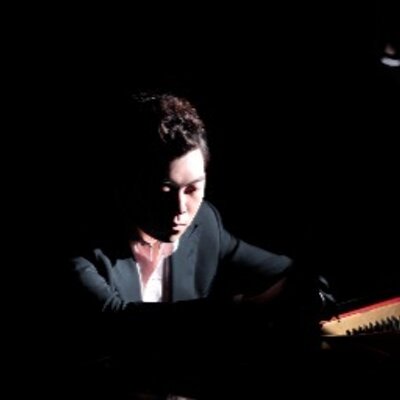
Young Kwon Choi (image: twitter.com)

For this collaboration, both artists began and ended indivisibly enough through duets, albeit constructs of wildly differing quality.   In between the Brahms G Major Sonata and Wieniawski’s Fantaisie brillante, the two went their separate ways.   Kim allied herself with Caleb Wright, a viola colleague from the MSO, for Johan Halvorsen’s Passacaglia, lifted from Handel’s Keyboard Suite No. 7 and extended when the arranger felt that the original variations needed amplification.  Both artists demonstrated impressive technical assurance, the fusion of lines well-contrived in the early Handelian pages, Kim relishing the firm flashiness of the latter variations.

For his part, Choi played the Chopin Ballade in F minor, the most intricately constructed and densely textured in the set of four.  Not that the work misfired, but the executant hurtled through pages that might have gained from more considered handling, particularly in the central development where the intended excitement relied on action-packed cascades of semiquavers while the intellectual changes rang thin.

The duo’s realization of the Brahms sonata, apart from a small fumble in the final Allegro molto moderato, came over with fine warmth of timbre and mutual responsiveness, Kim’s line a clear voice right from the warm-hearted opening, while Choi dovetailed with sensitivity in the work’s lyrically controlled paragraphs.

Wieniawski’s fantasy is an unabashed virtuoso exhibition for the violin based on themes from Gounod’s opera Faust.  Like most of the breed, it sounds exhilarating for the quick succession of technical fireworks that dominate its more vivid sections, notably the variant on Mephistopheles’ rollicking Calf of Gold aria-with-chorus and the Kermesse theme.  Kim vaulted through its demands with infectious brio, also finding a studied warmth for the piece’s central meditation on Gounod’s Act 3 love-duet.

In the recital’s short time-span, Kim and Choi began with the program’s finest music to represent the indivisible aspect of their partnership, but from then on their ways parted and even the flashy final duet proved something of a one-sided business with Kim occupying the limelight.  Nevertheless, the audience responded positively to the  musicians’ output and the exercise made an auspicious signpost in a fairly new initiative – well, new to me: the Marigold Southey Signature Series.