Ad hoc expanded ensemble scores

BEETHOVEN’S SEPTET

Ensemble Liaison & Friends

Hanson Dyer Hall, Ian Potter Southbank Centre

Monday September 22, 2025

Ensemble Liaison (L to R) David Griffiths, Svetlana Bogosavljevic, Timothy Young

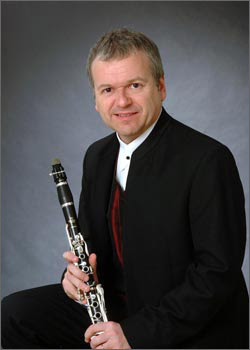
Naturally enough, the Ensemble Liaison relied on quite a few friends to mount its attack on Beethoven’s most celebrated work – well, very much so in the composer’s lifetime, and lasting quite a few years after that. For one thing, the Ensemble personnel was cut by a third for this work; see you later, pianist Timothy Young. The remaining members – clarinet David Griffiths and cello Svetlana Bogosavljevic – were assisted by some well-known professionals – horn Carla Blackwood, violin Dale Barltrop, bassoon Lyndon Watts – and a pair of ‘students’ quickly pursuing solid careers in Australian National Academy of Music participant Hanna Wallace on viola, and double bass Rowan Swarbrick who is finishing his Master’s degree at the Melbourne Conservatorium of Music in whose freshly fabricated halls this recital was held.

Not that Young was totally neglected. Indeed, the night’s program was dominated throughout its first rather brief half by Young as both composer and soloist. The evening opened with his relatively new work, Distant Waters of 2024, written for the Liaison forces and based on a simple four-note motif; not really a melody, as outlined by Griffiths pre-performance address. You could distinguish this mini-theme as it was subjected to a kind of free variation treatment that proved charmingly melodious in its amplifications, even if some of these sounded like contrapuntal exercises at their openings.

Young here deals in a harmonic language that might be described as post-Romantic as it was firmly rooted in traditional garb with some mildly adventurous modulation but nothing irregular in its rhythmic structure and an instrumental complex that favoured doubling of lines; not that there’s anything wrong with that – the greats did it, although having the cello and piano play the same bass line isn’t something you hear much of in contemporary compositions. But that’s just it: Young is writing in a style that harks back to less fraught times, devoid of striving dissonance and appealing in its optimism.

However, not much remains in the memory about the performance’s progress apart from its quiescence. Further, Distant Waters was close to submerged by what followed: Ravel’s Gaspard de la nuit suite of 1908, a fine vehicle for Young’s powerful virtuosity. His account of the first movement, Ondine, offered a subtlety eschewed by many another interpreter who expend a thunderous energy at the fortissimo climax of bar 66, which usually strikes me as out of proportion with the aqueous humour of the poetic narrative and a sudden tsunami in the middle of a rash of oblique colours.

As well, you could relish Young’s quiet insistence on the pervading melodic line cutting through the lavishly applied froth, culminating in the single-line address across bars 84 to 87 where (I’m guessing) the human says to the nymph: No dice, sweetie. Then the final page eclat of bitonal arpeggiating burst into play with maximum effectiveness as the last four bars mirrored the piece’s opening frissons in a demonstration of interpretative subtlety.

I can’t be the only listener who focuses attention on the B flat/A sharp mid-works pedal that Ravel sustains throughout Le gibet, so that the chordal web that is meant to distract from it takes second place to working out how the composer welds the two strata together. Certainly, you get involved in the drear and gloom illustrating Bertrand’s speculative poem that only settles into reality in nits final paragraph. Much as the monotone obsessed, my attention eventually turned to Young’s extraordinary hand-span which negotiated many chords flat-on, particularly some that most of us have to arpeggiate, like the 9th constructs at the piece’s opening and the falling figure that comes about in bars 20, 23, 40 and 43.

But, if you know this score, you’re really waiting for the impossible in Scarbo which Young accomplished with enough atmospheric touches to satisfy this listener, mining the movement for its acerbities, overt and muffled. You can’t say it was all plain sailing but each note seemed to be there as well as meeting the composer’s demands for rapid articulation, as in repeated demi-semiquavers that start at bar 2 and recur at bat 396. and in a set of full shoulder powerhouse explosions that finally burst out at bar 366, and again at bar 563 to the immense satisfaction of all concerned; it’s been a long time coming and the intimations nerve-wracking.

Young’s realization of the restless gnome’s activity lacked the vicious sparkle of other interpreters, possibly because he didn’t go in for a dry staccato attack. Yet his sense of the central character’s restlessness, sudden leaps into the foreground and retreats to the shadows, were finely realised across the breadth of this improbably long canvas.

After a brief break, we gathered for the Beethoven Septet of 1800 which is still a real pleasure to experience live, not least for the immediacy of its simple gaiety and open-heartedness. Each of the six movements is a delight to hear, even given my indifference to slow introductions and this work has two at either end. Barltrop and Griffiths established themselves as masters of the performance’s destiny, the former more overtly because of the ornate violin line in bars 3, 5, and 12-15 of the initial Adagio to Movement 1. But the ensemble work that followed in the Allegro was well focused and persuasive in its attack.

In fact, the only flaw that struck me in these pages is that odd hesitation that seems to be interpolated in most readings. It’s a sort of adjustment pause in bar 83 of the exposition where the violin soars up to a high G, then has to leap down to the first E on the D string. Is it that hard a jump that everybody has to wait for the adjustment? It might be harder when the figure returns at bar 218 and the jump is from a top C to the first A on the G string, but the imposed hiatus makes for an obstruction in the movement’s easy flow.

Moving on, the cantabile was finely achieved in the solos for Griffiths and Barltrop that outline the main melody to the Adagio, with some welcome exposure for Watts in a pendant phrase at bar 21: the first bassoon solo so far, I believe, complemented by a slightly longer one for Blackwood beginning at bar 68. Here was playing with a gentle bloom to its character of placid calm, the clarinet and violin in gentle call and response across the final section starting at bar 80’s recapitulation.

No complaints about the bouncy minuet, recycled from the Piano Sonata No. 20 in G Major. This is a point of delivery for the string quartet, mainly the violin but also Bogosavljevic who enjoys sudden exposure in bar 20’s main tune restatement. Beethoven’s equally happy Trio is memorable for the horn E flat arpeggios that punctuate the main melody; Blackwood articulated nearly all of these, only encountering a problem at the top of the mark in her repetition of this segment’s second half at bar 42.

A mildly propulsive attack on the following Tema found Barltrop and Wallace in excellent partnership which continued through the first variation, Bogosavljevic making a resonant contribution through her syncopations in bars 31 and 47. The violinist gave unassertive accounts of the rapid figure-work in Variation 2 and Griffiths and Watts combined to telling effect in the clarinet/bassoon top-and-tail to Variation 3. Blackwood came to the fore again – momentarily – in introducing and ending the B flat minor Variation 4 with unforced penetration.

And the coda came over with simple eloquence as the composer restructures/segments his theme in simple terms setting the clarinet/bassoon duo in antiphonal format against Barltrop/Wallace across the calando final bars. Again, the ensemble relished those deft solo and duet passages inn the Scherzo, especially Bogosavljevic’s long stretch of comfortable outlining in the Trio, until Barltrop entered to double her path at bar 113 for the final thematic restatement.

I can’t think of a happier moment in this work than the violin/cello duet that outlines the prime melodic matter for the Presto finish. This is Beethoven combining enthusiasm and pleasure in one hit of almost eight bars before others enter, and its impetus is infectious, setting a pattern/scene for the most jocund of finales. Once again, we encounter that hiatus as the violin negotiates a leap from a high B flat to the instrument’s lowest F sharp at bars 54-5, and again at bars 177-8 from a slightly lower E flat to B natural below the stave. But what do you expect? By now, it’s common practice, like Trump decrying climate change or the perniciousness of wind farms – well, not as stupid, but just as inevitable.

But the moment that catches my breath every time is the sudden chorale for the three wind that comes out of nowhere at bar 316: both a transformation and an illumination of the vital action that has sustained the movement so far and which leads gently into the violin’s cadenza that Barltrop outlined so precisely and deliberately (the same thing?) that the insertion didn’t jar. Then the rush home with the violinist having the last word with three exposed bars of E flat arpeggios before a climactic E flat in alt.

While the performance might have lacked the gloss of some European recorded readings, you would have enjoyed the brisk immediacy of this one from the Ensemble and friends. At times, the balance was over-favourable to the wind trio, but the string group has so much more meat in its parts, especially the two upper lines that natter endlessly across the score. As well, these players demonstrated an individuality in their work, particularly Griffiths (as you’d expect), Wallace and Bogosavljevic, all of whom displayed an energy and eloquence that supported the emotional involvement of the whole ensemble with an appreciative audience in this acoustically lively space.

Diary October 2025

BRUCKNER AND STRAUSS

Melbourne Symphony Orchestra

Hamer Hall, Arts Centre Melbourne

Thursday October 2 at 7:30 pm

A celebration here for two late Romantic masters of verbosity. In its endeavours, the Melbourne Symphony Orchestra will be directed by Vasily Petrenko, currently conductor of the Royal Philharmonic Orchestra and a youngish veteran who will bring fresh eyes (you’d hope) to some of the three works programmed. He starts with The Flying Dutchman Overture by Wagner, a hero for the two composers named in the title of tonight’s program. This 1841 work manages to bundle up all its leitmotifs in a wild and windy stretch of scene-setting. Then Victorian-born soprano Alexandra Flood will emerge to sing a selection of Strauss lieder including Zueignung (1885), Cacilie (1894), Befreit (1898), Freundliche Vision (1900), Winterweihe (1900), and Waldseligkeit (1900-1). Possibly there will be others, but these six set a worthy bar because all were orchestrated by Strauss himself. I’m finding Befreit and Waldseligkeit particularly appealing because they both call for a harmonium. Outweighing all these is Bruckner’s Symphony No. 7 of 1883 which presents myriad opportunities for rabid enthusiasts to question which of the several available editions will be used, and why. A harmonic feast throughout, the two outer movements are splendid examples of this composer in full rhetorical flow. Tickets move from $20 for anyone under 18, through to between $51 and $139 full price, with concession tickets a measly $5 less, plus – for everyone – the inexorable $7 transaction fee added on because processing your credit card is so time-consuming.

This program will be repeated on Friday October 3 at 7:30 pm in Costa Hall, Geelong, and again in Hamer Hall on Saturday October 4 at 7:30 pm.

GARDEN OF EARTHLY DELIGHTS

Luminescence Chamber Singers

Primrose Potter Salon, Melbourne Recital Centre

Friday October 3 at 7 pm

You’ll find six singers constitute the Luminescence Chamber Singers from Canberra: sopranos Josephine Brereton and Rachel Mink, mezzo AJ America (the group’s founder), tenor Dan Walker, baritone Lucien Fischer, and bass-baritone Alasdair Stretch. The sextet will be directed by Roland Peelman, long-time director of The Song Company from Sydney. In providing a musical counterpart to Bosch’s great painting, the singers have gone for the very old and the very new, opening with a Hildegard of Bingen double-header comprising the antiphons Cum processit factura and its companion Cum erubuerint (both about 1180-90). At various stages we hear the three Agnus Dei settings (four parts, three parts, then six parts) from Josquin’s Missa Hercules Dux Ferrariae of 1603-4, Orlando de Lassus’s chanson Dessus le marche d’Arras (published in 1584), Verdelot’s motet Veni in ortum meum which at least has the distinction of mentioning a garden, and Luzzaschi’s Dante setting of Quivi sospiri, written in 1576. Set against that, you have some early Cage in the 1940 Living Room Music: Story, the madrigal Poi che voi from Gavin BryarsSecond Book of Madrigals which may have been written in 2010, the world premiere of Australian composer Nicole Murphy‘s Escape, three of Netherlands writer Frank NuytsXXX SongsAnime, Dodl , Eine Kleine Nachtmusik – written in 2007 for Peelman and The Song Company, another premiere in Ode to an apple from Sydney writer Archie Tulk, then (speaking of that fruit) American singer/songwriter Fiona Apple‘s Hot Knife from the 2012 album The Idler Wheel . . . , Norwegian self-effacer AURORA‘s Earthly Delights (Hieronymus! You’re back in town) track from her 2024 album What Happened to the Heart? (arranged by our ensemble’s tenor Walker), and American humorist Bo Burnham‘s Welcome to the Internet from the double album Inside (The Songs) from 2020-21 (arranged by Peelman). A diffuse program, of a piece with the painting it all somehow celebrates. This arecital takes 70 minutes to get through; there’s no interval. But entry is $30 for a student, $35 for those under 35, and $60 ($55 concession) for the rest of us. And don’t forget the MRC’s curious added fee of between $4 and $8.50 if you book online or by phone – the now-traditional fiscal penalty for being au fait with modern-day banking.

TRANSCRIBED SONATAS

Kristian Chong & Friends

Primrose Potter Salon, Melbourne Recital Centre

Saturday October 4 at 7 pm

To speak of ‘friends’ is stretching it, in the context of this recital. The accomplished Melbourne pianist Kristian Chong is tonight in association with one pal only: the Australian Chamber Orchestra’s principal cello, Timo-Veikko Valve. The pair are presenting a 75-minute recital that comprises two works, neither of which originally involved the cello, although one is nowadays completely associated with that instrument rather than with its original voice. We’re talking about Schubert’s Arpeggione Sonata of 1824, featuring a hybrid cello and guitar creation that didn’t last long on the playing field and which gave rise to this amiable work: the only reminder of an early 19th century fad. Still, it’s the single sample we have of a cello/piano duet from Schubert, even if it’s a spurious one. Before this, Chong and Valve play Beethoven’s Op. 17 Sonata for Horn and Piano of 1800, which we recently heard in another transcription at a Musica Viva event from Nicole Baud and Erin Helyard on basset horn and fortepiano respectively. It makes for a mildly enjoyable quarter-hour experience without rattling your receptive rafters with any shocks or even little surprises. As the Arpeggione work comes in at about 25 minutes, you have to wonder how the rest of the promised time-span will be filled. Students can get in for $20, concession card holders for $42, standard-size patrons pay $53 – and everyone has to stump up a fee between $4 and $8.50 if you book online or by phone because it’s more time-consuming booking in advance than rolling up to the MRC box-office – I guess?

TRIO ISIMSIZ

Musica Viva Australia

Elisabeth Murdoch Hall, Melbourne Recital Centre

Tuesday October 7 at 7 pm

When the Trio Isimsiz got round to picking a name, the members opted for a Turkish word that means ‘nameless’. A fine example of artistic anonymity, I expect: don’t bother associating us with any irrelevant connotations because we are simply servitors of the muse – or something like that. The musicians – violinist Pablo Hernan Benedi, cellist Edvard Pogossian, pianist Erdem Misirlioglu – met while studying at the Guildhall in 2009, and here they are, prepared to soothe Music Viva patrons with a full-bodied program of three four-movement works. We begin with Brahms Op. 101 in C minor, written in 1886 and the last of his set of three masterworks in the form. Then comes Valencia-born composer/conductor Francisco Coll‘s Piano Trio, commissioned for the Isimsizes in 2020 and a regular feature in their repertoire ever since. Finally, a chamber music glory in Schubert’s B flat Trio No. 1 of 1827, a score that is fused into the consciousness of many musicians, especially those myriad ensembles (and their grateful audiences) that have grappled locally with its framework across many years of the Melbourne International and the Asia Pacific Chamber Music Competitions. So, it’s a rich program and admission costs anywhere from $20 to $153, depending on your age and financial situation, the latter put under further strain by a grasping $7 transaction fee when booking by phone or online.

WATER MUSIC

Australian Brandenburg Orchestra

Elisabeth Murdoch Hall, Melbourne Recital Centre

Thursday October 9 at 7 pm

Something like the Luminescence Chamber Choir’s program on Friday October 3, this presentation from the Australian Brandenburg Orchestra features the old and the new, even if that new traces its way back to the oldest of old. For the moderately ancient music, Paul Dyer and his ensemble will perform all three of Handel’s Water Music Suites. Most of us are very familiar with the first of these collections which lasts about half an hour, while the remaining two average about 10 minutes each and, for quite a few, this will be the first time we’ll have heard the complete 1717 compilation. Before this, the ABO will give the premiere of a collaboration between Aboriginal singer Rrawun Maymuru and Sydney writer Nick Wales. This currently goes by the over-indicative title Water but promises novelty, given Wales’ reputation for electronic composition while Maymuru brings us the ancient by singing in the Yolngu Mata language. Both musicians have previously worked together for the Sydney Dance Company, so the relationship between them isn’t a passing one. The occasion’s other feature is that it calls for a lighting designer – Trent Suidgeest who has worked consistently with the Brandenburgers since the COVID interruption. As usual, the ABO ticket price schedule offers a lesson in variety, costs varying slightly according to whichever performance you choose. Maximum is $196, minimum is $30 but there is a whole world of differentiations and not just if you’re claiming a concession or a seniors reduction (I wouldn’t worry about the second because it’s not much and is available for only one of the performances). On top of whatever you select, you’ll be hit with the MRC’s weird transaction fee range of anywhere between $4 and $8.50 if you order by phone or online – a sort of perverse anti-lottery.

This program will be repeated on Saturday October11 at 7 pm and on Sunday October 12 at 5 pm.

JOURNEYS

Melbourne Symphony Orchestra Chorus

Iwaki Auditorium, Southbank

Saturday October 11 at 7:30 pm

Another one of those run-through 75-minute programs, this outing from the Melbourne Symphony Orchestra Chorus doesn’t actually offer much variety of travel. The central panel in this four-part excursion is Victoria’s Missa pro Victoria, published in 1600 and taking its impetus from a Janequin chanson celebrating the French triumph at the battle of Marignan in 1515. This presents a vivid Renaissance texture, the choral forces in nine parts with an unusual (to me) telescoping in the Agnus Dei. Further into the night, we hear the composer’s motet O quam gloriosum est regnum of 1572; just as jubilant as the Mass but less imposing as it’s written for four parts only. Under director Warren Trevelyan-Jones, the singers also give an airing to two modern-day products. The first is Joseph Twist‘s Versus est in luctum, the first of the Australian-born composer’s Three Motets after Victoria published in 2011 and an effective work for voices with a decided turn towards grating 2nds. Finally, the singers revisit English writer Gabriel Jackson‘s To the Field of Stars, also from 2011, written for choir, percussion and cello and co-commissioned by the MSO Chorus. It adds to the concentrated Spanish flavour of the occasion by being a series of commentaries on the pilgrimage road to Compostella, written to celebrate the 400th anniversary of Victoria’s death. It’s the program’s major offering, substantial in having 8 movements that take nearly 40 minutes to negotiate. As you can see, the journey is a highly concentrated one. Entry is simple: $20 for those under 18, $55 for a standard ticket, with a risible reduction of $5 for a concession holder. Of course, you face a transaction fee of $7 as a necessary hurdle to impede financially your interest in these singers and their offerings.

LUX AETERNA

Melbourne Ensemble

Iwaki Auditorium, Southbank

Sunday October 12 at 5 pm

This Melbourne Ensemble has grown out of the Melbourne Symphony Orchestra, surprisingly enough, its core participants sufficient to perform Beethoven’s Septet: clarinet Philip Arkinstall, horn Saul Lewis, bassoon Jack Schiller, violin Freya Franzen, viola Christopher Moore, cello Elina Fashki, double bass Stephen Newton. For this recital, the numbers have been increased by one: violin Anna Skalova. All are current MSO players and will present a wild mix of a program this evening. To begin, Lewis plays the Epilogue from Britten’s 1943 Serenade for Tenor, Horn and Strings: a solo with the horn permitted to use only the instrument’s natural harmonics; o recherche little Benjamin. Next, Newton enjoys a solo in Gubaidulina’s Espressivo-Sotto voce: the third from her Eight Etudes for Solo Double-bass of 2009, spring-boarding from a work for cello. Keeping momentarily to the Russian side of life, Newton and Fashki perform Schnittke’s Hymnus II of 1974 which holds an engrossing final page. Into the home stretch and we encounter Osvaldo Golijov‘s Tenebrae of 2000 in its second version for string quartet which juxtaposes the ethereal with the brutal. To end, the ensemble presents the premiere of a new Gerard Brophy score: ISTANBUL, The Magic of Daily Life, written for these very players in their septet format – in 2020; a long time between drinks, as we say. It’s in five movements, taksim (reservoir), namaz (prayer), pepemelik (possibly stuttering), petrus (Saint Peter), geveze (chattering); doubtless, it will all become clear in the hammam. Tickets are $55, concessions still laughable at $50, and you pay a $7 transaction fee for booking online or by phone – Australian artistic entrepreneurship at its finest.

BENJAMIN GROSVENOR

Melbourne Recital Centre

Elisabeth Murdoch Hall, Melbourne Recital Centre

Tuesday October 14 at 7:30 pm

Here’s a young British talent who is a ‘genius’, according to the Spectator (what crazies write this sort of puffery?). We’ve had a few of such pianists over the past ten years, coming and going, adding to the weight of human experience, then sinking into the ruck, eclipsed by fresher faces. Well, let’s not abandon hope: Benjamin Grosvenor may be as good as the commentator opines. He’s certainly treading a familiar route on his march towards the pianistic pantheon. Tonight, he opens his fieldwork with the Chopin B flat minor Sonata No. 2, finished in 1839 and containing the famous Funeral March that the composer himself rejected for its association with death – something of a pity as it was played at his own funeral. Grosvenor then turns to Gaspard de la nuit, Ravel’s 1908 three-movement suite which tests severely everyone who delves into its pages. To end, the young (33) pianist presents Mussorgsky’s Pictures at an Exhibition, that 1874 compendium of varied and vivid colours that stands as a trial of endurance for the interpreter and a continuous chain of delights for an audience. Grosvenor is certainly not shying away from challenges, particularly as these three works have passed through the hands of many giants from the world of which he is part. Tickets begin at $67, then $87, up to $102, and $115 for ‘Premium’, while there are two concession grades of $67 and $87, neither of them applying to the top class. Also, if you’re booking online or by phone, you can anticipate a transaction fee of somewhere between $4 and $8.50, adding another financial standing level to the exercise. At this time of writing, the Murdoch Hall is about a third full.

IMPRESSIONS OF PARIS

Melbourne Symphony Orchestra

Hamer Hall, Arts Centre Melbourne

Thursday October 23 at 7:30 pm

Sort through this program, and you’ll come across a bit of non-French music. To begin, the Melbourne Symphony Orchestra under Venezuelan-born conductor Rodolfo Barraez premieres a new Australian work, currently listed on the MSO website as ‘New work’, which is being contributed by James Henry, the current Cybec First Nations Composer in Residence with the MSO. It remains to be seen (and heard) how this writer will transport us to Paris, or even if he intends to do so. At the evening’s centre is an unarguably French work in Ravel’s Piano Concerto for the left hand of 1930 which was the most successful product of the many commissions generated by that curmudgeonly artist, Paul Wittgenstein. Tonight’s soloist, British pianist Nicholas McCarthy, was born without his right hand – different to Wittgenstein who lost his in World War One. But the work is a riveting experience to hear, particularly for its final pages. After interval, Barraez conducts Franck’s Symphony in D minor, one of the mainstays of the orchestral repertoire and a lasting monument to the poor judgement of music critics. Fortunately, it has become inextricably linked with France’s musical history, even if the composer was born in Belgium. Anyone under 18 can get in for $20; standard tickets range between $75 and $139, while concession holders pay $5 less (Ubi caritas . . . ); everyone pays the $7 transaction fee if they book online or by phone, for (I keep asking) what?

This program will be repeated on Saturday October 25 at 2 pm

AUSTRALIA FAIR?

Flinders Quartet

Primrose Potter Salon, Melbourne Recital Centre

Wednesday October 29 at 7 pm

It’s always heartwarming to see a formerly staid organization like the Flinders Quartet kicking over the traces and making a political statement. Or is that not what’s happening here? The current members – violins Elizabeth Sellars and Wilma Smith, viola Helen Ireland, cello Zoe Knighton – make a bold opening move with a string quartet by Deborah Cheetham-Fraillon: Bungaree, written in 2020 and premiered online by the Flinders during the COVID years. Honouring the Aboriginal who went right round Australia with Matthew Flinders in 1802-3, the work is in three movements: November 24 (the date of Bungaree’s death), Kaaroo (the first of his wives), and Navigating the Truth, about which you’d have to ask the composer. Continuing this national introspection comes Australia Fair? Volume I: ‘The Australian Dream’ by Bryony Marks which first appeared at the Port Fairy Spring Festival of 2022 and which ran in tandem with a film showcasing the safe, monocultural life of this country in the first half of the 20th century, the era that culminated in the Big Sleep of the Menzies era. Then it’s back to the mainstream for Dvorak No. 14 in A flat Major, the composer’s last in the form and meant to be celebrating his life in America, although he finished it after returning to Bohemia in 1895 and it always strikes me as a protracted sigh of relief. There’s no home like your own home, even if it’s not perfect. Tickets are $42 for students and concession card holders, $53 for the rest of us, plus the enthralling exercise of negotiating a transaction fee of anywhere between $4 and $8.50 if you order online or by phone.

A CELEBRATION OF SIBELIUS

Melbourne Symphony Orchestra

Melbourne Town Hall

Thursday October 30 at 7:30 pm

This year is the 160th anniversary of the great Finnish composer’s birth, so why not? It’s all well-known material, until we get to the last work, the hearing of which live is almost worth the price of admission. Benjamin Northey conducts the Melbourne Symphony Orchestra in Finlandia, that rousing 1900 call to arms against the Tsarist bear. Then we can delight in the 1904 Violin Concerto which ABC Classic Radio seems to have on a loop. Tonight, the soloist is Edward Walton who is under 20 and so just the right age to take on this flamboyant, emotionally rich display piece. Another popular work follows in the Valse triste of 1903, part of a stage music contribution to a play by the composer’s brother-in-law. Then we finish with the Symphony No. 3 in C which I believe I’ve heard only once in the concert hall, as opposed to multiple auditions of No. 1, No. 2 and No. 5. This work, written across 1904-7, has a more brusque voice than you find in the first two symphonies, and not just because the score has only three movements. The texture is more clear, less self-indulgent; even the last chord comes as a bit of a shock. So the whole event is a concentrated sample of Sibelius, all works falling inside a seven-year span. If you’re under 18, a ticket costs $20; standard price falls between $35 and $105, with concessions coming in at a not-worth-mentioning $5 cheaper. Never forget the transaction fee of $7 if you order online or by phone – the price of doing business and an inevitable evil.

This program will be repeated in Robert Blackwood Hall, Monash University on Friday October 31 at 7:30 pm.

Some action, more placidity

A MUSICAL AWAKENING

Australian Chamber Orchestra

Hamer Hall, Arts Centre Melbourne

Sunday October 7, 2025

Timo-Veikko Valve

Perhaps the organization was more than a bit optimistic to hope for any awakening in this afternoon’s music, especially in the physical sense. After the first ten minutes or so, I was verging on the somnolent, mainly because the opening work, Illuminations, was played in near darkness with a backdrop of soothing electronically-generated bush noises, and the basic music, one of Hildegard of Bingen’s Marian acclamations (Ave generosa from about 1158), might tempt towards ecstasy in the right surrounds but not in the well-amplified environment of a tenebrous Hamer Hall.

Something of the same could be said about the Australian Chamber Orchestra‘s conclusion to their program: an arrangement for string orchestra of the 1825 middle Molto adagio to Beethoven’s Op. 132, his Heiliger Dankgesang for relief from illness where the composer stretches his material to weave a focused movement that has aspirations to take us away from the diurnal grind. I believe this finale came as something of a relief to ACO patrons, not least for the ardour with which a truncated ACO pronounced it. Mind you, its provenance as an arrangement remains obscure; Beethoven made no indications of moving it into the extended forces format.

But it was an uneasy concert experience for this listener, chiefly due to a sudden change in the programming order. At some stage leading up to this performance, Peteris Vask’s Musica serena disappeared, to be replaced by Jaakko Kuusisto’s Wiima – a sort of nature piece from 2011 (in this string orchestra shape) describing a winter wind. Somehow, the replacement meant that the core of our diet had to be moved around, with several problems arising for many of us faced with a set of contemporary pieces and trying to piece together what came where. Not to mention the hurried issuing of this information from a noticeably inexpressive voice murmuring over the hall’s speaker system.

Certainly, the opening Hildegard piece came first, the sound world centred on Genevieve Lacey‘s recorder outlining the chant while the supporting strings made great play with drones and open 5ths in Erkki Veltheim‘s re-imagining of the piece for modern ears. We couldn’t actually see Lacey, who stood in front of the string forces (3-3-2-2-1) and, while they were partially lit-up by desk-lights, she wasn’t. Anyway, the piece progressed serenely enough, Lacey left the stage and some lights came up (a practical illumination) to show us Simon Martyn-Ellis holding his theorbo and taking centre-stage for a solo which I assume was carrying on from Lacey’s meditations on the Virgin. It ought to be sufficient to say that the general tenor of the music remained roughly the same.

But it’s possible that Martyn-Ellis was doing an elaboration on something else. Somewhere along the line we heard Max Richter‘s On the Nature of Daylight from 2004 which struck me – as so much of this writer’s work does – as being based on predictable chords and melodic waverings that occupy a kind of Stasisland. Nothing happens. You can follow the progressions without thinking about it and that’s probably what happened because I’ve got absolutely no recall of the ACO musicians wafting through this miasma of old-fashioned harmonic progressions.

All of a sudden, we were woken from our meditations by the clean sounds of Kuusisto’s soundscape which, at last, showed a mind searching for unusual textures and sound-production techniques. Here was a score for our times, speaking a language at once contemporary and harking back to past tone-painters yet not descending to the level of mimicry. The ACO musicians gave us a vivid account of this bracing music, welcome for its bustling activity and allowance for individuality.

Lacey returned to give the world premiere of American composer David Lang‘s flute and echo, a clever concerto in which the recorder sets up series of solo melodic lines which are imitated by a solo violin (Helena Rathbone, leading the ACO), the content spreading to the orchestral body. This inter-leaving device gradually loses its rigidity and the opposition of woodwind and strings gains in contrast as Lang’s work moves to its conclusion. My only problem with this attractively lucid work was the amplification level which was high, and not just of Lacey.

Australian writer Melody Eotvos contributed Meraki to the musicians’ offerings; like the Lang work and Veltheim’s arrangements, commissioned by the ACO. Eotvos’s piece, taking its name from a Greek word, was written five years ago and presented these players with no obvious problems as it too harks back to a simpler time where the aim of communicating involvement or creativity results in a pleasing aural environment where any harmonic shocks (there are no rhythmic ones) register in the work’s centre with some pages of chugging discordant chords before everything is righted at the end and we come to a placid quietus.

Lacey and Martyn-Ellis (now sporting a baroque guitar alongside his theorbo)returned for Veltheim’s second construction: Imaginary Cities: A Baroque Fantasy which, like Illuminations, featured a soundtrack of noises, in this instance somewhat watery ones as the cities in question seemed to be transmuted into one: Venice. After some preliminary faffing around, we were suddenly hit by Monteverdi’s Domine ad adjuvandum from the 1610 Vespers (later the opening toccata to the composer’s 1637 opera L’Orfeo and here carried off without the Vespers‘ choir, of course, and lacking the brass), played straight. This is startlingly direct music, revelling in its monochromatic harmonic outbursts and a sudden delight to experience.

Lacey gave us two Vivaldi extracts: the first Allegro of the Recorder Concerto RV444 and, completing Veltheim’s entertainment, the finale to the popular RV 443, both of them coming from 1728-9. To my well-roused ears, these were played as written and the focus naturally fell on Lacey who invested both with her customary precision and clever differentiation of attack across repeated passages – and God knows you can find a lot of those in Vivaldi concertos.

In between, the supporting tape gave us a ney flute solo, a Sephardic song that melded with Strozzi’s Che si puo fare aria of 1664, and some faint tarantella dances, along with the rippling water and many other atmospheric noises that have not stuck in this memory. So the exercise catered for both courtier and commoner, just as Venice does today depending on the amount of cash you’re prepared to spend in that slowly-sinking marvel.

And then, the Beethoven quartet movement which had the benefit of bringing this musical journey to a sonorously satisfying ending with an impressive strength in the full-bodied chords that punctuate the score, e.g. 21 bars from the end. Nevertheless, the emergence of these noble sounds as a kind of aesthetic summation of the awakening process struck me as taking an easy way out. Some of us might be suspicious that the composer is too overt in his transcendental signals and this adagio needs its original surrounds to give it a suitable framework, a world that treats with the everyday alongside this singular ascent out of it.

Timo-Veikko Valve, the ACO principal cello, curated this event but made an unobtrusive figure onstage. At the end, his selection impressed for its catholicity, even if the opening veered into a highly restrained area of musical experience. I was tempted by my shortcomings in following the chain of offerings to hear the program again on the next night but was constrained by domestic troubles. However. one of the more successful features of this Sunday afternoon experience was the absence of serious coughers; apart from some rumbles during the Beethoven, the occasion was pleasantly free of laryngeal interference. Long may it continue.

Diary September 2025

MOSTLY MOZART – EINE KLEINE NACHTMUSIK

Australian National Academy of Music

Elisabeth Murdoch Hall, Melbourne Recital Centre

Wednesday September 3 at 11 am

As the old saying has it, what goes around, goes around. On August 10, we heard the Australian Chamber Orchestra plumbing our depths with the Barshai arrangement of Shostakovich’s String Quartet No. 8 of 1960, added to the composer’s catalogue as Chamber Symphony Op. 110a. This morning, the Australian National Academy of Music strings give it another airing but the Russian score doesn’t have the final word, as it did at the ACO event. That honour goes to Mozart’s Eine Kleine Nachtmusik of 1786, one of the most popular pieces by the composer and familiar to everyone from the priest ministering to Salieri at the opening of the film Amadeus to patrons of the Omega Ensemble’s appearance here on August 16 where we heard the opening Allegro alone. Adam Chalabi, the current Head of Violin at ANAM, will take his charges through these two works. He might also conduct the ANAM brass in two Mozart arrangements: the Kyrie and Lacrimosa of the Requiem, the composition of which 1791 torso dominated the concluding scenes to Forman’s aforementioned film of 1984. This is a run-through event lasting 75 minutes and tickets are a flat $59 or $52 concession, with the added wriggle of that transaction fee that lands anywhere between $4 and $8,50 if you phone up for tickets or go online.

A MUSICAL AWAKENING

Australian Chamber Orchestra

Elisabeth Murdoch Hall, Melbourne Recital Centre

Saturday September 6 at 7:30 pm

Director for this event is the Australian Chamber Orchestra‘s principal cellist, Timo-Veikko Valve. He will have a lot to deal with as the program moves across medieval chant and into contemporary American and Australian constructs. Guest Genevieve Lacey rouses us with one of Erkki Veltheim‘s Illuminations, which seem to be versions of some Hildegard efflorescences; in this case, Ave generosa. I note that last year, Lacey played a different Illumination by Veltheim in Hobart – O ignis spiritus – so he must be conducting an ongoing collaboration with everyone’s favourite mystical abbess. Back to earth for something from the unaccountably popular Max Richter in On the Nature of Daylight which comes from a 2004 album and has been used remorselessly in many contemporary films, none of which I’ve seen. Then we have a five-year-old commission by the ACO from Australian writer Melody Eotvos called Meraki: a Greek word meaning putting yourself into your work; well, what could be more lovely? That’s the local modern component while David Lang‘s newly written flute and echo represents the United States and here enjoys its world premiere. Back to Europe for the rest, beginning with Peteris Vask‘s Musica serena: a 2015 homage on his 70th birthday to the composer’s friend, conductor Juha Kangas. We’re back to Veltheim for what I suppose is another version of older music supplied by Monteverdi, Vivaldi and Ms Strozzi, the whole called Imaginary Cities; all right, but you’d have to suspect that they’ll be redolent of the composers’ homeland. And our last awakening features an arrangement by Valve of the Molto adagio in Beethoven’s Op. 132 String Quartet of 1825, as a sort of balance to the German nun’s controlled ecstasy. At the MRC for this event, you pay between $30 and $141, depending on your age (of course) and your financial resources; you also pay a fee between $4 and $8.50 per order to the Centre’s cent-counting gurus.

This program will be repeated in Hamer Hall, Arts Centre Melbourne on Sunday September 7 at 2:30 pm and back in the Elisabeth Murdoch Hall, Melbourne Recital Centre on Monday September 8 at 7:30 pm.

SPRING BLOSSOM, AUTUMN HARVEST

Australian New Goldberg Orchestra

Elisabeth Murdoch Hall, Melbourne Recital Centre

Sunday September 14 at 6:30 pm

New to me, the Australian New Goldberg Orchestra has been in existence since 2013. Its chief function seems to be linking European and Chinese musical traditions, offering a swinging diet comprising both cultures – as is the case with this program, the latest in a series with the above title. Conductor Thaddeus Huang begins this event with Reba Dance by Fang Kejie, a 71-year-old Chinese composer who won fame with this 1999 composition that has Tibetan roots and is therefore a questionable artefact. Huang ends the program with the Hai Xi Suite by Ming Wang who could be one of several composers with that name. In the middle comes a great favourite: Mozart’s Sinfonia Concertante K. 364 of 1779. In this instance, the soloists will be Zoe Black violin and Caroline Henbest viola; we’re all looking forward to a stylish C minor central Andante. As well, representing more of the West, Glenn Riddle is soloist in Poulenc’s Piano Concerto of 1949, a work that has rarely been heard here but holds a combination of sophisticated naivete and amiable heartiness (at least in its first movement) that distinguishes it from plenty of contemporaneous boiler-rattlers. Your full-price tickets range from $59 to $109; concession prices are $9 cheaper; students go $40, $60, and $90. Oh, and if you phone or order online, you won’t forget the moveable feast transaction fee of between $4 and $8.50, will you? It all helps . . . somebody.

SONGS WITHOUT WORDS

Selby & Friends

Primrose Potter Salon, Melbourne Recital Centre

Monday September 15 at 2 pm

You’d be expecting some Mendelssohn in a Selby & Friends program with this title and you’d not be wrong, But things are seldom what they seem and so it is here: these songs without words were produced by Australian composer Anne Cawrse in 2020. Three of them in all, their titles are Ornamental, Lied and Swansong; no surprise to anyone that they fall into the mould of tributes to both Fanny and Felix through their diatonic framework and the felicitous sweetness of interplay between violin, cello and piano. Following this none-too-exacting remembrance comes the Chopin Piano Trio in G minor, written in 1828 or 1829 and a surprising piece of bright juvenilia that makes you wonder why the composer didn’t try the form later in his life, even if you have to agree with those pundits who find the violin line unadventurous. Kathryn Selby and her associates for this event – violin Alexandra Osborne, associate concertmaster in the Sydney Symphony Orchestra, and cello Catherine Hewgill, principal cello with the same body – finish off their time with us through the big Schubert Piano Trio in E flat of 1827: a massive masterwork gifted with one of music’s most unforgettable slow movements. Tickets move between $63 and $81, with the unavoidable transaction fee of anywhere between $4 and $8.50 if you have the cheek to book online or by phone.

This program will be repeated at 7 pm.

CLARA-JUMI KANG + LATITUDE 37

Melbourne Recital Centre

Elisabeth Murdoch Hall, Melbourne Recital Centre

Monday September 15 at 7:30 pm

Let me not to the marriage etc. but what is going on with this exercise? In the first half, the period instrument group Latitude 37 which we have come to know and love is presenting a brace of works: Erlebach’s Sonata sesta in F of 1694, and Buxtehude’s Trio Sonata in A minor from about 1670. Now I’m assuming the ensemble’s personnel hasn’t changed: violin Julia Fredersdorff, viola da gamba Laura Vaughan, harpsichord Donald Nicholson. If so, welcome to all the pleasures, short-lived as they may be. Anyway, in Part 2 of this recital, violinist Clara-Jumi Kang will play three solo violin works of disparate flavours, beginning with Mieczyslaw Weinberg’s Sonata No 3 of 1979, the last of the unfortunate composer’s three. Piling on the fireworks will be the Ysaye Sonata No 3, called Ballade and written in 1923; for many of us, it’s the only one of the composer’s six that we can call familiar. To end, Kang presents the big Bach Partita in D minor, which ends with the taxing Chaconne and, I suppose, gets us back to the Baroque sound with which this event began. The South Korean-German violinist is making her Melbourne Recital Centre debut and good luck with that, but what is the point of the Latitude people preceding her? An act of sponsorship? Or friendship? Anyway, tickets move from $67 to $115; concession applicants get a cut of $15 or $20, depending on where you sit; and everybody phoning in or booking online pays the transaction fee of anything between $4 and $8.50. Don’t ask me why: I would have thought that the same amount of work went into handling the credit card arrangements for a cheap seat as for a pricey one.

STEPHEN MCINTYRE PLAYS SCHUMANN

Melbourne Recital Centre

Primrose Potter Salon, Melbourne Recital Centre

Thursday September 18 at 7 pm

Most of we old-timer music critics in Melbourne (not many left, you’ll be glad to hear) have a special affection for pianist Stephen McIntyre, and not only because he won the National Critics Award back in the days (1970s and 1980s) when you felt privileged to belong to that happy band of authorities which included Kenneth Hince, John Sinclair, Felix Werder, Peter Mladenov and a bevy of interstate also-rans. McIntyre won the award for performing the complete solo piano works of Ravel in (I think) the Warden’s Lodge of Trinity College. Tonight he presents two Schumann works, one being the three-movement Fantasie in C by the 26-year-old composer; written in 1836 and very demanding, even for its dedicatee – Liszt. But McIntyre opens with a rarity in the complete Bunte Blatter: 14 pieces written across the span 1834 to 1849 and assembled for publication in 1850. I know only the first (and easiest, apparently) from an AMEB exam back in the 1950s but, to counter my ignorance, the collection has been recorded by the well-known – Clara Haskil, Sviatoslav Richter, Vladimir Ashkenazy – and the (to me) totally unknown (a lot more). Both works last a bit over a half hour each and the pianist will play straight through. Full price tickets are $50; concessions are $40. And you have to take a punt on your booking fee being somewhere between $4 and $8.50 if you phone for tickets or try to get them online – and that’s what I call artificial intelligence.

MOZART’S GREAT MASS

Melbourne Symphony Orchestra

Hamer Hall, Arts Centre Melbourne

Thursday September 18 at 7:30 pm

As with many programs these days, this one leaves me at a loss as it does a historical reverse job with three completely different works. To begin our travels, Australian conductor Nicholas Carter, currently on a career vault from Bern to Stuttgart, takes the Melbourne Symphony Orchestra through an episode from Richard Strauss’s opera Intermezzo: the second of the interludes, Dreaming by the Fireside, where the female lead remembers her idyllic partnership with her husband (the composer gilding the lily in this autobiographical story-line, his real-life wife being a conceited pain-in-the-arse). This 1923 piece of broad late Romantic comfort-food is followed by the gravity of Brahms’ Song of Destiny which, despite a good many years spent listening to choral music, I’ve never heard live. Here, of course, the MSO is joined by the MSO Chorus for this uncomplicated and masterful 1871 tapestry, a treat especially for the tenors. You’d assume that, at this point, there’ll be an interval after about 25 minutes of playing and singing. Then we move back almost a century (and into the hall) to hear the Great Mass of 1782-3 which is imposing even in its unfinished state (it’s missing a good deal of the interesting parts of the Credo – everything after the homo factus est – and there’s no Agnus Dei). But you have a really substantial Gloria to enjoy and a mass that ends with jubilation is something of an improvement on the usual pleadings for a restful death. Soloists are sopranos Siobhan Stagg and Samantha Clarke, tenor Matteo Desole, and bass David Greco. Your standard ticket costs between $81 and $139; concessions are $5 cheaper (oh, the charity); children (anyone under 18) enjoy the occasion for $20; and you face a $7 transaction fee for your pains – patronage at a cost.

This program will be repeated on Saturday September 20 at 2 pm.

CARMINA BURANA

Melbourne Bach Cho

Elisabeth Murdoch Hall, Melbourne Recital Centre

Friday September 19 at 8 pm

Carl Orff’s popular cantata (meant to be staged but it never is) from 1935/6 somehow brings out the best in choirs, so you’d have to believe that it will be a walk in the park for the Melbourne Bach Choir, given the scores that its members have grappled with over the last 20 years. It’s a gift to interpreters, even the hard-pressed soloists who have to come out of the blocks prepared for some very risky work, like the soprano’s Dulcissime solo and the tenor’s falsetto-rich Olim lacus colueram. You’d have to assume that the conductor will be the Choir’s artistic director Rick Prakhoff, although he’s not mentioned in the Recital Centre website’s dramatis personae. The soloists will be soprano Jane Magao, tenor Robert Macfarlane, and bass Christopher Hillier. Patrons won’t hear the original instrumental forces – no woodwind, no brass, no strings, no celesta; just the two pianos, timpani and percussion (lots of the last, I’m hoping). It sounds like the arrangement brought about by Wilhelm Killmayer in 1956, which was approved by Orff. The Australian Children’s Choir will be on hand to help Magao through Amor volat undique and twitter through Tempus est iocundum. Yes, the score is at the other end of German musical history from the Bach Passions that I’ve heard Prakhoff and his forces tackle so successfully, but here’s a body that doesn’t rest on its laurels. Tickets range from $33 for a student right up the back of the balcony to $99 for your premium adult seat in the stalls; concessions sit on a sliding scale, depending on the regular price. As always, you face a a doing-business fee of between $4 and $8.50 if you’re flush enough to phone in or go online to make your purchase.

ENSEMBLE LIAISON & FRIENDS – BEETHOVEN’S SEPTET

Ensemble Liaison

Hanson Dyer Hall, Ian Potter Southbank Centre

Monday September 22 at 7 pm

As you can see, the Ensemble Liaison will host several guests to flesh out the personnel needed for Beethoven’s highly popular (in his lifetime and well after) Septet in E flat, completed in 1800. As well as the group’s regular members – cello Svetlana Bogosavljevic, clarinet David Griffiths, piano Timothy Young – we’ll be hearing violin Dale Barltrop from the Australian String Quartet, horn Carla Blackwood from the University of Melbourne and the Australian National Academy of Music, ditto bassoon Lyndon Watts. We are left with an unnamed viola and double bass (no part for Young in this long delight) but they could be ‘Students from the Melbourne Conservatorium of Music’ as the Melbourne Recital Centre’s publicity bumf specifies non-specifically. If Young sits out the septet, we hear him in a double role during the first two program components. First, he’s the composer of Distant Waters, a trio for the Liaison members premiered last year at a Musica Viva recital in Hobart. It’s Young’s Opus 2 and is apparently a series of variations in E minor. Straight after, he becomes solo pianist for Ravel’s triptych pf 1908, Gaspard de la nuit, which is one of the more demanding works for piano, from the irregular ripples at Ondine‘s opening to the menacing jocularity of Scarbo disappearing into the furniture. Ticketing for this night is simple: standard tickets cost $53; concessions are $42, and you also will have to find somewhere between $4 and $8.50 for the Centre’s odd booking fee range.

AN EVENING ON BROADWAY

Melbourne Symphony Orchestra

Hamer Hall, Arts Centre Melbourne

Wednesday September 24 at 7:30 pm

Lending their combined talents to this exercise, the Melbourne Symphony Orchestra will be conducted by Western Australian-born Jessica Gethin who has recently become connected to Orchestra Victoria. Her two soloists are Amy Manford and Josh Piterman, the latter being the first Australian to sing the lead roles of The Phantom of the Opera and Les Miserables in London. Mamford also hales from the west and has had success in London as well as partnering with Piterman in Andrew Lloyd Webber‘s 1986 musical treatment of Leroux’s novel for the Sydney Opera House production of 2022. Naturally, this work and the Claude-Michel Schonberg 1980 reduction of Hugo’s epic canvas feature prominently in the list of musicals to be mined for this celebration of New York’s theatre district. We also hear Bernstein’s West Side Story of 1957 which occupies a class of composition some levels above this night’s other music. As well, there’s Evita, written in 1976 and an early feather in the Lloyd Webber tricorne. Not to mention the same composer’s Cats of 1981 which does for T. S. Eliot what Florence Foster Jenkins did for Mozart. But that’s not all: there is the promising ‘and more’ added on to the list of specific shows that are to be selected from. Enjoy the orchestra. Standard tickets range from $80 to $135; concession tickets are $5 cheaper (that’s your MSO social conscience at work). The transaction fee is $7 which is par for the course these days; not that such regularity makes the imposition any more justifiable.

This program will be repeated on Thursday September 25 at 7:30 pm, and on Friday September 26 at 1 pm and at 7:30 pm.

.

Amiable but neither unexpected nor extraordinary

ELEVATOR MUSIC

Omega Ensemble

Elisabeth Murdoch Hall, Melbourne Recital Centre

Saturday August 15, 2025

Michael Collins

A Sydney-based group, the Omega Ensemble presents as a moveable feast of artists. For this segment of its national tour, the group comprised string players, alongside some crypto-strings/percussion in piano (Vatche Jambazian) and harp (Paul Nicolaou), with artistic director David Rowden contributing his clarinet to one work. As the Omegas’ guest, Michael Collins brought his clarinet to the stage for the brief evening’s two major works, demonstrating his expertise and interpretative flair with deceptive ease and making something substantial out of an odd scrappy program.

To begin, the Omega strings gave themselves a throat-clearer with the first movement to Mozart’s Eine Kleine Nachtmusik of 1787. Well, it also gave us a chance to get used to the body’s weighting of 4-4-3-2-2 which, from my seat, gave the bass line of this quartet an unexpected prominence. Not that you could complain about such a teaser which made for a congenial tuning-in exercise. As usual, the group overdid the dynamic contrasts well beyond anything the composer would have entertained, but they’re not alone in that. They repeated the exposition, which never fails to be a pleasing 55 bars to re-experience.

American writer Anna Clyne‘s Stride for string orchestra followed. Its three movements employ the melodic and sometimes the harmonic path of Beethoven’s Pathetique Piano Sonata No. 8, albeit with plenty of filler. Apparently, the composer found a similarity between the bass octaves at the first movement’s switch to Allegro di moto e con brio and the stride technique utilised by ragtime pianists; can’t really see it myself, but the shoe obviously fits for Clyne. Mind you, that all becomes irrelevant when she moves on to the second and third movements, the last being most direct of the three in utilizing Beethoven.

This is not the sort of music to stop you in your tracks through its level of inventiveness or novelty of timbres; it’s just akin to hearing the sonata referenced in a mushy web, a kind of filtered Beethoven at an unsettling remove from the original because of the transcription to strings. But it misfired for me because even Clyne’s changes of harmony accompanying the original melodies were ordinary. I suspect that the work’s success in performance relies on the style of attack adopted, which might have been more interesting in the hands of its original commissioners – the Australian Chamber Orchestra, which premiered it in 2020. Added to this, the bass component across the final rondo again overwhelmed whatever was happening upstairs.

We then came to the new double concerto by Australian composer Graeme Koehne called Dances on the Edge of Time, which title emanates from a Tagore poem and which to me promised something along the lines of Messiaenesque mysticism or perhaps a touch of Bengali complexity. But no: Koehne has produced a simple set of three dances – rigaudon, chaconne, gigue – which contain no terrors for players or audience, written in a happy diatonic style that is instantly accessible and free from any pretensions to depth or gravity.

Adding to this piece’s popular backdrop, Koehne heads each movement with a quote from the collected wisdom of either Randall G. Leighton (the American business analyst?), Mark Twain or Satchell Paige (a renowned baseball player). For the opening rigaudon, the instruction or life-message was ‘Work like you don’t need the money’, exemplified by a retrograde-sounding piece in four-square rhythm that called to mind Grainger and Holst in what sounded to be G Major, the two front-of-band clarinets indulging in some jaunty interplay and mimesis.

‘Love like you’ve never been hurt’ was the preliminary advice for Koehne’s chaconne in which I became aware of the harp’s timbre for the first time. For these pages, I thought that the prevailing tonality was D Major; or may be not as I’m finding it increasingly hard to claim having absolute pitch any more and trying to pick out tonality from finger positions is a mug’s game at best. Whatever the case, we enjoyed a few eliding slides into other keys while the cantus firmus moved from treble to bass across the movement’s stretch with a clean fluidity, even if the players didn’t seem to find much excitement needed to be summoned up while conveying these placid A-River-Runs-Through-It pages. Again, I sensed no strain in the output of Collins or Rowden while presenting this lush and predictable slow movement.

With the gigue, we were in unsteady territory at first with a clarinet duet that eventually settled into the expected 6/8 pulse. Here again the music occupied an ‘open’ key – C Major? – that moved into harmonically unchallenging episodes before the catchy main tune slowed down for a more drawn-out statement of its elements: a gentle and soulful interlude with the strings given the main burden while the clarinets sublimated themselves in attention-grabbing burbles. Back to the fast jig tempo and we reached a happily contentment-inducing cadence, all illustrating that timeless adage, ‘Dance like nobody’s watching.’

The composer is not concerned in this work with confronting anything that’s driven the art forward or into detours and culs de sac over the last century. His vocabulary throughout the new double concerto rarely moves beyond that employed by the English pastoralists. Further, he keeps his soloists well in hand with very little room for virtuosic flourishes, content to give them aural prominence among their support colleagues. To my mind, the work is congenial enough but not in the least bit ground-breaking. The program notes for this concert speak of Koehne pursuing a ‘neoclassical kind of aesthetic’ – but there’s no need for the neo qualifier.

As far as I could tell, the rather sparse audience (250? 300?) reacted favourably to this exercise, and I suppose that its reception can be viewed as a success, even if a few of us were nonplussed by the work’s innate conservatism, given the Omegas’ motto: Embrace the unexpected. Celebrate the extraordinary. Not with this work, commissioned by the ensemble itself.

To end, Collins took the lead for Copland’s Clarinet Concerto of 1947-9. As far as I can see, he has produced only one recording of this famous work – a Swedish Chamber Orchestra collaboration released in 2013 – as opposed to the three versions he has produced of Finzi’s less well-travelled concerto. You could find much to relish in the opening slow movement, in particular Collins’ ability to give us a crescendodecrescendo set of sequences that remained sensible, not straining the barriers of taste and sense. This atmospheric consequent of Appalachian Spring‘s placid stretches maintains its eloquence, even if it does suggest a Meditation on the Prairie ambience.

At last, we came to some hectic playing in Copland’s cadenza where the composer anticipates the coming action. In spite of the sudden heating-up, Collins gave us a sensible and ordered account of this 70-plus bar extravaganza that tests any interpreter’s agility and self-control. Not a squawk or a misdirect to be heard here as the soloist joined up with his Omega colleagues for the jazz- and Latin-inflected finale. Here you felt the lack of violins once again, even from further back in the Murdoch Hall, because of a lack of aggression as the syncopations piled up and some rhythmic anxiety appeared in the rear echelons.

As the freneticism continued, it struck me that Jambazian might have been well advised to have his piano-lid down or off; this instrument’s colour proved very prominent in the movement’s centre. Still, Collins dominated the terrain, not least when Copland exercised his heavy jazz tongue, as at bar 297 with the bass semi-pizzicato slaps while the clarinet saunters across the room. I wasn’t happy about the penultimate bar’s glissando up to the final unison C for everybody but you’d expect that the players will have coordinated that to better effect for tonight’s Sydney and Thursday’s Newcastle performances of this program.

Looking over the Omega appearances past and future for this year, it’s very clear that the body is a solid supporter of new music; its list of previous commissions is the most impressive and all-inclusive I’ve seen in this country from any serious chamber music enterprise. Most of us interested in new developments might have our expectations better fulfilled in the body’s final Melbourne appearance this year which features Bartok’s 1938 Contrasts (like the Copland concerto, another commission by Benny Goodman and still more challenging than anything we heard on this Elevator Music program), Nigel Westlake’s Rare Sugar clarinet concertino of 2007, and a new work from Sydney-based writer Ell;a Macens.

After the fun, a sobering reality

GERSHWIN & SHOPSTAKOVICH

Australian Chamber Orchestra

Hamer Hall, Arts Centre Melbourne

Sunday August 10, 2025

Alexander Gavrylyuk

In some ways, this afternoon’s event impressed for the breadth of its span in emotional content. Richard Tognetti and his Australian Chamber Orchestra performed three works that exposed their talent for breathing fresh life into a near-classic and giving two newer scores every opportunity to stake their claims for inclusion here. It might have had a lot to do with the age and predispositions of this particular audience but it struck me that the opening gambit in this concert made less of a case for itself than its companion while the program’s final work exercised its usual impact of uplifting despair.

For starters, we heard Zipingu by Canadian writer Claude Vivier, written for thirteen strings; I counted fifteen in the ACO ranks but you can’t have modernity (awkwardly, the piece is 45 years old) without flexibility. Sadly, I’ve not seen the score of Zipingu – a word used in Marco Polo’s time to refer to Japan – but its chief characteristics indicate that colour is the main objective. Vivier intended a kind of pan-Asian atmosphere, in which he achieved no little success with, as far as I could see, nobody attempting a vibrato throughout although tremolando proved king as a sound source.

For all its supporting polemic, Zipangu worked on this listener as a sort of musical diuretic as it lacked most of the connectors that your average Western concert-goer expects, or clings to. The composer’s canvas is full of incident but nothing stays with you and the absence of investment in the individual note – simply sounding it without much intellectual impulse, as if applying white to a white canvas – made this fifteen minutes or so quite challenging. I’m assuming that Vivier was seeing his Japan flat-on, without embellishment and the invitation was for us to absorb an abstract sequence of disparate shades.

As for the following Moments of Memory (VI) by Valentin Silvestrov, a Ukrainian composer who fled from Kiev to Germany when the Russians began the latest phase of their invasion, the ACO performed this world premiere (the organization had a hand in commissioning it) with assured ease. Still, little remains in this particular memory about a set of seven movements that melded into each other. It presented as a type of cafe music, a series of waltzes that might have been reminiscences of life in Ukrainian cities before disaster and drones made the composer’s homeland unliveable. Not that Silvestrov struck a tragic level and confronted us with suffering; his memory proved melancholy but warm, especially as vibrato had rarely made such a welcome comeback.

At the program’s end, Tognetti led his forces through Shostakovich’s Chamber Symphony in C minor, the 1964 arrangement by Rudolf Barshai of the composer’s String Quartet No. 8 which was written four years earlier. This was splendid work, the performance notable for its final two slow movements that gradually sink to that individual gloom that the composer made his own: the Largo that ends the composition one of the bleakest resolutions in Western music. Of course, this work would have been at the performers’ fingertips as they released a new CD of it in February this year, although the recording sessions date from 2021.

Yet again, the ACO demonstrated its depth of expertise and accomplishment by a vitally emphatic account of the Allegro molto second movement, clear-speaking in its crisp chord slashes and the power underpinning group statements of its single-line melodies. Likewise, the players managed to bring out the chameleonic nature of the middle Allegretto which seems innocent, almost simple-minded, but teeters on the brink of despair as its overt insouciance alternates with bitter vehemence, concord and discord masterfully balanced until the aggressive attacca opening of the finale.

From there it’s all downhill through the second Largo which, in this orchestral version, bears witness to Shostakovich’s inner torture. You can say what you like about the composer’s naivete in Russia’s political sphere and, if you like, share in the derision heaped on him by other Western composers who lived under no restrictions. But, when it comes to baring the soul’s dark places, nobody equals this composer who shows you a world of dour resignation which is, in the end, an affirmation of stern nobility.

Which made it all the more understandable that Tognetti interpolated a brief pause in these final pages when audience coughing proved intrusive. This was nothing you could blame on the unthinking young because the blight of expectorations and catarrh clearances were clearly produced by some of the elderly patrons in Hamer Hall who have forgotten (if they ever knew) the lessons of COVID and the benefits of masking your breathing difficulties. The ACO leader was too kind in waiting for these self-absorbed geriatrics, especially while in the process of constricting a profoundly moving experience; I’m just surprised (and grateful) that he didn’t walk off, taking his earnest colleagues with him.

Mind you, this work worked in several ways alongside displaying the ensemble’s gift for outlining an emotionally concentrated score like this one. It offered a sharp contrast with Silvestrov’s regretful farewell to things past; along with the personal trauma experienced by the Russian master, you cannot forget that part of the quartet’s impetus came from the composer’s visit to Dresden and the sight of that city still recovering from the fire-bombing of mid-February, 1945. The work commemorates a cataclysm while the Ukrainian writer seems to be memorializing a never-to-be-regained vision of his native land..

As well, the Chamber Symphony moved us into a different sphere, following as it did a dazzling performance by Alexander Gavrylyuk of Gershwin’s Rhapsody in Blue of 1924, a brilliant compilation of jazz-inflected piano solos linked, after that unforgettable opening clarinet solo, by big-band tutti passages. My standard for this work is the Bernstein recorded performance of 1959 with the Columbia Symphony which still raises the spirit for its breadth of vision and force of character. Gavrylyuk came close to this level with a muddle-free approach to the orchestra-supported solos, the piano ever clear throughout, and with an awareness of the exhibitionism, the bravura that an interpreter has to contribute to succeed across the score’s span.

Given the ACO’s personnel constraints, an arrangement was made for strings, trumpet (David Elton) and piano by Bernard Rofe, the organization’s artistic planning manager. That opening sort-of-glissando run was given to the trumpet which played a sterling role in making up for the missing woodwind and brass ranks from Grofe’s orchestration, and the ACO strings welcomed the chance to soar through the big E Major tune at No 28 in the old two-piano edition. But, despite everyone’s best intentions, the band/orchestral backing fell short in terms of timbre and bite, especially in that jubilant final cakewalk.

Before interval, Gavrylyuk and Elton fronted the Shostakovich Piano Concerto No. 1, all forces producing a reading of immaculate clarity, even in the final frantic galop. The pianist and trumpeter made a fine fist of their first real collaboration at No 8 in the Muzyka edition; controlled but headlong in its forward thrust and almost mellifluous when the tonality hits E flat Major. Gavryluk showed no hesitation (if the occasional touch of rubato) when handling the brilliant passagework of this first movement, particularly brilliant in the top-of-the-keyboard register, picking out the melodic line with pointillistic precision.

Elton gave a lucid account of the second movement’s trumpet solo beginning at Number 34. It’s a startling moment in this Lento, the instrument muted (who isn’t?) and spinning out its commentary in well-etched exposure above the strings’ murmuring 3/4 – more a pavane than a waltz – accompaniment. I suppose the Moderato that follows acts as a circuit-breaker after the subdued nature of the slow movement’s E minor fade-to-black. Its two-part invention opening devolves into another plaint for the strings, which serves as another red herring before the piano launches into the concluding Allegro con brio where exhilaration reaches its apex in this work.

Yes, there are moments when you think that the composer’s thumb-to-the-nose humour seems like overkill, as at that famous splat-chord in the middle of an Italianate trumpet solo nine bars after Number 63, or the rich supply of ‘wrong’ notes in the rage-over-a-lost-penny cadenza for piano that precedes the final Presto at Number 72,not to mention that extraordinary deviation to a mittel-European folk-stomping piano solo at Number 76. But the persistence with a military-inspired cadence right up to the final bar still presents as a sparkling piece of musical cheek, here briskly carried off by soloists and their quicksilver support.

I got the impression that the ACO members admired Gavrylyuk and his impressive commitment to the task, whether striking sparks in the 1933 piano-and-trumpet opus or weltering through America’s exemplary fusion of jazz and serious music. For some time, he has impressed me as a musician with very broad shoulders, capable of taking on many challenges and forging a triumph out of each one. You’d have to hope that his next appearance with this ever-ambitious ensemble will not be too far off.

Sweet and simple

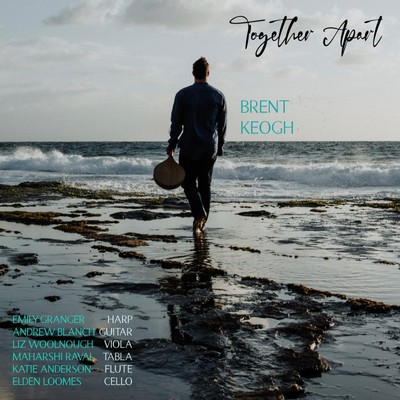
TOGETHER APART

Brent Keogh

Move Records MCD 643

I suppose that the most significant point of interest on this CD is the presence of the composer playing oud. Brent Keogh has been a student of Joseph Tawadros, who brought that Middle Eastern lute to our attention through his collaboration with the Grigoryan brothers and his several excursions alongside the Australian Chamber Orchestra. Keogh appears in all but the first four tracks of this recording, working in various ensembles with his guests. Still, it’s slim pickings as the disc comes in at a tad over 40 minutes’ playing time. Which makes this a sequence of eleven short pieces – four of them less than 3 minutes long, another four less than 4 minutes in length, one less than five minutes with one a little over that length, the longest piece lasting for 6’20”.

A further disconcerting factor is the minor research needed in trying to date the works performed. No information comes on the disc leaflet, and there’s nothing showing on the composer’s Australian Music Centre entry. When visiting Keogh’s own website, we learn that two major works here, the Hagia Sophia Suite (Emily Granger harp and Andrew Blanch guitar) and the Turimetta Suite (Katie Anderson flute, Elden Loomes cello, Maharshi Raval tabla, Keogh oud) were written in 2021. So was a brief piece for oud, viola (Elizabeth Woolnough) and tabla called Stormfront. I can’t find a composition date for The Red Candle oud solo; Rosie’s Dance for oud, cello, flute and tabla was co-written with Anderson some time before July 20, 2019 (you can see it performed on a YouTube video, although with a double bass substituting for cello). Alunir, the final track for oud and cello dates from 2020 (also found as a YouTube video but with Keogh playing oud and guitar!).

Much of this disc’s content consists of melodies that are simple and folk-inflected; you’re not hearing anything that is challenging here. Keogh sets his bar level pretty clearly in the opening Prelude to his suite on the great church-turned-mosque-turned-museum-turned mosque again. This section is for Granger’s harp alone and begins with a short motif that is minimally expanded before we hit a melody that could be Turkish, or anything. It also undergoes restatement and sits in a fixed tonality, a minor scale rather than a mode which is reinforced by the repetition of a bass note/anchor. One moment of harmonic deviation: that’s all. The atmosphere is firm, slow-stepping, ruminative rather than meditative.

The composer seems focused on giving us a hieratic setting, this musical vorspiel being in the nature of a call to prayer, I suppose. Blanch joins Granger for the following three movements, the first of which is a fast dance in which guitar and harp play a rather intricate melody line in unison to excellent effect. This is repeated in the movement’s last third/quarter while the central panel is taken over by an amplification/treatment of the harp’s opening motif. Does it bring the building to mind? Sort of, in an elegiac way and giving a good deal more picturesque an image than I remember finding in the interior some eight years ago.

In the next phase of this suite, the movement is slower, more measured and less rhythmically irregular. The guitar opens and the harp intrudes by reinforcing individual notes, but then enters fully into the partnership. You can find three melodies that are repeated with slight ornamentation and some differing antistrophes. As with the first movement, the bass note stays constant throughout (it’s the same across the three of them, I think). Unlike its predecessors, the third piece begins with a promising angularity in both instruments, but soon reverts to the minor scale/mode language that has prevailed so far. Keogh refers to major key sections radiating some relief in this not-too-sombre atmosphere: I counted one-and-a-half such breaks, and they didn’t stick around for long. The linear interplay is momentarily interesting but these pages struck me as meandering, somewhat laboured in the antiphonal moments, happier when the initial experimentation was done with.

In his three-movement opus celebrating Turimetta Beach, the composer offers musical reminiscences of three birds that he and his family encountered on their outings during the COVID epidemic’s early years. In the CD leaflet, these are identified as hawk, eagle and heron; on the Move Records website relating to this disc, they are kite, eagle and heron. As one who doesn’t know a hawk from a kite, but is determined to finish off a career spent in distinguishing a hawk from a handsaw, I found the first movement of this suite as simple as any bird. Keogh uses the flute for an initial phrase over a cello drone, even allowing the wind instrument a ‘bent’ note or six in its lyrical outpourings; the oud provides a simple Alberti bass imitation. We come to a halt and what Keogh calls the ‘alap’ is finished. He pairs flute and oud in unison on a catchy melody, eventually giving Loomes’ cello a go at it before suddenly moving everyone on to a more striking rhythmically varied thought and following that to the end of this amiable, breezy lyric refreshed by Raval’s gentle tabla patters

Keogh proposes that the second lot of matter in this movement suggests a chase; maybe, but it’s an orderly, single-minded pursuit that projects more of play than purpose. He uses a static melodic and harmonic vocabulary in which the modulations are as obvious as those in any popular music of these days. Things change when we deal with the eagle. Here, the rhythmic delineation is far more sharp as Keogh sets up a pattern of alternating time-signatures that would do his former master Tawadros proud. He allies the oud and cello in unison combination and puts the flute up as a respondent. The whole atmosphere has sort of moved from Turkey (and Australia) to India with some sustained sitar-like explosions of action in the cello, not made any less suggestive by the tabla support which promises Shankar or Ali Akbar Khan without delivering anything of those masters’ complexity.

The motion is rapid, almost headlong but the output stays disciplined, even through the last pages’ shifts in pairings. Once again, this suggestion of dynamism in flight gives the performers room for individual deftness, although the whole thing is too well-mannered to give us life in the wild, let alone on a Northern Sydney unpatrolled beach. When we get to the heron, we’re in minuet land with Anderson’s flute in control of the melody line and the oud remaining in a supporting role throughout. I found here that even the rather strait-laced creative energy in operation so far had become even less interesting as the instruments followed predictable patterns in nearly every compositional parameter.

Keogh’s disc leads into four isolated pieces via Stormfront which offers an initial theme in disjunct bars of 7/8 and 4/4 with oud and viola in unison while Raval offers slight cross-rhythms that really amount to doubling. The action is fast and repetitive, Keogh’s opening bars coming back again and again, but I find insufficient bite in the complex to give you a sense of approaching weather disruptions, although the composer might have hit on a way to outline musically what passes for a barometric drop in Sydney – not much ado about very little.

Four muffled chords begin The Red Candle, which moves to a melody that is restated several times with some interruptions from the opening chords, the whole conducted over a recurring pedal note which is either present or – in the best linguistic fashion – ‘understood’. The rhythmic pattern stays the same although the melodic direction alters about half-way through the piece, but we soon return to the opening chords (intervals, rather) and the initial melody. Finally, the melody and ostinato disappear and we’re left with another double restatement of the fulcrum chords. I’m not sure that this oud solo lives up to the composer’s intentions of the piece being symbolic of partly-revealed mysteries and a consolation that surpasses the pains of our existence. It’s simply a gently flowing cantilena which, for much of its length, maintains a single melodic strain set to a minor scale.

There’s a Gaelic side-trip in Rosie’s Dance: a mild jig in alternating 6/8 and 3/4 time – three of the former, one of the latter – which presents in ternary form, as do quite a few of Keogh’s products so far. Flute and oud play the melody line together for most of the time, the cello providing a gentle pulse-reinforcement while the tabla also stays with the prevailing rhythm for most of the short piece’s duration. Nobody gets up to any adventurousness, but that’s not this composer’s path. We are quietly entertained by a slight frippery, and that’s about all.

If any of these works is puzzling, it’s the last track. ‘Alunir means to land on the moon,’ writes Keogh who contextualises his work by a lengthy Einstein quote about humanity faced with the cosmos: we know something, but it’s nothing compared to the vastness of our incomprehension. Fair enough: we can all subscribe to that statement of affairs. Still, this piece speaks in a rather Earthy voice as it stays, for the most part, in a mode (Lydian, writes the composer) with a regular pulse, most noticeable when the oud and cello double each other. Some interludes emerge but the score ends with elaborations on and disjunctions of the modal melody, suggesting not so much the moon as cafe entertainment anywhere from Ankara to Alexandria.

Keogh is content to couch his thoughts in familiar guises, without any modernist trappings. He’s indebted to the Arabic world for the more exotic aspects of his output on this CD; you can also hear strains of this country’s folk music shining through. On the present showing, he seems content to occupy an unstressed emotional world, each work shaped with care and (for the most part) avoiding awkwardness. This is a placid voice, a gentle music that on this CD proffers an undemanding sequence of short-lived bonbons.

Clarity and calm

HAYDN REEDER SOLOS DUOS TRIOS

Move Records MCD 666

A retrospective for Haydn Reeder in some ways, this CD contains two trios – one in two parts scored for your classic piano trio; the other a single movement combining flutes, viola and harp – a pair of duos for flute and violin, then violin and cello, followed by a welter of solos, pretty much all for piano with a solitary exception for cello. One of the five keyboard solos comprises a set of six rapid studies, but the disc’s sixteen tracks are generally short: all the piano pieces come in at less than five minutes each, two of the studies not getting to sixty seconds. It’s not the slimmest collection I’ve come across on CD but at a little over 56 minutes, you’d be expecting fair quality.

Some of the performers are well-known, like cellist Rosanne Hunt, violinist Susan Pierotti, flautist Johanna Selleck, and pianist Danae Killian. Some have been local presences for several years, like violin Philip Nixon from Orchestra Victoria and violist Barbara Hornung whom I last heard three years ago on Johanna Selleck’s Becoming CD, also from Move Records. The Six Studies are entrusted to Elton Sun, winner of last year’s Young Lev Vlassenko Competition in Brisbane but information about him is hard to track down.; according to Reeder’s CD leaflet, he was 12 when recording these pieces.

As retrospectives go, this is a fairly wide-ranging one covering 25 years’ activity. The oldest of Reeder’s works we hear is the Tolling Bell Song piano solo of 1998; then skip forward eight years for the Two Pieces for Piano Trio. Sun’s readings of the studies come from 2014, while the Lines in a Landscape trio dates from 2016 and is the longest track here at 7’20”. Waxing and Waning, the violin/flute duet, was written in 2019 while everything else comes from 2021 (Rondo, piano solo), 2022 (Wheels Piece, another piano solo), or 2023 (Surrounding the Cello solo, and The Spinning and Weaving of Destiny for solo piano). Still, the first works by the composer I can trace come from 1970, so we’re hearing mature chamber music – well, middle-to-late period material.

Matters open with the two piano trio pieces. The first, Growth and Transformation, has it all in the title. It begins with piano notes which the strings take over; you’ve got to go somewhere from here. And Reeder does with increasingly more complex aphorisms, punctuated by lacunae, until we reach an instrumental interplay of pizzicato and staccato line-crossing. My only problem is that I’m not quick enough to realize what is being transformed, although the growth is apparent. This small sample of musical biology brings us Philip Nixon’s violin, Rosanne Hunt’s cello and Danae Killian’s piano, giving full voice to Reeder’s angular, atonal counterpoint.

The same artists work through Flowering of the Resonances, which opens with a series of thick chords from Killian in a sort of Donaueschingen vallee des cloches. The string instruments enter with a series of vehement brief attack-motifs and Reeder builds his piece around textures rather than any overt development I could find. Again, much of the progress is by short bursts of colour with plenty of room for tremolando and sforzando bolts from a clear sky. The results offer a series of instrumental colours, all three eventually weaving around each other softly near the end.

Selleck opens Lines in a Landscape on alto flute and ends the work on a concert instrument. The main interest here is her partnership with Hornung’s viola as their instrumental parts urge each other forward, in the early stages playing at least twice in unison. Mestrovic’s harp isn’t secondary in interest, her role coming into solitary prominence at specific points, but you couldn’t call her contribution linear. Reeder speaks of the songlines of our First Nations people and there is probably a case to be made for such an image in this music if only I could remember my Chatwin. As things stand, this trio is of a piece with its two predecessors in its calm abstraction, although the latter score is somehow more discursive, even if its setting is the horizonless Outback.

Naturally, the textural interplay is more easy to read in the Waxing and Waning duo, here performed by Selleck and Pierotti. The composer sets up his material very clearly and you can follow his intervallic and chordal workings without befuddlement, mainly because he varies the players’ attack and output with an eye for dynamic contrast, as well as living up to his title’s promise in outlining increases and decreases of activity through a transparent environment so that you are aware of every flutter and trill, no matter how faint. It’s yet another instance of Reeder’s ability to construct a scenario with simple means but maintaining your attention by not wearing out his welcome: being discreet in the best possible way.

Just as easy to comprehend is the following Wheels within Wheels for violin and cello. Pierotti and Hunt circle around each other but the movement only presents as regular in a sustained passage at the centre of the piece where the lines are simultaneous, if not congruent in their notation or direction. For most of the time, the wheels intersect but break off, the patterns momentarily circular but more suggestive of plot-lines rather than anything mechanical. It’s suggestive of a consciousness you have of parts of a complex becoming visible, then being shut off, or replaced by something similar but somehow askew. The effect is slightly unsettling but also refreshing in its open-endedness.

What follows these ensemble pieces is a chain of six solos, mainly for piano. Killian opens the sequence with the CD’s earliest piece, Tolling Bell Song, which is something of a single-minded construct comprising sustained initial sounds with arpeggio-like companion-notes radiating off from the initial stroke. Reeder offers rhythmic differentiation by alternating 2/4 bars with irregular semiquaver ‘fillers’ in 10/16 measures, for example, although even these have their initial bell-type strikes. Yet again, you’re reminded of Ravel, if in a vocabulary that is fifty years further along the historical track.

Sun’s readings of the studies are quietly competent. None of the six is particularly demonstrative or confrontational, all being interrupted, to a greater or lesser extent, by fermate or pauses in the action. As with the duos, Reeder presents his material at the outset and moves gradually (sometimes imperceptibly) into a sort of development, which could be a simple process of adding notes to a melody strand, as in No. 1, or swerving to an opposing piece of materiel, e.g. No. 4. These bagatelles are distinct in character and, to his credit, Reeder speaks in his own voice throughout, not really bringing to mind any significant precedents. And he has found a sympathetic interpreter in this young pianist who outlines each study with composed authority.

Killian opens Wheels Piece with another of the composer’s single-line patterns of five notes that rises, then falls back on itself before another line joins and we enter a now-familiar field of two-line counterpoint with caesurae. The rhythmic movement becomes more insistent and we return to the environs of the Tolling Bell Song with single resonant notes sustained while secondary arpeggio patterns radiate out from them. Then we return to the rising pattern from the opening which is now both assertive and shadowy before the rotation stops in a finishing upward flourish – the wheels have come off?

With The Weaving and Spinning of Destiny, Killian takes us immediately into Meine Ruh’ ist hin territory with a repeated simultaneous arpeggio-type pattern in both hands which moves into some by-now-familiar Reeder vocabulary with sudden stops and repetitions-with-accretions, the complex leading to abrupt bumps, both fortissimo and pianissimo, spiced by some repeated note ostinati. Some bass chords are splayed out until they are reduced to their single top note which is repeated, fading into an inaudible space. This may be the composer’s outline of a personal destiny, or it could be applied to us all but I find philosophy’s big subjects impossible to get a handle on; I’d be lost in Also sprach Zarathustra if it weren’t for Strauss’s signposts and the only dissertation/dialogue of some elevation that means much to me is Bernstein’s party-piece Serenade.

Rosanne Hunt gives a spirited performance of the solo Surrounding the Cello which contrasts a downward-moving initial motif with a set of aggressive double-stop intervals that can move in either direction. Reeder sets some technical hurdles here including (I think) sul tasto work and a moment or two or sul ponticello, your odd scrape and harmonic (I assume intentional). Nothing too outrageous, though, and all carefully compartmentalized thanks to the composer’s insertion of aural station-stops. It strikes me that it’s not so much a question of surrounding the cello but more seeing what it can do – a sort of a propos the cello.

Finally, Killian returns with Rondo, which I found the most difficult of the pieces to imbibe. It begins with shades – as the composer informs us – of Berg (the Piano Sonata opening?) and Schoenberg (Op. 11?), but moves out into more diffuse areas which pile up on top of each other. About a third of the way in, the tonality seems more ‘white-note’ than anything else in a stentorian declamation before we hear bass chords-plus-melody under high-tessitura decorative chord-sparks. The bass/middle register texture remains present for some time before a sudden burst of double-handed furioso which itself shifts into pointillistic staccato in both hands that brings the piece to an enigmatic, Scarbo-like open end.

You could call Reeder a middle voice in the development of Australian music, I feel, because he is not of the melody-rules-and-the-more-diatonic-the-better sept, nor is he part of the look-at-me-and-my-daring tribe. His language is calm, controlled and belongs to those logical, clear-headed and emotionally controlled ranks that work at composition with an awareness of responsibility to communicate with an informed band of listeners. I’m welcoming this CD as disseminating the work of a gifted contemporary writer who speaks to us with remarkable clarity.

Old and easy

MOZART’S CLARINET

Muisca Viva Australia

Elisabeth Murdoch Hall, Melbourne Recital Centre

Tuesday July 22, 2025

(L to R) Nicola Boud, Simon Cobcroft, Erin Helyard

We certainly heard the clarinet sound that Mozart would have been familiar with, although I was slightly disappointed that the more interesting of the two instruments that Nicola Boud wielded – a basset horn – appeared in only one piece: an arrangement of Beethoven’s Horn Sonata Op. 17, written in 1800 and endorsed by the composer in its transcribed version by Joseph Friedlowsky in about 1801. The other Beethoven works for clarinet that we heard saw Boud using a five-key clarinet for the Aria con variazioni of about 1792 which is the last of the Three Duos WoO 27 originally written for clarinet and bassoon but here employing Simon Cobcroft‘s cello for the bass part; and later for the Gassenhauer Piano Trio in B flat which was written in 1797 for tonight’s combination (at last) of clarinet, cello and fortepiano/pianoforte.

Mozart himself fared somewhat less well, being represented by two works. With limited resources, these musicians performed the Kegelstatt Trio in E flat which really calls for clarinet, keyboard and a viola, not a cello, but which proved mildly entertaining as we watched Hobcroft spend lots of time on his two top strings. And that was it, as far as Mozart’s clarinet went because the second work gave Erin Helyard a fortepiano solo in the C Major Sonata K. 545, greeted at its opening bars by a sigh of approval soughing through the Murdoch hall.

In fact, Helyard took the occasion to proffer a slightly different take on this classic. He played through the opening Allegro‘s exposition straight, then decorated the repeat with a smorgasbord of introduced interventions and ornaments. Much the same happened when he repeated the movement’s second part. And on it went through the chaste Andante but, as far as I remember, the concluding Rondo was performed without much elaboration, if any. A bit flamboyant, perhaps, this version but understandable as the sonata was conceived as a beginner’s piece and the temptation to dress up a too-familiar outfit would prove irresistible.

So, a lot of Beethoven’s clarinet in this Musica Viva recital and only one Mozart – and even that was a work that’s familiar to most chamber music lovers. Still, we heard some of the evening’s most convincing playing in the Kegelstatt‘s middle Menuetto, particularly at the start of the Trio’s second half with a finely balanced unison partnership between Boud and Cobcroft. All the same, the cello encountered several moments of dubious intonation – an odd note or two cropping up, admittedly infrequently, in both the outer Andante and Rondeaux that surprised more than a little as Cobcroft was playing the only non-archaic instrument onstage (even if the clarinet and fortepiano were modern copies).

But the point of the exercise was to show the difference between the clarinet timbre that Mozart would have known and the polished product that we have come to expect from the modern instrument when it outlines this particular score. And the results were? Well, not much, as far as I could tell. Boud might have more difficulty in producing the notes because of the lack of flexibility on the Lotz clarinet copy that she was manipulating but you couldn’t really fault the fluency or truth of her articulation which came across with excellent fidelity. Yes, you might have pointed to a couple of awkward moments in phrasing but these were so slight that they barely flickered on the surface of her line.

With the revamped horn sonata, it was hard to understand why Boud and Helyard bothered to repeat the 76-bar exposition to the opening Allegro as the content is bland as far as the horn/clarinet part goes and the only frisson comes in the keyboard alternating semiquaver chords across bars 56 to 61. Against that, we got to enjoy the startling bass notes of Boud’s basset horn. Furthermore, the players compensated for Beethoven’s very short Poco adagio with a vital, breezy account of the final Rondo with a very satisfying partnership in phrase mirroring and a dynamic balance that would have been harder to carry off with the natural brass instrument.

Cobcroft joined Helyard for the Ein Madchen oder Weibchen Variations of 1796: an easily imbibed set of twelve non-complex elaborations on Papageno’s Act 2 wish-fulfilment aria from Act 2 of The Magic Flute. I had more trouble with the cellist’s pitching here than anywhere else on the program, particularly an unhappy start to Variation 2 during which the clefs are reversed, the string playing treble and the keyboard bass in both hands. The outcome seemed momentarily unsure which surprised because the tessitura isn’t that high, only reaching G atop the staff.

Better followed, mainly near the end of these rapidly accomplished variants when we hit the two minore ones, the adagio/poco adagio Nos. 10 and 11 in F minor, particularly the former where the cello emerges only after the first half to take up an entertaining tit-for-tat with the keyboard. But even the penultimate variation has its own charm with a broad string melody set against complaining keyboard triplets that gave way to a brief cadenza for Helyard.

Not much to report about the Aria con variazioni. Beethoven only wrote four diversions on his air, with a rapid 31-bar Allegro in 6/8 as a coda. I found it hard to make sense of the repeats; in my score, every half is given again but it seemed that we only heard one half of each variation being recycled. Not that it mattered over much as the work itself is amiable but slight, with a pretty fair sharing of the labour and exposure between the instruments – perhaps a slight leaning towards the upper line. How about Cobcroft’s cello as a substitute for the bassoon? Well, of course it altered the interplay of colours but there’s not much point going all precious over an all-purpose workmanlike score like this one.

With the program’s concluding Gassenhauer, the trio worked together to better effect than in the preceding Mozart trio. We heard a repeat of the 105-bar exposition which I find is more often omitted, but was welcome here because it gave Boud the occasion to generate a few finely woven strands right from her first solo exposure in bar 12, and later in the movement between bars 184 and 192. Still, most of the clarinet’s work is in tandem with the cello and these musicians sounded comfortably balanced.

The Adagio holds some eloquently interwoven moments for cello and clarinet but I think the keyboard part dominates, not least because it is remarkably active. From bar 26 to bar 53 – the core of the movement – the piano is prominent with melodic content or rapid-fire accompaniment – well, rapid-fire compared to its competition. Here, Cobcroft shone with a clear penetration from his opening statement of the main E flat melody and in his mirror-imaging of Boud, e.g. bars 50 to 52.

The finale’s variations on Weigl’s popular tune came across with loads of drive and clear enjoyment, as in the piano solo Variation 1 and its pendant for clarinet and cello. And it was a pleasure to come across the vigorous return to ensemble status in Variation 3 in bar 61. Boud’s clarinet enjoyed a few exposed moments, as in the response to Cobcroft across bars 132 and 126, but it’s almost as if the composer remembered his wind line in the last variation and gave it a broad canon with the cello, even if everything stops for a sudden keyboard cadenza before the 6/8 syncopated romp home.

An enjoyable recital, in the end, made so by Boud’s liquid sound which disguised with high skill the problems of working through this music on a limited instrument. Across each of her four contributions to the exercise, you heard no irregularities in rhythm or squawks to interrupt the smooth amplitude of her delivery She didn’t elaborate on the difficulties in fabricating an even sound delivery from her two instruments which might have made us more aware of her labour of love in promulgating the older clarinet. But I suspect that most if us were happy to just bask in the warmth of this entertaining, non-aggressive music-making.

Diary August 2025

THE POETRY OF WAR

Melbourne Symphony Orchestra

Iwaki Auditorium, Southbank

Sunday August 3 at 11 am

Here’s another element of the Melbourne Symphony Orchestra‘s Chamber series, in this case combining music and poetry in a program curated by violinist Monica Curro. Of course, the subject/theme won’t be hard to flesh out, and the printed material on the MSO website refers to music by Debussy, Britten and Webern. And that’s not an ‘of course’ matter at all. No worries with Britten who has some war material to his name, even if we’re not being treated to snippets from the Requiem. Debussy’s a bit harder to pin down; you might take one of the three instrumental sonatas as being ‘ of the time’ rather than having any military connotations. Mind you, the same could be said of the Berceuse heroique (a piano solo) or En blanc et noir (probably not on this program as it calls for two pianos). As for Webern, I’ve no idea; the Cantata No. 2 was written during World War II but I doubt if anyone’s taking that on, particularly if you take into account the musical forces that Curro has gathered. They involve herself and Kirstin Kenny on violin, Gabrielle Halloran viola, Michelle Wood cello, Shane Hooton trumpet, Andrew Macleod flute, and Elyane Laussade piano. As for the poetry, that comes from actor Dennis Coard whose contribution is non-specific except that it’s coming from the 20th century. Here’s hoping we get a bit of French and German texts to go along with the Owen and Sassoon. A standard ticket costs $55, concessions go for $50, and kids get in for $20; you have to fork out $7 as a transaction fee, or for having the cheek to place an order.

ATMOSPHERE 3

Corpus Medicorum

Elisabeth Murdoch Hall, Melbourne Recital Centre

Sunday August 3 at 5 pm

Turn it into Latin and immediately the thing takes on gravitas. I don’t know when the Doctors’ Orchestra turned itself into the Corpus Medicorum, but here we are. The group of combined medicals – doctors, students, health professionals – will be directed in this concert by the estimable Fabian Russell; actually, Russell has conducted/is conducting all the Corpus’ events across the year. This evening, the group is going all-French in an ambitious set of forays that opens with Debussy’s La mer, that taxing set of three symphonic sketches from 1905. Violin soloist Natsuko Yoshimoto, currently concertmaster of the Queensland Symphony Orchestra, then fronts Chausson’s Poeme of 1896, the composer’s best-known work and a professional’s staple. She follows this with Ravel’s flashy Tzigane from 1924 – as boisterous a musical joke as the Bolero from four years later. The entertainment ends with more Ravel in La valse, that nightmare vision of 19th century Vienna written in 1920 and apparently having nothing to do with World War I. It asks for a big orchestra and is difficult, even for gnarled old-timers, to carry off persuasively. A standard entry is $65; concession card holders and students both are being charged $30, and ‘Booking fees may apply’, according to the publicity – I think you can count on it.

CIRCA & THE ART OF GUGUE

Australian Brandenburg Orchestra

Elisabeth Murdoch Hall, Melbourne Recital Centre

Thursday August 7 at 7 pm

Is this going to work? We’ve seen previous marriages between the Queensland-based circus company and Paul Dyer‘s Australian Brandenburg Orchestra in the past. I recall hearing/seeing French Baroque and Spanish catch-all programs in the latter years of the past decade. The Italian Baroque collaboration of 2022 didn’t travel live outside of Sydney, but now both organizations have put aside national colour and opted for a massive torso in Bach’s one theme-based collection of 14 fugues and 4 canons. This compendium lasts as long as the performers decide, it seems; one performance barely lasts 50 minutes, several more close to 90 and one I’ve come across goes for over two hours. Most musicologists agree that the work was probably written for – and is best served on – a harpsichord but I have little doubt that the Brandenburgers will not be consigned to the back-blocks by their artistic director’s instrument alone. Of even more moment is the question of the Circa acrobats’ choreography which will need to be of a sharp order to come into line with the matchless skill of Bach’s contrapuntal marvels. Still, the few occasions I’ve seen this collaboration in action, the music has to fight hard to attract any attention from the Circa corps’ brilliant aerodynamics. I don’t understand the ticketing process. A standard costs between $30 and $196; full-time students pay a flat $20; Under 40s pay $40; concession card holders pay between $59 and $109. These prices vary between performances and booking fees apply if you get your seat(s) online or by phone. You’d want to get good Bach for your buck.

This program will be repeated on Saturday August 9 at 7 pm and on Sunday August 10 at 5 pm.

TCHAIKOVSKY’S VIOLIN CONCERTO

Melbourne Symphony Orchestra

Hamer Hall, Arts Centre Melbourne

Thursday August 7 at 7:30 pm

Oh well, it had to happen: a rather orthodox program, even if it holds one surprise. Clearly, the evening’s focus falls on the great concerto of 1878, the most exhilarating of them all, thanks to the composer’s inimitable capacity for drama and colour. As soloist, the Melbourne Symphony Orchestra is initiating Dutch musician Simone Lamsma who has proved highly successful in North America and Europe. I believe she has played with the Sydney Symphony Orchestra but, like so many of her ilk, has not made it to anywhere more southern – until now. The concert’s conductor, Korean-born Shiyeon Sung, has been principal guest conductor of the Auckland Philharmonia and has worked with the Queensland Symphony Orchestra. Her big task is finding even more reserves of warmth in the benign Brahms Symphony No. 2 in D: the happiest of the composer’s four and blessed with a welcome underpinning gleam across its length. It’s also almost an exact contemporary of the night’s concerto, being written in 1877. But up-to-the-moment joy comes in a premiere from Greek-Australian writer Klearhos Murphy, the MSO’s Cybec Young Composer in Residence; his The Ascent, commissioned by the orchestra, is to be revealed – a triptych of (not too exhaustive, one hopes) meditations on the teachings of St. Nikitas Stethatos and that holy man’s proposals for a successful spiritual life. Normal rickets range from $75 to $139; concession holders are charged $5 less (big deal); if you’re under 18, the charge is $20., But everybody has to stump up $7 transaction fee per order; one day we’ll find out where that money goes.

This program will be repeated on Saturday August 9 at 7:30 pm

DANIELLE DE NIESE

Australian Contemporary Opera Company

Elisabeth Murdoch Hall, Melbourne Recital Centre

Friday August 8 at 7:30 pm

A singer with a large profile, Danielle de Niese is going to work through a wide-ranging program that stretches from Marcello and Handel to Weill and Gershwin with not much in the middle. I’ve not heard her (I think) so have no comment about her talent but she has an excellent group of well-known musicians supporting her: violins Curt Thompson and Sophie Rowell, viola Lisa Grosman, cello Richard Narroway, oboe Rachel Curkpatrick, harp Marshall McGuire, piano Coady Green. As well, she is being assisted by a vocal septet from the Australian Contemporary Opera Company: Sophie Bissett, Uma Dobia, Saskia Mascitti, Callum Warrender, William Grant, James Billson and Daniel Felton. The recital’s first half is specific with definite numbers and arias from Jimmy Lopez, Kurt Weill, James Macmillan, Christopher Tin and Patrick Cassidy, as well as the afore-mentioned Marcello and Handel numbers. After interval, it’s just names – Dan Bryer, Mike Needle and Tom Grennan, Kenneth Macmillan (really? The choreographer??), John Denver, Jerome Kern as well as Gershwin. In other words, you’re getting a potpourri of songs that I suppose de Niese likes to present. If you’re attracted, a standard ticket comes in between $75 and $149; concessionaires get in for $10 or $20 less, depending on where you sit; students can get mediocre seating for $35, and Under 40s get the same for $40. In this case, the transaction fee is a moveable feast, somewhere between $4 and $8.50; no idea how they apply this although I suspect the more affluent get stung most.

GERSHWIN & SHOSTAKOVICH

Australian Chamber Orchestra

Hamer Hall, Arts Centre Melbourne

Sunday August 10 at 2:30 pm

My favourite Ukrainian-born Australian pianist Alexander Gavrylyuk is appearing for the first time with the Australian Chamber Orchestra; it’s taken a while for the organization to perceive those talents that, to many of us, have been obvious for years. Still, here he is at last, front man for Gershwin’s Rhapsody in Blue (written in 1924 and here arranged for strings and solitary trumpet backing, God knows how) and the 1933 Piano Concerto No. 1 by Shostakovich for which the ACO and David Elton comprise the proper environment. We also will hear the Chamber Symphony arranged for string orchestra in 1967 by Rudolf Barshai from Shostakovich’s String Quartet No. 8, a work we’ve heard from the ACO on previous tours and which was released on a CD by the current players (you’d think) in February of this year. The event starts with Claude Vivier’s taxing Zipangu, the Canadian composer’s 1980 vision of Old Japan, with the help of some other Asian countries. As well, the ACO presents a newly commissioned work: A Moment of Memory by senior Ukrainian writer Valentin Silvestrov, who fled from Kyiv three years ago to find refuge in Germany after the Russian invasion. This is a remembrance for the victims of fascism and oppression, although it sits somewhat oddly beside Gershwin’s buoyant tour de force. Tickets range from $30 to $167 for full adult cost – now there’s a spectrum of choice for you. Pensioners and Healthcare cardholders get a lower rate (but not much), as do students and those under 35 (why them?).

This program will be repeated on Monday August 11 at 7:30 pm

MUSICAL FRIENDS

Flinders Quartet

Primrose Potter Salon, Melbourne Recital Centre

Tuesday August 12 at 7 pm

This ensemble has kept its shape for a while now – violins Elizabeth Sellars and Wilma Smith, viola Helen Ireland, cello Zoe Knighton. This particular program offers several surprises and two staples of the repertoire that you now hear all too rarely. Of more than usual interest is the presence of two commissions. The first is by Natalie Nicolas, a Sydney writer and a favourite of the Flinders Quartet. This is By the Tide of the Moon and celebrates Aida Tuciute, a former Lithuanian Olympic swimmer who has an affinity with the ocean. As for the second, it’s a joint work by Melody Eotvos from the University of Melbourne and Rishin Singh – Malaysian-born, formerly resident in Sydney, now living in Berlin. Called The Letter Writing Project, this is a joint composition where the composers constructed this work turn and turn-about by sending each other completed portions. In between and following these fresh compositions, we hear Mozart’s Adagio and Fugue in C minor from the ominous (for Mozart, as well as for our First Peoples) year of 1788. And the Flinders end with Borodin in D Major, his second string quartet of 1881 which proved such a fruitful source for Robert Wright and George Frost when they were assembling the score for their 1953 musical Kismet. Tickets are a very reasonable $53 full adult, and $42 for concession card holders and students; never forgetting that oddly varied transaction fee between $4 and $8.50 if you phone or email your request for tickets. Is that range in operation because of a client’s suburb? Bank? Credit rating?

TAKACS QUARTET WITH ANGIE MILLIKEN

Musica Viva Australia

Elisabeth Murdoch Hall, Melbourne Recital Centre

Wednesday August 13 at 7 pm

One of the world’s great string quartets returns under the Musica Viva banner to perform Haydn, Beethoven and a once-local composer’s work commissioned by the organization. This last is Cathy Milliken, born in Brisbane and now based in Berlin. Her new Sonnet in Emigration is a setting of Brecht (probably not the On the Term Emigrants poem of 1937; more likely Sonett in der Emigration of 1941 commemorating when the poor fellow and his family wound up in America). As I understand it, the interpreter of this, with the Takacs Quartet, will be Australian actress Angie Milliken – could be a sister, or a cousin, or completely unrelated. Anyway, before this comes Haydn’s Op. 74 No 3 in G minor, called for no good reason ‘The Rider’, and one of the least performed of the set written for Count Apponyi in 1793. The Takacs recorded this work in 2011 but with different players (now retired) on the two inner voices. The group ends with Beethoven’s Razumovsky No. 3 in C of 1808: the only one of the three which doesn’t have an identifiable Russian tune in its melodic content. But it is a powerful exercise in stamina for any executants, not least for its rapid fugue-finale. Standard tickets range from $65 to $153; concession holders and students pay the same – between $56 and $135. Under 40s get in for $49 and there are special rates for groups of ten-plus. Never forgetting that you have to deal with the swinging-freely transaction fee of anything between $4 and $8.50 if you try to get your tickets any old how except in person at the door.

ELEVATOR MUSIC

Omega Ensemble

Elisabeth Murdoch Hall, Melbourne Recital Centre

Saturday August 16 at 7 pm

Only three works in this program that runs for ninety minutes without interval; shades of a Mahler symphony or two. No need for an interval? No convenient spacing? The Sydney-based Omega Ensemble begins with British composer Anna Clyne‘s Stride of 2020 for string orchestra, premiered in that year by the Australian Chamber Orchestra in Wollongong. It presents as a three-part essay in fusing Beethoven’s Pathetique Sonata with contemporary sound, basing her exploration on the ‘striding’ octaves in the Beethoven work’s first movement left hand (at the start of the Allegro di molto). I suppose the Omegas can rustle up enough strings to deal with this piece, even if it’s hard to tell who will actually be playing on the night. The night’s principal guest is the UK clarinettist Michael Collins who I assume will take the centre spot in Copland’s Clarinet Concerto of 1947/8 which calls for strings, harp and piano. Both these works come in together at less than thirty minutes. Which puts huge emphasis on the last element of this program: a new double clarinet concerto by Graeme Koehne, commissioned by the Omegas and featuring Collins and David Rowden, the group’s artistic director. Will this last an hour? Or will patrons get to enjoy verbal explications of some length? I suppose the night’s title is some sort of tribute to Koehne as he wrote a piece with that title in 1997. Standard tickets range from $49 to $119; concession tickets are $10 cheaper in all categories but the top Premium bracket, which isn’t available; Under 30s get in for $39 in all areas except Premium. I won’t go into the season package deals but wherever you go and whatever you select, you’ll be faced with that transaction fee swinging like an arbitrary pendulum between $4 and $8.50.

MUSETTE

Melbourne Chamber Orchestra

Elisabeth Murdoch Hall, Melbourne Recital Centre

Thursday August 21 at 7:30 pm

In this concert, we enjoy the pleasure of hearing once again cellist Li-Wei Qin who is giving a run-through to a work most of us will have heard from him in his previous appearances here: Haydn’s C Major Concerto No. 1 from somewhere between 1761 and 1765. It’s a jewel among Classic era concertos for its melodic felicity and good-humoured vigour, especially in a lightning-fast finale, Moreover, this player is a dab hand at its sweeps and swerves. He’s also playing Jean Francaix’s 1950 Variations de concert – ten in all, with a short interlude before the last one; a nice match for the Haydn in light-filled bonhomie. Sophie Rowell and the Melbourne Chamber Orchestra begin operations with a work written for the artistic director herself during her time with the Australian String Quartet: Elena Kats-Chernin‘s From Anna Magdalena’s Notebook. Written in 2007, the composer uses two polonaises, two menuets, an aria and a musette from the 1725 collection. To end, the MCO plays Boccherini’s Symphony No 4, named La casa del diavolo. Written in 1771, the work is in three movements, both first and third having the same opening (economical old Luigi). It calls for a flute, and pairs of oboes, bassoons, and horns; but then, the Haydn concerto asks for pairs of oboes and horns, which may stretch the organization’s budget. Ticket prices are of the usual complexity: standard adult ones range from $72 to $144; concession and senior card holders pay between $52 and $129; Under 40s can get mediocre tickets for $40; children and students are admitted for $20; groups of 10+ pay less than the standard price on a sliding scale where the deduction decreases in proportion to your seat price. And you have that $4 to $8.50 variable transaction fee that probably operates on a Boolean intersection grid.

This program will be repeated on Sunday August 24 at 2:30 pm.