Encores galore

THE TIME TRAVELLER AND HIS MUSE

James Brawn

MSR Classics MS 1502

Brawn.jpg

This is a double CD which contains a plethora of pieces that, over my time listening to recitals, many pianists have used as encores.   Brawn travels across time indeed – starting with Scarlatti and Bach, then finishing up with Prokofiev and Gershwin.   He follows a scrupulous chronology, ensuring that Chopin (born 1810) comes before Liszt (1811), and keeps Scriabin ahead of Rachmaninoff, the mystic born a year earlier than the great pianist-expatriate.

There are a few carry-overs from Brawn’s first In Recital (MS 1501) volume; he has different interpretations of the first Prelude from Bach’s Well-Tempered Clavier, the third of Liszt’s Consolations, and the Prelude in B minor from the Op. 32 set by Rachmaninov.   As grounding comparisons, he accompanies the Bach re-examination with four other preludes from the same Book 1, and fits the re-cycled Rachmaninov inside a context of four disparate preludes.   A pity that the Liszt remains alone here, especially when Brawn showed his talent with this composer by way of an expert Mephisto Waltz No. 1 in the previous album.

The time difference is not too important in the Bach interpretations: the earlier 1:58, the later one 1:49.   It’s a bit more telling with Brawn’s B minor Rachmaninov where 5:57 changes to a racier 5:03.   And the Consolation moves from 5:24 to 4:11   –  a substantial change of approach; well, a more purposeful performance, you could say.

Disc 1 opens with two well-known Scarlatti sonatas: the E Major K. 380, and C Major K. 159.  The first enjoys a crisp airing with a fair swag of detached notes in the right-hand scale passages and the trills and ornaments are neatly inserted, the pianist saving his powder for the B Major climax in the second half.   Much the same applies to La caccia where the dynamics are more engaging than on many another disc: not just through juxtapositions of piano and forte, but a clever gradation across the central segments of each half  –  impressive in illuminating this simple-speaking bagatelle.

After the C Major Bach prelude, Brawn offers the C minor, D Major, E flat minor and E Major ones; fine, although I would have been more satisfied if a few fugues had been added.   Nevertheless, the D Major piece is articulated with precision and, as with its predecessor, projects a gentle flamboyance in the final bars where the motor-rhythm stops for a mini-cadenza flourish or two.   Brawn  makes no attempt at emotional dryness with the sarabande-like E flat work, using his instrument to give the two pages a romantic sensibility but without sustaining-pedal washes.  Still, the finest in this set comes at the end with an urbane rendering of the E Major invention, given with grace and a non-insistent metrical regularity; here, most of all, you would have welcomed the complementary fugue as a sprightly consequent to this prelude’s amiable gentility.

Mozart is dispatched with the Rondo alla turca and the D minor Fantasia.   Even with the first work’s over-familiar pages, Brawn maintains an interestingly light texture, especially when the janissaries are in full A Major flight.   Also particularly worthy of note are his left-hand arpeggios: brisk, not over-loud, appropriately suggestive of elegantly civilized drum fusillades.   He keeps the longer work measured, infusing the opening Andante with a muted emotional detachment which obtains even in the piece’s three cadenza bars where the approach is deliberate, eschewing the temptation to turn their swooping scales into leaps of legerdemain.   The result of this approach is to push the dramatic balance to the score’s front, the D Major Allegretto properly a relief of tension but something of an addendum.

Beethoven’s Fur Elise Bagatelle makes a fair space-filler, but the stretto from bar 61 to about bar 83 showed a nicely contrived mini-climax in what remains a sweet but insubstantial set of pages that lives up to its descriptor.   Schubert’s F minor Moment musical, the jog-trot No. 3, raises no eyebrows, nor does the G flat Impromptu, even if you could quibble with a few leaning-post moments where the regular sextuplet/triplet underlying figure is slackened – you understand why, but not necessarily the places where this rubato is brought into play.

Brawn presents seven Chopin pieces: three preludes and four etudes.  The E minor Prelude from Op. 28 makes a soulful introduction to Brawn’s approach to this supreme piano composer; the left hand is allowed to speak distinctly, where other interpreters muffle its repeated chords.   The sweep of the final Op. 25 Etude was well-maintained, this reading favouring the first accent of every tempestuous bar, which is probably wiser than treating its progress as 2/4 rather than 4/4.   With the E Major No. 3 from the Op. 10 Etudes, Brawn relished the fierce central pages where the mood changes from nocturnal to the heft and plosiveness of a polonaise; again, some over-sensitive pauses/hesitations emerged in the main theme’s reprise.

A shapely version of the Op. 25 A flat Aeolian Harp Etude accounts very well for yet another encore standard, capped by an attractive concluding four bars of arpeggios that actually make you think the work’s nickname might be appropriate.   Brawn ends his first disc with the Black Key G flat Major from Op. 10; it’s very vigorous, handles the right-hand trickiness with plenty of brio and only a few notes fail to carry.   Some chords in the bass are pretty emphatic at several points but the interpretation succeeds for its appealing bounce and well-judged tightening and loosening of the initial rhythmic juggernaut, sprightly though it is.

Disc 2 opens with the Op. 28 Raindrop Prelude in D flat, one of the lengthier pieces among the 24 in Chopin’s publication and very well-known in its own right.   Brawn does the right thing by sticking with his opening tempo into the central C sharp minor segment and doesn’t over-egg the two high-points in G sharp.   Concluding this bracket is a real rarity, both in actual programs and as encore fodder: the Op. 45 Prelude in C sharp minor.  Here is a persuasive account of a harmonic tongue-twister that the performer welds into a coherent whole without a trace of unnecessary theatrics or manipulation; indeed, this version is spartan in its lack of introduced ornament or colour-adding arpeggiations.

The Liszt Consolation No. 3 follows, the left hand susurrus generally more rapid than in the previous recording and with less time allowed for labouring over the melody.   Is the quickened pace an improvement?   Maybe.   But if anything sums up the sort of thing a fagged-out concerto soloist would like to treat adoring fans to as a goodnight gesture, this is it.   Of the Brahms Op. 39 Waltzes, we hear the penultimate and popular-favourite one in A flat Major; not too slow and not too light, especially when the triplets start in the reprise.   A more moving depth comes in the composer’s A Major Intermezzo from the Op. 118 Klavierstucke where Brawn spares us any muddy thickness, relying on the piece’s inbuilt phrasing, simply following where the composer leads, which is both honest and refreshing.

Grieg’s 23-bar-long Arietta that introduces the Lyric Pieces Op. 12 raises few ripples, apart from its cadential disruption of the composer’s habitual two-bar sequences/patterns.   Scriabin’s C sharp minor Etude is an AMEB staple, a fusion of Chopin and Rachmaninov, capping off a sequence of seven tracks that are a collective corner of temperamental reserve in this album.   Speaking of Rachmaninov, Brawn begins his tour with the famous C sharp minor Op. 3 Prelude, the one that composer wound up loathing.   Matters are fine up to the Agitato which Brawn takes fast to begin with and ups the ante so that the section loses balance  –  no, evenness  –  between the hands.

The G sharp minor Prelude, penultimate in the Op. 32, works much better through a dexterous recovery rate and a pliancy of metre.   The B minor No. 10 from that same set is exceptionally well accomplished, packed with telling details like  the three bars leading into the L’istesso tempo pages – a model of taut deceleration in atmosphere – and the gentle delivery of chords in the final twelve gloomy bars.   Listen to the restatement of the main theme in the following Op. 23 D Major where the action is in the alto line for a sample of digital skill and reliability; or the change in intensity at the move back to the major in the Op. 32 G Major’s last a tempo marking – simple yet striking, even in a moment of harmonic relief.

To finish, Brawn plays Prokofiev and Gershwin.   The Russian composer’s Toccata makes a striking encore but it’s exhausting; not that this puts off some players who can’t get enough of performing time.   This reading has a heart-in-mouth climax, the three bars of right hand octaves thrilling to hear; still, I would have liked the motor rhythm sustained without a break until the rallentando marking is reached.   I Got Rhythm in transcription (by Gershwin? Suppose so) is a 90-second flourish which raises the spectre of both the composer and Oscar Levant with its clever harmonic shifts and progressions.

You get a lot for your money in this demonstration of the keyboard’s historical progression; some fine interpretations are peppered throughout both discs.  Of course, you might carp (as I have) about some of Brawn’s readings but even the questionable tracks are some steps above the everyday that you hear regularly.  It’s an enterprising and entertaining trip that this gifted pianist takes you on and, if you meet a fair few familiar faces along the way, so much the better for the encounter’s informed nature.

Man of the moment

PIANO INSIDE OUT

Zubin Kanga

Move Record MD 3391

kanga

A little under a month from now, another Australian pianist based in London, Zubin Kanga, will be taking part in the ludicrously small amount of serious music offered at the Melbourne Festival with Cage’s Sonatas and Interludes and a Cyborg Pianist program that sounds – from the little information available – like a mutation into something even newer and stranger than the kind of music to be heard on this adventurous CD.    Kanga plays seven works, most of them by names that don’t register with me.  One that does is Elliott Gyger, Senior Lecturer in  Composition at the University of Melbourne.   Sydney composer Nicholas Vines rings some bells, if faint ones, in my memory; Daniel Rojas, David Young, Marcus Whale and Anthony Moles are simply names; Rosalind Page I’ve heard of but none of her music.  So this recording came as a voyage into the unknown, for the most part.

In fact, this set of works is as close to up-to-the-moment as you could expect, yet another indication of the Move label’s commitment to Australian art and to contemporary music-making in particular.   The pieces by Gyger, Vines and Rojas all date from 2011, the remainder of the content from the following year.   Despite their near-contemporaneity of production, each work is couched in an individual voice.

Gyger’s  .  .  .  out of obscurity, written for Kanga, begins both on the keyboard and in the piano, bringing into force a kind of balance between normal sound production and string-plucking, with some passages of hand-muting for variety.   The piece is both hectic in a well-ordered fashion and yet non-aggressive in atmosphere, unrelievedly active for the performer who is on the move without a pause, the complexity heightened by a liberal use of trills .  In fact, there is one stretch around the 4-minute point where I can’t see how Kanga achieves physically what he does with a vigorous right-hand and stopped plucked notes in the left.   Then, abruptly, the running pattern of notes stops and the piece becomes a soft musing on timbres: the under-the-lid work more metallic in character, the trills all-consuming, the notes arrayed in pointillist fashion before a fine epilogue of soft chords surrounded by a nimbus of string manipulation techniques, as the work’s emotional tenor moves into a cloud-like penumbra before one final, cheeky reference to the busy opening.  More than most of its type, Gyger’s demanding construct is both emotionally sympathetic and unfailingly interesting.

Nicholas Vines’ Uncanny Valley opens with a definite stretch of scene-setting, again using the inside and outside of Kanga’s instrument, the shadowy sound-meshes punctuated by abrupt wood-knocks.  The intention is to investigate ‘a strange perceptual phenomenon in the fields of robotics and animation’, the composer writes.   A set of variations depicts – as far as it can – an industrial robot, a humanoid robot, a stuffed animal, a corpse, a zombie, a bunraku puppet, eventually this species evolution winding up with a human being.  The style of writing suggests a world of references – at one point, Boulez without the dynamic leaps; later, a whiff of Cowell and a smidgen of Nancarrow; the grandfather figure of Cage presiding over it all.   Vines’ variation-shapes in the music itself escaped me, although the obvious indications of a change in attack and atmosphere are hard to miss.  Nevertheless, for this non-initiate, the distinction between the dead and the following un-dead  proved hard to decipher, although I suspect the zombie had more treble register action.   Vines’ piano sounds more prepared than that in the preceding Gyger  work – some paper or cardboard flutters in the instrument’s mid-register; but then, it also seems to be in operation without any notes being played.   And for the final peroration  –  an ascent out of the valley of polymorphs to the triumph of humanity  – any preparedness disappears in a near-Messiaenic ecstasy that makes a vividly affirmative conclusion to the longest work by far on this CD.   This performance is remarkably fluent and the recording exceptionally vivid with a generous reverberation and vital detail in the instrument’s output.

Daniel Rojas follows the lead (so far) by beginning inside and outside the piano.  His Entre Bajos y Alturas (Between Basses and Heights) has three discrete movements and, despite its employment of contemporary sound-production techniques, reveals a Latin-American impressionistic basis.   The first segment, Vastos Llanos (Vast Tablelands) uses what sound like folk-song melodies surrounded by a swirl of plucked bass reverberances and horizon-suggestive washes of sound.   Without a break, the Ochos Entre Dos (Eights Between Twos) hits the tango rhythm but doesn’t actually stay with it; rather, ringing changes on its rhythmic possibilities before coming to a percussive climax beyond anything Piazzolla could have imagined.   This is discarded for a salsa pulse – or something close to it – in the last section, Garras y Abrazos (Clutches and Embraces) which employs dance-rhythms to a somewhat scouring end, the language percussive and repetitious with a bristling ferocity before a sudden hiatus where the composer moves to the prepared section of his piano for a relieving moment.

Not Music Yet by David Young is a graphically notated score, but not the traditional form beloved of Bussotti, Feldman and their confreres.  It is a water-colour (reproduced in the CD booklet) and Kanga passes across it three times, performing in turn one of the three dominant colour-bands on the canvas.   He uses three sound-manufacturing devices for the three spectra: inside the piano for the black, the keyboard for the white elements, and mallets for the blue.  Naturally enough, the work’s progress is as much dependent on Kanga as it is on Young’s painting-score.   Who’s to pick holes in the process?  The performer’s subjective response is unarguable, even if Young insists that the work offers a paradox between precision and freedom.  So it undoubtedly does, and so it always has.  But I particularly liked the player’s conclusion: stopping in the middle of a propulsive action, as though he’d suddenly come up against the painting’s frame.

The disc’s shortest piece is Marcus Whale’s Errata which, unlike its companion works, focuses on a limited range of options: repeated chords, repeated notes and an unsettling air of nervousness until the work’s climax  –  a sequence of right-hand trills above a series of wide-leaping interval jumps in the bass  –   before a reversion to, and an amplification of, the disturbing semi-placidity of the opening, unnaturally sustained by the use of two e-bows (electromagnets) placed on the strings.  What the title refers to as mistakes is explained by Whale as ‘entropic slippages in practice, in machinery . . ‘   His piece gives a striking representation of matters falling in and out of sequence, of chaos avoided, and of the circularity of error.

The painter Imants Tilers and the philosophy of Heidegger inspired Rosalind Page’s Being and Time II: Tabula Rasa. Another three-section work, the composer follows the artist’s painting (also reproduced in the booklet) from left to right: the first part, remember me, reacting to an 18th century goblet, has Baroque flourishes colouring a mobile contrapuntal invention-type texture; the second part, late horizons, according to the composer’s vision, asks how we ‘navigate the abyss’ – presumably, with plenty of pauses for thought and moderated musing; the last stage, cosmos, proposes an environment of ‘the diaspora of constellations’, where time is suspended and music is reduced to well-spaced events – consciousness pinging against the darkness.

Lastly, Diabolic Machines by Anthony Moles opens for all the world like a traditional 12-tone work, the row announced in an angular octave statement.  But it develops into something of an old-fashioned exploitation of piano virtuoso sonorities, repeated toccata motifs topped and bottomed by brief reflecting bursts of action.  The moto perpetuo stops as Moles takes us into a slower version of the opening where two invention-type lines run against each other to a muted, sustained-pedal wash into stasis.  Naturally, the ferment returns, the lines positioned at either end of the keyboard and building to a fine climax using the opening violin-tuning motif from Liszt’s first Mephisto Waltz as a constructional tool before a sudden cut back to reveal the invention lines very soft and out of sync at the top of the keyboard, Moles’ machines reaching a futile, inoperative demise.  It’s the sort of work that Michael Kieran Harvey delights in, here carried off with considerable brio and a keen awareness of its opportunities for variety in a pretty tight structure.

You get an awful lot of bang for your buck – literally and financially – in this recording and the great asset is that Kanga makes a fine exponent of each work.  He doesn’t over-emphasize the obvious, letting the multiform methods of making new sounds appear essential to the music’s developmental path.  And, just as important as the interpreter’s skill, each work speaks in a characteristic voice; these writers are not all preaching from the same instruction manual.   If you’re going to hear Kanga at the Festival, this goes a fair way towards exposing his abilities in handling difficult music and finding the best in it.

Much of a muchness

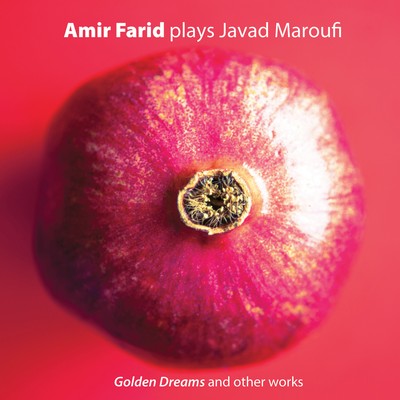
GOLDEN DREAMS AND OTHER WORKS

Amir Farid

Move Records MD 3380

amir-farid

A tribute by local pianist Amir Farid to one of the significant figures in modern Persian/Iranian music, this is an album which holds a limited fascination, mainly because it speaks of a world that most of us will never encounter.  Not that Persian music is a completely unknown quantity; I can recall hearing Court music at an Adelaide Festival many years ago and any listener can easily gain access to the nation’s traditional and folk music at the flick of a Google switch.

Javad Maroufi attempted to fuse his country’s music with that of Europe: a hard task when compared with his predecessors in that endeavour as most of them were by birth entrenched in the European tradition.   Maroufi’s education embraced both worlds and his piano music shows the way in which he tried to craft a language that spoke to listeners in both tongues.

Farid begins with Armenian Rhapsody, a soulful piece with a B minor tonality that doesn’t stray far from closely related keys.   A suggestively Oriental melody enjoys a straight common chord arpeggio underpinning and, in a treatment that quickens the tempo, Maroufi uses a dulcimer effect in the right-hand, imitating the santur  –   a cimbalom that is common to pretty much every country in the region from Turkey to India.   The composer faces the same problem faced by every writer using folk-songs: what can you do except play the tune louder or softer, as Tchaikovsky did with his little fir-tree?  The problem here is that, because of the unadventurous harmonization, the melody soon palls.

Fantasie follows the same pattern although the melodic content is more interesting and varied – well, there’s more of it – but the harmonic support is just as staid with no changes offered from a predictable series of underpinning chords. The santur imitation is heavily employed here.   Still there are modal deflections, including a recurring flattened second that contributes some much-needed colour in a none-too-atmospheric ambience.  Golden Dreams is one of Maroufi’s most well-known pieces and it has been subjected to a myriad arrangements.   After a burst of semi-improvisational-sounding introduction, the simple tune – a 6/8 lilt – begins with an Alberti bass underneath.   Farid gives it interest by his maintenance of the work’s underlying melancholy and by investing as much dynamic variety and pliability as he can in a construct that is easy to assimilate, no matter what your language.

Chargah-e-Esfahan strikes a heroic, quasi-Lisztian pose at its opening but quickly reverts to the by-now natural status quo.  A further  burst of action leads to a central section where the melody is interrupted by some flashy scale-work, but the piece seems to be an amalgam of segments, not at all difficult to decipher; some of them have a passing resemblance to folk-dances from further afield than Esfahan.   But Maroufi is concerned to end as he began with the same decorated melody returning to finish, with a final flourish of octaves that irresistibly recall Brahms and Liszt at their most ersatz Hungarian.

Rumi is the shortest piece on the CD; a brief musical vision, I suppose, of the 13th century Persian poet and mystic whose work underpins his homeland’s culture and those of many neighbours.  Any difference to what preceded it on the disc totally escaped me.   Jila’s Fantasy refers, I think, to one of the composer’s daughters and begins with an E minor melody in dulcimer mode; followed by a quicker movement which seems dependent on a simple descending scale and plenty of triplet passages, the opening melody later emerging in transmuted form.  Another tune follows with more obvious modal inflections.  Kuku is the longest work on the disc, but it breaks no new ground.  A tune that could be popular/folkloric in origin is given concordant treatment, as well as the all-too-familiar dulcimer/santur oscillating effect.   By this stage, the cupboard seems to be bare; Maroufi makes no effort to give his works any chromatic spike or rhythmic variety. Indeed, you feel that much of this music is suited to pianists of much less talent than Farid; a fair bit could be sight-read without stress.

The five Preludes owe much in atmosphere to Chopin, but not exclusively so.  There is a repeated passage in the first E Major one that brings to mind effortlessly Schubert’s Standchen and the over-use of sequences in thirds is a Romantic piano trope of the easiest kind; the santur device appears in the piece’s coda.  As it also does at the opening to the next F minor prelude.  But by this stage, the sequences and chord progressions were so predictable that I could play along with Farid, the score for the most part not needed.  The third in the series evokes suggestions of the Chopin D flat Nocturne but without its melodic adventurousness and avoidance of cliche.   A burst of aggression in the centre defuses into dulcimer-work before a return to the first material.   No. 4 in F sharp promises an original touch or two with its opening motive but cannot avoid slipping into the predictable; and, by this stage, those transient heroic flourishes are wearing pretty thin.  The last B minor begins with a deft modal turn or two; then, when the development begins, it reverts once more to a predictable modulation pattern.

Concluding the disc are two short lyrics: Pish-Daramad-e-Esfehan and Sari Galineh.  The first, Prelude on Esfahan  seems to be a well-known tune that Maroufi set in a more brisk arrangement than most others I’ve heard, here splendidly carried off by Farid.  The last work might refer to a village in Azerbaijan but it follows the same pattern as its companion with a few tricks of truncation at the end of phrases.

It’s a set of pieces, in the end, that present no problems – to us or to Farid, who has absolute mastery of the contents. But, compared to what we have seen him accomplish in the Benaud Trio, as a solo recitalist and in concertos, this is not very challenging matter; rather, an Iranian Album for the Young.   You can appreciate the point that Maroufi is straddling two stools and what he achieves in his efforts is not to be derided.  But, in a world used to the folk-song settings and utilizations of Bartok, Kodaly, Vaughan Williams, Holst, Grainger, Copland, even Berio, it seems that the Persian/Iranian pianist-composer was inclined to content himself with the use of too great a formulaic approach to his compositional constructs; at least, these piano ones.   A pleasant enough collection, but a little goes a long way.

His own man

THE MESSIAEN NEXUS

Elisabeth Sellars and Kenji Fujimura

Move Records MD 3369

Messiaen Nexus

Like many celebrated composers, Messiaen served as a nodal point, but not in establishing his own school, nor in being part of a substantial movement.  He stands out in the ranks of 20th century composers as a complete individual, even on a superficial level, for combining so many elements that other writers avoided or simply could not use.  The point of this CD is to indicate where Messiaen came from – although this retrospective glance is pretty frail – and the fruits of his pedagogic labours, which were legendary, in works by his students.

Elisabeth Sellars and Kenji Fujimura, colleagues in the Faculty of Music at Monash University, are long-time duo partners and this collection of seven works furthers their reputation as exemplary duo-artists.   As you’d expect, Messiaen is represented: first, by the solo piano Piece pour le tombeau de Paul Dukas of 1935, and, in the last track, by the Fantaisie for violin and piano, written in 1933 but not published until 2007.

But the disc begins with a violin/piano Sonata by George Benjamin, the British composer who studied with Messiaen and reputedly was the French master’s favourite pupil; mind you, Benjamin was very young at the time and the first movement of this work was finished at about the time that he began his studies with Messiaen..  Another pupil, Gyorgy Kurtag, is represented by Tre Pezzi from 1979 and some pieces from the solo violin collection Signs, Games and Messages, generally brief in length; the elements for this instrument’s version assembled from 1989 to 2004.  At the recording’s centre stands Anthemes for violin solo by Boulez, a late work from 1991 that was, typically, later revised to include electronics as part of the sound-mix.

Benjamin’s sonata, the most substantial work on this CD, has a unique vocabulary.  It begins with pointillist dollops of piano notes over which the violin stretches a long melodic line.  The pace is slow, hieratic, and you can hear Messiaenic trace-elements in the repetitions of both lines and the occasional suggestion of a mode or two in the keyboard writing.  In the movement’s central pages, where the ambience tends toward a Bartok brutality, the instrumental dialogue verges on the obsessive, especially in the piano’s sometimes clangorous writing.   In fact, the more you listen, the more teacher references you pick up, like the Quartet for the end of time tenor of the movement’s conclusion.

The quicker middle movement involves more under-the-lid work and a good deal of nervous ostinati, the whole heavy on effects; like his master, Benjamin is not concerned about unexpected referents that may occur to the listener, like the dance-hall suggestions that pop up, especially from some sinuous violin curvetting.  But the segment ends in a set of frenetic yet organized pages where the excitement level rises but you are aware of a mind in control of the ferment. The finale  is slow-paced, both more mellow than its opening counterpart and more dramatic in its gestures.   Again, you can find the influence of Messiaen in the slow-paced final peroration which, rather than ending in beatitude as the master would, finishes in a state of unresolved meditativeness.

Dukas, whose The Sorcerer’s Apprentice and Fanfare for the ballet La Peri are all that survive in the concert hall, taught Messiaen – as well as an honour roll of other European composers.   He was invited, like Ravel and Debussy, by the Societe Internationale de Musique in 1910 to write a work using Haydn’s name as inspiration – well, a jumping-off point; the Prelude elegiaque was the result, three somewhat desultory pages that begin and end in harmonic stacks, if suitably placid in character, with a more ornate middle moment.   If you want, you can find in the piece’s sustained and wide-ranging chords a precedent for something like the final movement of L’ascension – or not.   Fujimura’s reading is calm, the chords carefully splayed although the final bars fail to register fully on my equipment.

Kurtag’s Tre Pezzi are brief, making their respective statements without much by way of development.   Od und traurig lives up to its name, notable for deliberately off-kilter violin sustained notes that suggest depression and desolation; Vivo has both instruments moving more rapidly in a suggested march-rhythm, but the forward propulsion is interrupted by pauses and you hear few moments of full-bodied sound; Aus der Ferne sits for some of its length close to inaudibility, out-Weberning Webern with the violin playing simple diatonic sequences, the piano interpolating occasional punctuation marks as a  background.  Where this fits into the CD’s nexus musically speaking is hard to see.

Much the same could be said of the Boulez Anthemes, four pages packed with difficulties for any performer; just getting the improbably detailed expression markings correct presents Sellars with a huge task which she carries out with sense.  If the distinction between her piano and pianissimo delivery in bar 65 on alternate up and down bows is vague, who can blame her?   The work has a wealth of detail, superlatively organized and suited to the instrument’s potential.   But the time-changes, abrupt differentiations in modes of sound-production, flow-disrupting demi-semiquaver gruppetti, massively taxing quadruple stops – all combine to focus your attention on the instrumental timbre, rather than the intended sequence between initial and of verse  – as in the Tudor Lamentations settings – that prompted the composer.   A pity, as this is one of the few Boulez pieces I’m aware of that has any connection to religious inspiration and a less distracting environment might have revealed a sensibility that is masked with virtuosity in most of the composer’s greatest scores.  His teacher based the greater part of his oeuvre on his emphatically expressed faith although he didn’t write much that could be comfortably shaped to fit any liturgies, apart from those in his own head.

Messiaen’s tribute to Dukas may be an early work but it speaks the composer’s tongue eloquently, using one of his own modes of limited transposition and proceeding in a processional pace, albeit one with no allowance for regularity of step.   If anything, the work is triumphant in impact, without virtuosic demands except to get the fingers across those massive chord chains that resolve onto a dominant seventh; well, Messiaen says so although the key chord seems to me to be something else entirely.   Fujimura gives the piece plenty of space to make its celebratory statements with firm amplitude.

The four pieces from Signs, Games and Messages present few problems to Sellars.  The first, Doloroso, is a plaint that passes all too rapidly; Postcard to Anna Keller was written on the day of the dedicatee’s birth and is buoyant, optimistic and folksy in a strident fashion; Calmo-Sognando is an In memoriam for an old school-friend that expresses a masculine, mobile regret despite all the tapering away of its final phrase; the In nomine – all’ongherese begins with a stern one-line motive – and stays with it, the atmosphere growing more and more nationalistic as the short work proceeds.   In all, an intriguing bracket of works but the links to this CD’s nodal point seem tenuous.

Finally, Messiaen’s Fantaisie begins with a piano statement familiar to most organists: the opening recitative to the Alleluias sereins d’une ame qui desire le ciel, the second movement of L’ascension.  This angular proclamation recurs later in duo form with both players in unison, further on with a vitally contrasting piano support, and in a truncated form at the work’s final flourishes.   In between come interludes that are both sweet bordering on saccharine and drivingly active; it may be a young man’s work but it is already idiosyncratic and totally inimitable.

Which brings us back to the disc’s title.  It is probably the best term to describe the performers’ attempt; what they have contributed is a brief tour of voices that spring out of the Messiaen fulcrum.  Expecting them all to share a commonality of expression is to look for connections and links that are either not there or have been assuaged by individual development.

Mind you, the master might have been a wonder in the seminar room but he could also be a curmudgeon.  A one-time colleague, Anna King-Murdoch, accompanied Messiaen to the Dandenongs during one of his rare visits here; the composer was, as usual, wanting to transcribe some native bird song.  He’d heard of the lyrebird but never experienced its mimicking ability live.   The small party crept close to where one of the species was carolling when Anna stood on a stick, which broke.   Also broken (off) was the lyrebird’s song, not to be heard again    Messiaen was angry, as you might have expected.  But then, what sort of song-collector goes into the bush accompanied by a retinue that includes a journalist and photographer?

As ever, the music is what matters and the Sellars+Fujimura duet gives a fine airing of the Fantaisie and Benjamin’s self-possessed Sonata.  If you are left, like I am, wondering about the Kurtag brevities and their place in this Messiaen-infused collation, you can simply enjoy them for their own sakes, admiring the control and aplomb with which they are delivered.

Blasts from the past

IN RECITAL

James Brawn

MSR Classics MS1501

Booklet.qxd

Taking a pause from his labours in recording the complete Beethoven piano sonatas , Brawn produced this album that holds the makings of what could have been an old-fashioned recital program, complete with inbuilt encores.   The most substantial work is a regular these days, as well as a favourite of pianists in previous generations: Mussorgsky’s Pictures at an Exhibition.  Some steps down in terms of stamina comes the Bach/Busoni Chaconne transcription, partnered in flamboyance with Liszt’s Mephisto Waltz No. 1.  Less taxing material technically comes in the Liszt Consolation No. 3 in D flat, Rachmaninov’s B minor Prelude, while the first of Bach’s Well-Tempered Clavier Preludes brings up the rear, whimsically plain-speaking after a welter of barnstorming virtuosity.

Both the smaller Liszt piece and the Bach prelude would be familiar to most pianists, although it takes a fair deal of work to get them sounding as uncluttered as Brawn makes them.   In its one-note-at-a-time progress, the C Major prelude asks for an even pace and a regularity of delivery that also avoids the automatic.  There are no absolutes in pedal use or using the initial notes of each bar as harmonic foci and the performance here is mobile and dutiful.   The Liszt nocturne gives a fine instance of evenly applied left-hand support, letting the melody float on its path unchallenged; perhaps the performer allows himself a fair liberality with pauses before pivotal bar-lines, but the outcome makes as much sense as possible of this simple effusion.

Moving up the degree of difficulty, Brawn creates an imaginative creature in the Rachmaninov piece, revealing the piece’s dark surges of energy carefully, not breaking the thread for effects in those central pages where the massive double-handed four-part chords compete for attention with an elephantine melodic movement.   In fact, judging by this one sample, the performer could have presented a few more from this Op. 32 set to excellent effect; he shows a gift of perceptiveness in unifying the composer’s grinding keyboard mastery with that inescapable granitic melancholy.

Busoni’s transcription and Liszt’s waltz offer a stark contrast in technical responsiveness. Both the products of incomparable pianists, the pieces are opposed in emotional character and underlying force; Busoni’s treatment of the original partita’s unaccompanied violin line is massive over-kill, while Liszt spends much of his time avoiding a waltz metre, even a waltz bar-line as he jumps between fine-spun filigree and pounding martellato passages.

Brawn impresses in the Chaconne with his ease at negotiating inbuilt problems like Busoni’s left-hand chords that stretch the hand to more than discomfort.  Further in, he handles both rapid octaves and sixths passages with controlled rapidity while observing the arranger’s late-Romantic dynamic contrasts.   One of the variations in my edition went AWOL – just before the con fuoco animato direction – but you get swept up in Brawn’s note-avalanche before you first notice.   On the switch to D Major, Brawn succeeds markedly in living up to the quasi Tromboni direction, then contrives to keep the work moving in the fifth of the major-key variants by skillfully arpeggiating the left-hand chords.   Unlike other pianists, Brawn refrains from treating the work in large-scale blocks, although his manipulation of the last two variants before D minor returns is a powerful percussive onslaught of semiquaver alternations between the hands.  The triplets come earlier in Brawn’s closing pages than in my score but he completes the  work with persuasive grit – which is what you need to get through its digital and aural vehemence.

Liszt’s showpiece demands crispness at the outset and this player has its measure with finely clipped articulation before the main melody hits the ground and the whirlwind – with breaks – takes off.   Those scurrying arpeggios and scalar runs across the top of the instrument show a suitable agility, and the sudden shifts in tonality and pace make their points rapidly before Brawn moves us on.   Still, he is not afraid to pull everything back 18 bars before the final Presto – an affecting passage of uneasy calm.  Yes, you can find a few smudges where the action is middle-keyboard, but what do you expect?  The rapidity of response that Liszt asks for  is unnervingly difficult; to get the notes right is a mighty achievement.

Still, after this reading I was left wondering about how closely Brawn was miked at the Potton Hall recording studio; given a more ample reverberation, this work in particular might have gained in aural presence   –   a more resonant envelope, a bit of echo to give its brittle superstructure some greater spatial ambience.

Mussorgsky’s suite is a marvel in live performance, in part for the sadistic pleasure an observer gets watching its execution,  the sheer effort of working through its pages.  But it has attracted pianists galore to record it; multiple times for Ashkenazy, Horowitz and Richter, among others.   Brawn’s version is straightforward, without any re-shaping or distortions, even though the original has scope for dynamic adventurousness.   As with previous recordings by this artist, you notice some elements that have not struck you before, like the crotchet in the left hand at the start of bar 60 in Gnomus when all you’ve heard before is the expected minim.  The second Promenade gave an addition to the composer’s gallery – a study in contemplation as the gallery-visitor moves along, illustrated with telling restraint by this page of delicatezza playing.

Keeping to the letter of the law, Brawn ensured that the dotted quaver-semiquaver-quaver pattern in The Old Castle stayed just that, not a slovenly triplet. In the Tuileries pages, he made herculean efforts to keep the treble semiquaver staccato runs detached.  Bydlo began as it should – loud;  nothing as trite as having this big wagon/cart slowly coming into view, then fading to incorporeality over the last bars.  The Unhatched Chickens Ballet came over with fleetness of hand, notable for the accelerando at the end of the first page (and at each of its reappearances).

A similar energizing animated the conclusion to the Limoges Market segment, Brawn making sure of his right-hand chords rather than blurring the bolt into the next picture, Catacombs, which has me still wondering how he achieved the massive left-hand stretch at bar 21.   Kiev’s Great Gate impressed for the slow pace adopted during the last 13 bars – the peroration after the bells and whistles have had their time in the sun.  Even so, this conclusion had some of its thunder stolen by the crotchet triplets section that follows the second chant interlude, here rising to a sonorously impressive clangour during Mussorgsky’s extended bell imitations.

This great example of musical pictorialism takes pride of place in the CD and Brawn presents an involving  reading of its familiar pages, untrammelled by distractions or superficiality.   Listeners would also enjoy the weighty power of Busoni’s take on Bach, as well as a glittering version of Liszt’s diabolic dance.

Yu and the clarinet

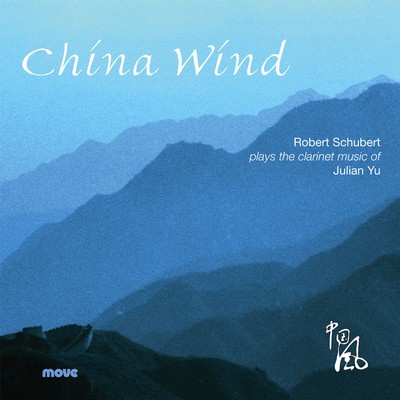
CHINA WIND

Robert Schubert

Move Records MD 3351

Julian Yu

This CD is a testament to the friendship between clarinet master Robert Schubert and composer Julian Yu, as well as an illustration of the encouragement that one musician gives to another to broaden a particular instrument’s repertoire.   The recording sessions involved range from 2000 to 2012 and employ the talents of the Victorian College of the Arts Strings under Marco van Pagee and a collection of the soloist’s Melbourne University colleagues and Melbourne Symphony Orchestra peers past and present – flute Derek Jones, violins Isin Cakmakcioglu, Lorraine Hook and Deborah Goodall, violas Danielle Arcaro and Gabrielle Halloran, cellists Rachel Atkinson and Virginia Kable  –  as well as his wife, Akemi, on piano.

The five scores performed here are not the only ones by Yu that employ clarinet; just those where that instrument is the dominant voice.  The earliest, Sol Do La Re for clarinet and string trio, dates from 1985; Atanos, eleven years later, is written for flute, clarinet and string trio; The Lamentations of Micius for clarinet quintet comes from 1998; a 2000 triptych based on poems by the emperor Li Yu, Silent and Alone, asks for clarinet, piano and string quartet; and the latest music, from 2002, is the Concerto on Chinese Themes where the VCA players support Schubert.

Yu is a remarkably able writer and arranger, his professional equipment ever prepared for the task, whether it be original composition or arranging other composers – and here his activity is more expansive than I’d thought: Tchaikovsky, Palchelbel, Saint-Saens, Holst, Glinka, Janacek, Ligeti and Berg – or writing ‘fusions’ with masters like Mozart, Biber, Beethoven and Mussorgsky.  His activity level is high, as is his facility, which is a very apparent quality on this disc.

The most recently written music, the concerto, sounds the most traditional.   In the classic three-movement format, it is constricted by its melodic material, the tunes it uses not remarkable in shape.   The work begins with a slow introduction foregrounding the soloist who occasionally concludes a phrase with that ‘falling’ break you can hear on Chinese folk-music recordings.   The work changes pace to a fast allegro with lots of action for both clarinet and strings, the effect being mainly that of ‘busy’ music.  In the middle slower movement, it seems that one tune only serves the writer’s purpose and the impression is calm and placid, if reminiscent of a travelogue sound-track.   The finale is, of course, rapid and packed with twittering and trilling, the texture relieved by a segment involving woodblocks.   But Yu treats his basic material in a surprisingly orthodox manner, with very little here to ruffle any anti-modernist feathers.   It’s a pleasant enough entity, a fine vehicle for Schubert’s voluble C instrument, but very concerned to give the Chinese folk-tunes a plain and non-challenging setting.

The philosopher Micius (Mozi) grieved apparently about the  way silk was adulterated by being coloured, marring its original pristine state – just as man is ruined by increasing contact with a corrupting world.   Yu imitates the ch’in (zither) with plenty of initial pizzicati for Cakmakcioglu, Goodall, Arcaro and Atkinson before the texture alters to a more communal mesh where the wind player’s long notes are mirrored by the strings, although the emotional atmospheric changes are more dependent on the quartet than the clarinet at the score’s central point.   Yu’s suggestions of grieving oscillate; you have moments of sedate resignation, then energetic dissatisfaction, even menace and, under all, the restlessness of those pizzicati that seem determined to disturb the despair of Micius.   Here, Yu’s vocabulary is emphatically contemporary, loaded with disjunct leaps and juxtapositions.   Still, The Lamentation of Micius is an odd choice of subject, especially as the philosopher himself denounced music as a wasteful activity.

Atanos brings Jones’ flute into play straight away with Cakmakcioglu or Goodall (both are credited in the CD booklet), Arcaro and Atkinson joining to move this brisk jeu d’esprit forward.   A small group of motives are sprayed lavishly across the ensemble’s sound and range spectrum but the composer is principally concerned with using ornamentation to inform his country’s melodic lines, not simply transpose a tune holus-bolus into a Western chamber-music or harmonic garb.   In this piece, you can soon discern his use of scraps of phrases over and over, his texture pointillist and rapid-fire with plenty of doubling for the two wind instruments.   But whether the music is rapid or meditatively paced, its character is optimistic, quick-witted and content, the final pages an object lesson in economy of material, vaulting from near-stasis to a happy and communal rush of blood.

Using a tone-row, Sol Do La Re opens with those notes on Atkinson’s cello before Arcaro, Schubert and Cakmakcioglu join in the expansively argued fugal-type texture.  Written as an exercise while Yu was studying in Japan, the piece is a fine contrast with its predecessor on this CD: measured in pace, sticking to the same rather heavy rhythm, packed with references to technical devices, this almost abnegates personality for a  kind of academic gravity that interests for the manner in which it suggests tonality by its row’s disposition and the trend to concordance that runs throughout its brief length.

The Silent and Alone pieces are brief atmospheric vignettes with Schubert taking the vocal line that featured in the original version of this work.   He is supported by Akemi’s piano standing in for the first version’s harp   – Hook, Goodall, Halloran and Kable a quartet representing the chamber orchestra that Yu wrote for in the first place.   Since We Parted is a brief poem that centres on a melancholy longing for home; in this vision, the speaker is unhappy, but resigned while the strings suggest his inner urge to be on the move back with an impotent repetitive rhythm.

The title poem, probably the most famous of the emperor’s surviving pieces, poses the solitary speaker on an isolated tower beneath the moon, finding a self-reflection in a courtyard tree as the pang of parting strikes his consciousness with unexpected force. The piano sets out a haunting 8-note ascending figure over which the clarinet softly broods, interweaving with the strings to establish a soft mood of detached despair; only a brief burst of energy disturbs the music’s even flow to end almost as it began.

Lingering Thoughts puts the poet in a landscape fringed by mountains, vast sky and misty water where he is embroiled in the surroundings by his thoughts.  The seasons change but the expected traveller doesn’t return and the poet is left with moon and wind to populate his solitariness.   Here again, there is a surge of life before a voiceless conclusion.  The music throughout each of these pieces is reflective of European art song, even an impressionist-style scene-painting, but the colour is not daubed on in the Debussy Pagodes manner; the Chinese element stays recessed – present, but not blatant.  And the CD as a whole serves not just as a monument to Yu’s writing for clarinet as solo but also as an expertly accomplished exhibition of the composer’s range of abilities, in particular the charm of his lyrical line and the jaunty expertise of his instrumentation.

Let’s notch it up a gear or two

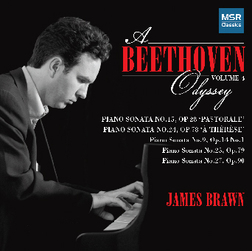
A BEETHOVEN ODYSSEY VOLUME 2

James Brawn

MSR Classics MS 1466

Booklet.qxd

In this second instalment of Brawn’s review of the complete Beethoven piano sonatas, the performer works through three of the very well-known masterpieces: the Pathetique No 8 in C minor, the Moonlight No 14 in C sharp minor, and the Waldstein No. 21 in C Major.  Each of these is familiar to pianists, both capable and the vaultingly ambitious, necessary obstacles on the path to self-recognition and all capable of fostering self-delusion.   As well, Brawn includes the two ‘easy’ catalogue-listed preludes to the Waldstein, although both Sonatas 19 and 20 were written almost a decade previously than their position suggests, closer in time to the Pathetique and atypically lean in content and texture.

It’s sort of like putting all the populist eggs in one basket and thus it makes the CD an attractive buying proposition.   Fortunately, the finished product is well worth attention for its own sake, beginning with a clean-limbed reading of the C minor work.   As the first disc in this series demonstrated, Brawn has a canny eye for details that others neglect or ignore, like the crescendo five bars into the first movement’s Allegro which comes at the right place rather than featuring in the ascending chord sequence that precedes it.  Throughout these pages   –   and the rest of the work, for that matter  –   Brawn distinguishes himself from many another performer by playing what’s written, giving full courtesy to Beethoven and his listeners.   He keeps to his tempi, maintains a clear texture, gives notes their right length, builds and releases tension with subtlety, and preserves the work’s stark directness of expression.   For once, the sudden Grave bars are delivered with as much sombre weight as they deserve.

Like the first movement, the Adagio cantabile comes across with a balanced deliberation, its progress interspersed with subtle semi-pauses denoting a sectional  change or something as simple as an imminent reprise.   Five bars from the end, for the first time ever, I heard a splendidly achieved crescendo/decrescendo that had never struck me before.   No murky blowsiness in the light-filled Rondo.   Mozart was only dead 7/8 years before and his influence is still pervasive; certainly, Beethoven’s gloom and thunder is approaching but, at this stage, not full-blown.   Here again come details that never struck you previously, like the cut back to piano at bar 182; it’s probably there on many other versions but this time its appearance is striking.    Brawn repeatedly displays an awareness of colour differentiation, as in the change from the semiquaver patterns of bars 107-112 to the immediately-following triplets: the landscape changes abruptly even though the underpinning urgent tension remains constant.

Too much has been inferred about the C sharp minor sonata’s history/background/ positioning in the composer’s love-life, but Brawn communicates from the first the dark, looming passion that informs the work.   He takes the direction delicatissimamente as a prime directive for the opening Adagio which remains on the move, sticking to an orthodox path although a hesitation with the broken 7th chord at bars 35-37 added a human touch to this dour nocturne.   The Allegretto was paced more slowly than other pianists treat it, which is usually as an aimless burst of bucolic sunshine.   In this handling, the page impresses as a more valid sequel to the liquid first movement; here there is doubt, regret, an autumnal calm as the composer pauses before the sonata’s scorching finale.

Brawn tries very hard and almost completely succeeds in making a sforzando on only the first of the repeated chords that finish off each arpeggio run-up in the Presto‘s first theme; it’s a remarkable effect, leaving you dangling.  Yes, other players observe the same dynamic direction but here the dent in your expectations is strikingly sharp.   Some excellent pianism appears with an impressive recovery rate in the leaps that pepper bars 47 to 56, and the demisemiquaver clusters from bars 163 to 165 reverberate like side-drum flourishes.   In all, the player offers a no-nonsense version of this restless Rondo, too often treated with that latitude afforded to Chopin’s final Op. 10 etude.

When the track for Sonata No. 19 began, it suddenly hit me that I’ve never heard this work live.  It is easy to churn out the notes, which may make it unattractive to recitalists,  but the atmospheric vein it explores presents interpretative problems.   Brawn invests it with a dignity that brings to the work’s few pages a kind of substantiality.   He gives its phrases every consideration, avoids any indication of hurrying, but impresses on his audience the movement’s small-framed restraint.   A delight from start to finish, the following Rondo/Allegro is an ignored treasure, packed with finesse; for example, the difference in how the player follows the same expression markings in close succession  –  at bars 120-121 and bars 122-3.

Sonata No. 20 is an open-slather field, with only two definite expression directions in its second movement; you can let yourself go, your realization tempered chiefly by the work’s sunny gentility.   Brawn keeps his attack rational and moderately dynamic; he presents an interesting outline, giving the left hand equal billing rather than falling in love with the optimistic upper melodic ripples.    I greatly appreciated his crispness in the Minuet, specifically his delivery of the over-riding rhythmic figure of dotted quaver-semiquaver- crotchet or minim: the simplest of motifs but once heard, never forgotten   This movement’s three pages enjoy a snappy delivery, a modestly exuberant skip in the Minuet itself well balanced by the lusty gusto of the C Major Trio.   It all makes for a performing style of delicacy without affectation.

Brawn ends his disc with the C Major Waldstein, a cow of a work written in the simplest of keys but loaded with pitfalls.  This version copes with pretty much every handicap that Beethoven loads on, the pace blistering from the rustling repeated bass chords that kick off the journey.   During the second theme’s announcement, Brawn concerns himself with the alto part at bar 38, the line carried on by the tenor at bars 47-48; it’s there to be played but a good many pianists concern themselves mainly with the decorative soprano triplets only.   Still, this executant knows that the only game in town when triplets take over the development is the harmonic changes and he powers through them to achieve maximum effect from the juxtapositions.   Listen to the relentless flying build-up of excitement (through a simple ascending scale in the bass) between bars 268-276 and you’ll hear as gripping a reading of this difficult passage-of-play as you could want.

The second movement Introduzione brings an abrupt change  –  Adagio molto  –  and Brawn delivers that exactly, descending gracefully from the page’s insistent dynamic highpoint to a near-mute bar 26 before gliding into the Rondo tour de force.   For the most part, he follows those notorious sustaining-pedal directions, an oddity I fail to fathom every time I hear this movement.   Moreover, Brawn does excellent, sometimes brilliant work with other obstacles  –  like the two-hand contrary motion triplets that go on and on from bar 352 to 377; later, the glissandi featured in bars 465 and 474 come across with admirable smoothness.    But the movement, despite its few moments of relief, is a slog; most of the interpolated episodes approach the bloody-minded and the trill work required adds a Pelion to Beethoven’s already oppressive Ossa.

Brawn gives a bracing account of this challenging score, not letting himself off by taking the easy road with jog-trot speeds, convenient easing-up at danger points, or slackening the tension with mid-sentence pauses.    There’s worse to come with the Les Adieux, No 28 in A, the Hammerklavier  .  .  .  in fact, all of the last five sonatas are packed with enough unnerving material to deter most of us.    But, so far with Brawn, the signs are more than promising.

What’s your fancy?

MUSIC FOR TRUMPET AND THE KING OF INSTRUMENTS

Bruno Siketa and Rhys Boak

Move Records MD 3379

Trumpet and Organ

Another addition to the impressive number of collaborative recordings on the Move label, this trumpet-and-organ effort offers a wide mix, ranging from Bach without frills to arrangements that are packed with incident.   The playing involves two organs: the Hill/Fincham instrument in St. Michael’s Uniting Church on Collins Street where Boak is the resident performer, and one in ‘Collingwood Castle’ where the Radixon Group has its Islington Street headquarters and which, despite assiduous searching, retains its mysteries as a privately-owned construct.

The Collingwood organ is used for duets exclusively while the artists also perform four works at the city church, which is where Boak chose to record his solos.   An early indication of the hybrid nature of the material on offer comes in the first track, an arrangement by both musicians of the Albinoni Adagio in G minor, now known to have been written by Remo Giazotto – not the first ghostwriter to take a leaf out of the Kreisler creative-abnegation handbook.    As expected with this slow-moving dirge, there are a few notes where tuning is not spot-on.   Less importantly, you can’t avoid feeling that the chord-supported cadenza-like passages for the trumpet  come straight from a spaghetti western – the spirit of Morricone putting in an unanticipated appearance.

Telemann’s Heroic Marches, La Generosite and La Grace, fare better, although in the first Siketa’s low Gs close to the start are questionable; the second piece’s slow D Major stateliness works much better for both players as a whole.

Boak’s first solo is Bach’s Toccata and Fugue in D minor, which is now ascribed to one of the composer’s students or friends; exactly which one is the problem.    This reading is unexceptional, with no Ton Koopman-style surprises in ornamentation or registration; only one unexpected pause for what could be a change of manual in mid-fugue disrupts the regular rhythmic underpinning of the work’s second part up to the ducks-and-drakes games at the Recitativo.   Later in the CD, the Little Fugue in G minor is handled with similar directness of utterance in the warm St. Michael’s acoustic.   During Edwin Lemare‘s transcription of the Pilgrims’ Chorus from Wagner’s Tannhauser, Boak shows a controlled flamboyance, the work’s inexorable progress handled with musicianship so that the decorative violin patterns that accompany the chorale in its stentorian climactic form remain in their place.   Guilmant‘s 1861 March on a theme by Handel is treated sensibly as a long crescendo, starting off with a theme outline in unusually reserved manner, gaining headway in the middle fugue and exerting plenty of sonorous muscle in the final grandiose pages.

Siketa gives to Alan Hovhaness‘s A Prayer f St. Gregory a calm delineation, which is the best approach possible with a work that is meant to depict a holy man’s spiritual and physical crisis expressed in semi-modal language that takes the listener nowhere.   Piazzolla’s Ave Maria was written for a film version of Pirandello’s Enrico IV, originally scored for oboe and piano; Siketa produces an attractive line but the piece itself is nondescript, a meander that indicates a mental break between its devotional re-naming and its original purpose.

The Romance from Shostakovich’s score to Aleksandr Fajntsimmer’s film The Gadfly sees the players in Collingwood and the tuning for the piece’s first pages is still not quite right, although matters improve by the reprise.   Rachmaninov’s Vocalise, another favourite Russian lollipop, enjoys more success and the arrangement by Boak, moving down a semitone from the original C sharp, uses the organ to good effect, although its dynamic pays over-deferential courtesy to the brass melody line which remains very prominent. The pair end their suburban bracket with the Ave Maria attributed to Caccini (how?) but composed by Vladimir Vavilov; as in every other version you hear of this piece, the executants never come close to being challenged.

The final trumpet+organ works are unabashed showpieces.  Jean-Baptiste Arban‘s Theme et variations sur ‘Norma’ holds some preparatory and fill-in work for the accompanist but its only interest is the trumpet’s virtuosity.   Siketa begins with a straightforward outline of Bellini’s Casta diva aria  –  well, the first part of it  –  complete with a cadenza at the end. The first variation is a bouncy march distinctive for a bit of quick action at its conclusion. Variation 2 continues in the same metre but with continuous semiquavers; not jerking the player around but testing his evenness of enunciation.   Matters ratchet up in Variation 3 where the action moves to triplets – really sextuplets – and the player is hard pressed; Siketa manages this very competently – I heard only one near-dropped note at bar 100.   A piu lento is the deceptive lead-in to the last section which features a gradual acceleration leading to a brilliantly definite conclusion.   In the excitement, the synchronicity between the players put Siketa under stress; at points like bar 135 where he had to draw breath, there was a danger of his being left behind by his inexorable escort in the race to the piece’s final post.

The other showpiece is better known as a violin encore: Monti’s Csardas; this appears to be the work’s first re-positioning for trumpet and organ.   It’s a brave effort but perhaps the unspoken request to ignore the original is impractical.   Triple- and double-stops are impossible to accomplish, as is the Meno quasi lento segment in harmonics which is taken over by Boak; any spicy acciacaturas are too difficult to negotiate in this context.   Still, the interpretation goes some way to catching the original’s faux-Gypsy spirit and there are precious few flaws, the most notable a missed note eight bars before the final A tempo/piu presto gallop.

I think that the motive underpinning this recording is more entertainment value than repertoire expansion, although it does accomplish that end with six of the tracks being arrangements by Boak.   The content jumps around – from familiar Bach and Telemann to Hovhaness of 1946 and a 1984 piece by Piazzolla, the most modern of the 14 works presented.    It will interest trumpeters, I suspect, and admirers of both Melbourne musicians involved  –  and those with a taste for that noble, vital sound-world so desired by wedding organists who have to make do with their trumpet stops: a poor substitute for the real thing, as this CD demonstrates.

Here we go again

A BEETHOVEN ODYSSEY

James Brawn

MSR Classics MS 1465

Brawn 1

Not that there’s any cause for complaint in facing another cycle of the Beethoven piano sonatas.  Such an exercise has occupied the talents of many artists, some of whom have brought new life to hoary standards from the well-worn catalogue; we would be much the poorer without the recordings from Arrau, Brendel and Pollini.   British-born and sometime-Australian resident James Brawn has entered the lists with this CD, which has been swiftly followed by three others; currently, he is exactly half-way through the cycle of 32 and, like any sensible artist, is not taking them on sequentially.

In this first essay, Brawn performs the first and last of the Op. 2 job-lot dedicated to Haydn, followed by the blistering Op. 57 in F minor, the Appassionata.   Each reading is finely calibrated in meeting the composer’s multiplex of technical demands, and the performer reaches a persuasive accommodation with the individual sonatas’ intellectual and emotional rigour.

Beginning at the beginning, Brawn impresses straightaway in the Op. 2 F minor Sonata No. 1, not least with his accounting for Beethoven’s sforzandi.   These are treated humanely, as abrupt interjections, not belts around the listener’s ear-hole.   So the texture remains clear throughout, especially in the first Allegro where Brawn avoids the usual trap of blurring passages of maximum activity, chiefly by observing a sensible dynamic spectrum and maintaining a brisk pace in which the trills are handled as integral icing.

The ensuing Adagio enjoys careful treatment with small touches of rubato that still preserve the movement’s fluency.   The only possible fault I could find in the Menuetto was one sforzando too many, while the finale was taken very fast, as required, with a sustained reliability of delivery in the segment’s chains of left-hand arpeggios.   A passage of particular interest comes between bars 161 and 172; excitingly urgent in its emphasis on the bass melody the first time around, then even more so with the reinforced right-hand doubling on the repeat.   Speaking of which, Brawn observes that of the movement’s second-half  – easy to accomplish in the studio, of course, but you rarely hear it in live performances, especially from younger interpreters.

For the Sonata No. 3 in C Major, the semiquaver passage-work comes across in emphatic and digitally decisive shape, yet the first movement’s exposition is distinguished by a generous fluency, only faltering at bars 156-8, the sole question mark in a set of pages that rattle past with fitting assurance and contentment.   For the Adagio, Brawn  is intent on observing melodic continuity rather than following the usual pattern and detaching notes in the onward flow, as from bar 43 inwards; unexpected, but it works for me.

A generously applied staccato dominates the Scherzo wherever slurs are not indicated, but the Trio is the opposite – a melange of pedal-sustained right-hand arpeggios.   In the spritzig Allegro finale, the lightly articulated attack is refreshing, as intended.   Here the only awkwardness comes in the busy pendant to the main theme from bars 8-16, and at its recurrence later on at 116-205 – but then I can’t recall another interpreter apart from Brendel who can give these segments some persuasive kind of organic continuity.

Ten years lie between these two works and the Op. 57 which is one of the four most popular of the composer’s output in this form.   Brawn’s reading has an admirable spaciousness right from the opening which is handled as a true Allegro rather than a shock-and-horror show of inconsistent metres.   In finding and communicating a structural cogency in these challenging pages, Brawn is distinguishing himself from the ruck; not afraid to give full weight to the composer’s explosive, almost manically insistent blocks of full chords alternating between the hands, and then giving an urgency to the counter-weighted piano leavening while avoiding any hint of neurasthenic twitching.   His account of the Piu allegro is exemplary, carried off with passion and lucidity, most notable in a bracing passage from bars 249-256 – as powerful and biting as you could want.

The pianist treats the central Andante‘s theme with deliberation, allowing himself the space to linger at a few points, although the following variations come across as regular without metronomic rigidity.  The last Allegro concludes the drama with plenty of character, its almost-continual restlessness carried off as all-of-a-piece, dynamically sensible and unflustered.   Brawn powers through the coda, hitting his left-hand accents manfully in the sonic mash of bars 325-340 and bringing the whole to a rousing conclusion.

This is sensible Beethoven, giving these sonatas a well-rounded airing and facing the interpretative problems with gusto and honesty.  Brawn’s command and sympathy are present on every page and I look forward to experiencing the rest of his efforts in this wide-ranging musical exploration.

Laying it all out

SATELLITE MAPPING

Amir Farid

Move Records MD 3402

Satellite Mapping

Released this year, here are the complete works for piano solo by Melbourne composer Stuart Greenbaum, a luminary of the University of Melbourne’s Faculty of Music and a writer whose name is continually before the public.  In his 50th year, Greenbaum’s retrospective is being observed by pianist Amir Farid, one of the Benaud Trio musicians and a highly esteemed contributor to this city’s cultural life.   While this retrospective takes up a double CD, much of the music it contains is brief in length, and every so often slight in character.   Yet, because of the composer’s absorption of a wealth of influences from the serious and popular fields, his work has a consistent attractiveness, not afraid to show an inner emotional world that appeals across the potential spectrum of listeners, from those aware of musical developments over the past half-century to others who eschew background for straight-talking  –  not that these groups necessarily exclude each other.

The album follows the development of Greenbaum’s craft in temporal order, starting with the 1991 Portrait and Blues Hymn, recorded some time ago by Michael Kieran Harvey.   Farid’s handling of this miniature displays some basic elements in the composer’s style: a penchant for pauses, a grounding repetition of phrases with varying harmonic-block underpinning (or not), progressions straight from a jazz player’s vocabulary, an easily digestible formal lay-out.   It’s a birthday-celebration piece but its title eludes any definite interpretation.

One of the recording’s major works, Ice Man, follows.  Among the more impressive and sustained products in Greenbaum’s output, this three-movement set of meditations refers to  extracts from Andrew Scott’s Lost in the Himalayas memoir, which details the Australian doctor’s celebrated 43-day ordeal in 1991.   The first (and shortest)  part – Lost | The Moon | Don’t leave me here – presents an atmospherically quiescent sound scape that suggests a detached despair, erupting into a short blast of vehemence before returning to the prevailing placidity.   Picture of an anorexic | Dignity | The dream continues the prevailing pointillist writing style, projecting sound pictures of a landscape where nothing happens in the physical surroundings; only the sufferer’s mind has active flashes that fade to silence or lead to obsession, denoted by repeated chords, a series of arpeggiated or broken sequences that grow slightly by accretion.   But, over all, the  music speaks of isolation, even when Scott’s dream of addressing his family brings about a passage of relative magniloquence.   But in the end the activity dies away to a single repeated note, like a drop wearing away stone.

For the last movement, They must have seen me | Faint voices | Affinity,  the atmosphere changes from meditative to flurries of action, although Greenbaum returns to the passive mode when the excitement of a possible sighting by helicopter dissipates.  Not that the composer is following a script, but it is difficult not to project your own narrative for piano writing that is, at its core, pictorial/impressionist.   Common chords over an oscillating D octave pedal propose a return to humankind and the movement ends with a kind of reconciliation, Scott’s affinity being with the rock that sheltered him and his acceptance of the Himalayas’ beauty, despite their innate menace.  Farid outlines this work’s slow-paced poetry with a high sympathy, giving each gesture plenty of space and maintaining a steady pace through to its consolatory final bars.

Innocence (in Stillness) was written for a birth and may be familiar to some pianists from the AMEB Grade 2 syllabus; a melody punctuated by some simple bass notes and chords, it’s over before you know it.   Looking to the Future, composed as a theme for a play concerning the 1989 Newcastle earthquake, states a bluesy theme several times, then stops on a middle-instrument question – a real bagatelle.   From 1996 comes one of the composer’s more well-known pieces, But I Want the Harmonica which, in some ways, bears traces of the preceding two scraps.   Again, the work follows a clear path, its motivic  repetition sufficiently varied to sustain interest as a descending sequence of two-note gruppetti enjoys multiple accompanying variants with a heavy jazz colour at its high point.   This work exemplifies Greenbaum’s individual vein of melancholy not taking itself too seriously as he recalls with open-hearted benignity a childhood school experience that meant much to him.

The first CD ends with three pieces that cover ground similar to that already covered.  New Roads, Old Destinations attempts to illustrate an Escher drawing, one of those trade-mark building designs where stairs ascend and descend simultaneously.  Chords follow a downward path round a central ostinato, either inside the harmonic progression that forms the piece’s material, or below it.   The structure plays neatly with the concept of nothing changing except superficially; as in the Escher drawing, the actual lines remain the same, no matter how you perceive them.   First Light’s four-note basic motive offers a sort of reflection of the previous piece, the motion being upward over a central-keyboard ostinato.   And again, the added-note chords, even the modulations, are reminiscent of a soft-edged Shearing-style improvisation that rises to a powerful C sharp Major conclusion – yet  the almost inevitable, unsettling distant high notes that conclude the work offer a coda of quiet negation, or at least a question-mark.   At about half the length of the other two pieces in this concluding triptych, Fragments of Gratification presents an evanescent meditation on one, possibly two, themes which rises to a brief dynamic high-point at about 1:40 but its true air-space tenancy is coloured in soft pastels.   Composed on the last day of the previous millennium, it eschews hoo-rah celebration for a gently rueful anticipation.

Disc 2 begins with Equator Loops, a set of variations radiating our from a central D; this is one of the few points on either of these discs where Greenbaum asks for unabashed virtuosic playing, the concluding loops in particular wide-ranging and aggressive.  Three Optical Allusions presents as a short suite dealing with musical representations of a solar eclipse, a time-lapse photograph and a Mobius strip.  It is hard to avoid impressions during the second of these, a gradually expanded rising phrase over a fixed bass pattern, of hearing something like  organized doodling, while the third offers little more, except louder.

Four Thoughts remain in the same compositional continuum.  The End of Winter oscillates between two short phrases; For Oliver offers a touch more interest in its change-ringing on simple, if rhythmically varied melodic matter; the Escher (again) inspired Spirals moves into some interesting, almost adventurous territory after a somewhat numbing first half; Bagatelle for Aksel kept its mystery – it is based on a children’s song – until near its ending, but it brought to your attention how surprisingly orthodox is Greenbaum’s underpinning tonality.

Written for Elyane Laussade, Matilda Deconstructions takes fragments of Waltzing Matilda and, in the first segment, gives a driving minimalist-mimicking moto perpetuo; the second dissection, less rhythmically rigid, uses a five-note falling ostinato to support yet another set of wilting, decorative passages of play.

Glen Riddle recorded The 4th Saturday in April among a slew of Greenbaum occasional pieces two years ago, and Farid brings an equal gift of placid serenity to this wedding gift for a wedding that Greenbaum could not attend.   Evocation of 2006 sits as a kind of memento mori concerning one of Greenbaum’s students who died young; the Albeniz connection is a vague one, although the ostinato has some congruence with a permeating figure in the Spaniard’s piece.   And the composer’s avoidance of the anticipated in his disposition of the descending five-note scale pattern in the work’s last third is masterly.

Written for the birth of the composer’s daughter, Lavender for Hanna presents some quick variations on the British folk-song Lavender’s Blue; another miniature that is over very quickly.   More substance comes in Allusion, Introspection and Ascension which uses well-established piano masterpieces as springboards.  The first takes part of Chopin’s Barcarolle and superimposes a structure that oscillates between the chromatic versatility of the original and a patch of 1930s-era syncopation that brings the piece to a close in medias resIntrospection extracts certain chord progressions from the finale to Schubert’s last B flat Major Sonata, but does not do very much with them; it’s as though the original is too self-sufficient to need much treatment – which rather defeats the purpose of the exercise.   The middle one of Liszt’s Petrarch Sonnets generates an exciting outburst in the last Ascension piece, even if the referrents are difficult to decipher until Greenbaum offers some literal quotes; Farid here provides a resonant interpretation of a piece that maintains its virtuosic roots.

The CD’s title work begins sparely before slowly passing to a roiling across-the-keyboard melange: an exercise in depicting the overwhelming detail that emerges as you hit the plus indicator on your Google map image.  It’s an ingenious concept – the gradual crescendo in information – yet it completes its work pretty rapidly; rather like the impatience most of us show when using a satellite map.   The CD ends with Fanfare for Elizabeth: not a royalist tribute but a piece written for the 80th birthday of Greenbaum’s mother.   It uses an optimistic rising four-note trumpeter’s motive but does not modulate outside its A Major framework; still, it’s emphatically a celebration, an occasion for jubilation, and a suitable conclusion to this lengthy remembrance of things past.

On the composer’s website, you can find analyses of some of the pieces on these discs, viz. First Light and two parts of the Ice Man set.  See http://www.stuartgreenbaum.com