Small-scale, with sympathy

LATIN AMERICAN PIANO MUSIC

Alejandro Alberto Tellez Vargas

Move Records MCD 639

You’d have to assume that this pianist is Mexican-born, if only because the few life details you can glean point to his bachelor’s degree coming from the Escuela Superior de Music, even if his Ph. D. was earned at the University of Melbourne and – as far as I can find – he resides in that city. On this CD, he performs works by seven composers: Cuban writer Ernesto Lecuona enjoys four exposures; Ricardo Castro from Mexico is heard in three tracks; the voice of another Mexican, Manuel Ponce, is heard twice; and three of the remaining four writers, all of whom are heard in one manifestation, are also Mexican – Alfredo Carrasco, Ernesto Elorduy, and Mario Ruiz Armengol. The odd man out is Luis G. Jorda who was born (and died) in Catalonia.

As a preface in the CD’s booklet, Vargas writes a few words in Spanish. As far as I can make out, he says the following: ‘I dedicate this recording to my beloved fathers [artistic?], many thanks for my piano lessons and for all the support during my studies and concerts. Also, I want to thank my dear siblings for all your patience during those long afternoons when I sat practising in the living room.’ Pleasing and charmingly domestic, as is most of the music that the pianist presents which is either of the salon or a small bijou serving well as an encore. I didn’t anticipate that this courtly, colonial music would have much overtly striking about its character and that prediction was largely fulfilled; it’s hard to avoid the impression that this perspective into Latin American art has an all-too-comfortable European veneer – the landscape of the 19th century virtuoso pianist.

So none of the great names of the Romatic-to-Modern Mexican school appear: no Chavez, no Revueltas. Vargas has concentrated on the small-scale compositions of – in the main – a minor rank of writers whose vocabulary is slightly infused with national colour but is chiefly the product of the drawing-room. Fortunately or unfortunately, this ambience lacks any Chopinesque chromatic intrigue or superbly arched melodic contour; in many instances, composition is presented as a pastel-shaded art.

The works representing Lecuona are A la Antigua in D flat Major, Ante el Escorial in E flat minor, La Comparsa in F sharp Major, and Gitanerias in D minor. Well, the first has the key signature for C sharp minor for its first part before changing to D flat Major for the happier, scherzando second section; its main interest lies on the second beat syncopations and also in leaving you with the question: what is so old-fashioned about this? Standing in front of the monastery/palace, Lecuona begins with full slow chords in both hands in a melodic minor shape, a kind of chorale with which he also ends his meditation after a virtuosic flourish and a central passage in G flat Major. In fact, the piece consists of an arch form with the first melody, after those initial chords, being treated later to a left-hand enunciation before the aspirational chords return.

The composer’s vision of a Cuban carnival procession opens softly with a bass figure that persists across the piece’s brief duration as the parade arrives and passes, off into the distance following a resonant climax. The gypsy business comes from the composer’s six-part Suite Andalucia and falls into a predictable ternary shape with a semi-D Major relief in the middle; sprightly and attractive in Vargas’ treatment which disappoints only in a blurring across the crescendo four-bar link before the return of the initial material 54 bars from the end.

Castro presents as less folkloric than Lecuona. His three samples are an A minor Prelude (Barcarola), Polonaise in G sharp minor, and Caprice-Valse in E Major – the composer’s Opus 1. The Venetian-indebted piece is, as far as I can tell, in 9/8 – which might present some challenges for rhythmically illiterate gondoliers. This is eminently acceptable salon music, showing a mastery of orthodox Romantic writing for the piano, the piece notable mainly for its left-hand semiquaver motif. A lot of Chopin is present in the polonaise, including an aggressively strident introduction with plenty of bravely martial repeated chords, although the main theme and its consequents don’t strike me as really assertive. Also, a note at the top of the instrument is sounding out of tune, but I can’t isolate it (maybe the instrument’s top G sharp?); and Vargas inserts quite a few delays while he readies himself for some awkward arpeggiations. This is the second-longest piece on the CD (coming in a few seconds behind Castro’s Opus 1) and its repetitious material tends to fray.

In fact, the Caprice-Valse concludes the CD and is one of the more intriguing tracks of the 15. Your attention is taken up from the beginning by the waltz’s bantering between 3/4 and 6/8 which Castro plays very cleanly so that you don’t lose connection with the basic pulse. The piece begins with a bit of bravura and stops every so often for some interpolated fireworks, handled by Vargas with infectious brio. It isn’t demanding on a Lisztian scale but it does test the executant’s fluency. Castro also spices up this piece de concert with some rhythmic irregularities and a flashy vivo and grandioso that bring us home to general satisfaction.

I suspect that the only name familiar to many of us will be that of Ponce; in my case, almost totally for his association with, and compositions for, Segovia. Here, the first of his works is a Scherzino Mexicano in D Major, the shortest on the CD as Vargas doesn’t play the first part’s repeat of 16 bars’ worth. It’s a generally quiet bagatelle with an adventurous chromatic sequence in its central section, and the main melody is certainly catchy. Its complement is the Intermezzo in E minor, the first of three. This is another ternary construct with a slightly fierce central highpoint, but the main concept of repeated thirds travels just about as far as this work’s length will carry it. The executant allows the final quaver chord to linger for a long time; he probably didn’t agree with the composer’s curt conclusion to this melancholy miniature.

Carrasco’s Adios in A Major is a dance (a habanera, I think) as well as a song, because my copy has words inserted. This is another A-B-A format where the centre is stormy and ardent and the framing passages suggest languor in a set of two-bar phrases in balance with each other. The three danzas called Tropicales by Elorduy are one-page trifles that Vargas extends by playing everything at least twice. Perhaps the most successful is the third which is of a piece, without a fast introduction, and its language shows more sophistication than its companions; being kind, you call them ‘lightly atmospheric’ and the performer adds more of the same while employing an attractive rubato in the slower reaches of all three.

Armengol, last of the Mexican writers celebrated here, contributes a Prelude in E Major for piano or harp which deals with two key elements: a rapidly rising arpeggio-type figure, and a sequence of block chords – grist to the mill of any harpist, of course. What dominates everything is the spirit of Debussy: the Arabesque No. 1 and the Reverie come to mind straight away, followed by La fille aux cheveux de lin, Claire de lune, probably Danseuses de Delphes. For all that, the composer follows a fairly unsurprising harmonic plan and the piece’s elements circle each other with the inevitability of a rondo. Vargas treats these pages with considerable care and sympathy.

And so we arrive at the Spaniard in the works. Jorda’s Danzas Nocturnas is a series of three vignettes: Moderato, Con tristezza, and Mesto; 54, 16 and 48 bars long and in F minor/Major, D minor and A minor/Major respectively. All partake in the habanera rhythmic underpinning, although it’s not a strict observation with a plethora of languid triplets brought into play. Vargas handles these short dances with elegance and fine responsiveness, extending their substance by playing all the repeats and then some, my only quibble coming with his interpretation of mesto which here has little of that depression I usually associate with the term, having first encountered it in Beethoven’s Piano Sonata Op.10 No. 3.

It rounds out a CD of considerable charm, expertly carried off by Vargas who is at some pains to demonstrate the restraint and fresh-eyed inspiration of these writers. Owning a considerable technique, the interpreter offers fluent versions of pieces that have been passed over in favour of more flamboyant Latin productions by famous names, significant composers with advanced skills and insights. Much of the music recorded here can be found on the internet, scores and performances; still, as far as the latter are concerned, few match Vargas in ease of production and sympathy with his small-frame material.

Peaceful but predictable

ECLIPSE

Concordia Mandolin & Guitar Ensemble

Move Records MCD 612

The latest product by this well-known Melbourne group comprises works by well-known guitar/plucked instrument expert Michelle Nelson who was first guitar with the Melbourne Mandolin Orchestra across this century’s first decade, taking up the same position with Concordia in 2013. In fact, Nelson has been conducting a healthy professional life for 40 years now and has produced several additions to the Concordia repertoire – all of them, as far as one can judge from this CD, traditional in language and instrumental use.

Not that there’s anything wrong with that. This composer is given to wondering how modern music composition (20th century) strayed so far from popular taste of the time. Yeah: it’s the same sort of thing I self-divert with when listening to the Gabrielis and Bach, Gesualdo and Chopin. Funnily enough, I tend to come down on the side of the benighted composer who finds little stimulating in the simple-minded. But, if you want to continue finding your inspiration in the folksy and the English bucolic, be my guest; just don’t wait around for praise on your originality.

This small CD (40′ 45″ long) contains four compositions: Bishops Spell, which is a musical portrait of musicians Ida (recorder) and Frank (mandola) Bishop; the title work Eclipse: Concerto for Mandola and Plucked Strings with soloist Darryl Barron; After the Fire, a rearrangement of an earlier construct expanded into two movements; and Jim Greer’s Jig. This recording was due for release in 2020 but universal infections got in the way; hence, its arrival now. So the family portrait was recorded at Move Studios in 2019, the concerto at the same venue in 2018, the two-movement new construct probably put down in 2022, and the jig recorded live during Concordia’s first post-lockdown concert at Christmas, 2021.

The Bishops’ family portrait begins with a jovial, folk-like tune (British Isles). Will Hardy‘s recorder answering the orchestra’s statements with variations, the whole featuring some extensions that seem to work against the four-bar phrase pattern that matters start off with. Still, the trend is to the non-adventurous, although the atmosphere is jaunty. That’s Ida dispatched. Frank begins more soberly – a slow 3/4 rather than Ida’s brisk 6/8, and the more meditative male enjoys a calm depiction from Darryl Barron’s mandola, even though it has to be observed that Ida is well-represented in this movement, having a definite melodic and descant function in turns. Furthermore, Ida has the last word.

The Family Life third movement has a percussive element as underpinning – just your normal hand-beaten drums (bongos?) supporting the two soloists as they work together through a four-square melody and its small-scale elaborations, It all sounds slightly medieval/Renaissance in character, as though the Bishops were early music enthusiasts; and, as I know from bitter experience, the interest in such complexes generally falls to the solitary woodwind line. Things move from the four-square 4/4 a little after the half-way point to a more meditative triple-beat interlude, before the drums return and we come together for a rousing estampie conclusion. As you’d assume Nelson’s language is eminently assimilable with nothing much to astonish anyone born before 1700.

The composer’s Eclipse concerto has three movements: Eclipse: Approach, Eclipse, and Eclipse: Release. I can’t argue for the shape of the first of these. It takes a firm stand at the start with some block chords, a strong melody based on an upward-rising arpeggio; the composer allows both soloist and orchestra to deal with both elements, then stops before moving into more lyrical territory. Nelson has an occasional habit of curtailing or extending her regular phrases but the working out of material is orthodox with a lot of pattern-work where the development section would be. A return to the opening second-inversion chord/arpeggio melody and we’re not long before the home stretch is in sight.

[As a completely oblique observation, I have to report that the strongest impression I have from what I’ve heard so far on this disc recalls nothing so much as Debbie Wiseman’s theme music to the BBC One production Shakespeare & Hathaway. It might be the suggestion of massed lutes that is produced by the Concordias, or the definite if unadventurous bass line, or the optimistic bent of both Wiseman and Nelson. But the aura is reminiscent of Stratford at its cleanest, as we see it in the series, despite the mandolin’s necessity to play tremolando much of the time.]

The middle slow movement starts out in the same key as its predecessor, the threnody melody articulated over a fixed bass note for the opening strophes. The soloist occupies a semi-prominent role before everything halts for a cadenza where the harmony stays pretty constant, apart from a chromatic frisson about the four-minute mark. The slow march recommences, working on three layers (eventually four when a sustained bass note is added) as the rhythmic level sees people playing with Beethoven’s ‘Fate’ motive. This leads to a climactic point, from which apogee the music dies out to an ambiguous conclusion – which is actually an imaginative depiction of the state in which an eclipse’s maturation leaves us.

The Release is very abrupt: we’re immediately back in clear skies with a slightly threatening march that, for much of its initial statement, follows an iambic metrical pattern. The first antistrophe appears to recapitulate a memory from the first movement, before we slow down for a more melancholy stretch that ends interrogatively before we revert to the march/strut. Another cadenza appears which owes something to Rodrigo although lacking that master’s quirkiness and timbral curiosity. Back to the iambic rhythm and a final reference to the first movement’s chord inversion, and this mainly-minor mode concerto ends with a unison/octave emphasis.

A minor quibble: Nelson entitles her first movement to After the FireIncinerat – as ‘burnt to ashes’. It’s a bit more specific than that as it means ‘he/she/it had burnt it (to ashes)’, the pluperfect of incinero. Not that it means anything to most people except those of us who sweated through six years of the language in secondary school, back in the days when they taught it. In fact, the afore-mentioned tremolando effect is atmospherically suggestive here, especially at the start where a free-standing flickering comes across very well. I’m not as enamoured of the guitar and bass solos that follow because they bring a touch of interruption, of unexpected voices in a bleak aural landscape.

Harmony Returns, the second movement, begins with a reversion to the expected. The ambience is TV soap comfort with a series of rising adjacent chords spreading the benignity until a tune arrives after a minute of preparation: an amiably swinging 6/8 melody which is well-established before a subsidiary figure enters for some more mercilessly predictable repetitions. Then it’s heigh-ho for the original lightly syncopated melody that has suggestions of something that could have been produced by/for Captain Corelli – a nostalgic Mediterranean travelogue, perhaps. As with much of Nelson’s output, it’s not so much a question of harmony returning but more an iteration of the fact that harmony never left.

It’s probable that the composer’s fire is one of the bush infernos that have swept across the country, but the post-crisis ambience that she has constructed is free from any signs of PTSD or shivers of reminiscence – at least, as far as I can tell. As for the CD’s finale, the jig in memory of Concordia member Jim Greer, it’s a pretty rough affair, compared to the preceding tracks. Attack is not as split-second as the group is capable of and the rhythm is heavy-handed; everyone sounds as though they’re not at ease with the work which, for some reason, ends on a chord inversion. Yes, it’s a live performance after a long epidemic-controlled cessation of activities, but the players’ assurance of address does not satisfy as much as in the three preceding scores.


A long time coming

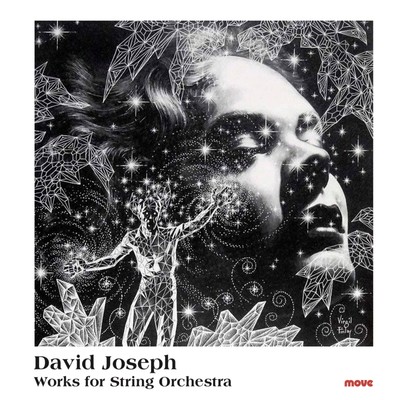
DAVID JOSEPH: WORKS FOR STRING ORCHESTRA

Melbourne Chamber Orchestra, Zagreb Soloists, Ripieno Kammerorchester

Move Records MD 3460

This CD is a blast from the past; three blasts, in fact. Australian composer Joseph wrote two of the three works offered here in 1992, the other in 1999. Honourably aged, you may think, if not exactly ancien regime. But the recordings have not been available since their premieres, as I understand it. For instance, tracks 1 and 2 comprise the Chamber Concerto for Piano and Strings, , commissioned by the then-director (1992) of the Melbourne Chamber Orchestra, violinist Spiros Rantos. Originally conceived for Rantos’ wife, Brachi Tilles, the first soloist was Michael Kieran Harvey. So far, fine. The score was premiered at Melba Hall in Melbourne University’s Faculty of Music. What we hear on this CD is a performance recorded in the former ABC studios at Waverley, Harvey as soloist with Rantos conducting his MCO. This must have taken place between 1992 and 1995, after which the ABC moved to Southbank.

As for the second work, Scheherezade was written for the Zagreb Soloists, one of Europe’s premier chamber orchestras. I’m assuming that the composition date of 1999 was also the year of the work’s first performance (which is heard on this CD), but it’s hard to be sure. In Joseph’s catalogue, the work appears as Study for strings, ‘Also known as : Scheherezade’, and an undated presentation of this work by the late lamented Academy of Melbourne under Brett Kelly is also documented, as well as appearing on a previous Move Records collection of Joseph’s music which was released in 2006. The remaining composition, Dialogues of 1992, was written for violinist Urs Walker and the Ripieno Kammerorchester of Winterthur. Its first performance under conductor Howard Griffiths took place on September 5, 1993 and what we have here is a recording of that occasion.

Now, the Chamber Concerto is written in three movements, according to the disc booklet: Toccata, followed by Poem of Love/Meditation. In the original, there were no musing moments but you take what you’re given. In the Australian Music Centre documentation, this work was actually written for the Rantos Collegium, which disbanded in 1996 or thereabouts. Somehow, the Melbourne Chamber Orchestra was spun out of the Collegium – or did it really emerge from the dying throes of the Pro Arte group? Well, the orchestral group is strings, which could be sourced from any one of the three ensembles.

The Toccata is a hard piece to pin down. It follows an almost moto perpetuo chugging rhythmic pattern which is relieved for only a few seconds at two places. The harmonic language is dissonant, suggesting Bartok and Prokofiev, although the overall texture is reminiscent of Mosolov’s short-lived brutalism, or even the less sloppy moments of Messiaen’s Turangalila. For all that, the movement radiates energy, Harvey’s realization of the solo part both hard-edged and scintillating, the pianist addressing his work with unflappable authority and a determination of output that every so often leaves the strings in his wake.

I think I’ve found the separation between the second part’s two sections. For the Poem, we’re apparently in Messiaen-Land where the strings settle into an ascending or descending motif of two chords, Harvey’s keyboard offering a rhapsodic commentary. The impression is less firm in contour than the French master’s Chant d’amour excursions but much less populist, even if Harvey’s contributions suggest several of those Messiaenic modes of disposable musical income. And these pages are definitely proposing an emotionally benign state; if not the Turangalila garden of Sanskrit delights; rather, a calm and welcoming landscape in which the dissonances mutate with remarkable smoothness, a cleverly achieved absence of surface friction no matter what progressions are quietly taking place.

The Meditation, I suspect, begins when the piano sets off on a sequence of stately chords that pass up and down the keyboard from top to bottom against a shimmer of strings from which a solo violin emerges with a soothing if angular melodic line. The musing is carried out with something of a forced-march mentality behind it, as though the action itself rendered the mind active rather than flooding it with random impressions or metaphysical ephemera. You couldn’t call this section of the work vehement or threatening but the consciousness being exercised has a clear, if repetitive, path to follow. Yet again, the spectre of Messiaen rises up, mainly in the shape of the chord processional, but the uses that Joseph puts this sequence to is less aspirational, less grasping for the ideal.

Joseph’s Scheherezade is not the gorgeous panoply of Rimsky-Korsakov but seems more empathetically related to Ravel’s Asie, even if the colour is monochromatic. The work starts with a unison/octave melody that eventually takes on a mildly astringent harmonic coating, Joseph taking his theme (such as it is) from the slow movement (presumably the first Moderato of the two in the score) to Vaughan Williams’ Symphony No. 6 in E minor. The atmosphere remains fairly taut and menacing throughout with what seems like closely argued harmonic structures kept well-leashed; Joseph stays well away from sentiment and colour for its own sake.

You can find some Oriental flourishes, but they are pretty rare in a dour landscape. The composer insists on a hefty attack style (or perhaps that’s just the Croatian players’ reading) and the work’s progress enjoys a heavy-handed treatment with semi-tragic undertones; perhaps Joseph is less concerned with the narrator’s flights of fancy and more with the sad, if not downright tragic, extracts from the 1001 Nights. Just on a technical point, the writing is monolithic as far as string technique is concerned: the only pizzicati I heard came in the last minute; maybe there is a slight use of harmonics, although to me it simply sounded like high violin work; you won’t come across any behind-the-bridge or on-the-fingerboard work; the work’s progress is too slow to admit of anything as frivolous as saltando or staccato. In sum, this is a rather grim Oriental fantasy, more illustrative to me of the current situation in Syria, Gaza or Lebanon than in the head-in-the-sand images we have of life in Jordan or the smothering of gross cruelty in Saudi Arabia or the Emirates.

Finally, we come to the Dialogues, contemporary with the Chamber Concerto. This is the shortest work on the CD but not by much, coming in at 19′ 40″ minutes (not 9’04” as the CD booklet states), while Scheherazade stretches to 20′ 48″ and the concerto a few seconds less at 20′ 42″ in total. All one movement as a set of variations on ‘natural sounds – birds etc.’, this is an aggressively punchy work. driving and dramatic from the opening: its avian life is prehistoric, non-stop in its vehemence apart from a few short releases from about the 15 minute mark.

The performance is admirably committed, although you can hear a few discrepant moments that got away from conductor Howard Griffiths – the basses not quite in sync with an upper-string layer at a few dramatic passages. Further, the acoustic of the recording’s venue – St Peter Church, Zurich – is rich in resonance with a pronounced echo; this building’s high ceiling, tiled floor and richly wooded gallery contribute to a sound that can be overwhelmingly clear. Still, the memorable contribution in this reading comes from soloist Walker whose line is dazzling, vital, toweringly virtuosic. In all, Dialogues is the sort of score that should appeal to a body like the Australian Chamber Orchestra with its requirements for split-second discipline, an unyielding ferocity of attack, and a sustained convulsive power.

As matters present themselves on the web, Scheherezade is the most recent composition listed in Joseph’s output, if the Australian Music Centre information is any guide. This composer’s absence (of 24 years?!) from the lists is most regrettable, even if he has shifted his career path from music to law. These three works show a granite-hard assurance in their creative character, as well as a command of form and purpose that impresses mightily. Their re-discovery in the composer’s analogue recordings archives was a happy chance and we are the richer for their airing on this CD.

High spirits and optimism in major keys

A BEETHOVEN ODYSSEY VOLUME 8

James Brawn

MSR Classics 1472

Here is the penultimate leg in this long voyage, Brawn has only two more works to release and the complete argosy comes home to Ithaca. For this CD, he has allocated four of the lesser-known elements in Beethoven’s output of 32 works, although each of them holds a world entire, even the F Major two-movement gem. It’s been a long time since I heard any of these in live performance; they’re usually the preserve of aspirants, as the big guns in the field go in search of more fleshy game. But each adds another facet or thirteen to this pianist’s insightful chain of interpretations.

None more so than the four-movement Sonata No. 13 in E flat Major, a quasi una fantasia companion to the more celebrated Moonlight Sonata No. 14. This particular work asks for an attaca between each segment, underlining the composer’s use of building-block inter-relationships, not to mention his looking backwards to the content of former pages, particularly obvious in the sonata rondo finale. Brawn opens his initial rondo with amiable expansiveness, giving full weight to those intrusive left-hand sforzandi at bars 6 and 7, then gently plucking out of the ether the C Major chords that surprise in the best Beethovenian style at bar 9, eventually attacking the central allegro with enthusiasm before taking us back to the four-square main theme and its gradual dissipation into three quiet bars of the home key.

It is hard to fault the following Allegro molto, either. This repeat-rich proto-scherzo enjoys an easy exposition, even when the arpeggios stop, and the syncopated version of the opening pages is persuasive if the whole passage is a tad blurred until the climax arrives at bar 132 where the off-the-beat right hand rings clear to the second-last bar. As in some previous sonatas, Brawn is free with his mini-pauses and phrase-pointing across the short Adagio, taking the rider con espressione with some interpretative amplitude, mainly in pausing before a bar’s first downbeat. Such an approach gives these 26 bars plenty of breathing space, if achieved at the expense of melodic fluency.

But the vivace finale runs past with an infectious head of steam; even the leaps at places like those between bars 31 to 35 are kept up to the mark and the handy treatment of this movement’s first (prime) subject are happily busy, rather than plodding as hefty semi-inventions. The performer maintains the light-footed humour and optimism by observing a style of attack that emphasizes Beethoven’s delight in movement, so that the episodes that touch on the minor (e.g. bars 131 to 138) come across with energy rather than weight. This is completely assured playing, a sunny conclusion to the sonata and in every way an atmospheric contrast with its opus number companion.

You might find the same in the following G Major Sonata No. 16 with its jaunty off-the-beat initial gambit that carries through the opening Allegro vivace‘s first subject. The exposition here is not all major-inflected, especially towards that section’s conclusion, but the development – as much of it as there is – definitely pursues a chain of minor modulations. Here you can enjoy Brawn’s unfaltering clarity, especially in those stages where the melodic operations transfer to the left hand, or those thinly textured but awkwardly placed pieces of mini-counterpoint (see bars 261-263). And this performer makes as much dynamic contrast as he can with the unexpectedly (or is it?) soft ending to the movement, as later he does in the sonata’s concluding rondo.

More of the contented Beethoven comes in the middle Adagio grazioso, Brawn following a fine vein of the adjective throughout with a clean observance of the left-hand’s initial arpeggio separated notes and allowing himself some metrical latitude at the end of elaborately decorated right-hand work (bars 10 and 12). He is not to be hurried in the two cadenza breaks, accounting for these brief rhythmic oases with quiet, measured placidity. Mind you, the composer is Romantically voluble throughout this Venetian arena, nowhere more so than in the plunging 6ths and 3rds of bar 107, but I admired the subtlety of Brawn’s restrained negotiation of some left-hand 7ths that are present but muffled, most obviously in bars 116 and 117. Small details like these send you back to pick up more occasions of delicate delivery.

The sonata’s conclusion is deceptive as it opens with a neatly balanced primary theme, then moves to play relentlessly with this tune’s opening mordent figure. Indeed, the composer occupies himself with subsidiary material, accompanying triplets and the like, before reviewing his amiable first idea, then moving into more hard three-part labour from bar 87 to bar 98: an instance of modulation working to little purpose. A lengthy period of footling leads to two brief adagio breaks before a presto coda that concerns itself almost exclusively with the afore-mentioned mordent shape. Compared to the preceding movements, this impresses as expanded beyond its dimensions, the working-out full of forward motion but lacking substance. Brawn treats it with an ease that recalls the first movement, following the triplet scale passages and left-hand melody announcements with a sympathetic response to each sequence-laced vagary.

Another four-movement sonata arrives with No. 18 in E flat Major, here distinguished by a musical sobriquet, ‘The Hunt’. This is an opus number companion of the preceding G Major work and shares its buoyancy of outlook, particularly in the even-numbered movements. You get the impression that its first movement is a stop-start operation, mainly because a ritardando is built into the opening gesture (see bars 3 to 6) and its reappearances. But these pages move forward with developmental purpose and the welcome presence – as in all the works on this CD – of whimsicality, here more contained than in its co-opus G Major’s opening allegro. Brawn keeps the pleasures coming smoothly, allowing only the smallest of independent gestures in the two irregular bars (54 and 177) and he negotiates his trills without cramming in extra oscillations (particularly the chain across bars 193 to 201), eventually opting for a piano final cadence.

He gives an individual transparence to the following 2/4 scherzo, one of the more infectiously pell-mell movements in Beethoven’s middle period sonatas. The initial theme and its restatements are not drowned in sustaining pedal melding but come across with excellent clarity. Some of the demi-semiquaver left-hand interjections from bar 42 to bar 49 are not as crisp as you’d like, although most of the later stretch (bars 147 to 154) are close to exemplary. Also, Brawn’s accounting for those abrupt fortissimo chords that punctuate passages of two-hand semiquaver work show a deft hand in supplying an apt dynamic level – just vehement enough not to drown out what follows.

Commentators speak of the Menuetto‘s standing as an unexpected throw-back to Mozart and Haydn – the sonata form’s courtly age. But this example seems integral to the work, standing as an easy break between two rapid-fire bursts of energy. The first third sets up a gentle, controlled environment through a simple series of splendidly interlocking four-bar phrases, before the gentle surprise of the Trio’s mildly vaulting chords, before the Menuetto‘s return and that touching calando conclusion. The whole is treated with clear sympathy and responsiveness: a model lesson in giving unassuming pages their proper respect.

As for the ‘hunt’ finale, Brawn maintains his presto pace convincingly, with just a hint of awkwardness in an odd spot like the left hand work in bars 135 to 138, and later, the preparatory pause before those 10-note chords at bars 307 and 317. But you find plenty of examples of exemplary skill, like the first over-the-hills-and-far-away burst from bar 64 to the end of the exposition, the relieving settle onto C Major at bar 120, and the ease of the crossed-hands single notes and main-motif statements between bars 280 and 299. This is a sustained example of rapid-fire playing but – as I’ve said before – articulated with admirable clarity and almost-unflagging impetus.

To end, Brawn gives us the shortest work on this CD in the F Major Sonata Op. 54. Compared to its predecessors on this CD, this score is decidedly odd. While the first movement opens easily enough, it soon (bar 24) takes a turn away from a slightly dour menuetto into aggressive contrary motion octaves in triplets for each hand; the two elements contrast and sort-of combine before the end. What presents as disparate in the first pages becomes more rational after the repetitions, yet the contrast is not really fused. I liked Brawn’s subtle force applied in the triplet-dominated pages, alongside a clipped approach to the opening material’s dotted-quaver-semiquaver repeated pattern. As across all four of these sonatas, you can rely on this pianist to give full measure to each note’s rhythmic value, even when the part-writing verges on the complex; everything is in its place and subsidiary elements are given as much care as dominant melodic lines.

Finishing this disc is a driving interpretation of the sonata’s Allegretto which many a pianist manages to turn into burbling. Not so here where the ceaseless semiquavers lead into a development of considerable tension across bars 23 to 99 – the movement’s core. Brawn keeps a cool head throughout the multiple modulations that Beethoven works on his one theme and carries us happily into a celebratory coda that keeps its head, despite a momentary indication of acceleration. An ending that borders on the over-wrought, if not as jubilant or as ferocious as the finales to its catalogue companions (the C Major Waldstein and the F minor Appassionata).

So what are we waiting for? Two late sonatas round out Brawn’s enterprise: the A Major Op. 101 and the B flat Major Hammerklavier Op. 106 – the first two in that late period sequence of five incomparable masterworks, setting the benchmark for Romantic (and beyond) pianism. It’s a consummation devoutly to be wished.

Not new enough

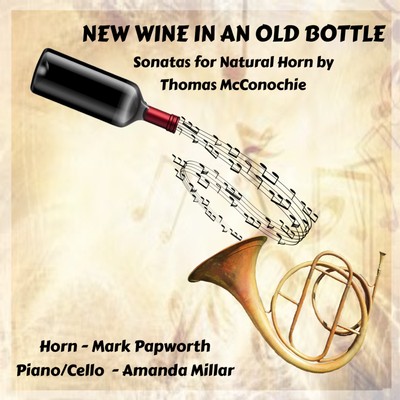
NEW WINE IN AN OLD BOTTLE

Mark Papworth and Amanda Millar

Move Records MCD 632

Here’s a perplexing product: a set of four sonatas (one is actually a sonatina) for natural horn with accompaniment for fortepiano or cello. I know Papworth’s ability from another Move Records issue of Wagner Ring chunks, Siegfried’s Story; Millar is an unknown quantity in my experience. They have devoted their talents to these works by Thomas McConochie, an Australian musician with an interest in the antique brass instrument who produces music to flesh out an almost non-existent contemporary repertoire. Of course, the horn in its valveless form continued in use up to (most notably) Brahms, who had a penchant for the older mysteries, but you’ll rarely come across readings of the C minor Symphony in which natural horns appear.

Now this CD’s title seems to refer to the horn with crooks as the old bottle. Fair, enough. But what is being poured in can hardly be classed as a new wine: it’s vintage, but undistinguished. McConochie’s formal patterns are predictable, as are his melodic shapes and harmonic structure. It had to be so, you’d think, given the natural instrument’s capabilities. For many of us, the natural horn is exemplified for these times by the Prologue and Epilogue in Britten’s Serenade Op. 31. Even given the limitations imposed on the English composer, you’ll hear nothing so advanced here. I can’t see how these compositions have added substantially to the repertoire; rather, they return to ground that was well-trodden by the time of Haydn and Mozart.

The CD doesn’t contain details about the four works’ lengths, so here goes. Like all of them, the Sonata No. 1 in F for Natural Horn and Fortepiano Op. 14 has three movements lasting 15′ 11″: Allegro (6′ 09″), Andante (4′ 58″), Sonata-Rondo (4′ 04″). Next comes the Horn Sonatina No. 5, Op. 16 No. 3 with a duration of 10′ 02″: Presto (3′ 09″), Adagio (2′ 31″), Presto (4′ 22″). A novel Sonata for Natural Horn and Cello in D Major, Op. 22 takes up 13′ 27″: Allegro (5′ 09″), Recitative and Aria (5′ 25″), Presto (2′ 53″). To finish, the Sonata No. 2 in E flat for Natural Horn and Fortepiano, Op. 15 lasts for 12′ 58″: Allegro (5′ 24″), Andante con moto (3’23”), Maestoso (4′ 11″). The whole CD takes 51′ 38″, which is a bit on the under-nourished side. But then, you have to take into consideration the quality of, and degree of difficulty involved in handling, these scores.

I’m probably wrong as far as the horn side of things is concerned, but the piano aspect is unassuming; quite a few of these movements a competent player could sight-read. Both instruments take up the simple first subject of the Sonata No. 1, the piano making most of the running as the movement moves forward, after an overused rhythmic motif that sounds like Mozart . . . no, more a contemporary whose imagination has dipped considerably. The phrases are four-square and nothing new is allowed to interrupt the Alberti bass-rich accompaniment. As for the melodies, these are well enough in their openings but fail of their promise with several awkwardnesses in their rounding-off. What of modulation and harmonic interest, you cry? Forget it. The second movement boasts an ‘Oom-Pah Section’ but this lasts about a minute; the segment sounds like desiccated klezmer, and goes nowhere but simply serves as a diversion from its calm, bland surroundings.

For his finale McConochie hits 6/8 and the suggestions of hunting horns with a few more stopped notes than we’ve heard so far. Still, this is a restrained hunt with an unhealthy penchant for repeated notes and chords. The piano’s solo ritornelli are rather frequent and the main subject of this Sonata-Rondo (rather more of the latter than the former) is yet another instance of the first half being let down by its consequent. You can take as an instance any of the Mozart horn concerto finales but their buoyancy and innate verve show that McConochie has so much to learn about sustaining interest.

Incidentally, the two outer sonatas are written for natural horn ‘and fortepiano’, but the keyboard instrument employed here in both is a normal pianoforte. Would the earlier piano’s use have made much difference? Possibly, mainly as a credible partner for Papworth’s muffled timbre.

For a bit of a giggle, the sonatina is subtitled ‘A Little Bit of Sturm and Drang’; and so it seems, right at the start, but the proposed aesthetic doesn’t last. The first movement is gifted with an opening that is arresting for about two bars, then moves into banality and more awkwardnesses, especially in the use of repeated notes. The horn part is secondary; for sure, Papworth gets to play the themes but the keyboard dominates in treatment and overall activity. As for a prevailing compositional period, it’s still uncooked Mozart. Matters are reversed in the slow movement where the horn gets dibs on the first mournful tune; the central B section moves in to the relative major before the A opening is repeated, This section has more going for it than its predecessor with the establishment of an Eroica-indebted funeral march rhythmic pattern and a definite arch to the main melody. The finale presents as an allegro rather than the prescribed presto and the piano sets most of the running as the horn is limited to finding a relevant note and sitting on it while the keyboard goes around an unarresting series of modulations in the various episodes of this rondo.

Next comes the horn and cello work. Its opening allegro improves in performance security on the exposition’s repeat but the modulations in the development cannot be regarded as much more than predictable and – every so often – clumsy. But the musicians themselves sound uncertain in their work here with very little colour invested in phrasing. The following Recitative is a short introduction with a metrical inevitability that persists until a short horn cadenza leads us into a 6/8 lyric during which the horn enjoys a good deal of exposure; Millar provides an arpeggiated support before taking on the central section’s melody-line herself.. The cellist’s articulation and production values are not always reliable with some obvious difficulties in her part’s upper reaches, so that it’s something of a relief when this movement draws to its end.

There is another trace of the Mozart horn concerto finales in this sonata’s concluding Rondo, but the opening section and its returns prove very welcome after some strained interludes (how many are there? One?). You can see how the work is meant to bounce past with infectious jollity, but this doesn’t come off. Perhaps the players take these pages too slowly; possibly the movement requires more determination in attack and dynamic variation. Whatever the case, music of this simplicity needs high expertise to give it any performance interest because there is not much to grab onto as far as content goes.

The composer believes he learned much from writing his first sonata and feels that this is reflected in the more equable partnership of his E flat Sonata. This may be so but you have to wonder at his idea of distributing the goods. For instance, the opening Allegro‘s second subject is announced by the piano, then the horn, at which point the keyboard’s accompaniment is both prosaic and intrusive. But by this stage of the CD you realize that not much is going to emerge that is strikingly original and the compositional methodology is far from sophisticated, as evidenced by the development pages which hold several instances of ungainly part-writing. Even the scale passages for both executants come across as laboured, hard work rather than imaginative flights.

Not much to take exception to in the Romanza, although McConochie can’t avoid odd strokes that a more aware hand would have struck out like the descending bass’s conclusion before the move into a minore variant, and a piano left hand of no little tedium. With the last movement, we hit the world of variations but not in a big way: there are only three of them and all are quite predictable, if vehicles for Papworth’s expertise more than anything else. McConochie’s theme is four-square and plain and nobody is really stretched – except the horn in the movement’s unexpectedly athletic coda.

Here again, as in so much of the whole CD, I sense a lack of character. You have to take into account the necessary limitations of the brass line; even so, nothing here grips the imagination – neither the content of the works themselves, nor the interpretations offered. I can imagine that the natural horn community might be pleased with these additions to their archives but nothing here advances the instrument’s expressive or technical horizons.

Filling in a neglected corner

LIVE

Victoria Brass

Move Records MCD 641

Brass bands don’t come across your path every day, least of all in these times when they are commonly associated with the military rather than a company that actually makes something rather than weapons. Growing up in Sydney, I came across none except the rancid collection of bugles and side drums that marched in front of our school’s cadet unit. In Melbourne, the Box Hill City and the Kew bands were far more prominent, notably on civic occasions. But, until now, Victoria Brass has not even been a name, as far as my experience has gone. It presents as a conglomerate of players from various sources in the state (chiefly, the city of Melbourne, it appears), gathered together on particular occasions; this disc records several of those – concerts that took place at St. Andrew’s Anglican Church in Brighton, Box Hill Salvation Army Hall, Ian Roach Hall at Scotch College, and Bendigo’s Sacred Heart Catholic Cathedral.

In fact, there are two sets of personnel recorded here – one from 2021 (Bendigo and Brighton), the other from 2022 (Box Hill and Scotch). You will find a few variations across the year space. Soprano cornet and principal cornet remain the same, while the four solo cornets are all different, as is the repiano cornet. All second cornets remain the same, one of the three third cornets remains the same, and the flugelhorn is taken by two separate players. All horns and euphoniums remain the same, but the 2022 line-up has a second euphonium. The solo baritone part falls to two different players and the second baritone set-up shares one player – but the second baritone in 2021 becomes the solo in 2022!. The solo trombone stays the same over the years, but only one of the second trombones survives, and the bass trombone player changes between discs. Tuba personnel stay the same, apart from an extra B flat player in the 2022 recordings. Finally, percussionist numbers change from five in 2021 to three in the following year; in the latter, there are two survivors and the fifth-named in 2021 plays among the third cornets in 2022! In short, it’s a slightly claustrophobic little world and I haven’t noted all the benched/interchange players – just the obvious ones.

As for what they play, the 2021 ensemble present the Toccata that concludes Widor’s Organ Symphony No. 5, an arrangement of the Benedictus from Karl Jenkin’s The Armed Man Mass, another arrangement of the fourth movement to Saint-Saens’ Symphony No. 3, a version of Sullivan’s The Lost Chord, Handel Parker’s hymn Deep Harmony, and Philip Wilby’s The Pilgrim’s Progress (Story of John Bunyan). From the next year come the premiere of Andrew Batterham’s Trumpet Concerto with the Sydney Symphony Orchestra’s principal, David Elton, as soloist; Tallis’s Third Mode Melody (‘Why fumeth in the fight’); the finale to the ballet Checkmate by Bliss, Eriks Esenvalds’ Only in Sleep, Jared McCunnie’s Elegy, and part of the Cathedral Square Coronation Scene from Mussorgsky’s Boris Godunov. In other words, half of the tracks for each of the combinations.

As far as I can tell, the fount of all wisdom for all of these tracks is Matthew van Emmerick, an expert director and euphonium specialist who is Victoria Brass’s principal conductor. His soloists are trumpeter Elton, organist Calvin Bowman (the Musicke Master at Brighton’s Anglican church), and singer/narrator Matthew Little who shines in the Bunyan biography.

Some of the music performed is taxing in terms of clear production, particularly under live performance conditions. But there are a few tracks which are straight and uncomplicated, like the several hymn tunes where the demands are mostly for an even dynamic and a secure top line. Still, the Brass get off to an impressive start with the Widor toccata, beloved of wedding organists throughout the Western world. The division of labour in handling those right-hand arpeggios from the original is cleverly accomplished; the top cornets taking the left-hand chords while an active gaggle share the accompanying unbroken semiquaver-figure (or do they? Later on, one instrument alone handles this figure); soon, the bass entry at bar 9 with the composer’s striding pedal line is most impressive. In fact, Bowman takes some part in this arrangement by Philip Sparke, his organ contribution an addition by Philip Wilby, although you’re hard pressed to pick it out – perhaps the sumptuous bass line from bar 50 on? Certainly, he isn’t called upon to provide those incessant semiquavers when the score moves outside the top brass’s range.

Batterham’s concerto in this band accompaniment version is a fine example of expert and sympathetic writing for soloist and a brisk revamping of the original orchestration for strings. While the composer might well be a master of various genres (as claimed in the CD booklet), this piece is written in something I can only call contemporary orthodoxy, not varying much from the kind of jaunty dissonance (not too much) to be found in British composers of a century ago. For example, the middle movement is a flowing, lyrical andante with plenty of Elgarian warmth in its chord progressions and calm suggestions of the organ loft, as well as a graceful economy of melody.

Like the quick declamations of the opening movement, the third forges a bright path for all, right from the start with its pizzicato strummings supporting a fresh-faced 6/8 solo arc, with a wood-block clicking quietly during one of the episodes and a timpani/bass drum emerging in the finale’s later stages. But, as with all good concertos, the emphasis sits firmly on Elton’s solo line which has an attractively jaunty character in the score’s outer pages and a dexterity that you’d expect from the work’s prime executant. Not much of gravity is being expressed here but the work stands as a more-than-worthy addition to a repertoire which is not that substantial; it’s probably not true, but the last trumpet concerto written by an Australian composer that I can recall is Raymond Hanson’s product of 1948! That can’t be right, can it?

Not much to report about the Tallis arrangement by New Zealand cornet/conductor Ken Smith. He gives three iterations of the theme as outlined in Vaughan Williams’ Fantasia with pretty orthodox harmonizations, the second heavy on lower brass and a few cadential descants for the cornets in verses 2 and 3 with a somewhat superfluous Amen added by way of conclusion. Eric Ball’s highly active arrangement of the Finale to Bliss’s ballet becomes something of a broad-beamed melange before the block chords denoting the Red King’s last stand, and there are a few messy notes in subsidiary lines near the movement’s opening. But the aggressive last pages are confidently carried off.

Starring in Tony Small’s arrangement of Jenkins’ Benedictus is euphonium soloist Michael Wells who gives the original’s solo cello line a welcome infusion of clarity and an absence of swooping and near-glissandi that can cripple the work’s innate sensibility. As well, you would go some way to find a moment as powerful as the Hosanna explosion in this reading. But it’s easy playing, I think, for both soloist(s) and ensemble, with nothing of great technical moment apart from maintaining dynamic control. And, as when listening to Lloyd Webber’s Requiem (and in certain phases of Britten’s War Requiem), it strikes me that the emotional effect is too simple, too calculated to manipulate; but then, I think that about the In gloria Dei Patris of the Missa Solemnis and nearly everything in the Verdi Requiem.

Another Wilby arrangement comes with the Saint-Saens Maestoso – Allegro with Bowman kicking off all our Babe memories. The arrival of that noble main theme almost works except for the organ dynamic level which is not loud enough to complement the ensemble taking on the strings’ announcement of the chorale; also, the piano four-hands scintillations here are sorely missed. A good deal of the movement is omitted; just as well, as the absence of woodwind and string timbres would be very noticeable if Wilby had stuck to the original’s grandiose self-indulgent repetitions. As well, without the original instrumentation, organ and brass are a tad disjunct as far as tuning is concerned, especially in the fortissimo pesante section at Letter GG in my International Music Company 1950 reprint score, Again, you can hear some high notes fluffed if you listen hard enough, and the tempo seems to be rather ham-fisted – insistent, regular, lacking much elasticity.

I liked the simplicity of Esenvalds’ setting of Sara Teasdale’s gentle poem; his melody is folk-simple and the rich choral fabric under the soprano soloist impresses for its timbral depth and suggestions of consolation, even when the choir takes over in the work’s centre. In this arrangement by Phillip Littlemore, the Brass’s flugel horn, Andrew McAdam, substitutes for the solo voice and the results are pleasing, especially as an instance of a sustained melody enunciated seamlessly and with emotional restraint.

Wilby’s own work celebrating Bunyan impresses for its vision, even if the identification of the Puritan writer with his own Christian seems ingenuous. This work begins with an unaccompanied male voice singing Who would true valour see/He who would valiant be to Vaughan Williams’ setting of the melody line – all three stanzas. Having accomplished this, Matthew Little then starts on a set of read excerpts from The Pilgrim’s Progress with musical illustrations: The Journey, Meditation, Vanity Fair, and The Celestial City. In other words, we are given a selection from the writer’s narrative as the hero is divested of his burden and journeys to his transfigured end.

You hear traces of the hymn tune early in the suite but, of course, it comes into its own when the pilgrim arrives at his destination. As illustrative music, the work meets expectations, notably in the rapid hurly-burly of Vanity Fair. The Brass are agile and solemnly stentorian in turn but there isn’t a good deal of audience challenge in The Pilgrim’s Progress as a musical experience. It’s probably more intriguing for brass players. Nevertheless, the work has appeal as an illustration of how to score for brass and organ in four separate scenarios.

Melbourne composer Jared McCunnie’s Elegy is part of a larger work, SIEGE, which deals with the Martin Place Lindt cafe disaster of December 2014. The score ends with this movement which commemorates the two victims: Tori Johnson and Katrina Dawson, the latter dying from police-generated shrapnel in one of the more cack-handed terrorism-related incidents of modern times. This movement is calm, slow-moving, rising to a powerful climax before dying out into unforgiving silence. McCunnie’s language is uncomplicated and earnest in emotional character, his elegy doubling as a lament for the waste of two useful lives.

I can’t remember when I first heard Sullivan’s very popular song; probably in my teens when all I knew of the composer were some of the Savoy operas. It isn’t as off-putting as many another wrenching Victorian-era gem of religiosity and there’s a good deal to be said for performing it in arrangement, like this excellent version by notable British brass band expert, Gordon Langford, which gains a great deal from Bowman’s organ in Brighton. A very truncated version of the Kremlin coronation from Mussorgsky’s opera (another Littlemore construct) seems to conflate two segments, leaving out the self-torturing aria that the Tsar sings to himself while the crowd and boyars are apparently otherwise occupied. You can hear an uncertain cornet wandering at one stage and there’s some rough trombone work later, but you get the general flavour of the scene, with even a break for a carillon. All very exciting but, sadly, a pale echo of the real thing.

The disc concludes with a flawless reading of Handel Parker’s hymn, arranged by American academic Lee Harrelson. Apparently, Victoria Brass uses this four-part harmonization as a rehearsal warm-up and it makes a modestly rich-flavoured ending to the ensemble’s endeavours. To be honest, I prefer the sense and stability of such slower tracks on this recording to the frenetic or heftier offerings, although the Bliss Checkmate is a stand-out. Like a good many other musical observers, I’ve not encountered a brass band in the normal run of concert-going; this product by Victoria Brass shows that the loss has been a significant one, made all the more telling by my grandson’s enrolment this year as a trumpet student at the Victorian College of the Arts; I feel that my ignorance of brass literature and performance practice is about to be remorselessly filled in.

Last sonatas but not the last word

A BEETHOVEN ODYSSEY VOLUME 7

James Brawn

MSR Classics MS1471

Carrying us onward towards the conclusion of his complete Beethoven piano sonatas cycle, James Brawn has grouped the final three works in the series under one roof. It’s a bold move, presenting the major intellectual challenges before taking on an imposing technical mammoth: the Sonata No. 29 in B flat, Hammerklavier. While this last-mentioned is the preserve of master-pianists (although I’ve heard a few readings that disappointed greatly, including one where the performer simply left the stage mid-slow movement), each of the final three sonatas features commonly in recital programs these days – much more than half a century ago when they were avoided in favour of more agreeable works with appealing nicknames.

The favourites linger, of course, Pathetiqueing, Moonlighting and Waldsteining their ways across recital programs until their appearance induces frissons of ennui: you know that nothing informative will be achieved across the duration of yet another Tempest or Appassionata but, like Christians the world over, you wait in hope (usually disappointed). With the last three sonatas, you can expect more fine gradations of interpretation. It’s not that they are more difficult to get around than their predecessors, although certain movements are risky – the Prestissimo from No. 30 in E Major, the I’ve-been-everywhere fugue that concludes the A flat Op.110, and the multi-layered Allegro of Sonata No. 32’s first movement.

Brawn’s reading of Op. 109, the E Major Sonata, is blessed with a well-matched pair of opening movements before the disproportionately long theme-and-variations conclusion. For the opening Vivace/Adagio, he finds an appealing give-and-take set of speeds which don’t over-egg the changes from the initial two-note motif-chains to mini-cadenzas (bars 9 and 58), passages that often enjoy a piacevole treatment rather than the disciplined observation of underlying pulses that obtains here; why the hell would Beethoven have bothered with those explicit groupings of demi-semiquavers and hemi-demi-semiquavers unless he wanted pianists to exercise a relative tempo ratio? Brawn’s care for detail shows out in minutiae like his handling of the last crotchet’s worth of bar 12’s right hand, and the elision of those wafer-thin joins between segments (bars 9, 15, 57 and 65).

The following very fast movement also shines for its sensible treatment, the pauses slight and used to mark a differentiation of attack rather than employed for the usual excuse of repositioning a hand. Brawn makes full use of the expression markings (well, those in Wallner’s edition for Henle), with a few clever dynamic pulling-back instants that serve to keep the onward rush buoyant. And here was one of the more fluent transfers of attention from right hand to left at bar 112; it only lasts a few seconds but it’s become one of my discriminant points for determining a player’s dynamic balance and care in avoiding bluster.

For the sonata’s largest span, the third movement theme and six variations, Brawn shows the requisite alternation between ultra-sensitivity, as in the hiatus breaths he employs during the melody’s first articulation’s phrases, and helter-skelter jollity (Variation 3) alongside an Handelian determined simplicity during Variation 5’s fugal mesh. The executant shows commendable care with the second variation’s juxtaposition of detached semiquaver two-note motives and the broad chordal thematic treatments (bars 41 and 57). A more relaxed approach typified Brawn’s handling of the Etwas langsamer variation which enjoyed a quietly splayed outlining; not enough to undercut the prevailing metre but sufficient to suggest a surging barcarolle.

For all that, you have to relish this pianist’s bringing the sonata home in the final variation where the sustained trills on B (with a brief excursion to home-key E) generate an underpinning that threatens to overpower the material being outlined both above (mainly) and below. With a further example of that insight shown across this odyssey, Brawn observes a dynamic level that doesn’t distract from the composer’s strands of operation; you find no heavy pounding of those arpeggio/broken chord chains that reveal a simple, devastating musical deconstruction before the theme returns en clair, bringing us round to full term.

I’m not so taken with the first movement of Op. 110 in A flat Major. Admittedly, Beethoven’s writing is fitful, putting a sonata-form shape through several odd wriggles and engineering sudden changes in tonality. Brawn underlines these oddities and abrupt shifts by pointing them up (or out) with brief pauses, so that the movement advances as a set of episodes rather than as wholly-woven fabric. I suppose it’s a fundamental problem of interpretation – how do you treat a chameleonic canvas? – but my view comes down on the side of playing the pages without any tangential commentary on the not-so-subtle shifts in register alongside the traditional modulatory brusqueries.

Not much to find fault with in the ensuing Allegro molto. Brawn keeps a cool head, especially when faced with the invitation to belt out the forte and sforzando chords. Further he gives the central D flat Major trio some lucidity by not accelerating or moving into a slushy over-use of the sustaining pedal. Still, this page-and-a-bit is hard to integrate in any sense; you can’t call it aimless because it has direction (mainly down, from a fair height) but any congruence with the surroundings escapes me. Of course, I could go to that bank of scholars and hanger-on pedants who make theses and careers out of explaining these ‘problem’ sonatas but life’s too short; well, it’s getting that way in this quarter, what with the endless struggle against infections both physical and mental, particularly now that we have returned to normal after the Australian Open has limped to its flaccid conclusion.

You can find more justification for Brawn’s pointing-up character in the tragic-heroic last movement of this work where arioso, recitative and fugue are assembled in a carefully staged scenario of lament and ebullience. The pianist is very painstaking with his left-hand chords and their shadings into one another right across the Adagio ma non troppo when it really starts (half-way through bar 7). Further, his outline of the Klagender Gesang itself proves to be irreproachably clear and poised, With the fuga‘s first part, this reading preserves a contrapuntal clarity and control that obtains up to and throughout the reinforced bass explosions at bars 45, 72 and especially 101. Brawn also manages to suggest the rests between those enigmatic semiquaver chords from bar 131 to 134 while still following the sustained pedal direction.

For the fuga‘s inversion and complexities, this interpretation takes the high road by treating the score with respect, ensuring clarity even as the argument becomes more determined at the change of key in bar 153. Further, in the final pages where the material is reduced to an alternating bipolarity and Beethoven stretches further and further outward to the topmost and most bass-ic limits of his instrument, Brawn observes the decencies, articulating with weight but without bombast or hysterics. Which gives us a reading informed by warmth and integrity, one where I can’t find any note or gesture out of place.

Last of all comes the C minor Op. 111: a minefield, they say. It’s not technically over-remarkable but its first movement offers too many opportunities for pontification before and after bar 19 where the Allegro kicks off properly. Brawn is awake to the inbuilt drama of the scene-setting seventh chords at the opening and the unsettling hiatus chords between bars 6 and 10 where expectations of regularity are roused and left unsatisfied. He is quite happy to indulge in a considerable hold-back whenever he comes across a poco ritenente in the main dramatic chapter, while some hard-pressing passages come within cooee of dragging, e.g. bars 37 to 42. Then there emerge some fine sweeps of impassioned confidence; for example, the crescendo at bar 96 leading to a marvellously contrived piece of contrapuntal display, rich in octaves from both hands until the escorting semiquavers take over at the end of bar 108.

Another effective interpretative illustration comes in the final bars. After a chain of eight sforzandi and a vehement tonic affirmation, the subsequent chords become epuise, until the menacing semiquaver runs emerge in the bass while the right hand consoles with three resolutions into a tierce de Picardie – a passage that brings to most minds the penultimate relaxation (8 bars from the end) in Chopin’s final Op. 10 etude.

Yet again, I’m impressed by Brawn’s intellectual control, specifically in the second movement Arietta with variations. His initial pace is spacious, and you can hear every element of the chord work, no matter how raw the texture. Each variation is welded into a framework that relies on its foundation rivets, no matter how discursive or florid the embellishments. I’ve listened to these pages several times, making sure that Brawn gives exact measure in the syncopations and displacements of the later variations when tied chords or notes ask for intense concentration from an executant; or further on when both hands operate in the bass clef (bars 65 to 71, 81 to 88) and those left-hand groups of nine demi-semiquavers hare murmur clearly; or closer to the end when Beethoven brings in his trills, which are delivered in this context with unstudied regularity.

The CD is an excellent sample of Brawn’s powers in Beethoven performance. The three works are treated with a respect and firmness that reveal an intimate awareness of the composer’s demands and a fidelity to the works’ aesthetic compass – true to the drama, the gravity, the incredibly powerful impetus underpinning what can look on paper like ambling. This isn’t Brawn’s final odyssey leg – there are two more discs to come – but it’s a considerable and bracing contribution to the journey.

Fiat lux

THREADING THE LIGHT

Felicity Wilcox

Move Records MCD 636

I don’t know how to catalogue this four-part exercise. According to the notes available on the Move Records site, the score formed the basis of Wilcox’s Ph.D. submission and was written between 2008 and 2012. The composer provides a good deal of technical detail on how she contrived the background/supporting musical stream that runs throughout the work. As you probably know if you’ve dabbled in academia, very little impresses a supervisor/examiner more than graphs, tables and photos of mechanisms; the trouble lies in interpreting the numbers which few people (except those paid to do so, viz. supervisors and examiners) can be bothered attempting. I had a few tries and got some way in – but then you listen to the CD and have to wonder at the need to explain technical details when the whole product presents more puzzles than the technical tooling around with frequencies extracted from or supplied by Sydney percussionist Michael Askill’s singing bowls.

Wilcox’s four soundscapes go by elemental titles: Light, Water, Blood, Fire. The overall emotional tenor of the work is meditative and ritualistic, with a heavy accent on Near and Far Eastern practices. Not that you wouldn’t be aware of this from the composer’s instrumental fabric, but it helps that she uses singers who beaver away at various texts that might give some reinforcement or illustration of the work’s four generic titles. Soprano Alison Morgan, contralto Jenny Duck-Chong and baritone Mark Donnelly are the nominated vocalists, the last-named moving very close to a tenor range in the score’s latter pages – a tribute to Donnelly’s versatility.

It’s a mixed ensemble that provides the bulk of Wilcox’s output, all led by Sada Muramutsu. Top of the town sits a string trio: violin Anna McMichael, viola Luke Spicer, cello Anthea Cottee, with a prominent part allocated to Alison Pratt and her multiform percussion. As a central body, we hear a string quintet: violins Ben Adler and Victor Wu, viola Tara Hashambhoy, cello Anthony Albrecht, bass Muhamed Mehmedbasic, while Ben Burton supervises the composer’s electronic instrument. Once again, according to the online booklet, the recording’s mixing and mastering (Daniel Brown at Trackdown) was carried out in March 2012 – which means this disc has been a long time coming.

One of the more intriguing compositional bases that Wilcox employs is a contrast between just intonation and equal temperament, the first sourced from the bowls and manipulation of their output while the second is the regular tuning of the string-rich ensemble. Any disjunction between the two tuning systems is not apparent at the start of Light, Track 1, but the aim is to refine the difference into obviousness by the time we reach Track 4, Fire, so that eventually a palpable disjunction obtains. God knows the difference ought to be clear as the work moves at a ceremonial pace for the most part and the progress is rarely interrupted by technical conundrums of a significant order – apart from the electronics which seem happy for much of the time to bathe us in a soothing infinity pool of familiar warmth layers..

So we begin with Light and plenty of bowl sounds, some of them sounding real-time, others pre-recorded. The atmosphere is hushed, reverent and inescapably oriental. A female voice (Duck-Chong?) begins singing a three-note Vedic mantra about sacred light illuminating us. A continuation of the subtly pulsing backdrop brings forward a male voice (Donnelly) celebrating the light of Allah (as outlined in a Quran verse) in a melodic arc that seems to be farther-ranging than the first solo but is limited to the same three notes (plus some octaves). At all events, simple percussive tinklings emerge in the struck-bowl main timbre-world and take on some prominence here as punctuation points. I believe it’s Morgan who gives us the final textual content with a Buddhist lama’s prayer of thanksgiving (for light, of course); again, her material follows the same trail as blazed by her peers. What follows is an instrumental slab where the three base notes are elaborated and twisted into all sorts of predictable shapes by McMichael with two essays in melisma, eventually followed by Spicer and Cottee rising out of a sonorous band supplied by the string ensemble with some occasional high bells and an underpinning current of bowl sounds operating as a support.

The language is deliberately limited but the dynamic level moves from meditative calm to fierce percussiveness. At its opening, Water sets a suitably limpid atmosphere with sustained bowl sound-bands, the strings entering gently in high/harmonics strata, with an occasional dollop of a Wilcox gesture where a soft string passage or crescendo ends in a chordal thump. The composer’s textures now have become less transparent, her string ensemble producing a sustained mid-range sound-band that could have escaped from Penderecki’s Threnody. Suddenly, we have moved into a new and completely unexpected segment where the bass is a five-note cantus firmus above which Cottee pours out a sad if mobile lament. It’s the sort of music that struck me as being useful for indicating a transcontinental trudge of the Burke & Wills genre, but no: such an interpretation is overturned by all three singers breaking out in an (eventually) unison setting of the opening lines to Psalm 23 (22) with a strikingly non-impressionist vision of the still waters. It’s hard to penetrate the vocalists’ Hebrew, given the strident accompaniment, but with a few hearings under the belt I’m not sure whether they reach the final phrases set out in the online booklet about being guided along straight paths for his name’s sake.

We are again grounded by two more settings which appear in reverse order to their printing in the booklet. First come a few lines about the Lord pouring out blessings, written by the composer’s brother, Rev. Dr. Gavin Wilcox who died in 2008 from cancer aged 46, and to whom Threading the Light is dedicated; this setting is a wide-ranging one with a welcome addition of vocal and instrumental glissandi that relax the three- or four-note limitations exercised so far. Duck-Chong and Donnelly outline an anonymous Buddhist prayer (well, most of it) about rains filling streams and oceans being reflected in the exercise of human goodness in healing all things. Here. we’re back in limited ground, Duck-Chong’s line at least mobile while the baritone sings a single note. Then the movement ends in similar condition to its predecessor: in a lengthy interstellar hum punctuated by a single note.

Comparatively brief in this context, Blood lasts for 6 1/2 minutes and uses one text; well, actually two, but the second comprises just two Latin words for blood. The main one is a Vedic mantra in which the aim is complete identity between the chanter and whomever/whatever he is addressing; not so much blood will out as much as blood is blood, as we say in Calabria. The movement opens with a Bloch-reminiscent cello solo couched in a more adventurous vocabulary than that used by the Jewish master. Donnelly sings through the Sanskrit quatrain with similar adventurousness before being joined by the female voices who generally finish off his lines for him. I think the mantra is repeated three times, the latter two a pulsing monotone in Donnelly’s case; underneath come sinuous strings arcing and glissading above an insistent timpani. Here, the ceremonial achieves its hypnosis through forceful insistence, rather than quiet repetition.

The movement’s second half comprises mainly an interweaving of the three voices, sticking to a limited number of notes for each and treating the two words sanguis and cruor with increasing intensity that involves aggressive string linear interplay and a vehement undercurrent iof percussion, including a prominent side-drum. Without a score, I can’t make much insightful headway into the work’s interstices but, once again, it appears that Wilcox is deliberately confining herself in her material while expending more adventurousness on drama; this piece ends with an explosion, not the suggestion of an all-embracing, eternal continuum. The final strokes have the singers returning to the Veda’s final words, ‘Light of all lights’.

Last comes Fire, about double the length of Blood. We’re back with the singing bowls straight away and on the lookout (listenout) for a change in temperament and pretty quickly there’s a scale that announces the new – the changed, rather – followed by the cello playing an imitation, possibly to illustrate the technical differentiation. The string group focuses on a single chord, alternately soft and loud, sustained and agitated before the bowl music returns and integrates itself with a single string line. So far (about a quarter of the way through), there’s little to grab on to, even if you’re prepared to find fiery flickers in the alternating timbres. Then comes another of those bowl scales which is definitely filling in your usual well-tempered cracks; the ensuing cello solo (Cottee, I assume) now seems to be doing the same thing with another odd scale/arpeggio upward motion/gesture before a substantial solo that features some welcome technical flourishes. This merges into a chord and some isolated ejaculations for all three vocalists which dissipate into a sort of tutti for strings and bowls.

The voices enter; first Donnelly, with another verse-prayer from Gavin Wilcox, speaking of the individual’s helplessness and a complete frailty that depends on the Lord’s support to survive. Meshing in with this comes yet another excerpt from Psalm 23 (22) – the bit about walking through the valley of the shadow of death but enjoying divine support from both rod and staff. As before, the Old Testament extract is sung in Hebrew and I think has been entrusted to Duck-Chong because it sounds as if it’s Morgan who immediately breaks in with yet another text: an anonymous saeta to Our Lady of Sorrows which bears a close resemblance to the Stabat Mater‘s first stanza. In all three vocal lines, we have returned to the tonal chastity of the work’s opening, Wilcox using few notes and maintaining a regular pulse of one note repeated twice underneath the singers; nothing like a constant unvaried pulse to suggest the hieratic.

This slow, lurching pace continues through the final sung fragment which is for all three voices and is an evening prayer ascribed to Muhammad, a salutation that again records the worshipper’s total dependence on God. The vocalists rise to a vehement climax that involves the interjections of slapping-sticks, the episode culminating in an instrumentally reinforced open-chord Amen – very Muslim in its decisiveness. And immediately we are changed, in the twinkling of an eye, back into the outer reaches of the universe with a final sample of sustained humming and soft high strings. I’m not sure what part fire plays in all this; I suspect that where I expect the vivid and the passionate (the ardent), Wilcox is more concerned with the (divine) spiration that ignites us all. Sad to report that, at about the halfway mark of this finale, I’d forgotten completely about listening for the disjunction between Wilcox’s two tuning systems; it’s certainly there – he that hath ears to hear, let him hear.

Congratulations to Wilcox and her collaborators for getting this CD into the light of day. It strikes me that its content deserves attention, principally because of its rarity in celebrating the numinous with individuality and doing so by using in part a novel language of sound sources. A kind of catholicity pervades the work, the textual sources highly varied in their origins, and the musical content falling into a strange land. Somehow, the orthodox sits alongside the novel – and not just alongside but the two intertwine. Indeed, it is these moments of fusion that interest me, more than the singing bowls as an isolated creation. Most listeners, I believe, will find something admirable in the course of hearing Wilcox’s substantial musical essay, not least her vaulting ambition.

Why not take all of me

LIGHT IN DARK

Jennifer Enchelmaier

Move Records MD 3465

One of the oddest anthologies I’ve come across, this CD features all the (till-now) known piano solo music by Tom Henry, a Melbourne-based composer who began his career path as a flautist before changing to the more idealistic, top-of-the-class transcendental role of a composer.   He has an ideal interpreter in Enchelmaier who lavishes her skills on rich and poor alike – or perhaps it would be better to distinguish between the junior and the elder, the tyro and the proficient, the smooth and the rough.  What is apparent is that Henry travelled through a not-uncommon creative trajectory that began with imitations of the masters, then switched overnight to a cracker-jack contemporary style which takes the wind out of your sails through its stark contrast.

But then, this vault between light and dark (you choose) is not at all clear-cut.   Enchelmaier begins with 14 pieces stretching from 2003 to 2006.   They come in various groups: three Songs without words (2003-2006), three Studies for modern times (2005) and three Ecstatic preludes from that same year, a slightly puzzling brace from the composer’s 2006 Pieces for children (originally three in number, but A Funny Game has been omitted  –  hence the descriptor here of From ‘Pieces for children’).   Then there are the Three short pieces for piano of 2005 which take on the function of a midriff punch after what we’ve heard so far because they sound like Webern of the Variations for Piano alternating with Schoenberg of the Drei Klavierstucke.   And these lead into the Piano Sonata No. 1, written for Michael Kieran Harvey and an excellent vehicle for that pianist/composer’s scintillating skills.  This is followed by the forward-leaning Three pieces for piano of 2010, and the one-movement Piano Sonata No. 2 written four years ago and less elliptical than its predecessor in the form from 2006.

We start with the Ecstatic preludes No. 1 – Like an omen.   Well it’s ominous enough, taking its opening cell – a clipped, falling interval – and putting it through some unremarkable, post-Rachmaninov harmonic changes.   No, not so much ominous; more, a prophecy emanating from a Tarot reading.   Sensual and languid depends for its mood-setting on surging scales that aren’t allowed to take over the message which is a carefully circumscribed melody that suggests the eroticism of Saint-Saens.   Finally, Calm and flowing presents as something of a study for the right hand which reserves its melodic interest for the middle two notes of every quaver group of four; as I’ve mentioned before, this is written in a style that suggests Rachmaninov but without the surprises, harmonic or lyrically transporting.

Pop song is the first of the Studies for modern times; not too modern, I’d suggest, as its language is lush and harmonically too subtle for anything I’ve heard from the gutter-mouthed rappers that captured the imaginations of my students and too frisky in its instrumental range to compete with the musical debris that spews from my gym’s sound-system.   Not to mention that the vocal range required to sing this piece would be beyond the abilities of anyone currently performing on any ‘pop’ stage.   The death of Pope John Paul II prompted April 2005 which manages to sound optimistic and elegiac at the same time.   Henry imposes a fair amount of bell-ringing on us with a running scale figure doing the peals while a few chorale-suggestive figures range across the keyboard; it’s not La cathedrale engloutie (the pace is too rapid for Debussy’s lush washes) but the liturgical suggestions are there for those unkind enough to find them.    And the composer’s forging along an harmonically conservative path seems right in line with the heritage (such as it remains) of Karol Wojtyla.    Last in this set, Film theme suggested all sorts of possibilities.   It’s got a rolling undercurrent of left-hand arpeggiations and a ‘noble’ tune in block chords that proposes all sorts of visual equivalents – the Australian bush but not too far west of the Great Dividing Range, a Mary Tyler Moore family drama, Avatar 3 in its pictorial obviousness, perhaps even a Big Sur Buddhism scenario in a cleaned-up Kerouac setting.

From ‘Pieces for Children’ involves A sad story and Barcarolle.  You might find signs of Schumann here, although Mendelssohn is more the go despite some harmonic slips and slides.   The story has a melancholy fluency to it but it could be played at sight by a reasonably competent pianist; Enchelmaier spices the outline with clever phrasing and sympathetic dynamics.   As for the Venetian scene, you look in vain for any complexities; the pulse is regular and the right hand melodic outline is not distinctive enough to distract from the piece’s lack of adventure or colour, despite some sudden swerves into a new tonality – for a moment.

Henry admits to a collegiality with Mendelssohn in introducing his Songs without words and the three small-frame works share a certain picturesque reflectiveness with the German composer’s miniatures.   Remembrance is upper-level lounge music with a wealth of added 7th chords and a definite lyrical shape; I was distracted by an odd resemblance in the work’s emotional character to Joseph Kosma’s Autumn Leaves  –  not that there’s anything wrong with that.   More blues-inflected chord work emerges in Nocturne, a simple ternary shape with a very long central section (in relation to its surrounds) but the initial flourish is attractive enough to tolerate repetitions.   New York comes over as a sort of ambling promenade not that far removed from Loved Walked In but bedevilled by its unchanging movement of block chords, occasionally spiced up with some arpeggiations; it’s certainly a very benign view of a city that I found menacing and unpleasant, by day and by night.

Now we come to the split where Henry’s compositional language turns into the second half of the 20th century.   Following his studies with Lawrence Whiffin (or probably during that time), Henry produced Three short pieces for piano which are aphoristic in terms of length (in particular the last Molto allegro) and unpredictable in terms of rhythm and harmony which is emphatically atonal and probably 12-tone although you can hear repeated notes and motifs that would disrupt strict application of the rules.   All of a sudden, the listener has to cope with an abstract set of soundscapes, starting with an Andante of tight-lipped stringency, followed by a Piu agitato that is my pick of the three for its expressive range and technical dexterity.   Aficionados of the Second Viennese School will find plenty of reminiscences in these all-too-brief essays.

Henry wrote his Piano Sonata No. 1 in 2006 and revised it in 2011; a fascinating fact although it’s difficult to know what to do with it.   As it comes across on this CD, the composer’s style-world has moved on from brief bursts of a 1920s vintage to short explosions of a 1950s/60s Boulez/Stockhausen variety – at least for the sonata’s scene-setting Theme which looks on paper like one of the Klavierstucken: ultra-refined dynamic markings, glancing shots before a sustained crotchet or minim, subdivisions of rhythm like a quintuplet that’s as much rests as it is notes, leaps of 7ths and 9ths: the whole panoply of serialized physical jerks, although, as I say, I don’t think the principles are being applied in too doctrinaire a fashion.

The following Variations movement is probably divided into six sections, their material emanating from the thematic material of Movement 1.    You can find common intervallic vaults, I suppose, but the music is chameleonic and, despite the divisions, its progress is continuous.    Also, Henry is fond of the direction recitativo; that gives his interpreter all the leeway necessary to handle whimsical creative flights as she pleases.    In fact, most of these sectional indicators aren’t that helpful to the ear: what Henry calls Molto calmo e ritmato requires a large amount of creative listening, as does quasi una Habanera and, later, Violente.  However, you can take pleasure in the pockets of high-pitched pointillism across this variations sequence, as well as Henry’s ear for the dramatic gesture and the pointed repetition.

The finale , Molto perpetuo, presents in two versions: one where the linear rhythmic values are prescribed, the other a sort of breakdown into consecutive quavers.   Whichever one you pick, the results follow a different vocabulary to that obtaining in the preceding two movements.    It winds up being diatonic in character towards the end after a  moderately athletic main body.    At times, I was reminded of an old-time passacaglia where the bass is emphatic and definitely placed while quavers follow their predictable path on top.    In fact, about half-way through, the texture is satisfyingly complex with three layers in full operation.  But this is not your usual perpetual motion rush as Enchelmaier exercises plenty of rubato and dramatic emphases, especially in the last minute where the work seeks the security of a tonal resolution,   This you can receive as a haven or a restoration of the natural order; or you can wonder why, after showing mastery of a contemporary compositional style, the work peters out in a kind of surrender to the tonic.

Which is why the interest arises in the direction of Henry’s revision of 2011.   In this form, the work is lopsided and I wonder whether the Moto perpetuo is part of the original or an addition (or transformation?).   Or take it the other way: that the last movement is a survivor and the Theme and Variations attest to the composer’s adoption of advanced techniques in his compositional address.

Another surprise comes with the Three Pieces for Piano which seem to be homages in their different ways.   Henry acknowledges the influence of earlier writers in his Intermezzo: an attractive expressionist soundscape with some lush writing of considerable warmth interrupted by piercing outbursts of temperament and a quiet tonal ending with a faint echo of the last chord in Berg’s Sonata – a bit fanciful as a comparison but not impossible.    The CD’s title track is a series of episodes that opens with two factors in operation – a chorale, and surrounding decorations both high and low; this disintegrates in several ways, the main ones being an assumption of importance by the colourful material at either end of the keyboard, and an incorporation of the chords into a faster-moving stage of activity.    It’s an odd combination of restlessness and steady progress, but it eventually finds a quiet subterranean resting-place.    Last, Henry’s Toccata also acknowledges the past, specifically Prokofiev whose hefty 1912 gem is echoed here, and I think you can also detect a smidgen of Khatchaturian although Henry sticks with a regular pulse of quadruple-time semiquavers without any relieving triplets such as the Armenian introduced into his flashy pseudo-virtuosity.   Again, Enchelmaier avoids martellato continuity and leavens the movement forward with a pliant ritenuto or four.

The latest of Henry’s piano solo endeavours, his Piano Sonata No. 2 was commissioned for a 50th birthday and is based on the name (most of it), represented in musical notes, of the celebrater.   This piece follows the composer’s studying with Stuart Greenbaum, Head of Composition at the Melbourne Conservatorium of Music.   Certainly, you can hear a change in approach here, more in line with the harmonic smoothness in the Moto perpetuo ending the Piano Sonata No. 1 but, despite the homogeneity acquired by using the name-motif as fundamental, the work still impresses as episodic.   So it’s not really your old-time sonata form at play here but more like a rondo.   And that doesn’t really get to the heart of the business because the apparent wholescale reversions are few in number.

For instance, the sonata opens with a stately theme set out a an octave or two, this sentence moving with an effective stateliness, even grace.   That rhythmic movement then changes abruptly to a gambolling bucolic episode, somewhere between Vaughan Williams and Bartok at his least acerbic.   Here Henry sets up a pattern of rising and falling scales in both hands that takes over his forward thrust; these are especially noticeable in pages where the right hand carries out its ups and downs while the left hand generates chords that follow a scale progression, albeit more slowly.   Mind you, the derivation of this developmental matter from that opening cell is clear as day.    Not sure about what follows when an arresting trill leads into Ondine land with some voluptuous colour washes giving way to a return of the bucolic skipping toned down and the scales are replaced by ‘open’ arpeggios in the right hand that reach a highpoint about half-way through the sonata.   Another bucolic trace element and a richly Romantic meditation with a spectral recurrence of the opening noble striding in arpeggiated format before we enter the last lap with Henry employing a falling interval as his calm farewell to arms.  

It’s here that Enchelmaier comes further into the picture by singing this two-note phrase to the ejaculation He-ya in a concordance with her piano part.    This vocal line involves both a rising and falling minor third in alternation, then rising and falling perfect 5ths.   According to Henry, the  intention is to accentuate an intended atmosphere of meditative stasis, and it kind of achieves that end in a coda that even revisits the countryside, albeit in slow motion, before the movement slows to a definite ending, despite its ephemeral dynamic.   You  might have expected, after pages that exercise a kind of impressionism in their harmonic ambiguity, that Henry might leave us with an added-note chord, reinforcing the unfinished nature of spiritual experiences.   But no: when Enchelmaier breathes her last rising murmur in a space where words have no substance, the sonata resolves onto a minor chord with no interrogatory accretions.

You have to take your hat off to Henry who reveals every part of his achievements on this disc; it’s not a Greatest Hits selection but the entire oeuvre that he has written (so far) for solo piano.    He shows us his beginnings with a late (and sometimes middle) 19th century bent, using the conventions of that time (in fact, there’s rather a lot of these pieces, as they take over half-an hour of the CD’s 72 minutes’ length); then comes the abrupt shift to a world of technique-shaking demands familiar to us survivors of the challenges promulgated by Bussotti, Berio and Kagel (not to mention the apparent insanities committed to manuscript by Pousseur and Ferneyhough); finally, it’s an arrival at the ‘new lyricism’ where ev’ry compositional mountain and hill is made low.   All of this makes for a refreshing, wholesome hejira, one that is probably not completed.   Along his path, Henry has been gifted with a sympathetic and conscientious interpreter who exerts her considerable interpretative craft across each of these 21 tracks.


Nobody hangs around too long

RHYTHMS OF GREEN & GOLD

John Martin

Move Records MCD 622

I’ve been ambivalent about jazz and all its offshoots for many years. After the initial rush to the head during young adulthood when Monk, Mingus, Davis and Coleman set impossibly high levels of accomplishment and virtuosity, an inevitable reaction set in, similar to the disillusionment that comes to us all through an excess of Wagner or Mahler – when you realize the importance of emotional brakes, if nothing else. Just as with low culture’s implementation of serious music – who can forget the drum-kit added to Mozart’s No. 40, or the smoothing out of dissonance in Copland’s Fanfare? – just so do you have to acknowledge the bowdlerization of jazz’s limitless potential in melody, harmony, rhythm and timbre. Many of my contemporaries would remember still the adoption of jazz in the 1950s and early 1960s as entertainment for the pretentious young habitues of Melbourne’s clubs, the brief flash that marked the advent of Brubeck and the MJQ (mainly in recordings, although I heard the former play at Rushcutter’s Bay sometime in 1960), not to mention a few out-of-left-field experiences like the 1965 appearance of Thelonious Monk in the Melbourne Town Hall, playing to an audience of about a hundred of us. But today? The well-worn furrows have been ploughed to base rock and you look fruitlessly for anything original outside the realms of fusion – which is to say, compromise.

This disc offers 19 tracks of solo piano, compositions old and new by Australian composers (hence the CD’s title reference to our national colours – which aren’t any such thing, of course, as this country is still marching in a vexillatory two-step with its colonial master) some of whom offer refined takes on jazz rhythms, if not much else. About half of the writers are well-known, like Elena Kats-Chernin, Ann Carr-Boyd, Stuart Greenbaum, Ross Edwards and the performer himself. A few names rouse tremors in a waning memory bank, viz. Rod Heard and Matthew Dennett, while others have escaped my attention – Amanda Handel, Tom Anderson and May Howlett. The most senior writer represented is Howlett while Dennett is the youngest of them. As for temporal substantiality, Kats-Chernin takes the prize with her Nonchalance that almost lasts 7 minutes; at the other end of the scale sits Greenbaum’s Taurus, coming in at 1’30”. Quite a few of the remaining 17 tracks are brief, seven coming in at under 3 minutes.

Sydney composer Handel is represented by three compositions: Dreamboat Blues, Bootleg Blues and Blue Laze, the last-named being the most substantial. Martin’s reading of Dreamboat is laid-back, to the point where its underlying pulse is relaxed at two obvious spots; the structure is simple, 7th chords abound and no ripples are raised. A jaunty syncopated bass line prefaces the Bootleg drama which features a more adventurous harmonic palette, even if the format is little more sophisticated than its predecessor; again, Martin allows himself a rhythmic flexibility – although that might be written in. Blue Laze is a pleasant post-Gershwin laze which too often sounds like an exercise in peregrinatory chords, its deliberately lolloping bass a genial support for upper meanderings that are amiable if aimless. All these pieces are of an unobtrusive genre of jazz with nothing depressing or ‘dirty’ about them; another way of saying that they’re lacking any decided personality.

Tom Anderson has published a collection of rags – won prizes for them, no less. His A Walk Down Ragtime Lane is a fair representative of the genre with various clear-cut segments jammed alongside each other in the best Joplin tradition. Again, Martin puts in the odd hesitation, almost as though he’s finding a bit of trouble handling what sounds like a pretty easy-fitting modulation. As with a good deal of her work, Elena Kats-Chernin’s Nonchalance exists in several forms but the piano version here is something like a slow toccata or a piano study; there are a few jazz traces, mainly in some syncopated spots like bars 13 to 19 but the piece is probably included because of its original genesis as referring to suave characters in old black-and-white movies (George Raft? Or George Sanders?) but its continual middle ground of Alberti-bass type quavers in sets of four is more reminiscent of Hanon than Hampton. It was probably more effective in its original shape for cello and piano. At about a third the length of its companion, Kats-Chernin’s Reflections derives from an earlier suite written for a piece of theatre. Again, there is a binding sequence of Alberti quavers but the piece is appealing for its melodic sentiment: the sort of thing a very competent tea-lounge pianist would present with the merest suggestion of harmonic liberation.

Canberra-based musician Matthew Dennett proposes a nicely meandering melodic upper line in Round Midday but his piece is cursed with a repetitive bass line comprising steady block chords that seem to work against the free-and-easy meanderings in Martin’s agile right hand. I take it as a tribute/offshoot of Monk’s Around Midnight classic and there are plenty of homage points; like the American’s original, it might have worked better (probably does, in fact) with a mixed ensemble dealing with its bare bones.

Three Australian waltzes by Ross Edwards come from 1988 and you won’t find in them any sign of Maninyas-type ecstasy; rather, you can detect Chopin and Brahms, even a touch of Satie in the third. The Sassafras Gully Waltz is dedicated to musician/educator Nicholas Routley; Sandy Stone’s Waltz inevitably goes to Barry Humphries; and the Annandale Waltz was written for the composer’s wife Helen. All three are undeniably in 3/4 time and any twist of jazz goes a-begging. Yet the mood, tempo and enunciative changes across the trilogy exemplify the personalities of the dedicatees: determined and bouncy, old-fashioned and sentimental; quirky and ruminative. As you’d expect, Martin has little difficulty in delineating these short, medium-range-difficulty works with a care that invests them with merit, maintaining a fine balance of charm and caricature.

Another New South Wales writer, Rod Heard is represented by four works, the largest grouping on the CD. First comes Take 7, a tribute to Paul Desmond (of course) but not as seductive as the Brubeck classic; we can keep track of five (see Tchaikovsky) but any larger odd number (until 9, to state the bleeding obvious) is beyond most of us (despite Bartok). Heard keeps pretty close to his home key and avoids rhythmic games by maintaining his original allocation of accents; taken as a whole, this optimistic gambol reminds me of Grainger who also showed a penchant for the tonic in a good deal of his piano music. Summer Arrives presents as a sort of two-part invention at either of its ends with more substantial episodes intervening; the odd thing is that its rhythmic element seems to be the least interesting part of its structure.

A more obviously jazz-inflected piece arrives with Barbera Blues, which refers to a variety of Italian grape; mind you, it might just as well have been called Montepulciano and achieved the same result. It’s a 12-bar blues in essence with a middle section in the major that leads to a nicely contrived high-point, but the framing pages display a quiet sinuousness that shows a familiarity with and ease at handling chord progressions endemic in jazz practice. Finally, Rags to Riches boasts a clever title and is a straight rag in the Joplin vein with plenty of discrete sections and some repetitions to give us the reassurance of familiarity. It seems to me that Martin takes this too quickly and employs too many pauses to mark transitions between segments; as well, some of the writing is awkward across its essays in momentary counterpoint and the interpreter’s uneasy execution of them.

Probably the most Romantic music on the CD comes from Martin himself in his The Everglades at Dawn, which has nothing to do with Florida but refers to a National Trust property in Leura through which the pianist/composer takes us on a walk. You can appreciate Martin’s piece as a placid amble at first, although it leads to something more intense later on but the initial impression – at least for the first third of the score – is of an English pastoral, something like Cyril Scott but with less purposeful modulations. As far as green-and-gold rhythm is concerned, the composer is more concerned with a kind of fluent rumbling than any metrical nips and tucks, the interest mainly lying in a slightly elliptical melody line.

A slight syncopation distinguishes the placid elegy Taurus by Stuart Greenbaum, written as a remembrance of Australian composer James Wade who died suddenly in 2017 at the age of 38. The piece is both emotionally charged and restrained, a ternary-shaped deploration that makes its statement without elaborations, and then stops. Martin treats it with calm consideration, realising just the right amount of Greenbaum’s simplicity of utterance. A sort of companion piece comes in Looking to the Future which Greenbaum originally wrote for a play dealing with the Newcastle Workers Club disaster of 1989. It is slightly more optimistic than Taurus with an aggressive counterweight that follows the opening quiet cellular statement; however, a similar melancholy pervades both short pieces, each coming in well under 2 minutes long.

Western Australian-born May Howlett has contributed The Baroqua Rag: a combination term that covers J. S. Bach and Berocca. The first is easy to detect as Howlett uses the opening subject of the C minor Fugue in Book 1 of The Well-Tempered Clavier, stated en clair towards the end. How she gets the effervescent tablet into the mix remains a mystery; I can’t remember the jingle that mentioned how you get back your b-b-bounce but I sense it might be in there, somewhere along the way during this rather awkward piece with an over-repetitious bass; well, over-anchored might be a better way of putting it. Last of all comes Ann Carr-Boyd – not quite as much a veteran as Howlett but of the same generation. Her The Solitary rag comes from 2020 and is a kind of comment on the arrival and isolation of COVID with minor key (A?) bookends around a melancholy major-key middle, which presumably recalls the good times when we could socialize without penalties, personal or state-imposed.

But it’s an odd piece with which to end. Martin seems to be doodling around with it, taking his time over the end of sentences and blurring the piece’s outlines – but then that may be the way Carr-Boyd wants it outlined, so as to emphasize its nostalgia, a longing for the way we were. Such an epilogue does remind us of the current state of public safety (here comes the revolution), the uneasy condition of our world, and so is a worthy musical image of the green and gold national cosmos (!) that we have to negotiate. An interesting CD, then, if not a particularly challenging collection of Australian produce.