SCHUBERT’S FANTASY & OCTET
Australian Chamber Orchestra
Hamer Hall, Arts Centre Melbourne
Sunday May 24 2026
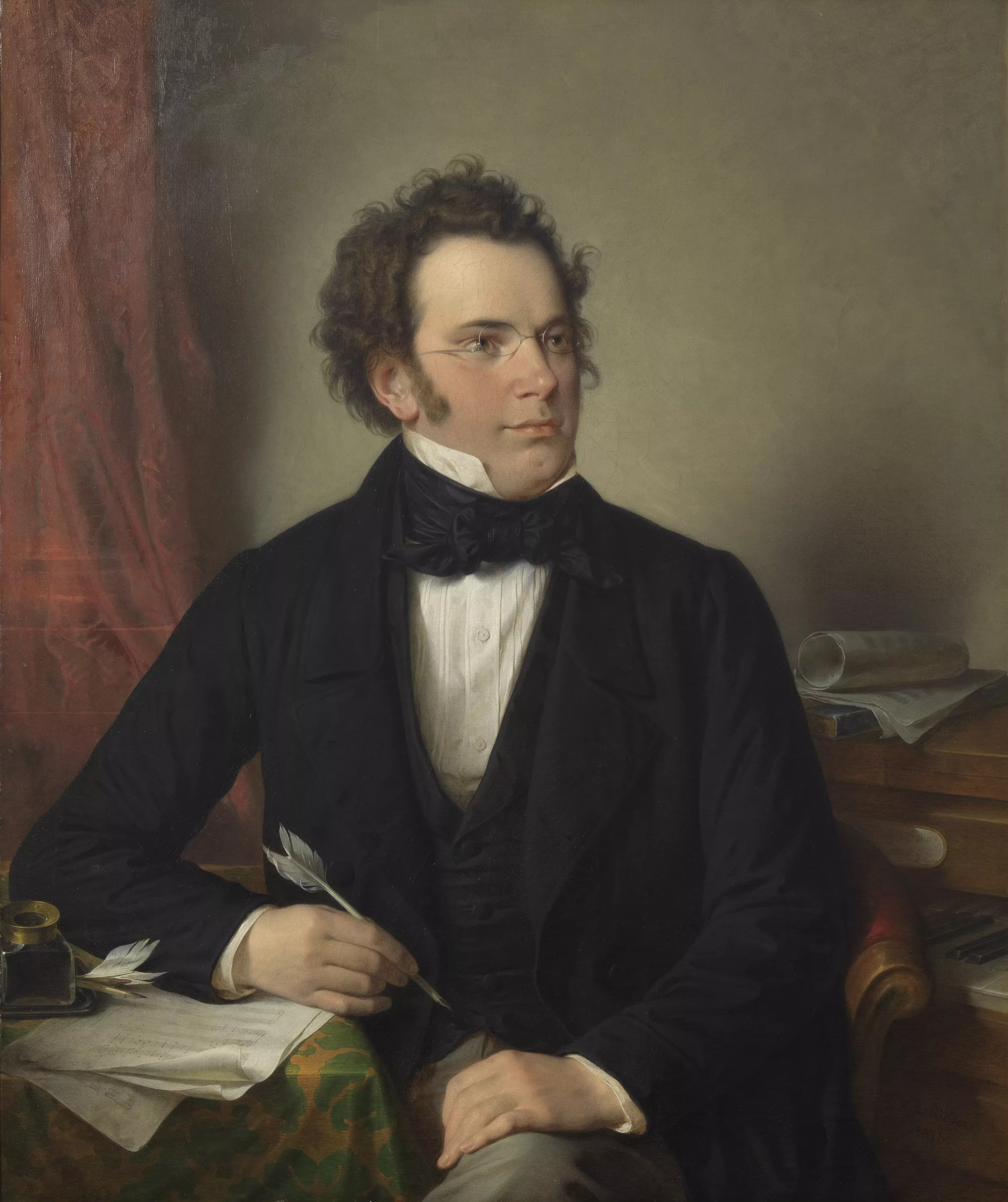
For this segment of the organization’s national tour, the Australian Chamber Orchestra hit with vigour the second term in its title, utilizing only eight players in a program that featured two works only: Schubert’s late Fantasy of 1827 for violin and piano, and the Octet of 1824. Thanks to artistic director and lead violin for this recital, Richrd Tognetti, the Fantasy was transcribed for the same number of musicians as takes part in the longer work, which meant a good deal of work for the ensemble’s clarinet, David Griffiths, on a break from the University of Melbourne’s Conservatorium. But then, you wouldn’t want to give all that right hand filigree work to another violin (in this case, Helena Rathbone), thereby setting up a continuous timbral duality with yourself.
The arranger had two other wind players to temper his usual corps. Carla Blackwood, also from the Melbourne Conservatorium, produced a reliable (and that’s saying a lot) line that remained in equilibrium with her colleagues for the most part. A bass line to complement long-time ACO underpinning member Maxime Bibeau and cellist Johannes Rostamo (on holiday from the Stockholm Philharmonic) came from the Sydney Symphony Orchestra’s principal bassoon, Todd Gibson-Cornish. Fleshing out the string quintet was the ACO’s head viola, Stephanie Farrands.
That’s an impressive body of musicians and this afternoon’s work made for a very satisfying experience. As you’d expect, the Fantasy arrangement taxed the players on occasion, Blackwood having to handle an awkward set of semiquavers early on, but finding compensation in a rich texture-filling partnership with Gibson-Cornish. Tognetti shared the load evenly when the group arrived at the Sei mir gegrusst variations, the accompaniment/piano part unsurprising in its new task allocation but rich in colour-variety, thanks to the three wind visitors.
For all that, the Fantasy in this format centred on Tognetti who met his line’s challenges with assurance. During the initial Andante, he gave himself room to breathe with several rubato-like lingerings. But the ensemble followed these small breathing-points with informed ease; as you’d expect, in this seventh performance in a run of twelve. Not too surprisingly, Tognetti maintained a restraiint of address, not breaking out of a pretty placid dynamic range until the C Major Allegro march, the work’s antepenultimate segment that somehow brings to mind a carefreee branch of the old Davidsbundler.
In this muted approach, he was well-matched by Griffiths who sailed perilously close to inaudibility at certain stages where he worked in mirroring or doubling the violin solo’s material. To his credit, the clarinettist’s piano/pianissimo passages made a vital element in the sound-world of this interpretation. Still, I missed the robust definition that comes with the original, the two instruments complementary and focused on the composer’s display of melodic richness.
As you might have expected, the Octet‘s opening brought us into a musical landscape more fluent and easier to imbibe. Also, the players sounded driven and involved across the first movement Allegro with a taut and clever weighting in play. Blackwood managed cleanly those exposed two-octave horn leaps seven and seventeen bars after Letter C in my old Breitkopf & Hartel score. As well, it was a welcome pleasure to hear solos from both bassoon and viola ringing with some prominence rather than submerged in the secondary matter from higher voices. As far as I can remember, the players didn’t repeat this movement’s exposition; yes, it makes the work longer by some minutes but I think it repays the effort, even in a big canvas score like this one.
A finely poised passage came with the clarinet/violin duet thirteen bars after the start of the following Adagio. Later, Rostamo generated a firm hauptstimme at Letter E, giving the main melody a suddenly more forward-sounding projection in a movement that passed without much drama, best typified by Griffiths’ dangerously soft coda top line fourteen bars from the comforting conclusion.
Then, a welcome dose of buoyancy in the fourth bar of the Allegro vivace which bounded past with infectious vim and dynamic contrasts in the usual strophe/antistrophe pattern. I’ve not heard this style before (I think) but the non-vibrato viol approach to the first phrases in the Trio from Tognetti made for a fine differentiation between the outer and middle segments of this movement.
The following seven variations on the composer’s Freunde von Salamanka tune are a rather predictable set and, for me, wear out their welcome pretty soon. That’s even more the case when all the repeats are observed, which I think they were in this performance, although the horn’s Variation III seemed to me to be underweight. But the one immediately following, which highlit Rostamo, enjoyed full length and made for one of the finer displays of full-bodied production in these pages.
The remaining two segments gave us more deftly measured playing, notably a well-concerted sotto voce ending to the coda after the horn’s introductory solo, and a gripping version of the final movement’s Andante molto thanks to everybody’s curt delivery of those initial semiquavers before fulcrum chords in these sixteen-and-three-quarter bars. I’d have preferred a more vital outlining of those virtuosic triplet bursts of bonhomie from Griffiths and Tognetti which can exhilarate the listener even more than the emsemble in full flight does across the several deliveries of a bounding main tune that somehow always strikes me as imbalanced – possibly because of the trill-rich nature of its first half being set alongside the simpler insistence of the second eight-bar sequence.
Both elerments in this program gave us a fine exposure to Schubert’s splendid melodic richness and, in the Octet, a rare experience of hearing live one of his major chamber music constructs outside the string quartet/quintet format. What proved most impressive to me was the unfaltering mode of attack and model interweaving of textures from a body that, apart from the strings, was gathered ad hoc – for these specific works only: a fortuitous collection of highly competent, responsive talents.

