DORIC STRING QUARTET & LLOYD VAN’T HOFF
Musica Viva Australia
Elisabeth Murdoch Hall, Melbourne Recital Centre
Tuesday June 16, 2026
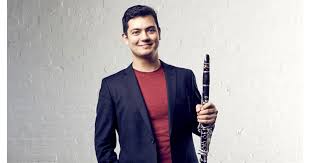
Lloyd Van’t Hoff
It’s probable that I haven’t seen the Doric String Quartet since 2007 when the group played in that year’s Melbourne International Chamber Music Competition held at the South Melbourne Town Hall, which was at that stage home to the Australian National Academy of Music. It seems that I missed the Quartet’s most recent visit for Musica Viva Australia in 2019, in which year I moved to the Gold Coast in a search for physical warmth – simply put, heat. Not that I can recall any of the members from the original group; the only one who has survived is foundation cellist John Myerscough.
While Ying Xue has occupied the second violin role since 2018, the latest arrivals from 2024 offer a somewhat disturbing contrast. Viola Emma Wernig makes an ideal match for Myerscough’s assertive bass line, the pair combining to excellent effect in Thomas Ades‘ Alchymia of 2021, more stridently in the post-interval Razumovsky No 1. Unfortunately, first violin Maia Cabeza produces a cultivated, carefully honed timbre that offers little competition to her colleagues in full cry – and that’s a great pity as her sound colour is very attractive and finely articulated.
As a warm-up, the Dorics offered Britten’s Three Divertimenti of 1936 which broke over us with all the textural brilliance we’ve come to enjoy from this composer, even while being all too aware of the calculated charm invested in this product of his early 20s. During the opening March, you could relish the clarity and truth of the ensemble’s octaves and unisons which featured strongly across the movement. Wernig’s well-projected and shapely line graced the middle F Major Waltz, lending some weight to this clever-clever interlude.
But the main interest came in the concluding Burlesque with its masterly oscillation of sound-production techniques and in which Cabeza made a clear-cut appearance on the change of key-signature at Number 11 in the Faber score of 1981. This movement holds a good deal more interest than its predecessors because of the abrupt shifts in attack mode and the wide-ranging harmonic sleights that Britten exercises in what amounts to a brisk musical reflection of the contorted work of the pages’ dedicatee: Francis Bacon.
As for the concluding Beethoven Op. 59 No. 1 of 1806, this left me unsatisfied because of the ensemble’s balance problems. Time and again, top violin lines that you knew should be there, riding the blast, failed to appear or turned into pale imitations of themselves. Even details like the communal sforzandopiano accents in the opening F Major Allegro from bars 67 to 70 were dominated by the lower lines, which made the first violin’s solo exposures – bars 130-1 and 134-5, for example – very welcome. A little further on, the long ‘solo’ for Cabeza between bars 152 and 190 proved strikingly well-crafted over some at times impatient support.
But later, the chugging quavers in the background that underpin the first violin from bar 261 to bar 276 distracted from the main message – which was hardly replicated when Myerscough had the first subject beforehand between bars 254 and 260. Still, matters improved in Beethoven’s Allegretto which the Dorics all took to with gusto, although even their collegial zest wasn’t quite enough to compensate for the composer’s moments of insistence.
Later, Cabeza projected the Adagio‘s first theme with eloquence through six of the opening eight bars and her accompanied cadenza across bars 126 to 132 impressed for its variety of attack as she led into the finale with its Theme russe manipulations. Here, I suppose, the tendency to go hell for leather dynamically proved irresistible and the Wernig-Myerscough combo bounded in tandem across bars 73-105 as the exposition turns seamlessly into a development-of-sorts.
Possibly this performance might have impressed more in a recording studio where output levels can/are/always will be adjusted, but the lasting impression was unsatisfying in that one respect. Not so with the Ades construct from 2021 for basset clarinet and string quartet which gave us the most rewarding performance of the evening. The work springs (it is said) from Elizabethan London and, to my mind, reveals much of the composer’s habit of adapting and adopting whatever takes his fancy; in this instance, the opening four notes of Dowland’s Flow, my tears, published in 1600.
Ades’ first movement deals with Shakespeare direct under the title A Sea Change (… those are pearls …); a trifle odd as we’re well out of Elizabethan times with The Tempest‘s first production. Anyway, the composer builds a type of free-flowing fanrasy on the falling steps of the fourth interval. When it comes to the second movement, The Woods So Wild, Ades adopts a lighter touch in what is something of a scherzo, as he deals with a song popular in Tudor times, the original tune believed to be a favourite of Henry VIII and the subject of variations by Byrd and Gibbons. I liked the sotto voce character of many of these pages, Van’t Hoff a leading voice here.
With the following Lachrymae movement, we’re definitely in Dowland territory and Ades treats his quartet like a chest of viols for some of the time with plenty of non-vibrato passages and a steady progression that sounded less like a fantasy and more the shape of a chorale, albeit a grim one, based on the Flow, my tears head motif. As for the final Divisions on a Lute-song, the composer quotes from Berg’s Lulu, giving the street organ tune (that most of us have experienced from the fourth movement in the composer’s 1934 Suite from the opera) to his clarinet. From there on, the divisions/variations become progressively more complex, the development eventually stopped from its semi-rambunctious forward motion for a slow meditation.
This builds to a powerful climax, prefaced by a clarinet glissando following the best Rhapsody in Blue tradition, then sinking through what might have been a slow-moving Mahler Adagio quote, or it could have used some of the chord progressions from the Siegfried Idyll. The final impression is of a lament, despite its consolatory pianissimo ending, and I don’t want to be over-pedantic but Wedekind’s Lautenlied sits well outside the Elizabethan framework in time and geography, even if the Berg opera’s finale takes place in London during the Jack the Ripper terror of 1888.
Alchymia was, to some degree, a showcase for Van’t Hoff’s instrument, yet the Doric players melded into an exemplary unit with each voice a clear and lucid component across the whole complex. For once, you felt in sympathy with those Schoenberg allies and patrons who wanted to hear new works twice in a row; Ades’ score held so much variety of content and colour that all of us would have gained from such a repetition. To be honest, I can’t say the same about most contemporary work that I come across.
It made for a highpoint in this recital that didn’t so much disappoint as peak early. Commentators aplenty have written that Ades sits in a line of succssion to the towering figure of Britten in English music and he shares in the senior composer’s melodic felicity and brilliant instrumental colouring. But you find a willingness to investigate and linger over his work in Ades that makes a contrast with Britten; at least, in my experience outside the opera house. Will we hear Alkymia again? Maybe, but you have to agree that the combination of players needed is an odd one, despite its effectiveness.
 O'Connell the Music