FROM WINTER’S STILLNESS
Australian Chamber Orchestra
Hamer Hall, Arts Centre Melbourne
Sunday July 26, 2026
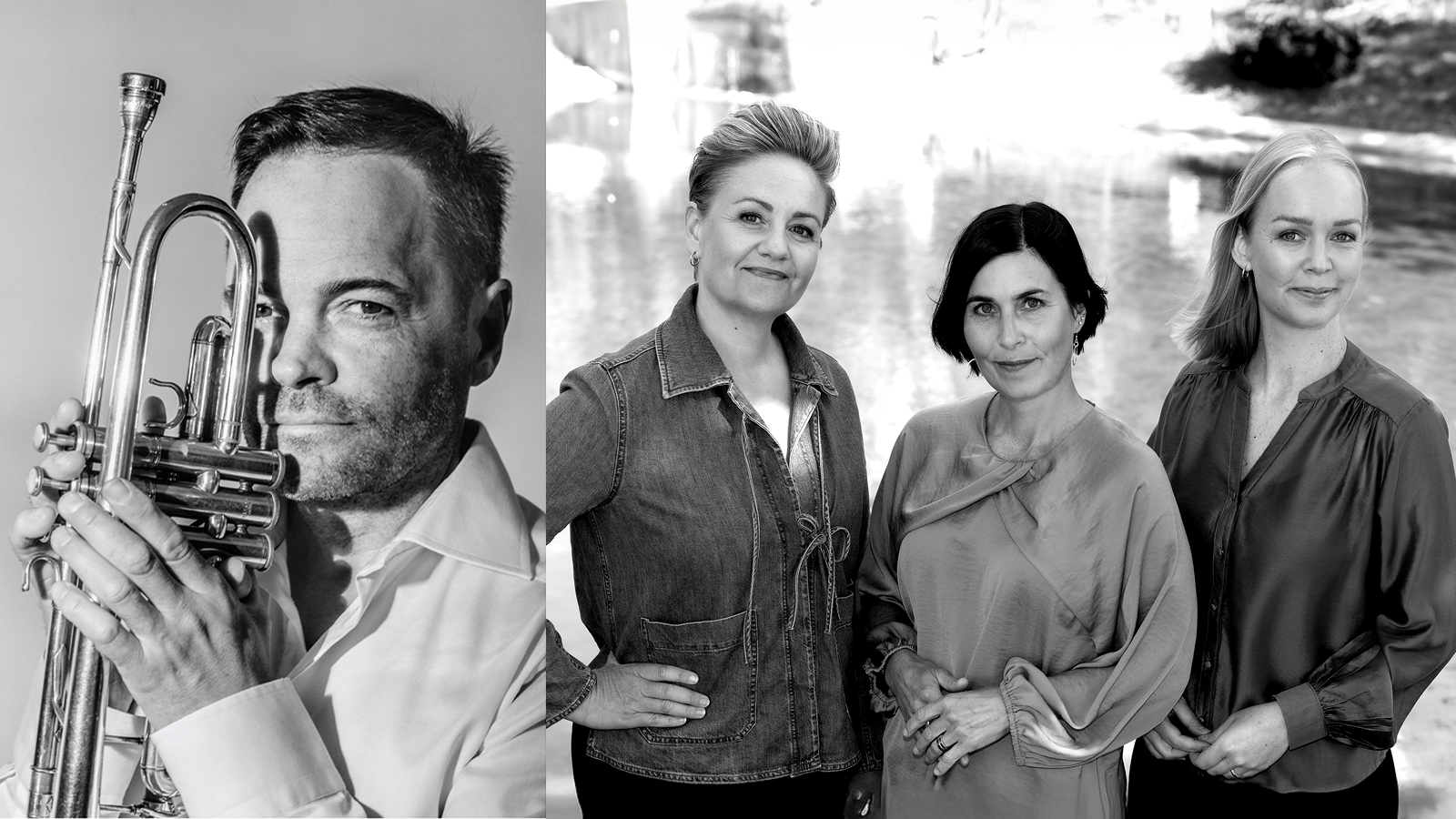
Arve Henriksen; (L to R) Jorunn Lovise Husan, Anna Maria Friman. Ditte Marie Braein
Going out on a frequently-grasped limb, the Australian Chamber Orchestra under its artistic director Richard Tognetti is presenting an occasionally unnerving program on its latest national tour. The organization is collaborating with Norwegian jazz trumpet virtuoso Arve Henriksen and kind-of period vocal ensemble Trio Mediaeval – Norwegian soprano Jorunn Lovise Husan, Swedish ‘singer’ Anna Maria Friman, Norwegian soprano Ditte Marie Braein (sorry: this useless WordPress site won’t make a ligature for the a and e in the middle of her name). As you can easily guess, what is being offered in this undertaking is a fusion of sorts. The afternoon’s first half wove a seamless web that moved too easily between its various components, while after interval we heard Schnittke’s Concerto Grosso No. 1 interwoven with Christian chants and a Swedish hymn.
To be frank, the first half of this concert passed as somnething of a blur. Tognetti, his orchestra and his guests played on a darkened stage (desk-lights in operation) with a blank backdrop that changed colour following no apparent pattern. In the end, I’m not sure whether this was done for specific synaesthetic reasons but it struck me as a waste of resources. With the lights down and no information about the work being played available, you were put into the role of a listening sponge, trying to differentiate between the six works being performed but being all too conscious that your memory wasn’t coping with the musical flow.
For instance, we began with a couple of pieces by Henriksen: The Plume of Ash and Acceptance. These come from different albums that the trumpeter released in 2018 and 2021 respectively and I’d be lying if I said I could tell the difference as both seemed to be using folk tunes and contemporary jazz tropes, the ACO providing a steady backdrop for Henriksen’s solo line which every so often took on the sound of a flute (deliberately so) and for the rest sounded like Miles Davis spitting out an improvisation on one of his more adventurous tracks from the 1970s.
A change in background colour and we arrived at Terry Riley‘s Half Wolf Dances Mad in the Moonlight of 1985 which brought a sudden rhythmic energy to the fore as we followed the American composer’s use of repetition in a moto perpetuo that doesn’t quite give up its pulsations. It struck me that Tognetti spent a good deal of his time directing the ensemble in a piece that, for a good while, followed a regular pulse. But then he was leading an expanded group of 24 players, and 14 of them were either guests or ACO Emerging Artists.
Henriksen returned with Trio Mediaeval for the Australian premiere of Kellamang, written recently (I don’t know exactly when) by Estonian composer Tonu Korvits. Its title refers to a carillon or set of bells and the singers worked through three poems under that title by Doris Kareva; these have been translated rather freely (as I found out later) but were sung in Estonian, and I think most of us would have enjoyed seeing a translation displayed rather than basking in our dark(ened) ignorance. Still, we heard bell sounds, particularly towards the end of a series of settings that tested the singers’ mastery of dissonance.
A short move across the Norwegian Sea to Iceland and we arrived at another premiere, this one commissioned by the ACO from Hildur Guonadottir: Timinn og Vatnio, a setting of parts of Steinn Steinarr’s final work, Time and (the) Water. The text is substantial, even in this truncated form which uses only four of the original’s twenty-one divisions. In the dark, even with a none-too-complicated musical texture, this experience slipped past without making much impression beyond mild irritation at the trumpet’s distractive power. Without comprehending what was being sung, where did the brass instrument fit in? I’ve no idea still.
A Norwegian folksong, Det lisle banet, gave us a chance to enjoy the Trio Mediaeval’s transparence in simple part-singing. I assume this was in place to tie up the various Scandinavian/Baltic threads we’d experienced so far; or perhaps it was just a favourite of the singers who recorded it nearly twenty years ago. Whatever its rationale, we were then conveniently re-introduced to Iceland by way of Fljotavik from a 2008 album by the post-rock band Sigur Ros. Sweet to the point of saccharinity, this piece underlined the prevailing harmonic stolidity of much of the music we’d heard so far. That’s fusion for you.
After hearing my first piece by Alfred Schnittke sometime in the 1980s, I spoke to John Sinclair, veteran music critic for the Melbourne Herald newspaper, asking if he thought – as I did – that Schnittke was a fabrication: not just one composer, but a committee that worked together to produce whatever it was we’d been listening to. It struck me that we’d been exposed to a style of composition made notorious by the Yellow River Piano Concerto of 1970, a method being mimicked under the general name of ‘Schnittke’ by some Soviet musical apparatchiks.
What I didn’t know at the time was that the composer – a real writer – was finding his feet at the time of writing his Concerto Grosso No. 1 (1977) as a polystylist, which term seems to mean that anything and everything contributes to the manufacturing process. This is evident throughout the six movements of this work, here performed with Tognetti and Satu Vanska as the two violin soloists. Both artists worked with admirable unanimity across the discrete segments of this score, remarkably congruent in their fierce attack, notably in impressive double-cadenza moments.
Nevertheless, this second half of the program began with a St. Birgitta Hymn, a strikingly arranged medieval chant in honour of the Swedish mystic – Rosa rorans bonitatem – from Trio Mediaeval, accompanied discreetly by the ACO and followed by an improvisatory variant from Henriksen on piccolo trumpet. Cut straight away to the Schnittke work’s Preludio, scored for strings with the aforementioned soloists, harpsichord and prepared piano (both performed by an oscillating Simon Tedeschi). This is a slow-moving, brooding set of pages in which only the soloists show signs of animation.
The Trio then outlined a St Sunniva Hymn, which turned out to be our old friend Aeterna Christi munera, a (possibly) 4th century chant very familiar to those of us who have sung Palestrina’s Mass based around that hymn. What it has to do with the Irish-born Norwegian martyr eludes me but the text sung here is totally different to that from the one for the Matins for the Common of Apostles or Martyrs. In this, Henriksen’s solo came as a kind of stanza in itself, moving in its breathiness and juxtaposition with the solo voice that sang the new text.
Schnittke’s Toccata movement explained the need for those extra string personnel as it splits into 21 individual lines at several stages, underpinning the frenetic action from our violin soloists and harpsichordist, all of it following a ripieno–tutti pattern that sounded as if structured very much by a latter-day Vivaldi or Corelli. Here, Tognetti and Vanska entered the lists with a vigour that moved into ferocity at the score’s more intense moments, like between Numbers 12 and 14 in the Universal edition.
A traditional Swedish hymn, Pris vare Gud, brought the Trio to one line, I think; it passed with remarkable rapidity. Then back to the concerto for a Recitativo which became an essay in grating minor 2ns, 7ths and 9ths with some extreme virtuosity required from the soloists, certain passages packed with octave glissandi and terrifyingly rapid passages at the top of their instruments’ range. Emotionally, you would have expected that this to be the work’s highpoint, its dramatic focus. But no.
For their last intercession, Trio Mediaeval and Henriksen gave us a St. Magnus Hymn for the martyred Earl of Orkney, Nobilis humilis, which is one of the first examples of medieval polyphony, re-arranged here to include the trumpet line. As a farewell, this was surprisingly stalwart and rhythmically stolid. But then came the Cadenza–Rondo–Postludio conclusion to the concerto which again gave the soloists a more advanced, massive test of concentrated endurance. This virtuosic writing was contrasted at one stage with a kind of tango from Tedeschi’s keyboard, feeding into my initial delusion that the composer was a compositional kaleidoscope. Perhaps unfair; you really need to know more of the composer’s later products to make any sort of informed pronouncement.
But the multiple personalities in Schnittke’s concerto might have been a programmatic comment on the nature of this concert, which presented us with several strands that only the individual listener could tie together, despite the cues and indications given by the performers. However, we enjoyed an afternoon of exposure to music that came from outside the normal Australian concert hall experience; well worth it, I say, particularly as it gave us a well-rounded portrait of the ACO, albeit in extended format, performing in several different personalities.

