A Brahms to remember

ENSEMBLE Q PLAY BARTOK AND BRAHMS

Ensemble Q

Primrose Potter Salon, Melbourne Recital Centre

Saturday August 22, 2026

Daniel de Borah

During the five-and-a-half years I spent on the Gold Coast, I never managed to hear Ensemble Q, the brainchild of Paul and Trish Dean and a fixture of Brisbane’s musical world over the nine years since the body’s generation. Their forays to Melbourne are a new venture, I think, and clearly welcomed by a swath of younger musicians who might know clarinettist Paul from his years as director of the Australian National Academy of Music (2010-2015). Or they might be observing the performances of Adam Chalabi, currently ANAM’s Head of Violin. Of course, that’s assuming that these young patrons have connections to ANAM or the country’s various musical institutions of learning.

Most of us know Daniel de Borah as a Melbourne-born pianist who is currently teaching at the Brisbane Conservatorium in Griffith University, where I heard him give a faculty recital some years ago. Cellist Trish Dean is another Griffith faculty member and has appeared frequently all over the country, if not that often in Melbourne. And the last member of the quintet that represented Ensemble Q on Saturday night was violist Benjamin Roskams who recently participated in the later days of the recent Australian Festival of Chamber Music held in northern Queensland.

This brief (75 minutes, without interval) recital opened with Paul Dean, Chalabi and de Borah powering through Bartok’s Contrasts of 1938. The opening Verbunkos began jauntily enough but soon developed into a strident outpouring for clarinet, which instrument took over much of the running. At certain moments, I wondered if the players had taken account of the Salon’s very lively acoustic, and the work reached some dynamic levels that bordered on the painful, Chalabi’s line after his opening pizzicati was often drowned out and gained some pre-eminence only at the Meno mosso of bar 30. De Borah was at some pains to make himself heard but came to the fore at the glissandi-rich passage between bars 45 and 54.

Chalabi held more prominence in the middle Piheno, even though the trio’s output again proved very lively in these close quarters. But both he and Dean gave an equally passionate account of the movement’s climax (senza piano) across bars 33 and 34. De Borah took control in the final Sebes with his octave semiquaver pattern work, although you’re hard put to find any thematic interest in the keyboard part during the first pages. Still, he and Chalabi made fine work of the relieving Piu mosso at bar 132 where the violin articulates that melting B/E Major folk-tune in a peacefully mobile time signature of (3+2+3)(2+3)/8.

After this elongated oasis, the stop/start rush to the end brought us back to the striving urgency that ran as an undercurrent across this reading. It’s one view of the composer’s odd score even if it left you on edge for a good deal of the work’s duration, waiting for the next explosion to disrupt Bartok’s even temper shown through a discerning balance of resources and material that you can hear from trios with a less virtuosic, moderately aggressive style of attack.

A small piece of Australiana followed with Margaret Sutherland’s slight Nocturne of 1944 for violin and piano. Thirty-one bars of 12/8 semi-sweetness, this also enjoyed an energetic airing, especially in the substantial middle section where Chalabi urged out his line with a determination that was mirrored by de Borah’s weighty negotiation of the composer’s shifting harmonic backdrop. Mind you, from what I’ve seen of the score, Sutherland left no dynamic directions, so a version hinting at machismo has just as much validity as any other, I guess.

The Ensemble concluded their night’s exhibition with Brahms: the Piano Quartet No. 3 in C minor of 1875. It’s another work that you don’t hear often, the format more popularly represented by the composer’s first G minor essay in the form. But this score shows a remarkable control of structure expressed in the most glowing and ardent language, extraordinarily rich even for this high Romantic composer. After the opening suggestions, the group abruptly hurled us into the ferment at bar 31 with that decisive unison downward scale from all three strings before de Borah entered with the start of a concerto-style peroration.

From here on, the interpretation proved both persuasive and cogent, the participants engaged fully in this first Allegro‘s argument. From all quarters, the playing showed a dedication and involvement that you rarely come across expressed with such ardour, the chains of polyphony unwinding with a sense of presence that involved the listener completely. For once, an ad hoc group of players showed us what superlative music-making can come about when those involved are confident in each other and their shared artistry.

Even the slightly off-kilter scherzo came across with an easy style of delivery in its jocund passages, and a delicious contrast in the answering strophe beginning at bar 23 where Brahms plays ducks and drakes with G Major and G minor: just a deft flight of fancy to disrupt the bounding 6/8 metre but remarkably uplifting in effect. Still, the main thrust of the movement is brisk galumphing, concluding with a rousing almost-unison 19 bars of power from the strings above the piano’s urging 6/8 chords, the whole arriving home with irresistible emphasis.

To be followed by the Andante and a finely shaped opening solo from Trish Dean – 16 bars of impressively shaped cello lyricism surging above de Borah’s supple accompaniment almost entirely confined to the bass clef. And then, a melting duet with Chalabi; only ten bars but packed with intense tenderness, only to be capped by Roskams’ arrival for the string trio that carries the movement forward after one of those interludes (bars 25 to 34) that display the composer’s expressive depths, similar to what you hear in the carol setting for Brahms’ Geistliches Wiegenlied of Op. 91.

Finally, we heard an Allegro commodo equal in propulsion to the first movement, de Borah making no errors as far as I could tell in a stormy series of pages that bore witness to the composer’s emotional turmoil throughout this quartet’s long gestation. At the same time, you had to be impressed by details like the striding, rivetingly clear octave melody for Chalabi and Roskams from bar 54 to bar 67; the string trio’s invasion of Mendelssohn’s Piano Trio No. 2 territory with the chorale at bar 75; de Borah’s ebb and flow in development while the strings sustained notes, e.g. bars 103 to 150; and the communal descent to darkness from the ben sostenuto of bar 340.

It all contributed to the final impression of a splendidly contoured reading of a great work and a further cause for regret that I didn’t get to any Ensemble Q performances up north. If you live in Melbourne, I’d suggest that any future recitals from this body deserve your attention, especially if they’ve scheduled Brahms; it will be a long time before any of us hears chamber music of this quality – besides the Selby & Friends events – and a performance with this combination of experience and spirited attack.

A most generous pianist

THE LIFE IN BETWEEN

Michael Kieran Harvey

Move Records MD 3483

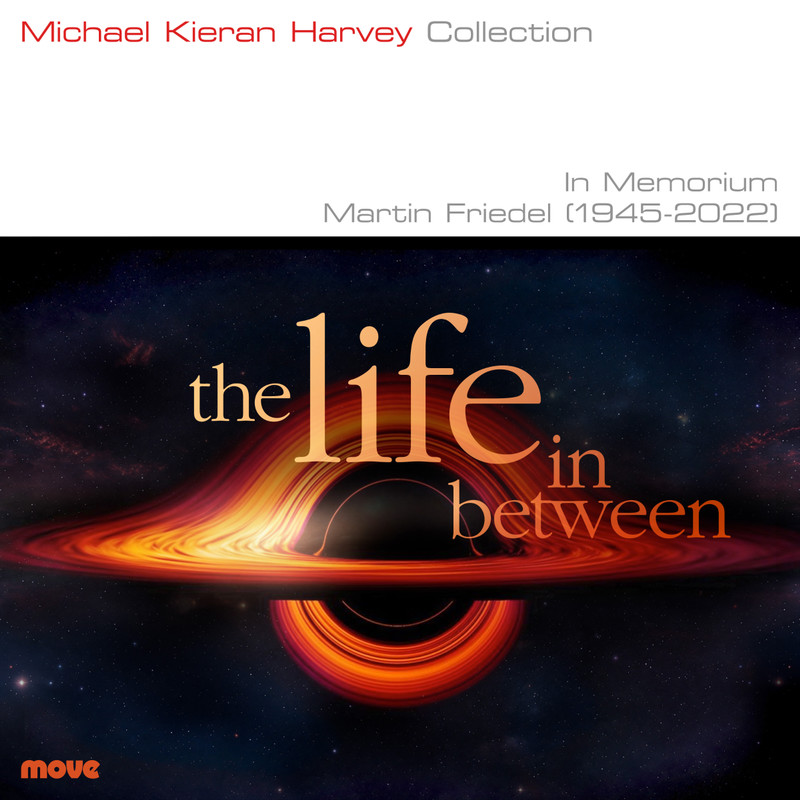
Here comes another solo collection on the Move Records label from Michael Kieran Harvey, that endlessly fertile pianist-composer now resident in Hobart and still (happy 65th birthday for last month) one of the dominant forces in this country’s musical environment – playing with the same mastery while writing works that are thoroughly exciting to hear. On . . . the life in between . . . , he gives pride of place (and his CD’s title) to the last work by Martin Friedel: a 2022 compendium of ten short pieces (the longest lasts 4’01”, the shortest 1’21”) with little room for virtuosic flourishes and emotional outbursts, despite its being written for Harvey – our most technically brilliant and temperamentally flamboyant pianist.

Harvey plays nothing of his own, exerting his talents on behalf of five other composers. The oldest piece presented here is Johanna Selleck‘s Homage to Liszt from 2013 when it was premiered by the writer’s colleague at the University of Melbourne’s Conservatorium, Ian Holtham. Almost contemporaneous is Andrian Pertout‘s L’architecture du cosmos from 2013-2014, first performed a year later in Paris by its commissioner: Chilean musician and activist, Maria-Paz Santibanez. This construct from the Melbourne-based writer/academic strikes me as the most rigorously organized work on the disc.

With the challenging title of Eine kleine Nachtmusik (after Dorothea Tanning), Colin Spiers produced four movements in 2021 that owe nothing to any Mozartian predecessors and everything (including their titles) to the 1943 painting by the then-Surrealist American artist and – to put it in sexist terms – Max Ernst’s fourth (and last) wife. This enjoyed its first performance, I believe, from Alexander Gadjiev in Hobart a year after he’d won the Sydney Piano Competition for 2021. Bruce Crossman‘s Not Fading Resonance presents as a 2023 exercise in friendship for its dedicatee (pianist Harvey, on his 60th birthday) and sustained sounds from the keyboard, held notes and chords emerging out of rapid flurries of activity in a large-scale rondo form.

The most recent composition. Vaughan McAlley‘s Toccata, was composed last year for Harvey and is the most tradition-echoing work on this CD. It demonstrates McAlley’s long background in choral singing (the Ensemble Gombert, Ormond College and Scots’ Church Choirs) and his mastery of ye olde-fashioned techniques of counterpoint and harmonic sequence. To thine own self be true, false wise-old-man Polonius said, and his dictum is carried out faithfully by this writer who lashes his Renaissance/Baroque colours to the mast without any self-deprecation.

Selleck’s Liszt tribute is packed with references to the Hungarian composer’s B minor Piano Sonata, completed in 1853. She opens with an upward leap on a larger scale than the original’s bar 8 move to Allegro energico and it isn’t long before she introduces a version of the single-note tattoo that emerges in bar 14. Harvey’s powers at overwhelming the listener through relentless virtuosity are allowed free rein at certain points and Selleck shows less interest in the languorous themes of Liszt’s large-scale construct, concentrating her (and Harvey’s) energies on that upward leap and the descending G minor scale articulated in the Sonata’s second bar.

Where Liszt’s score ends in B Major placid shadows, Selleck concludes her rhapsody on an upward flourish that serves as an affirmation rather than a reminiscence and is a valid reinforcement of this Homage‘s intent – a reminder of Liszt’s reputation across the centuries as a keyboard master of brilliance rather than a soulful poet, although he could be that all too easily; witness the Consolations, if you must. Harvey enters fully into this 19th century tapestry with contemporary threads, making the most of its Romantic undercarriage with persuasive zest.

Pertout’s score is substantial and differs from two other compositions by being all of a piece and the longest in simple length. It’s intended to be a homage to Stockhausen, for which purpose he employs the German composer’s Klavierstuck IX which is, like Pertout’s opus, partly based on the Fibonacci series; three familiar pieces by Ravel – Gaspard de la nuit, Jeux d’eau, and Une barque sur l’ocean; and three obscure compositions produced in the middle-to-late years of his life by Ukrainian-born/American composer Leo Ornstein – A Morning in the Woods, A Long Remembered Sorrow, and Metaphor No. 3.

These Ornstein works have no resemblance to the works that the writer produced in his young, ultra-avant garde days, but are more tonal, impressionist (well, the first two are), and prone to repeating patterns, as well as indulging a passion for setting four against three in terms of rhythm. You don’t come across anything as outlandish as the opening bars to Klavierstuck IX with its relentless chord repetitions, and the construct turns from 20th century elliptical to a kind of grave musical recueillement quickly; even the high-tessitura pointillism in these early-to-middle pages sounds more soft-edged than anything out of Darmstadt.

The rapid single-note tattoo with which the work opens recurs often, as do quick clusters and trills but at first in the context of sustained chords – some urgent, some placid. The work’s centre shows a restlessness that mirrors the opening pages and the repetition and fragmentation bring Ornstein to mind as Pertout’s language imitates the semi-improvisatory harmonic movement (or lack of it) that obtains in the first two of the above-mentioned pieces. Certainly, you come across some Scarbo-indebted explosive jerks and a long stretch of filigree work that occupies the limelight towards the piece’s luminous conclusion might suggest Ravel’s fountains.

But L’architecture speaks in Pertout’s own voice, in the end and, thanks to Harvey’s free-wheeling hands, it’s an unexpectedly amiable one. As for Colin Spiers’ suite based on aspects of Tanning’s painting. the opening Hallway brings Une barque sur l’ocean to mind with its relentless 11:8 bass line at the outset under a chain of right-hand fourths that suggests foreboding and uncertainty. Eventually, the repeated pattern transfers to the right-hand which lightens the atmosphere, if not completely removing the sense of menace, but the final reversion to bass rumbling restores the piece’s unsettling atmosphere.

Next, Duality possibly refers to the two female human figures in the painting but might mean something completely different to the composer. It begins with some brisk high chords, some of them arpeggiated, that frame the piece’s pages. In between comes much hard-driving action which at times recalls those Six Dances in Bulgarian Rhythm that conclude Bartok’s Mikrokosmos, at others the Shrovetide Fair mobile stasis; a set of pages to keep you guessing. Sunflower refers to the unnervingly large centrepiece of the painting, here represented by some slow-moving bass chords, followed by cadenza-type scintillations, both coming close to dialogue but having to contend with other matter before an ending which brings back that 11 demi-and-semiquaver gruppetti sequence from the work’s first pages: a kind of macabre poem in irrational menace, thanks to Harvey’s relentless delivery.

Last is Doorway. There are four of these in Tanning’s painting, the furthest away slightly ajar. This opens in a kind of oppposition to Hallway with a regular 10 demi-semiquaver pattern in the right hand against which the left hand offers a melody of sorts. Before long, both hands are in the rapid tintinnabulation game and the melody becomes more stalwart before fragmenting and the 10-note pattern rises to the top of the keyboard while the left-hand returns to its original melody, now obscuring it with trills; which could be another version of that in-my-end-is-my-beginning scenario or it could mean we can escape into light through that half-opened door.

Friedel’s ten-part collection opens with a series of solid and slow bass-heavy chords whose dissonance is muted by their low register until an accelerando about three-fifths of the way through, leading to a final chord that is sustained for an awfully long time. Next, a determined melody in a single isolated line is punctuated by a soft treble chord and a grinding bass cluster. This is followed by a belle-et-bete dialogue, a treble melody of some angularity answered by a gruff bass response, one after the other, until both reconcile with soft chords at either end of the spectrum.

The fourth segment operates with the same contrast between high (reasonably) and low but the chords launch into each other, so that the energy is not between the two layers but an integration of both. Like its predecssors, this also ends with a long sustained texture. Not so with the following gruelling essay which operates for most of its length at either end of the keyboard, the hands operating simultaneously and sustaining the prevailing grim emotional landscape through a firmly administered atonality.

The contrast between upper and lower voices is more satisfactorily drawn in the next set of pages where both follow their own paths, one note at a time with a few exceptions, mainly in the left hand for some short chords/intervals. It’s something like a hitherto-undiscovered Webern study: angular, uncompromising, honest. What follows is a complement, being labelled ‘vi. b’ and maintaining the same disjointed motion but sounding as though it’s following a single thread; once again, with some stand-out chords or intervals but the main thrust that of a one-line melody (aren’t they all? Better expressed as a chain of notes) spread across the keyboard’s full range.

Track 8 (piece vii) shows more volatility. An irregular pattern of notes is outlined in both hands, then acquires a harmonic framework that seems to be in fourths or fifths (augmented and diminished – no consonances here, as far as I can tell) which aggregate on top of each other until a general pause (long), with pianissimo chords to finish. The second-last work operates on three levels: in the middle, another single-note melody. with a downward-heading semi-arpeggio in the bass and isolated fifths (perfect, I think) in alt, all operating at different points in time, apart from a few doublings between the middle and top levels of action.

Last of all comes a variation on a chord. I think it’s G Major/minor and the piece begins with an unexpectedly strident challenge in its octave statement and percussive bottom-of-the-keyboard response. As the segment moves forward, its core acquires some notes, some of them fundamental to the chord, others peripheral; but the drama gradually yields to quiescence and the final page of this Track 10 ends with the same elongated resonance as obtained in Track 1. Now what any of this has to do with the quote from which Friedel’s composition takes its title, I’ve no idea. ‘Regard as one, this life, the next life, and the life in between.’ Thus spake the Tibetan sage Milarepa close to eleven centuries ago and I suppose we’re all pretty happy to go along with that advice but how the composer’s aphorisms bear on this – well, you work at it, grasshopper. But the score intrigues in its spartan directness and its innate consistency.

Crossman’s work is an exercise in generating resonances, most effectively through pressing down notes silently so that they sound after a percussive explosion around them. But the composer is pursuing all sorts of resonances by juxtaposing registers and simply allowing the sustaining pedal to do its work and carry various layers across each other. By its nature, Not Fading Resonance is spasmodic, packed with abrupt note-play and over the top in its dynamic directions: for example, a septuple piano in bar 2 and a nonet sforzando in bar 3 which give an ocular fascination to the score-reader but present an impossibility for any performer. Still, Harvey observes this piece’s fits and tremors with his usual aplomb in controlling a sterling example of sonorous theatre.

Last is McAlley’s tribute to French masters like Widor and Boellmann, although its opening is distinctly Bach-like with the right-hand playing a two-line gigue while the bass sets up what could have been a chorale melody, if only it hadn’t held some pretty wide interval leaps. A little further on and that base melody operates on two levels with our running gigue triplet pattern in the middle. Eventually, the striding bass is leavened by middle register chords while the right hand is occupied with McAlley’s unending dance, and the work ends with an eloquently extended tierce. Written with organists in mind, it sounds thunderously satisfying in this reading, Harvey as happy in handling its semi-traditional harmonic language as he is with the several vocabularies of the other writers whose music graces this benign and rewardingly catholic CD.

Not to be missed

NICOLAS ALTSTAEDT & THOMAS DUNFORD

Musica Viva Australia

Elisabeth Murdoch Hall, Melbourne Recital Centre

Tuesday August 11, 2026

Nicolas Altstaedt & Thomas Dunford

With a few exceptions, this proved to be an unusually focused program, centring on two of Bach’s cello suites and extracts from the considerable output of Marais with a soupcon of his competitor Forqueray. Nicolas Altstaedt and Thomas Dunford worked very well in their cogent cello-theorbo duet combination at throughout this entertainment where the emphasis fell on the cello imitating Marais’ viol, while Dunford made a splendid showing as artist-in-support while seizing his chances for flamboyance with a will. The only odd moments came with a rendition of Part‘s pointedly aimless Spiegel im Spiegel invention of 1978 which, thanks to Dunford’s ability to provide link passages, and the content of both pieces, merged seamlessly into the slow movement of Duparc’s 1867 A minor Cello Sonata: proof once again that King Solomon (possibly) was right when he noted that there was nothing new under the sun.

But that’s not quite right, is it? I’ve found three different headings for the central pages of Duparc’s score. In this night’s program notes it’s listed as a Lento; a PDF score online has it headed as a Largo; on an Instagram page from Altstaedt, he plays the piece with Dunford under the headings of both Lento and Lamento. Steven Isserlis performs it on a Proustian disc as Lamento. Whatever the truth of the matter, Part and Duparc made a fine pairing but I can’t believe that they added up to the combined duration of eighteen minutes, as set out in the night’s schedule.

The six Marais pieces included two scores that have become familiar to us, thanks to programs by native and visiting lutenists. Wrapping up the evening’s first half was Les Folies d’Espagne which, in its original shape, featured the famous La Folia tune and 31 variations, from the 1701 Pieces de Viole Livre II. Here, Dunford gave exemplary service as support for Altstaedt’s wildly disparate modes of attack and dynamic, the whole carried out with exemplary verve and empathy from both executants. Contrary to expectations (and schooled by many another set of Folias-plus on harpsichord, organ, strings, etc.), this reading proved invigorating, perhaps due to the executants’ essays at souping-up the original with rasping attack-strokes, accelerandi and plenty of what passes for fortissimo on these two instruments.

Another well-known Marais product is Les Voix humaines, also from the 1701 collection and a gem of soft utterance and melodic grace. In particular, the duo made a moving experience of this brevity’s ending, their output reduced to near-whispers at the cadence. In spite of the overwhelming mastery of the Bach works, I thought the entertainment reached its high-point in this ornate but deeply expressive page-worth of music-making.

Without doubt, we all enjoyed the opening gambit of placing Marais’ La Reveuse (from Book IV of 1717) alongside Forqueray’s La Leclair: a juxtaposition of both composers in contrasting moods – well, in their prevailing moods, most of the time, it would seem. It introduced Altstaedt’s variation in timbre and dynamic inside both pieces as well as showing Dunford’s talent at glittering cascades of chords and contributions of contrapuntal interplay, particularly in the vivid flamboyance of those suggestions of the great violinist in full flight.

The original scheme was to insert Feste champetre, also from Marais’ Book IV, at the halfway point of Dunford’s transcription of the Bach Cello Suite No. 1 in G major (just as an odd point of order, was this transposed down a fifth? It sounded that way to me but, not having perfect pitch, the perception came about (probably) through a fault in my hearing). I can’t imagine what brain fade led to that idea as the piece’s studied bucolicism would sit uncomfortably between Bach’s courante and sarabande in most respects. Fortunately some kind of sense prevailed and we heard the Marais after the uninterrupted suite, in alliance with Les Folies d’Espagne where it sat quite happily.

In their final Marais bracket at night’s end, following Les Voix humaines Altstaedt and Dunford added the Grand Ballet from Book III of 1711 and Book IV’s Le Tourbillon. The first of these turned into a tremolo-rich exercise from Altstaedt but Dunford’s part proved more interesting for its sparkling support of a more deliberate cello line. Altstaedt enjoyed his own display in the final imitation of a whirlwind that brought the program to a feisty conclusion. But what I carried away from this last Marais bracket was the responsiveness of both musicians to each other’s output – their dynamic give and take, and their communal flurries into and out of faster speeds.

All honour to Marais and (to a lesser extent) Forqueray, Duparc and Part but the twin pillars of the Bach suites dominated the program’s two halves. We have precedents galore for Bach transcriptions; not exactly limited to but definitely associated in my lifetime with Segovia who mined the violin sonatas and partitas for his own instrument. He certainly arranged the arpeggio-rich Prelude and two other dances from the Suite in G Major, and Dunford has carried the task forward by setting the other movements. Despite the mastery involved, a basic problem still obtains: a lute can handle chords exceptionally well, but it can’t legato, to coin a verb. So the suite takes on a completely different sound character.

If you can swallow that, and everybody in the Murdoch Hall seemed to be onside, then Dunford’s exhibition was brilliant: packed with nuance, loyal to the original, clean in shape and articulation. My only real question lies with the idea of differentiation. It was clear when the Prelude ended and the Allemande began but the mode of attack failed to register; ditto with the Menuets and Gigue. For sure, Dunford is able to generate energetic initial strokes but he seemed to keep most of these for his Marais. As when we saw Segiovia here at the Town Hall back in the 1960s, you could admire the technical craft at work as long as you repressed your memories of the original.

Altstaedt opened the program’s second half with the Cello Suite No. 5 in C minor which proved to be a remarkable reading. Rather than confront us with the bull-cello approach so familiar from other players, he gave us the Prelude without digging into his instrument’s bass C notes that come up so often in the first nine bars. The Allemande proved a model of piano grace, with a startling flexibility given to the tempo, while the following Courante made a splendid contrast in its aggressive outline of the chromatic slithering between bars 13 and 16.

Individuality was the highlight of Altstaedt’s Sarabande reading, including a very soft repeat of the first eight bars. But this search for quiet outlines and statements could be noted in much of the suite’s latter half, in particular an extraordinary muffled account of Gavotte II‘s triplet orgy. The process reached a telling point when the Gavottes merged into the Gigue and we moved into a subfusc landscape where contours almost disappeared in the player’s restlessly soft dynamic and we were (well, I was) transfixed by the music’s eventual disappearance on that final bottom C – a moment of rarely achieved magic.

Another element that disposed this near-sold out house to benevolence towards these musicians was their obvious friendship and affection for each other. It’s something you come across rarely: to see players embracing each other without awkwardness or affectation, but simply happy in their work, confident in each other, and committed to enriching their listeners with some information and many memorable displays of expertise and interpretative insight. They perform tomorrow night in Newcastle, on Monday in Brisbane and conclude their tour in Adelaide on Tuesday; it’s doubtful that you’ll see a more rewarding pair of musicians at work for a long time.

Diary September 2026

BUSH, BORSCHT & BONN

Selby & Friends

Ptimrose Potter Salon, Melbourne Recital Centre

Wednesday September 2 at 2 pm

Nearing the end, I’m trying to find relevance in the titles of programs: an interest I’ve avoided for many years but which has come to be fascinating in recent times. For its latest touring program, the Selby & Friends ensemble – in this instance featuring piano Kathryn Selby, violin Susie Park, and cello Julian Smiles – will play trios by Australian senior writer Ross Edwards, Novgorod-born Anton Arensky, and Germany’s pride, Ludwig van Beethoven. Edwards’ work (of either 1998 or 1999, which has now been followed by a newly-composed score in this format) has featured on a Selby & Friends program before: back in 2021, when Selby and Smiles toured with Smiles’ Goldner Quartet (of happy memory) colleague, violinist Dene Olding. You’d have to assume that this translucent work of three movements, lasting about 15 minutes, represents the ‘Bush’ because the composer has certainly laboured to bring that national presence into his work. It’s followed by Arensky’s Piano Trio No. 2 in F minor of 1905. Nowhere near as popular as the writer’s first work in this form, it’s slightly more substantial, lasting about 35 minutes, and notable for its final set of six striking variations and muffled reprise. Perhaps this is where the borscht comes in,although that’s usually considered a Ukrainian dish. As for Bonn’s most famous son, his Piano Trio in E flat Op. 38 of 1803 is an arrangement of his highly successful Septet, with the piano taking over the string lines, the violin substituting for the arrangement’s preferred clarinet, while the cello takes up most of the original’s bassoon line. Whichever way you hear it, the Septet/Trio lasts for about 40 eloquent, mainly optimistic minutes. Tickets are $89 (concession $69), Seniors $87 (not any advantage, then, relying on that card), and students $69; and you have the Recital Centre’s $4-to-$8.50 money-grubbing transaction fee to shell out if you order by phone or online.

This program will be repeated at 7 pm.

MOSTLY MOZART – PLAY WITH FIRE

Australian National Academy of Music

Elisabeth Murdoch Hall, Melbourne Recital Centre

Thursday September 3 at 11 am

An incendiary morning from those artists-in-completion-mode working at the Australian National Academy of Music, directed by the Adelaide Symphony Orchestra’s associate principal cello (and ANAM alumnus/a), Sharon Grigoryan. Lots of fire to be heard, then, but not so much Mozart who is represented by one of his more obstreperous and brilliant-sounding symphonies: No. 35 in D, the Haffner of 1782. This happy score ends the program, and Haydn begins it with his Symphony No. 59, written in the Esterhaza residence years sometime between 1765 and 1769. It is nicknamed the Fire, because some of its movements were used as incidental music to a play called The Conflagration. After this follow several pieces with more obvious connotations. Manuel de Falla’s Ritual Fire Dance from El amor brujo will be heard in its original 1915 gitaneria version; in the only performance I’ve heard, this calls for a chamber orchestra rather than the richly padded readings that come with the composer’s later re-vamps. We’ll hear the last of Debussy’s Preludes for piano, his 1913 Feux d’artifice, which you’d have to guess will be given to us in Colin Matthews’ orchestration. Or is it Peter Breiner’s version? Or that by Francis Gorge? Concluding the night’s semi-theme comes another glittering piano original in Scriabin’s Vers la flamme of 1914 – in Leytush’s odd orchestration, you’d suppose. Anyway, it will be a packed hour of music-making which Grigoryan may direct from the first cello desk. Tickets are simple: $59 standard, $52 concession (be still, my beating heart), students and Under 40s $49. Don’t forget the $4-to-$8.50 booking fee that the Recital Centre imposes, milking its clients of more cash with dubious justification.

ORGAN GALA

Melbourne Symphony Orchestra

Melbourne Town Hall

Thursday September 3 at 7:30 pm

These days, it’s not hard to guess what you’re going to get when you put an orchestra and organ together. Yes, it’s Saint Saens’ Symphony No 3 of 1886, the finale of which was used to risible effect in Chris Noonan’s 1995 Babe film. While the Melbourne Symphony Orchestra is conducted by Finnish-born Emilia Hoving, currently associate with the Royal Philharmonic, the attention-grabbing organist will be English-Australian Joseph Nolan whom I have never heard in action but who is a notable Widor expert. Before the blasts and rumbles from the Town Hall’s fabulous instrument under Nolan’s hands and feet, Hoving takes us through a farrago, beginning with Four Dances from Ginastera’s ballet Estancia, presumably the suite that the composer organized first in 1943. Continuing the earthy motif comes the Suite No. 1 that Guiraud arranged for publication in 1885 from Bizet’s Carmen opera of 1875. This involves the fate theme from the opera’s prelude, the Aragonaise before Act 4, the Intermezzo preceding Act 3, the heroine’s Seguedille, the Dragons d’Alcala interlude anticipating Act 2, and the Toreadors music from the Prelude and Act 4. Even more Latin colour arrives with the atmospherically rich 1994 Danzon No.2 by Mexican composer Arturo Marquez, nicely complementing Ginastera’s concluding Malambo. Bringing the Hispanic/pseudo-Iberian segment to a close, there’s a horn-led tour of the Athenian forest by way of Mendelssohn’s Nocturne extracted from his 1842 incidental music for A Midsummer Night’s Dream. This event comes as part of a three-day Organ Festival sponsored by the MSO that also includes the Durufle Requiem (see below) and a recital from Nolan. Tickets for this particular concert range between $45 and $105, concessions $5 cheaper, Under 18s paying $20. Also, the MSO imposes an $8 transaction fee if you book online or by phone; you could try just turning up with cash in hand, although the current state of play (or so the organization would have you believe) is that there are 100+ seats available in both the stalls and in the gallery.

This program will be repeated on Saturday September 5 at 2 pm.

DURUFLE’S REQUIEM

Melbourne Symphony Orchestra

Melbourne Town Hall

Friday September 4 at 7:30 pm

This is the second major component of the Melbourne Symphony Orchestra‘s short-lived Organ Festival. As you can tell from the title, it will involve the MSO Chorus but our local body will be joined by some visitors: the Tasmanian Symphony Orchestra Chorus. If you know the Requiem, you’re aware that there are some sections reserved for two soloists; in this case, mezzo Sally-Anne Russell and baritone Simon Meadows. You’d also be interested to know that the MSO itself won’t be in attendance; the only musical support will come from English-Autralian organist Joseph Nolan. Well, that’s all fine; Durufle wrote his Requiem originally in 1947 for vocal forces and organ accompaniment (with a cello obbligato, apparently). Alongside this major work, we’re to hear Faure’s brief (barely six minutes) Cantique de Jean Racine, composed by a still-teenage Faure in 1865 for SATB choir and organ (or piano). Just before the 45-minute-long Mass for the Dead, the choirs will present some more Durufle in his Quatre motets of 1960, composed for a cappella SATB choir, although this disposition swells to seven lines in the opening Ubi caritas, six in the second all-female Tota pulchra es, and stays in the four regular parts for Tu es Petrus and Tantum Ergo – all of them based on the Gregorian chants so familiar to Catholics of a certain generation (mine). This event lasts a little over an hour, so tickets are cheaper than those for the preceding night’s program: standard moves between $50 and $84, concessions are a staggering $5 cheaper, and Under 18s still have to pay $20 – all of it encumbered with the MSO’s $8 transaction fee if you book online or by phone. And wouldn’t you know it? According to the MSO website, there are 100+ seats left in both stalls and balcony!

THOMAS DUNFORD

Melbourne Recital Centre, Utzon Music/Sydney Opera House & Van Diemen’s Band

Elisabeth Murdoch Hall, Melbourne Recital Centre

Friday September 4 at 7:30 pm

Sticking around for some solo recitals after his Musica Viva tour with cellist Nicolas Altstaedt, lutenist Thomas Dunford is being sponsored by three organizations, appearing three times in Tasmania (Hobart, Launceston, Burnie), once here, then once more in Sydney’s Utzon Room: an impressive five appearances in six days. What he’s performing here lasts about 75 minutes non-stop and it’s remarkably ‘clean’ – that is, relatively free of arrangements . . . well, except for the last piece which is our old friend, the Chaconne from Bach’s D minor violin Partita (written sometime between 1717 and 1720), and we’ve become used to that on a similar instrument, thanks to Segovia’s guitar transcription (which he recorded to generous acclaim – except from guitarists – in 1959). Dunford begins with Dowland; well, the performer’s British and why give us anything second-best? A praeludium, Fortune My Foe, A Fancy, Semper Dowland Semper Dolens, Mrs. Winter’s Jump, A Dream, The King of Denmark’s Galliard, Lachrimae, and the Frog Galliard make for an impressive opening bracket and one that is too tiring to date individually (ah, the delights of sloth). Then follow Kapsberger’s Toccata No. 6 published in 1604, Joan Ambrosio Dalza’s Calata alla Spagnola printed in 1508, a sarabande and chaconne by de Visee (although these could have been originally written for guitar; who knows without some solid provenance?), Les voix humaines by Marais presumably based on the original piece for viol(s) published in 1701, and the Bach to end. Tickets fall into four groups, ranging from $79 to $139, with concessions of $20 for the middle two, and $49 for Under 40s sitting in those same middle two seat groupings. You pay between $4 and $8.50 for booking online or by phone but, at time of writing (August 8), there are nearly 500 seats available and the Circle/Wings level is not being used. So I’d be tempted to risk turning up on the night at the box office with lots of small change.

NEW LIGHT

Flinders Quartet

Primrose Potter Salon, Melbourne Recital Centre

Wednesday September 9 at 7 pm

It’s not the first all-female string chamber ensemble to feature in this country’s musical life – from memory, the Astra Society was an all-women orchestra – but the current members of the Flinders Quartet have a wealth of experience between them that speaks volumes for their interpretative maturity. For their latest program, the members – violins Elisabeth Sellars and Wilma Smith, viola Helen Ireland, cello Zoe Knighton – begin with some new lights working in the form with an as yet unnamed premiere construct from Australian writer Naomi Dodd, who was the Melbourne Symphony Orchestra’s Cybec Young Composer in Residence for 2024 and who writes in an amiable, accessible semi-contemporary voice. Then we hear Grazyna Bacewicz’s String Quartet No. 3, a three-movement score written in 1947 when the Polish composer was living in Paris and still able to pursue her career as a solo violinist. It comes in at an average of about 18 minutes. Finally, we hope to have a fresh vision of one of the string quartet repertoire’s staples; Beethoven Op. 127 in E flat. Sitting at the beginning to the composer’s late products in this form, this 1825 work is rarely heard; like the Bacewicz which precedes it, the piece is highly regarded but neglected – I believe I’ve heard it only once or twice in live performance. So this recital has considerable merit for its rare content. Tickets are $55, with a concession/student cost of $10 less. The transaction fee imposed by the Recital Centre for online or phone booking for both is $7; I’d be tempted to risk showing up on the night to avoid this charge, but the group is a popular one, enough so to fill the Salon.

JUSSEN BROTHERS PLAY POULENC

Melbourne Symphony Orchestra

Hamer Hall, Arts Centre Melbourne

Thursday September 10 at 7:30 pm

Dutch duo pianists Lucas and Arthur Jussen have made a considerable impact online, thanks to their tapes on YouTube which show the brothers as superlatively synchronised and empathetic in everything from Bach transcriptions to Bartok’s Concerto for Two Pianos, Percussion and Orchestra. On this occasion, with the Melbourne Symphony Orchestra they are presenting Poulenc’s Concerto of 1932 which is an ideal vehicle for these musicians’ reliable dexterity and subtlety of inflexion in the work’s middle Larghetto movement. Before this, Nodoka Okisawa, chief conductor of the City of Kyoto Symphony Orchestra, takes the MSO through Three Film Scores by Takemitsu which is a strring orchestra compendium of music for Jose Torres (1959), Black Rain (1989), and The Face of Another (1966); it lasts about 12 minutes. A bit more from Japan after interval in Takashi Yoshimatsu’s And Birds Are Still . . . for strings of 1997; an appealing, sentimental piece written with some eloquence in a smooth contemporary idiom. To end, Okisawa brings us back to Poulenc through his four-movement Sinfonietta of 1947 for small orchestra (double woodwind and brass without trombones/tuba, harp, timpani, strings). Janacek, it isn’t; closer to Dorian Le Gallienne, if more intentionally chic. Tickets follow the usual pattern: standard between $75 and $139, concession $5 cheaper, Under 18s $20 – and the MSO’s reansaction fee of $8 per order online or by phone. Whaddya know? The website tells us yet again that there are 100+ seats available on all three levels of the hall; when you’re on a good thing, stick to it – apparently.

This program will be repeated on Saturday September 12 at 7:30 pm.

BRAHMS REQUIEM AND SZYMANOWSKI STABAT MATER

Melbourne Bach Choir and Zelman Symphony

Elisabeth Murdoch Hall, Melbourne Recital Centre

Friday September 11 at 8 pm

Didn’t we hear the 1868 Brahms work from this body some years ago, in 2018?? Well, it’s eight years further on and tonight the Melbourne Bach Choir will be enjoying the support of the Zelman Symphony Orchestra rather than its own instrumentalists, all of them under the control of the choir’s artistic director Rick Prakhoff. On that previous occasion, the massive Brahms score was complemented by Szymanowski’s Stabat Mater, as it is here. The night’s soloists will be soprano Helena Dix and baritone Warwick Fyfe for the Brahms, and both these artists with mezzo Belinda Paterson in the Polish composer’s 1926 score. Even with a necesssary infusion of new voices as generational change takes effect, you’d anticipate that enough survivors remain from the earlier performance. Of course, there was a time when the Requiem proved a staple for many choirs, particularly in this country’s major capitals; nowadays, it enjoys an occasional airing and is immensely rewarding for all concerned, especially the solo soprano with that wrenchingly fine Ihr habt nun Traurigkeit choir-escorted aria. Szymanowski’s work shows an expressive depth that proves most welcome from a composer who walks the fine line between diatonicism and dissonance. I hope the singers put in the extra mile and articulate the Polish text, in which language the composer conceived his score. But the program gives an intriguing contrast between some often opaque polyphony and striking, clear textures. Ticketing is more of a Brahmsian character tonight; the hall is divided into four grades, prices ranging from $69 to $119, top seats earning a $20 concession while the remaining three only attract a $10 reduction. Students pay between $59 and $99, depending on their cash flows. Everyone is susceptible to the $4-to-$8.50 Transaction Fee imposed by the Recital Centre, but I’d be tempted to avoid booking online or by phone as, at the time of writing (August 10), less than a third of the hall is occupied.

PIETER WISPELWEY WITH PIERS LANE – NIGHT I

Melbourne Recital Centre

Elisabeth Murdoch Hall, Melbourne Recital Centre

Tuesday September 15 at 7:30 pm

Here’s the first of three recitals from Dutch cellist Pieter Wispelwey and our own Piers Lane as the sometimes-requisite pianist. If the programs have a running theme, it comes from the scheduling of all three cello suites by Benjamin Britten, the first of them in C from 1964 ending tonight’s offerings. These works were written for Rostropovich and have no escorting line, so Wispelwey will be front-and-centre for this exposition. Mind you, Britten’s scores must be very familiar to him by now; he recorded all three in 1992, then again in 2001, taking another bash at No. 3 in 2008, and putting his talents to the British writer’s service once more with a re-visit of No. 1 in 2010. Tonight’s Britten is in nine movements, most pretty brief apart from the Fuga and Marcia. As for the pairing with Lane, that will give us Prokofiev’s 1949 Cello Sonata in C Op. 119; this is in three movements, was also written for Rostropovich, and lasts the same as the Britten suite – about 25 minutes. Furthering the voice of not-very-Soviet Russia comes the Shostakovich Op. 40 Cello Sonata in D minor of 1934 in four movements, not dedicated to Rostropovich, also coming in around the 25-minute mark on a good day. Wispelwey recorded both this and the Prokofiev sonata with Dejan Lazic in 2003. Lane also recorded them way back in 1988 with Alexander Baillie. Tickets, set on four levels of expense, move from a top of $139 to a low of $79; concessions of $20 are available only in the middle two grades; likewise Under 40s are restricted to the central gradations, both costing $49 for some inexplicable reason. You have to meet the Recital Centre’s Transaction Fee demands of anywhere between $4.50 and $8 but, at the time of writing (August 10), there are about 500 places available, and this recital is not using the Circle and Wings of the Murdoch space. Keep an eye on the Centre’s website; I’d be tempted to speculate in cash on the night.

PIETER WISPELWEY WITH PIERS LANE – NIGHT II

Melbourne Recital Centre

Elisabeth Murdoch Hall, Melbourne Recital Centre

Thursday September 17 at 7:30 pm

In the middle night of the three recitals being offered by Dutch cellist Pieter Wispelwey and partly-Australian pianist Piers Lane, the Britten theme persists with his Suite No. 2 from 1967, its five movements premiered the following year by dedicatee Rostropovich. The work’s impetus leads persuasively to a concluding Ciaccona, one of the composer’s most convincing Bach homages across the sequence of three suites. No. 2 lasts a few minutes less than the first of the composer’s essays in this form. On either side, Lane accompanies Wispelwey in two repertoire stalwarts. First is Schubert’s 1824 Arpeggione Sonata which the cellist has recorded three times: 1996, 2009, and 2019. Lane also recorded it – with cellist Tim Hugh in 2015. Although it wasn’t written for the cello, this instrument is the most commonly heard playing Schubert’s string line in the three-movement, 20-minutes-long work, so there’s no sudden desecration involved. To end the night, the musicians play Mendelssohn: Sonata No. 2 in D minor of 1843 which holds four movements and lasts for about 25 minutes. Wispelwey recorded this work in 2011 but, as far as I can tell, it will be new to Lane, who will doubtless take delight in the composer’s active keyboard part. Ticketing follows the same pattern as for the previous recital in this series: standard seats range from $79 to $139; concessions of $20 are available in the middle-of-the-range seating, while Under 40s pay $49 for the same spaces. Everyone has to pay the $4-to-$8.50 transaction fee if ordering online or by phone but currently there are a little over 450 stalls (the only part of the hall being used) on offer.

PIETER WISPELWEY WITH PIERS LANE – NIGHT III

Melbourne Recital Centre

Elisabeth Murdoch Hall, Melbourne Recital Centre

Friday September 18 at 7:30 pm

Concluding this series of three recitals featuring Dutch cellist Pieter Wispelwey and London-born pianist Piers Lane, we hear the last of Britten’s three cello suites, that from 1971 and the most scouring of them all in dramatic terms. This appears to be programmed at the centre of tonight’s proceedings; it might have been better placed at the end because the composer’s language and landscape are as fatalistic and final as he would ever achieve. As pointed out above, Wispelwey has recorded this work several times: in 1992, 2001 and 2008. In this respect, he has joined an illustrious crew including Steven Isserlis, Alexander Baillie, Truls Mork, Rohan de Saram, Julian Lloyd Webber and a slew of others whose names mean little to me. The duo work together at the evening’s start in the Cesar Franck Violin Sonata from 1886, heard here in (you’d have to assume) the famous transcription by cellist Jules Delsart which was heartily approved by the composer. Wispelwey recorded the work in 2002, as did Lane in 2017 with violinist Tasmin Little. Finishing the night, we hear Chopin’s Cello Sonata in G minor, finished in 1847 and quite solid in its four-movement structure (in particular, the hefty initial Allegro moderato) which takes about half-an-hour to accomplish. Wispelwey recorded the work in 1997, the second movement only in 2000, then the whole thing again in 2011. A limited research indicates that Lane hasn’t recorded it at all. Ticket prices have remained the same: they move between $79 and $139 in four divisions, with concessions of $20 available in the central two sectors; Under 40s can get $49 seats in those same middle ranks. You have to pay somewhere between $4.50 and $8 if you order online or by phone but currently (August 10) there are over 500 stalls spaces available (no Circle or Wings seats are being used). Makes you think.

HANDEL AND BACH

Melbourne Symphony Orchestra

Elisabeth Murdoch Hall, Melbourne Recital Centre

Saturday September 19 at 7:30 pm

A rare Baroque outing for the Melbourne Symphony Orchestra, working under the direction of harpsichordist Kristian Bezuidenhout who was born in South Africa and raised here, now a London resident. The evening starts with Bach’s Suite No. 1 in C, probably written closer to 1724 than 1731 when all four of the composer’s orchestral suites were completed. This one calls for a pair of oboes, a bassoon, and your normal strings/continuo set-up. It has seven movements, lasts for a little over 20 minutes, and is the one that I know least. Bezuidenhout then gives us his own version of the Contrapunctrus XIV, the incomplete one (which this player has finished for us in his own sweet way) from Bach’s Art of Fugue that emerged between 1740 and 1746. A change of pace to Handel brings us the Overture to Admeto, a 1727 three-act opera, its quick opening pages calling for oboes and strings only. We then continue the D minor setting with the Concerto grosso Op. 3 No. 5 for two oboes, bassoon and strings/continuo; five movements in all, about ten minutes long, coming from a set of six concertos published in 1734 and compiled from different sources, then appearing without the composer’s authority – and today’s musicians complain about copyright crime. A little Bach filler follows with the Sinfonia from a 1726 cantata, Falsche Welt, dir trau ich nicht. This set of 84 bars turns out to be the first movement of the composer’s Brandenburg Concerto No. 1, complete with two horns, three oboes, bassoon and the usual body of strings and continuo; ah, the joys of recycling. Finally, Bezuidenhout takes his forces through Handels’ Water Music Suite No. 1 in F Major and Suite No. 2 in D Major of 1717, all fourteen movements with a few very familiar items among them: in Suite 1, the waffling horns-rich third movement, the elegant Air and buoyant Bouree alongside Handel’s idea of a Hornpipe; to follow, a more convincing Alla Hornpipe from Suite 2. Prices for seats are a nightmare: standard moves from $43 to $115 across five levels of differing auditory value (really?); concession holders and full-time students pay $5 less in all areas except the worst where there’s no price change; children pay $20 for all but the top-level seats; and don’t get me started on the Groups of 10 schedule which is not available in the cheapest sector. You’ve got to meet the Recital Centre transaction fee of between $4 and $8.50 if you order online or by phone; it’s unavoidable, more’s the pity, because today (August 11) there are only ten seats available across the Murdoch Hall.

CHAMBER MUSIC FOR STRINGS

Melbourne Symphony Orchestra

Iwaki Auditorium Southbank

Sunday September 20 at 11 am

This event from the Melbourne Symphony Orchestra Chamber sub-grouping (no surprises there) has been curated by one of the body’s violas: Jenny Khafagi. The MSO musicians that she has involved swell to their largest number for the Brahms String Quintet No. 2, a highly appealing and summery work of 1891 which asks for two violas (Khafagi and Fiona Sargeant) alongside two violins (Matthew Tomkins and Freya Franzen) and a solitary cello (Rachael Tobin). Coming in at over thirty minutes in length, this work puts a formal capstone on a morning which, up to its appearance, has been American experimental in character, featuring two string quartets. First comes California-born and co-founder of the Bang on a Can collective David Lang‘s brief (about five minutes) wed; originally a memorial piece for piano from a set of eight written in the 1992-97 span, it was not much later co-opted for a 1997 production of The Tempest. What follows is a score that has appeared in local programs several times across the last few years; Caroline Shaw‘s Plan and Elevation from 2015 which was a product of her time (2014-15) as the inaugural music fellow at the Dumbarton Oaks estate. She gives musical interpretations of five aspects of the buildings and (mainly) grounds in the Harvard University research centre: The Ellipse, The Cutting Garden, The Herbaceous Border, The Orangery, The Beech Tree. All five movements add up to an average of 17 minutes. Tickets are $50 standard, $50 concession, Under 18s $20. For this event, staged on its own premises, the MSO is charging an $8 transaction fee for online or phone bookings. Sadly for those among us trying to avoid this ridiculous imposition, the Iwaki room is not large and sells out pretty quickly, especially to those of us who like to see orchestral musicians grappling with close-order, intimate music-making.