A challenging miscellany

FROM WINTER’S STILLNESS

Australian Chamber Orchestra

Hamer Hall, Arts Centre Melbourne

Sunday July 26, 2026

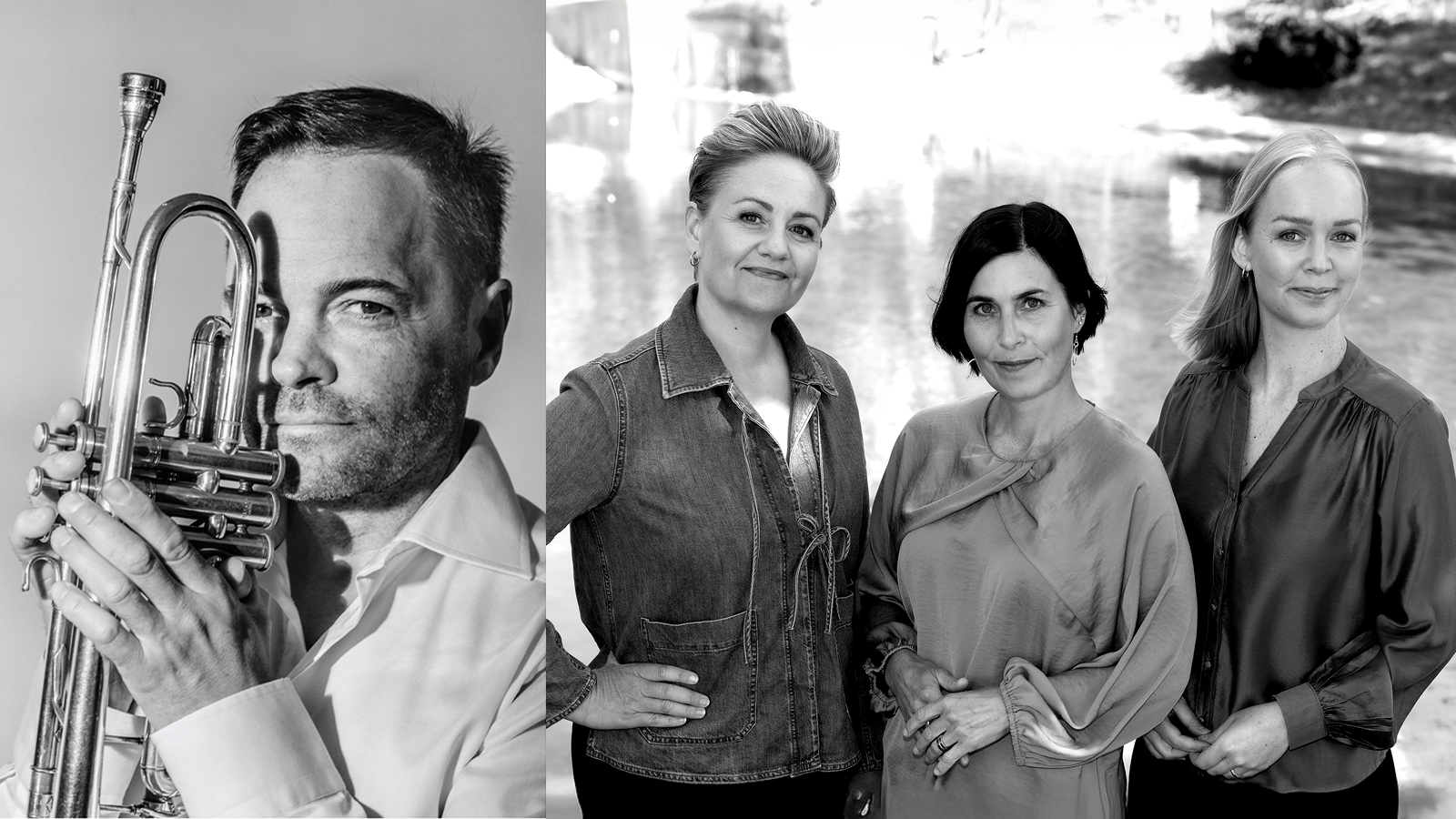
Arve Henriksen; (L to R) Jorunn Lovise Husan, Anna Maria Friman. Ditte Marie Braein

Going out on a frequently-grasped limb, the Australian Chamber Orchestra under its artistic director Richard Tognetti is presenting an occasionally unnerving program on its latest national tour. The organization is collaborating with Norwegian jazz trumpet virtuoso Arve Henriksen and kind-of period vocal ensemble Trio Mediaeval – Norwegian soprano Jorunn Lovise Husan, Swedish ‘singer’ Anna Maria Friman, Norwegian soprano Ditte Marie Braein (sorry: this useless WordPress site won’t make a ligature for the a and e in the middle of her name). As you can easily guess, what is being offered in this undertaking is a fusion of sorts. The afternoon’s first half wove a seamless web that moved too easily between its various components, while after interval we heard Schnittke’s Concerto Grosso No. 1 interwoven with Christian chants and a Swedish hymn.

To be frank, the first half of this concert passed as somnething of a blur. Tognetti, his orchestra and his guests played on a darkened stage (desk-lights in operation) with a blank backdrop that changed colour following no apparent pattern. In the end, I’m not sure whether this was done for specific synaesthetic reasons but it struck me as a waste of resources. With the lights down and no information about the work being played available, you were put into the role of a listening sponge, trying to differentiate between the six works being performed but being all too conscious that your memory wasn’t coping with the musical flow.

For instance, we began with a couple of pieces by Henriksen: The Plume of Ash and Acceptance. These come from different albums that the trumpeter released in 2018 and 2021 respectively and I’d be lying if I said I could tell the difference as both seemed to be using folk tunes and contemporary jazz tropes, the ACO providing a steady backdrop for Henriksen’s solo line which every so often took on the sound of a flute (deliberately so) and for the rest sounded like Miles Davis spitting out an improvisation on one of his more adventurous tracks from the 1970s.

A change in background colour and we arrived at Terry Riley‘s Half Wolf Dances Mad in the Moonlight of 1985 which brought a sudden rhythmic energy to the fore as we followed the American composer’s use of repetition in a moto perpetuo that doesn’t quite give up its pulsations. It struck me that Tognetti spent a good deal of his time directing the ensemble in a piece that, for a good while, followed a regular pulse. But then he was leading an expanded group of 24 players, and 14 of them were either guests or ACO Emerging Artists.

Henriksen returned with Trio Mediaeval for the Australian premiere of Kellamang, written recently (I don’t know exactly when) by Estonian composer Tonu Korvits. Its title refers to a carillon or set of bells and the singers worked through three poems under that title by Doris Kareva; these have been translated rather freely (as I found out later) but were sung in Estonian, and I think most of us would have enjoyed seeing a translation displayed rather than basking in our dark(ened) ignorance. Still, we heard bell sounds, particularly towards the end of a series of settings that tested the singers’ mastery of dissonance.

A short move across the Norwegian Sea to Iceland and we arrived at another premiere, this one commissioned by the ACO from Hildur Guonadottir: Timinn og Vatnio, a setting of parts of Steinn Steinarr’s final work, Time and (the) Water. The text is substantial, even in this truncated form which uses only four of the original’s twenty-one divisions. In the dark, even with a none-too-complicated musical texture, this experience slipped past without making much impression beyond mild irritation at the trumpet’s distractive power. Without comprehending what was being sung, where did the brass instrument fit in? I’ve no idea still.

A Norwegian folksong, Det lisle banet, gave us a chance to enjoy the Trio Mediaeval’s transparence in simple part-singing. I assume this was in place to tie up the various Scandinavian/Baltic threads we’d experienced so far; or perhaps it was just a favourite of the singers who recorded it nearly twenty years ago. Whatever its rationale, we were then conveniently re-introduced to Iceland by way of Fljotavik from a 2008 album by the post-rock band Sigur Ros. Sweet to the point of saccharinity, this piece underlined the prevailing harmonic stolidity of much of the music we’d heard so far. That’s fusion for you.

After hearing my first piece by Alfred Schnittke sometime in the 1980s, I spoke to John Sinclair, veteran music critic for the Melbourne Herald newspaper, asking if he thought – as I did – that Schnittke was a fabrication: not just one composer, but a committee that worked together to produce whatever it was we’d been listening to. It struck me that we’d been exposed to a style of composition made notorious by the Yellow River Piano Concerto of 1970, a method being mimicked under the general name of ‘Schnittke’ by some Soviet musical apparatchiks.

What I didn’t know at the time was that the composer – a real writer – was finding his feet at the time of writing his Concerto Grosso No. 1 (1977) as a polystylist, which term seems to mean that anything and everything contributes to the manufacturing process. This is evident throughout the six movements of this work, here performed with Tognetti and Satu Vanska as the two violin soloists. Both artists worked with admirable unanimity across the discrete segments of this score, remarkably congruent in their fierce attack, notably in impressive double-cadenza moments.

Nevertheless, this second half of the program began with a St. Birgitta Hymn, a strikingly arranged medieval chant in honour of the Swedish mystic – Rosa rorans bonitatem – from Trio Mediaeval, accompanied discreetly by the ACO and followed by an improvisatory variant from Henriksen on piccolo trumpet. Cut straight away to the Schnittke work’s Preludio, scored for strings with the aforementioned soloists, harpsichord and prepared piano (both performed by an oscillating Simon Tedeschi). This is a slow-moving, brooding set of pages in which only the soloists show signs of animation.

The Trio then outlined a St Sunniva Hymn, which turned out to be our old friend Aeterna Christi munera, a (possibly) 4th century chant very familiar to those of us who have sung Palestrina’s Mass based around that hymn. What it has to do with the Irish-born Norwegian martyr eludes me but the text sung here is totally different to that from the one for the Matins for the Common of Apostles or Martyrs. In this, Henriksen’s solo came as a kind of stanza in itself, moving in its breathiness and juxtaposition with the solo voice that sang the new text.

Schnittke’s Toccata movement explained the need for those extra string personnel as it splits into 21 individual lines at several stages, underpinning the frenetic action from our violin soloists and harpsichordist, all of it following a ripienotutti pattern that sounded as if structured very much by a latter-day Vivaldi or Corelli. Here, Tognetti and Vanska entered the lists with a vigour that moved into ferocity at the score’s more intense moments, like between Numbers 12 and 14 in the Universal edition.

A traditional Swedish hymn, Pris vare Gud, brought the Trio to one line, I think; it passed with remarkable rapidity. Then back to the concerto for a Recitativo which became an essay in grating minor 2ns, 7ths and 9ths with some extreme virtuosity required from the soloists, certain passages packed with octave glissandi and terrifyingly rapid passages at the top of their instruments’ range. Emotionally, you would have expected that this to be the work’s highpoint, its dramatic focus. But no.

For their last intercession, Trio Mediaeval and Henriksen gave us a St. Magnus Hymn for the martyred Earl of Orkney, Nobilis humilis, which is one of the first examples of medieval polyphony, re-arranged here to include the trumpet line. As a farewell, this was surprisingly stalwart and rhythmically stolid. But then came the CadenzaRondoPostludio conclusion to the concerto which again gave the soloists a more advanced, massive test of concentrated endurance. This virtuosic writing was contrasted at one stage with a kind of tango from Tedeschi’s keyboard, feeding into my initial delusion that the composer was a compositional kaleidoscope. Perhaps unfair; you really need to know more of the composer’s later products to make any sort of informed pronouncement.

But the multiple personalities in Schnittke’s concerto might have been a programmatic comment on the nature of this concert, which presented us with several strands that only the individual listener could tie together, despite the cues and indications given by the performers. However, we enjoyed an afternoon of exposure to music that came from outside the normal Australian concert hall experience; well worth it, I say, particularly as it gave us a well-rounded portrait of the ACO, albeit in extended format, performing in several different personalities.

Happily-matched musicians

FROM ROMANCE TO RECKONING

Selby & Friends

Primrose Potter Salon, Melbourne Recital Centre

Wednesday July 22, 2026

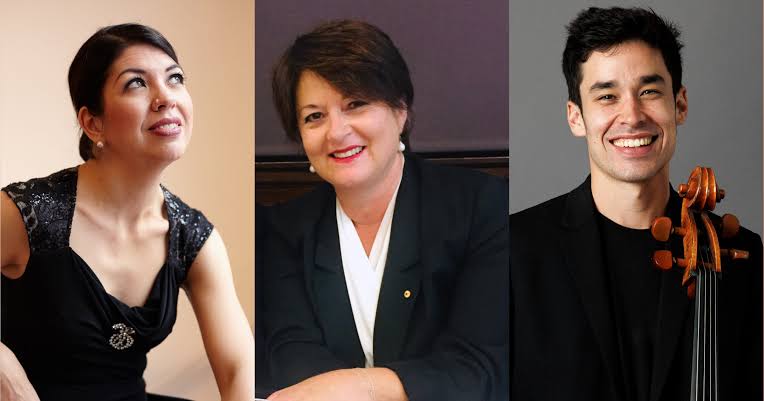
(L to R) Natalie Chee, Kathryn Selby, Richard Narroway

No trouble getting the Romance in this program from Selby & Friends. As well as the magniloquent Mendelssohn Piano Trio No. 2 in C minor of 1845, we were treated to Schumann’s 1851 Violin Sonata No. 1 in A minor, and the same composer’s Drei Romanzen written in 1849: all solidly Romantic period material and coming from a tight six-year span in the middle of that rich artistic movement. As for the Friends, this time around we heard violinist Natalie Chee who is concertmaster of the Melbourne Symphony Orchestra, and Richard Narroway who has taken up the role of head of cello at the University of Melbourne’s Conservatorium.

It has to be noted straight way that the partnership between these two string players and pianist Kathryn Selby was close to ideal. All are musicians working at a high professional standard, as you’d expect, and they make excellent partners for their style of interpretation, especially through their full-frontal dynamic certainty and a highly satisfying care in phrasing – shaping lines with a synchronicity that startles and delights for its apparent ease and decisiveness.

Right from the start of the sonata, Chee projected a strong line which matched Selby’s insistence on delivering every note audibly, even in those grumbling accompanying figures that start the initial Mit leidenschaftlichem Ausdruck movement. The performers repeated the 64 bars long exposition to give us a double-dose of forthrightness, and the development maintained their focus on intense delivery of this sonata segment that works tirelessly at its main theme.

The middle F Major Allegretto strikes me as more scherzo than slow movement; well, so it would to anyone who isn’t interested in finding that these pages offer a fusion – they don’t and the prevailing atmosphere is that of light-hearted pleasure with two momentary more recessive moments. Chee took over the running for most of this segment, making the several recurrences of that opening three-bar motif a cleverly-shaped experience each time.

With the Lebhaft that winds up this score, it was remarkable to observe the deft dovetailing (generally) of Selby’s entries with Chee after the violinist had set up the semiquaver patterns that dominate these pages. The pianist only misfired on one bass note and twice (that I heard) in her right-hand flurries but the sense of nervous energy that came across was a welcome change to the hectic pounding I’ve heard in the past (admittedly from student players). I don’t think any interpreter can do much to dry out the muddiness that comes when the piano moves into triplets just before the key-change to E Major in this movement’s central pages, yet Selby managed to surrender a dynamic front position to what is a pretty low-lying line from Chee.

For Narroway’s duet contribution, the cellist (I assume) picked the Op. 94 Three Romances which were originally written for oboe and piano and which you very rarely hear in that format; I think Nick Deutsch might have given them to us during his years (2016-2020) as artistic director of the Australian National Academy of Music. The composer certainly allowed the violin to be considered as an alternative solo voice; I’m not sure about the cello, as the three pieces change markedly in colour and emotional suggestions when the lower-voiced instrument is employed.

For example, the opening Nicht schnell impressed as more shadowy and sombre than when you hear it from a violin, particularly while the piece was developing (sort of) to a highpoint, then gradually wound itself back down into the dark. As another consequence, Selby’s part moved out of the background to work on equal terms with the cello’s output; not just in dynamic strength, which it would surrender when partnered with an oboe, but more in its stratum of operations, the focal line now sitting in the centre of the keyboard’s complex.

The cello enjoyed more exposure in the next piece, Einfach, innig, probably because it is given a more four-square melody to work with while the keyboard may be active but appears to be working in a more constricted framework because it only occasionally doubles the string line. Selby moved further forward into focus across the central Etwas lebhafter F sharp minor interlude during which she played a continuous counterweight with her triplets. Later, both executants made the most of their final surge of energy between bars 72 and 74 where Schumann enjoys a simple chromatic side-step or two before a partial restatement and a touching fade to A Major placidity.

The last romance, another Nicht schnell, proved to be a gem of narrative and melody-shaping, during which I could find no faults in the frequent octave doublings, and the approach and recovery from the several fermate that dot the action. It was simply one of those happy moments of duo performance where the quiet lyricism of the work grabs your attention and nothing distracts you from its progress; not an essay in concentrated effort but a display of dedication from two artists fused in the completion of a happy task, if not one with mighty challenges.

We ended the night with the formidable Mendelssohn trio about which I can say little except to point to the power of this interpretation which realized the score’s potential in many ways. Although we came to enjoy the composer’s first essay in this form after its sort of re-discovery in the 1970s and 1980s, most of us would have made our acquaintace with this C minor work during those chamber music competitions that occupied this city’s attention in the pre-COVID years, during which time it became a favourite among piano trio competitors.

With these three musicians, the score enjoyed a treatment that proved bracing, aggressive and loaded with drama. All probably unconsciously put an emphasis on the fuoco term in the first movement’s performance directive, Selby fulfilling a role that she has taken on many times over the years with this work. Mendelssohn gives the piano first dibs with a sequence of attention-grabbing common chord rumbles and places most interest to the keyboard part through its sheer activity while the strings enjoy the soaring power of the opening melody (Letter A in some post-1874 editions I’ve come across).

Once again, as in the preceding duo works, the players kept steady hands during this movement’s rushes into action, and then pitched their approach to the second subject and its re-appearances with exemplary care for each other. The pianist was able to arpeggiate with firm abandon, secure in the knowledge that both her colleagues were capable of etching their lines in the fermenting fabric.

But Mendelssohn makes a gift to the keyboard at the opening to the Andante by leaving it to outline the first subject alone in the initial eleven bars before violin and cello treat it with melting sixths and thirds. After which, it’s a glorious ambling journey to the dynamic (and harmonic) climax 12 bars from the placid conclusion: the whole process a moving experience in this interpretation.

As for the rapid Scherzo, I relished the deliberate contrast between the fairy-light semiquaver-rich opening and the heft of the new theme that emerges at the change to G Major with Selby giving her peers plenty of space to drive the composer’s donward-scale tune, yet canny enough to prepare us aurally for the return to Titania-and-Oberon-Land with those left-hand semiquaver clicks eleven bars before the change back to G minor.

Still, it’s a rare trio that can’t make a success of the finale to this work with its bounding first theme, the assurance found in the sweep of its E flat Major consequent that never quite resolves, and the initial quiet statement in the piano of the Vor deinen Thron chorale with the strings at first quietly capering around it. Here, the performers hit the same vein of elevated rhetoric that they mined in the work’s opening with a consistent breadth of timbre and a fluent movement between restraint and force that would have brought this audience to its feet if it hadn’t been, in the main, somewhat elderly.

As for the Reckoning proposed in this recital’s title, I believe that came in the evening’s opening miscellany: the Fire Dances of 2020 written by eight Australian women composers. This collection offers different views of the 2019/20 bushfires that hit the nation so severely, the composers moving from the initial smoke to the ashes that danced around for weeks after the furnace was doused. All were brief, half of them under two minutes, the longest slightly over two-and-a-half minutes.

Nat Bartsch‘s Haze for Days gives us a piano part of upward-sweeping arpeggios, the strings generating rather tonal melodies over the top in a mildly suggestive musical picture. Olivia Bettina DaviesHaze (a trio version of an earlier guitar piece from 2015) came over as a more visceral exercise, her violin and cello lines mainly sustained, then some slow glissandi to suggest the undergrowth’s rustling in anticipation. In Crowning Dance, Natalie Williams imagines the fire reaching treetops and leaping across them, set out in a contrapuntally complex burst of activity something like a close-order invention. The cello outlines a mobile semiquaver ostinato in Maria Grenfell‘s Wall of Flames, the piano indulges in some high-pitched pointillism, the violin produces eerie sound effects, and the effect that this piece eventually achieves is percussive and frenetic.

The cello outlines an ostinato at the start of Hilary Kleinig‘s Fire Storm, above which piano and violin generate vehement noise slashes, some of them improvised; while this is slightly suggestive of a fierce weltering violence, it sounds odd because of its basis in a solid minor tonality – C? In the suite’s longest segment, Elena Kats-Chernin documents In the Embers’ Path with all three instruments partaking in a chugging motion of some heft. For most of the piece’s length, the pulse remains four-square in rhythm, everybody coming together for a safe-as-houses finale.

Cycads After Fire by Cathy Applegate refers to plant regrowth after the fire has passed; optimistic in flavour, this is more of a piece de salon than anything else in the collection, set in a definite tonal backdrop with lush lyrics for all. Finally, Isabella Gerometta‘s Will-O-Wisps (I think the composer is referring to the ‘will-o’-the-wisp’ or ‘will-o’-wisp’ phenomenon, classically oriented as ignes fatui) uses the violin in alt with the cello in small scraps of sound, the piano being the progenitor of some lightly-delivered activity.

As a suite, Fire Dances has its moments although the variety of voices works against any sense of uniformity of approach – or of reaction, to be honest. Some of the pieces appeal for their ability to illustrate their titles; others have success in suggesting striking emotional responses to those often horrific, often tragic days. But the oscillation between different styles of composition makes the work something of a grab-bag – interesting in parts rather than for its totality.

Enthusiasm for patches of brilliance

KEYS TO LIFE

Jayson Gillham & Iyad Sughayer

Elisabeth Murdoch Hall, Melbourne Recital Centre

Sunday July 19, 2026

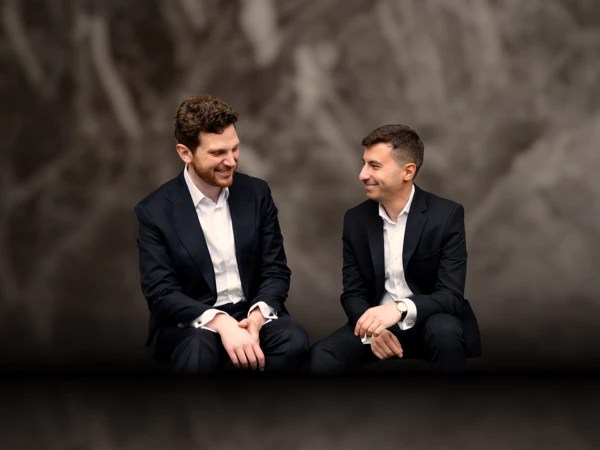
Jayson Gillham & Ihad Sughayer

Not too surprisingly, this duo-piano recital by Australian-born Jayson Gillham and Palestinian-Jordanian Ihad Sughayer was close to packed out. Whether that was due to a horde of music-lovers dissatisfied with the Melbourne Symphony Orchestra’s policy on addresses from the stage, or the occasion inspired an alternative crowd of Palestine supporters to come out in support of an artist with links to that country and another who has been penalised for speaking for the hundred-plus Palestinian journalists killed during the first ten months of the war in Gaza, I don’t know. Perhaps Gillham has an unexpectedly large number of Melbourne fans and they showed up simply because their man was in town.

Whatever its origins, this audience was wildly appreciative of everything and anything. A battery of mobile phones were held up across the theatre before the players sat down. Mind you, no prohibitions regarding snaps were mentioned in the leaflet/program and nothing beats having your own vision reinforced for posterity. In several (no, be honest: most) cases, people clapped between movements and went into Federation Square mode at the end, giving a standing ovation after what was a respectable exercise of talent but hardly on a level of flawless delivery as displayed by the Jussen brothers, who will play in this hall next month, or the Labeque sisters (who, though benchmark duo-pianists, admittedly haven’t been back here for thirteen years).

Gillham and Sughayer (who, as far as I can find, have prepared part of this program by playing once, in April, at the Scotland Conservatoire) are indulging in a kind of capital city tour. After Melbourne, they go to Brisbane, where they’re booked in to the Concert Hall at the Queensland Performing Arts Centre. Then it’s on to Elder Hall at the University of Adelaide, finishing up at the Angel Place Recital Hall in Sydney. As at this moment (July 20), you’ll have no problem getting a seat at any of these venues.

So what are these musicians offering? They begin with Debussy’s Petite Suite of 1889, four movements with qualities that still beguile, like the opening En bateau with its benign first melody, or the clattering Maillotins-reminiscent Ballet. On this night, the pianists utilised the sustaining pedal liberally; well, that’s their privilege as no edition I’ve come across tells you what to do in that regard. Still, the Menuet and Ballet were given with brisk definitions of Moderato and Allegro giusto respectively, to the point where the performers’ congruence suffered in a score where that relationship is not severely tested.

The Petite Suite is written for piano four hands, with Sughayer playing Prima. Mozart’s Sonata for Two Pianos of 1781 followed, with Gillham taking that role. As usual, the missed notes and timing discrepancies stood out, although both players recovered from the latter pretty quickly. The opening Allegro‘s exposition was repeated and the movement worked towards its resolution competently enough, apart from a short mess just before the re-statement of the second subject in the recapitulation – somewhere in the bars-126-to-135 ferment.

As for the central Andante with its almost breathtaking main melody (except for bars 5 and 6), I believe the pianists repeated its exposition as well, which proved to be a true pleasure, if not as much as their sense of grace in the concluding segment of mirroring that follows bar 106. I would have enjoyed the final Allegro much more if the performers made more of its lightness of touch, as the approach every so often appeared to be bulldozing through the heftier moments when both pianos are engaged in simultaneous semiquaver flurries.

Ravel himself arranged his own 1905 Introduction and Allegro for two pianos and these interpreters made excellent work of the piece’s free-wheeling exhibitionism, Gillham playing the origiunal’s initial flourishes for harp with loads of verve, giving us some fetching glissandi along the score’s path. But you missed the original instrument’s texture, not least when it moves into harmonics at the Tres lent bars in the central cadenza. While it made for an interesting aural experience, I’m afraid the exercise struck me as the sort of thing you subsitute when you can’t assemble the requisite instruments for the piece in its ‘right’ state.

Sughayer is a Khachaturian expert, having recorded the Armenian composer’s complete piano works; that probably includes the early Piano Concerto of 1936 which enjoyed high popularity when I was a student but which I’ve heard in the concert hall only once in the last sixty years. The program began its second half with the Three Pieces for Two Pianos, written in 1945 and sparkling with interest every so often. In the Ostinato, Gillham provided a solid bass line and the upper-level development from Sughayer showed slight traces of Prokofiev.

But the central Romance proved the most intriguing of the triptych, mainly for its freedom of invention and utterance which brought to mind Khachaturian’s lyrical felicity when giving vent to his unapologetic Romantic streak. The Fantastic Waltz sounded like hard work for both musicians who, in the end, had to flog the piece’s central theme to a frenetic pulp.

If the night had a pivot for the politically motivated supporters present, it arrived with Houtaf Khoury‘s Isolated for piano four hands, enjoying its premiere. The Lebanese writer still lives in his homeland, I believe, and he spent almost a decade studying in pre-War (the current one) Kyiv. So he’s been on-site if not actually involved in the two great conflicts of these days. This work, according to a prefatory note read by Gillham, speaks of the composer’s present situation and does so in an attractive language of what I can only call polytonal impressionism.

Khoury avoids tragic overtones but the prevailing atmosphere sounds melancholy, if not depressed. What works in the composer’s favour is his ability to keep a narrative mobile, refreshing itself on a bare-bones opening to come to territory that is more optimistic, as Khoury intended, with an extended passage near the conslusion that recalled the sound of bells ringing – not in jubilation but as reminders of a life-affirming state of existence, beyond the grim position that confronts all in Lebanon today.

What followed Khoury’s piece was, however, the best music on the program. No, it wasn’t the most aspirational or the most inspired, but it was a score brilliantly contrived for two pianos: Arensky’s 1888 Suite No. 1. This comprised a(nother) Romance, a Valse and a Polonaise; all were examples of cross-fertilization and complementarity (as our American cousins say) at its best. The opening piece held melodic content of a fairly ordinary quality but its expression proved both accomnplished and elegant, When it came to the Valse, what impressed was the sophistication of Arensky’s fioriture from both executants, and what I recall of the Polonaise was the infectiousness of the composer’s rhythmic manipulation which – as with every later composer in this form – suggested Chopin, but in this instance without copying him.

At the end of the program came Chabrier’s Espana in yet another two-piano version, arranged like Ravel’s work by the composer and published in 1884. This fell rather flat for me, although the audience was wildly enthusiastic. But it seemed pretty bare-bones, without the vivid orchestral tapestry that the composer created, incapable of offering the timbral variety (embodied in the sparkle of tambourine, cymbals and triangle) that animates what is a rather repetitive jota. For all tbat, the performers brought an unflagging energy to this all-too-well-known masterpiece.

An encore – Ravel’s Le jardin feerique that concludes his Mother Goose Suite of 1910 – finished the night in stately style, the slow move from pianissimo to fortissimo as well controlled as I’ve heard in live performance: gravity without ponderousness. It made for an elevated conclusion to this amiable recital, elongated beyond its scheduled length by the artists’ insistence on speaking to us before every piece presented. Sill, as Gillham has shown in recent years, he is a big-hearted artist, one who is secure in his convictions and in his expert pianism. He’s also lucky to have Sughayer as his colleague – an artist with an equivalent commitment and virtuosity.

Four inside stories

INNER LANDSCAPES

Omega Ensemble

Elisabeth Murdoch Hall, Melbourne Recital Centre

Monday July 13, 2026

Paul Stanhope

Pursuing its latest two-state tour, the Omega Ensemble from Sydney presented a hefty program on Monday evening, all in one swoop without interval. Luckily for everyone, the music we heard (apart from the opening piece) proved to be involving and generally animated, with two concertos in succession after an arrangement by Mahler for strings of Schubert’s String Quartet No. 14, Death and the Maiden. As for personnel, the Ensemble gathered together eleven strings – six violins (including two guests), two each of violas and cellos, one (guest) double-bass – alongside the body’s soloist regulars, clarinet David Rowden and piano Vatche Jambazian.

As for that beginner, the Omegas performed Soliloquy by American John Corigliano, arranged in 1995 to commemorate his father who was concertmaster of the New York Philharmonic for over 20 years. To this filial end, the composer has apparently recycled the central movement from his 1977 Clarinet Concerto for smaller forces: the clarinet, of course, and string quartet, which in this instance featured (I’m guessing) violins Emma McGrath and Asmira Woodward-Page, viola Neil Thompson, and cello Paul Stender.

Soliloquy is a successful elegy, intertwining and contrasting the clarinet and first violin line in an emotional landscape that is restrained and yet quietly eloquent. Corigliano’s content is spare and focused, my main memory being of upward-moving arpeggio figures for nearly all participants which brought to mind the opening row statement in Berg’s Violin Concerto. As well, the composer reaches a carefully judged conclusion, the melodic threads fading to silence from both McGrath and Rowden: a final fade to black.

The full complement of strings assembled for the Schubert/Mahler monument. I think that most of us would have experienced an orchestral reading of this work from the Australian Chamber Orchestra which has taken Richard Tognetti’s arrangement on tour here and overseas. Inevitably, the Omega players lacked the mobility and striking accuracy of the ACO in full flight but it was difficult to find faults in Monday night’s reading, apart from some momentary lapses from the top violin line which, to be fair, is put under most stress during this score.

In their attack, this ad hoc body displayed fine definition right from the initial D minor gestures. As well, the players had been carefully prepared for the arranger’s dynamic differentiations and endlessly mobile ebb and flow of phrasing across the opening Allegro. The 140-bars of exposition weren’t repeated but, in a large-frame work like this, with its concentrated material, I don’t suppose we missed it.

Schubert’s treatment of his own song in the second movement set of variations swerves from bleak to dulcet to aggressive in a moving emotional canvas that is packed with great moments. Here, we heard some solo lines as the body wasn’t large enough to follow Mahler’s reduction of some first violin sections to three desks. And the use of mutes made for some fine alterations in texture, especially from the lower lines. My only complaint came with a bar or two of scruffy intonation from the first violins when the lied re-emerges at the movement’s end.

With the third movement, the players enjoyed the heft of the quasi-boisterous Allegro molto with its signature syncopations, all of them making a solid and uniform attack on its outer bars, before the move into sentiment with the D Major Trio. In spite of an appealing curvaceousness in the first violins here, I admired more the warm-timbred duet of violas and cellos betweeen bars 84 and 100, and the second violins’ chance to shine at bar 140, which kind of demonstrated that group of three’s higher success rate at playing piano (a prominent pianissimo, actually) than their ‘first’ colleagues.

With the Presto conclusion to this quartet, you were faced with the expected pell-mell rush right through whole pages; none of that ACO habit of shaping the phrases with mini-hesitations and pseudo-pauses which also gives you variety in attack and heightens your expectations. This was a (generally) straight-through run of high energy with a firm support from violas, cellos and the single double-bass Adrian Whitehall, although what struck me on several occasions was the pentrating power of violas Thompson and Andrew Jezek coupled with our cellists Stender and Mee Na Lojewski in exposed bars like 238 to 241, exposed briefly in mid-tumult.

Capping their performance, these string players welded into a taut composite for the 46 (47) bars of Prestissimo that conclude the work with a resolute vehemence that remains in the memory long after the music has stopped, What you might have missed out on in subtleties of inflection and searing uniformity of articulation from an ACO reading, you were compensated by the directness of address and emotional commitment from this Omega group, playing with six muscians less than Tognetti’s champions.

Before we reached the next piece, a noticeable number of older listeners left the Murdoch Hall, apparently not interested in the later program elements. Well, they missed some fine music-making through their small-minded abstention. American composer Jessie Montgomery‘s Rounds amounts to a one-movement piano concerto, Jambazian doing the honours with the 11-strong complement of available strings. The work opened with a full-bodied chain of short blows as prelude to the main theme of this rondo. Jambazian also outlined his part with a percussive zeal that I hadn’t encountered in other readings.

Indeed, the pianist found a violent layer in this score that served to act as both spur and complement to the strings, the forward motion eventually settling into an appealing nocturne for the piano while his accompaniment eventually comprised the repetition of a fixed strand. Montgomery also introduced a sound-making device that I think required her strings to play/scrape above the bridge; still unsettling when you first hear it but effective in breaking up the semi-sweetness of this work’s central pages.

Finally, we heard a new Australian work in Paul Stanhope‘s Paludarium Dreams for clarinet, piano and strings – in other words, everybody who’d participated so far this night. The composer was present and joined Omega artistic director Rowden for one of those brief pre-performance explications that was probably of assistance to those who hadn’t read the program notes or who didn’t know anything about Stanhope’s life and work.

The concerto begins with a movement called In Flight – bird sounds using those glissandi and short sound wisps that pop up in Sculthorpe’s music. As a soundscape, it made remarkably persuasive listening for us, even if specific bird calls would have escaped those of us who are ornithologically challenged. Mind you, there is no attempt to directly write out specific cries; no Oiseaux exotiques excursions into exact duplication. The landscape of noises changes into more broad strophes as Stanhope moves through his sanctuary while his vocabulary is comfortable without venturing too far from something approaching traditional tonality.

After a jubilant outburst of musical pantheism, the birds return and we strike on a Nocturne, prefaced by frog croaks and more of those above-the-bridge scrapes from the strings. The atmosphere is not placid and takes on the nature of a scherzo occasionally; Stanhope’s idea of a night-piece is more in line with Bartok than with Chopin. Rowden produced some impressive amphibious noises although what struck me most throughout this movement was the prominence of Jambazian’s part, both forceful and recessive by turns.

The third movement, The Carollers, begins with a clarinet cadenza of substance, a fine show-piece for Rowden’s control of register and rapidity of attack. When the ensemble enters, we are in a more urban environment and the work’s metrical motion has moved into something more jagged, less free-flowing or rhapsodic as had been the case towards the end of the previous segment. I know we enjoyed Stanhope’s employment of nature sounds, but here the work moved into being driven by effects rather than growing a world out of them; a hectic series of yelps and high notes presented the city (Sydney) to this listener as more disordered and discordant than it actually is (or is it, these days?). Rowden enjoyed another cadenza-of-sorts near the score’s conclusion, where those Parramatta River birds are heard once more.

Stanhope’s new work is a solid contribution to the small catalogue of Australian clarinet concertos, even if the piano element is often just as present a force in the score’s lay-out. Further, it provided a generous self-revelatory conclusion to this evening which focused intently on the psychological make-up of its contributor-composers: from Corigliano’s tribute to the voice of his father, to Schubert’s intense and stark confrontation with his own mortality, to the concision Montgomery shows in finding eloquence through a fusion of poetry and music, ending in Stanhope’s outlining of his physical world and how he posits himself in it.

A rewarding event, then, and another instance of the Omegas’ catholicity of output. Certainly, the enterprise deserves a larger audience than it currently attracts, let alone one that stays the course for its full program. We all hope for better times and, in this admittedly parlous state, would welcome more patrons to visit future events mounted by these gifted visitors from the not-so-deep North.

Worthy, if light

EMILY GRANGER

Melbourne Recital Centre and Tier 1 Arts

Primrose Potter Salon, Melbourne Recital Centre

Tuesday July 7, 2026

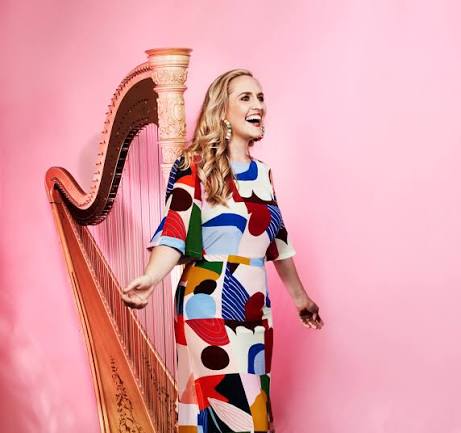
Emily Granger

Starting his Endymion, Keats wrote, ‘A thing of beauy is a joy for ever.’ He was probably right: we treasure the beautiful and it transcends fashion and time – or it should. We can all assemble our ideal musical beauties and I’d suggest that the beautiful in my eyes would be the same as yours if only we shared identical parameters. Of course, we don’t and my list is uniquely personal: Byrd’s Four-Part Mass, Sull’ponte di Hiroshima, the Tallis Fantasia, Ihr habt nun Traurigkeit, Dawn in Daphnis, Circles, The Housatonic at Stockbridge, Brahms 4, Dalla sua pace, Blazhen muzh, Sun Music III, Beim Schlafengehen – you could go on for quite a while before hitting your second-best layer.

This paradox of what’s mine is yours and its ill-omened reverse struck me about half-way through harpist Emily Granger‘s album launch last Tuesday, reinforced when we reached the final work on the schedule which gave the event its title. This was written by Adelaide-based cellist/composer Hilary Kleinig and, in a way, encapsulating much of Granger’s output over the preceding hour or so. The piece began as a softly running 6/8 dance operating on two levels – a sort of Alberti bass with an amiable melody on top, all in a pretty plain tonal language. Not much happened of any significance and, in its second half, the work moved into something close to doodling, before a return to the initial melody in a coda of unexpected brevity.

A Thing of Beauty concluded a presentation in 12 parts, sponsored by the Melbourne Recital Centre and Tier 1 Arts, of solo harp music by eleven Australian women writers. As you can probably infer, I found most of the scores to be similar to each other, a sentiment possibly underlined by the performer’s deliberate choice of music that was easy on the ear and which sounded unchallenging in its rhythmic and harmonic vocabularies. Not that you can fault anybody for that, least of all if you find beauty in simplicity, This modest approach was typified in Granger’s first selection: Emily’s Suite by Sydney composer Alice Chance. This comprised three short movements, written for Granger last year and a pleasant introduction to the evening. Full of Wonder showed plenty of ripples in (possibly) A minor; Ballad proposed a melody in its lower register under upper decoration; Chorale proved to be packed with arpeggiated chords, not much challenging to the ear in their construction. All quite acceptable music-making, yet uninvolving.

I’m not sure what happened next. The performer could have embarked on Romanian-born harpist Ulpia ErdosReminiscing from 1998 or she could have presented Tasmanian harpist Christina Sonnemann‘s 2007 Mavista. Whichever it was, the work sounded like a folk fiddler’s tune, coming from a player with her/his tongue firmly tucked in his/her cheek, the piece acquiring tittivations and flashy sparks as it progressed.

But we were put back on track when Granger announced what she was about to give us next. Margaret Tesch-Muller, a soprano-composer who bounces between Sydney and Btrisbane, wrote Snow and Shadow in 2017. Suddenly we moved into a minor key although the piece’s progress proved harmonically bland with a somewhat constrained melody that moved in steps rather than leaps. This performance emphasized a calm and dark atmosphere but little else remains in the memory.

To this point, Granger had given us some small verbal addresses between numbers, starting after Chance’s suite. It’s been said before but is probably worth repeating: if you’re going to speak, even in a small room like this one, you have to be audible and comprehensible. It also helps if you have some information to impart. The harpist’s opening talk impressed for the number of times she wove in the pronouns ‘I’ and ‘my’. What I gleaned was that the various elements on the new CD represented a kind of search or journey. The trouble was that Granger spoke to the left-hand side of her audience, her mouth hidden behind the harp’s soundbox for those of us to her right; hence, most of her mini-speeches failed to come across successfully.

This lack of clarity almost disappeared while she spoke of Adelaide-based composer Anne Cawrse’s Come to me, another piece written for Granger last year. The composer was inspired by Christina Rossetti’s Echo which speaks of loss and regret; Cawrse gave us a sober and intriguing reaction with a constant, steady pulse underpinning a firm melody, the composer’s language an interesting mixture of minor and modal vocabularies. To my mind, this piece presented as the most sophisticated element on the program so far.

sanddollar, written in 2021 by Sydney pianist Sarah Elise Thompson, opened with repeated bass notes and a constant pattern under isolated high notes. The piece makes a virtue out of its accompaniment, even if its effect is tending towards tedium, despite its four-square duple nature moving into sextuplets. Melbourne composer Katy Abbott was in the audience and introduced her Not Just Another Day from 25 years ago, written to celebrate a friend’s delivery of a baby girl. Sadly, the composer proved as unfamiliar with projection as Granger and I missed the second part of her address. But this composer has an individual voice and it showed through a harmonic and melodic breadth that proved most welcome, even in this brief work that made much of its opening 4-note pattern.

Melbourne pianist Nat Bartsch wrote Call and Response in 2017. We could all perceive the Call strophes that resonated firmly; the Response, I’m not so sure, unless it came in the very soft echoes/repetitions of the main message. During harpist Tara Minton‘s Alby’s Lullaby of 2015, I kept on thinking of Play School – not for long as the piece was quite short. But, in its 3/8 or 6/8 rhythm and pleasant meandering progress, you were reminded of the friendly background sounds that escorted Big Ted and Jemima on their way; predictable and slightly poppy in the best 1960s style.

Another talk from Granger preeceded Sonemann’s Karoola Seasons, written 20 years ago. The performer prefaced each of these four movements with a haiku, from which you could glean the occasional word; a pity as some oral information might have given breadth to this series of character pieces, in so far as seasons have a character – living in Melbourne, you know that’s nonsense. Spring came over as monotonal, if not modal, its content happy to make a statement and stay fixed to it. We encountered a similar absence of adventure in Summer which oscillated in its harmonic base between the piece’s tonic and leading note in a cascade of arpeggios. Autumn brought a lowering of activity level, appropriate for its title, while what I thought was the most substantial segment, Winter, showed us Sonnemann presenting a convincing duo of upper and lower patterns, the whole structure articulated with impressively soft attack in an ode to evanescence.

A pair of scores by Canberra musician Sally Greenaway brought us alongside Kleinig’s conclusion. Encore de Lirico from 2014 showed us a regular four-square pattern of two notes on the upper level, then two notes downstairs. The internal texture made stabs at unexpected modulations but we soon returned to home camp. Then Encore Perhaps Tomorrow, written in 2009, didn’t stay around for long as the composer set out a gentle melody and let it speak for itself without much elaboration, even though this earlier Encore showed a tad more harmonic daring than its predecessor.

Of course, we were given a final speech in which Granger thanked several people very graciously, even if I couldn’t make out any of their names. I know she thanked us for being present at this exhibition and the well-filled Salon responded to the program’s end with goodwill, if not rapture. And that’s really how I viewed this recital: the player is highly competent (she’s currently harpist with the Queensland Symphony Orchestra and teaches at the Queensland Conservatorium and University) and she is absolutely at ease with the program she gave us, even more so now than on the various extracts you can find on YouTube.

She has aimed for a certain emotional level where very little disturbs a placid surface; not my idea of a thing of beauty, more of pleasure. Put all these pieces together and you’re in the territory of Greta Bradman’s Mindful Music programs on ABC Radio. It’s too harsh to say that this brand of musical entertainment is mind-numbing, yet there’s not much solid substance to cling to during these tepid aural saunas. Congratulations to Granger for devoting her new CD to Australian women writers, but on this showing there’s still some way to go before these composers move into territory beyond lightly spun entertainment.

Diary August 2026

TOUR DE FORCE #3

Corpus Medicorum

Elisabeth Murdoch Hall, Melbourne Recital Centre

Sunday August 2 at 5 pm

Doctors and their medical accomplices are back for what I think is a final Corpus Medicorum musical exercise for this year, raising funds for research into lung cancer at the Royal Melbourne Hospital. Conducted by Fabian Russell, the body presents a two-pronged program – concerto and symphony, omitting the once customary overture. Violinist Anna da Silva Chen is a member of the Australian Chamber Orchestra and here gets the chance to bring her own insights to the Mendelssohn E minor Concerto which had – for this composer – a long gestation: 1838-44. It’s one of those works that most of us know very well but, despite the fact that every soloist has played it, there’s an inevitable pleasure in crossing those familiar pages once more. As for the symphony, settle in for the sprawling Bruckner 8 which can last for 80+ minutes. It’s the composer’s last completed symphony and it also took a long time to finish: 1884-92. You can experience the work in many editions as musicologists have built careers on their re-interpretations and re-formations. The forces required are extensive, no matter which of the two ‘original’ versions you use. A standard ticket costs you $70; concession $40 (that’s what I call considerate); student $30. You have to find some spare cash for the Recital Centre’s variable Transaction Fee of anywhere between $4.50 and $8. Currently (end of June), seats are readily available, so . . .

SHEKU KANNEH-MASON PLAYS FINNIS

Melbourne Symphony Orchestra

Hamer Hall, Arts Centre Melbourne

Thursday August 6 at 7:30 pm

Cellist Sheku Kanneh-Mason played at the wedding of Meghan Markle and Prince Harry, a show that was watched by millions and illustrated trans-Atlantic vulgarity with breathtaking cultural obtuseness. Still, if that’s a stepping-stone to stardom, seize it with both hands because such a chance won’t come again – rubbish: of course it will. Anyway, here he is, eight years after running through some royal lollipops, doing a tour of Australia and fronting the Melbourne Symphony Orchestra under chief conductor Jaime Martin in a new concerto, co-commissioned by the MSO with the Los Angeles Philharmonic, the Dresdner Philharmonie, and the London Symphony. This new score has been written by British composer Edmund Finnis (no: I don’t know him, either) and was premiered by our guest in LA last November. It was to have been played in Dresden a month ago but Kanneh-Mason hurt himself and couldn’t perform. So we’ll hear it second, before its London airing in October. So lucky. As a preface, Martin conduct’s Debussy’s Prelude a l’apres-mid d’un faune from 1894, after which not much was ever the same in music or ballet, although to look at Terpsichoreans today, you’d think that Nijinsky’s erotic thrusts had never existed. We complete the night with Tchaikovsky’s Symphony No. 5 in E minor of 1888: always popular and reassuring, even with its Paul Hogan-reminiscent slow movement – a test for any principal horn. That andante will bring us a welcome sample of Australian monocultural adaptation – using the foreign-grown in service of our own once-great cigarette advertising industry; makes you proud of the Farrer electors (some of them). Tickets cost between $75 and $139; concessions are $5 cheaper; Under 18s pay $20. And then there’s the $8 transaction fee if you order online or by phone. You could probably get a seat from the box office on the night; the MSO website information about availability is much the same for whatever event you look up, which makes me suspicious.

This program will be repeated on Saturday August 8 at 2 pm.

ANAM 30TH GALA WITH SIMONE YOUNG

Australian National Academy of Music

Elisabeth Murdoch Hall, Melbourne Recital Centre

Friday August 7 at 7 pm

For some reason, the Australian National Academy of Music has only been in operation for thirty years. I would have sworn it was longer, with all those memories of having to trek out to the South Melbourne Town Hall in the organization’s heady early days. Well, not so early; I can’t remember the years when Trevor Green and Ronald Farren-Price began the exercise as its first artistic directors, as I only became aware of ANAM in the reigns of Frank Wibaut and John Harding, followed by the Dean brothers’ halcyon terms. Anyway, Paavali Jumppanen has been in control since 2021 and has settled his institution into its Abbotsford premises. From which domicile it is emerging for this celebration, the body’s orchestra here under the control of Simone Young, who was well into her career when ANAM opened. Tonight, she takes her young forces through, to start, Gubaidulina’s 1971 Fairytale Poem about a piece of chalk which eventually realizes its ambition of drawing landscapes rather than formulae. Then comes a test for first-desk players in John AdamsChamber Symphony of 1992 for 15 soloists, similar to Schoenberg’s Op. 9. After interval (I assume) for inexplicable reasons, the orchestra will play the few seconds that constiutute the Epilogue to Gyorgy Kurtag‘s Beckett-based opera Fin de Partie of 2018.Then, we finish with something more or less traditional: Strauss’s Tod und Verklarung tone poem from 1889 which requires large forces, including two harps, and a belief in the Artist as Hero which is stretching it in this composer’s case. Entry ranges from $65 to $95, concessions $20 cheaper at all levels; Under 30s and Seniors pay between $55 and $85. You also have the Recital Centre’s Transaction Fee of anywhere between $4.50 and $8 which you’ll have to come up with, venal as the whole business is, because there are only a few seats left.

NICOLAS ALTSTAEDT & THOMAS DUNFORD

Musica Viva Australia

Elisabeth Murdoch Hall, Melbourne Recital Centre

Tuesday August 11 at 7 pm

Here is an eccentric duet appearing for Musica Viva Australia: German-French cellist Nicolas Altstaedt and French lutenist Thomas Dunford. As you’d expect, the pair combine for a program heavy in French Baroque – Marais (six pieces) and Forqueray (three) – with some excerpts from the Bach Cello Suites in G Major and C minor. For something closer to our time, we hear the Lento from Duparc’s 1867 Cello Sonata and that modernist carry-all, Spiegel im Spiegel, written by Arvo Part in 1978 for violin and piano with the string line able to be played on viola or cello; the piano bits on lute, I’m not so sure. Viol master Marais is represented by La Reveuse, Le Tourbillon and Le Badinage from Book 4 of the Pieces de viol published in 1717, Les Folies d’Espagne and Les Voix Humaines from the 1701 Book 2, as well as a Grand Ballet that seems to be a generic title possibly arising from something in that 1991 film Tous les matins du monde. As for Forqueray, his gamba trifecta – La Leclair, Fetes champetres, La Buisson – all come from the only source of his compositions: a volume of 32 pieces published in 1747 (two years after Forqueray’s death) by his son, Jean Baptiste. The ticketing is complicated. Adults can choose from four levels that range between $65 and $163; concessionaires and students enjoy reductions of $18, $15 and $12 in the top three levels; Under 40s get in for $49, while Under 18s pay $20. As well, you have to contribute anything between $4.50 and $8 for the Recital Centre’s Transaction Fee – hard to avoid as already (July 4) there are only about 100 seats still available.

NIGHT SONGS

Ensemble Liaison

Hanson Dyer Hall, Ian Potter Southbank Centre

Thursday August 13 at 7 pm

It might be under the auspices of the Melbourne Recital Centre, but this particular recital is being held next door in the new building (well, new to some of us) that is part of the Victorian College of the Arts/University of Melbourne Conservatorium of Music complex. As for the night’s title, that comes out plainly in a 2009 called Nocturnes by Australian writer Iain Grandage. A two-poem setting for soprano, clarinet and piano, this will involve Sydney-based guest artist Chloe Lankshear as well as Ensemble Liaison regulars David Griffiths and Timothy Young. Before this, we hear Andre Previn’s brief Vocalise of 1995 for soprano (Lankshear), piano (Young) and cello – the Liaison’s Svetlana Bogosavljevic. Putting the singer to more extended use, the Ensemble (well, Lankshear and Young) presents Debussy’s 1887 Ariettes oubliees, six Verlaine settings of exceptional empathy, followed by the composer’s Cello Sonata of 1915, first in a projected series of six such works, now one of the string instrument’s repertoire staples. To end, the players perform Osvaldo Golijov‘s Three Songs for Soprano (and Orchestra) of 2002 which will probably be mounted in an arrangement, although the only one I can find is for string orchestra which is at cross-puposes with the composer’s large percussion battery in the original. Anyway, ticket details are simple: standard is $53, concession and student $42. As well, the Recital Centre is charging between $4.50 and $8 as a Transaction Fee if you order online or by phone. I’d front up on the night, preferably with fee-avoiding cash, even if the venue holds only 400, as opposed to next door’s Murdoch Hall catering for 1,000.

JAIME CONDUCTS MAHLER 6

Melbourne Symphony orchestra

Hamer Hall, Arts Centre Melbourne

Thursday August 13 at 7:30 pm

Settle in for a long bout with this night’s title work; it can take up to 90 minutes to get through and you’d have to assume that Jaime Martin, chief conductor of the Melbourne Symphony Orchestra, won’t introduce a substantial break along the way. The MSO itself should still be familiar with this score, having recorded it under Mark Wigglesworth for a 2005 release. Although . . . no: not many of those players from 21 years ago will have survived. What will be interesting – in a way – will be Martin’s choices on the two vexed questions about this score: in which order to play the two central movements, and whether to have two hammer-blows in the finale, or three as Bernstein did in his three recordings. Mahler dithered at length about the order of the Scherzo and Andante and his widow got involved in the argument after his death, claiming spousal authority – which you’d have to question, considering the lady’s credentials where facts are concerned. The composer himself cut the hammer-strokes from five, to three, then to two; Alma identified three tragedies in the composer’s life as being represented by these dull smashes, which strikes me as putting the cart before this 1904 horse. At all events, here is Mahler’s largest purely instrumental work in terms of resources needed (possibly four harps!) and it makes for a riveting narrative, which is hard to say about its successors. Before this, and possibly the only work before interval (shades of Stenz putting Ives’ The Unanswered Question before Mahler No. 2), we hear a ‘new work’ by the orchestra’s initial Cybec First Nations Composer in Residence, James Henry. With a background in pop, rock, house and techno, this fresh score will make an ideal introduction to the Austrian writer’s psychological excoriation. The usual ticket prices apply: standard between $75 and $139, concession a whopping $5 cheaper, Under 18s $20. Add on the MSO’s own $7 transaction fee per phone or online order. Once upon a time, Mahler 6 would pack them in; will it today? I’d be tempted to show up on the night, bearing lots of coins.

This program will be repeated on Saturday August 15 at 7:30 pm.

VIVALDI’S LEGACY

Australian Brandenburg Orchestra

Elisabeth Murdoch Hall, Melbourne Recital Centre

Thursday August 20 at 7 pm

In this concert program, the Australian Brandenburg Orchestra is putting itself under the control of guest director and Baroque violinist, Augusta McKay Lodge, an Ohio-born musician resident in Paris. She is attempting to shine a light on Anna Maria della Pieta, a Venetian musician for whom Vivaldi might have written a plethora of works including the per Anna Maria Violin Concerto in E RV 267a, which score sits at the heart of this concert. Lodge also takes part in Vivaldi’s Concerto for violin and organ (which part will most likely be undertaken by the ABO’s artistic director, Paul Dyer) RV 774 which was recently discovered in the Anna Maria Partbook – well, the solo violin line was found – and the rest (all of it) was reconstructed by Federico Sardelli. We hear a solo violin sonata by Pisandel, the A minor JunP IV.2. This composer was much admired by Vivaldi but did Anna Maria play this piece? I don’t know; does anyone? Finally, we hear a Tartini violin concerto in G minor GT 1.g01 which could come from anywhere between 1725 and 1735. Was Anna Maria conversant with this score? Possibly: she lived to be about 86, dying in 1782 and outliving all three composers we hear tonight. Also scheduled to play solo is Baroque flautist Melissa Farrow; can’t tell where her contribution comes into play. As for tickets, these are of mind-blowing complexity. Somehow, the modest Murdoch Hall has been divided into an improbable six regions; your standard seat price ranges from $45 to $167; concessions for the top four of these six come in at between $31 and $62 cheaper; Seniors range in the top four areas from $77 to $151; full-time students in all divisions except the top pay $20; Under 40s pay $36 but it’s unclear where they can sit except for the second-top spot. You have to come to the Recital Centre’s bloated Transaction Fee party of anywhere between $4.50 and $8; at time of writing (July 5), there are over 150 seats still available.

This program will be repeated on Saturday August 22 at 5 pm, and on Sunday August 23 at 5 pm. Tickets are more expensive for both of these performances but their availability is about the same.

METROPOLIS: SOUNDS OF CINEMA

Melbourne Symphony Orchestra

Hamer Hall, Arts Centre Melbourne

Friday August 21 at 7:30 pm

This one-off celebrates Australian-born film composers; three of them – Thomas Meadowcroft, Bryony Marks, and David Hirschfelder. The Melbourne Symphony Orchestra shows a fair deal of dedication to this project by being the commissioners of the program’s opener: Meadowcraft’s Hollywood Parsifals for Foley Artists and Orchestra in which the Berlin-based composer celebrates the makers of film sound effects. How will he achieve this? No idea but a Foley artist, John Simpson, is listed among the concert’s soloists; God knows what he makes of being classed among a group of perfect fools. Marks wrote the soundtrack for the first film directed by her husband, Matthew Saville: Noise, a 2007 thriller which concerns suburban Melbourne murders investigated by a detective with tinnitus. We’re to hear Their World – an extract of about ten minutes from that soundtrack. Finally, we hear three suites from films for which Hirschfelder provided the music: The Dressmaker, Legend of the Guardians, and Strictly Ballroom. These have all been arranged by Jessica Wells, a formidable name in her field. Benjamin Northey conducts and other participants include percussionist Eugene Ughetti, guitarists Slava and Leonard Grigoryan, and Hirschfelder himself playing piano as he has throughout his career for luminaries like Little River Band, the Peter Cupples Band, John Farnham and David Hobson. Adult tickets cost between $59 and $99; concessions are a ridiculous $5 cheaper; Under 18s pay $20, but everyone pays the MSO’s transaction fee of $8 if ordering online or by phone. At the moment, plenty of seats are available, even though the Hamer Hall Balcony is not being used.

ENSEMBLE Q PLAY BARTOK & BRAHMS

Ensemble Q

Primrose Potter Salon, Melbourne Recital Centre

Saturday August 22 at 7 pm

On a national tour, the Brisbane-based Ensemble Q presents an amiable enough entertainment in the Recital Centre’s smaller space. They begin with Bartok’s Contrasts, the composer’s 1938 trio for clarinet (Paul Dean), violin (Adam Chalabi) and piano (Daniel de Borah). Enjoying the restrained ebullience of several Hungarian and Romanian dance tunes, this score is a splendid display piece for all three participants, packed with striking dissonances and requiring an unfailing rhythmic versatility, especially in its rapid finale. Chalabi and de Borah collaborate in Margaret Sutherland’s brief 1944 Nocturne that illustrates rather well this venerable Australian composer’s occasional fusion of dissonance and quiescence. To end this 75-minute recital, we hear the Brahms Piano Quartet No. 3 in C minor from 1875 – the last one and the least played in live performance, possibly because of its emotional bareness or its internal complexity. Anyway, we know Chalabi and De Borah are involved; British violist Benjamin Roskams is taking on the tenor part, but the cellist is unidentified. You’d have to expect that Trish Dean, the Ensemble’s co-artistic director, will be the chosen party for this role. Tickets are $75, concession $65, student $30. As well, the Recital Centre’s transaction charge comes in somewhere between $4.50 and $8, for a service that is grossly over-valued. Currently, plenty of tickets are available, but you can’t count on that remaining the case because the Salon only holds an audience of between 130 and 140.

LUCAS AND ARTHUR JUSSEN

Melbourne Recital Centre

Elisabeth Murdoch Hall, Melbourne Recital Centre

Monday August 24 at 7:30 pm

I suppose most of us would know these Dutch brothers from YouTube, on which site you can observe their duo skills easily enough. As you’d expect, their empathy borders on the extraordinary, especially in two-piano works like the Mozart concerto K. 365 of 1779 but more obviously in four-hand pieces where the interweaving of dynamic and line is flawless. Plaudits to the Recital Centre for snapping up Lucas and Arthur Jussen as they pass through town on their New Zealand/Australia tour. To begin, they perform the Mozart four-hand Sonata in D K. 381, allegedly written in 1772, possibly for performance by the lad himself and sister Nannerl. Then we hear another four-hand repertoire staple in Schubert’s F minor Fantasia of 1828 which is one of the more challenging duets because of its chameleonic character. After interval (I assume), we move to the 20th century and works by two friends. First comes Ravel’s choreographic poem La Valse, completed in 1920, perhaps in the composer’s own two-piano transcription of that year, but more likely in Lucien Garban’s version, also from 1920. To end, the brothers play Stravinsky’s seminal The Rite of Spring ballet of 1913, its first published version being the composer’s own four-hand transcription. While you can see the Stravinsky, Mozart and Schubert works from this pair on YouTube, I don’t believe they have recorded the Ravel, so that guarantees about 13 to 14 minutes of novelty value. The cost of standard tickets ranges across four levels, from $79 to $139, with concessions of $20 available only in the middle two strata; Under 40s can access the two lowest tiers for a flat $49. You also have to find the Recital Centre’s fee for handling your credit card details if you book online or by phone – that’s an extra $4.50 to $8, depending on your financial status. I don’t think the Circle/Wings seats are available (or in use), but there are over 300 seats left today (July 6) in the stalls. Worth the gamble of turning up, cash in hand, on the night? Keep an eye on the Recital Centre’s website.

HOW TO TRAIN YOUR DRAGON 2 IN CONCERT

Melbourne Symphony Orchestra

Hamer Hall, Arts Centre Melbourne

Thursday August 27 at 7:30 pm

This franchise has escaped me – and most of my grandchildren as well. But there must be something in it that appeals – all that left-over Game of Thrones angst, perhaps. Also, as a sequel, it’s rated highly by those who should know – children and film critics. Obviously, the Melbourne Symphony Orchestra administration and artistic gurus see merit in taking on the film and supplying the soundtrack in real-time; so much so that they’re doing it four times and the middle two performances have not many seats left. Dean DeBlois’ 2014 film features (mainly) music by John Powell who used a 120-member orchestra, a 100 voice choir, and some odd instruments like the Celtic harp (bring back Mary O’Hara), uilleann pipes, Highland bagpipes, tin whistle (for that James Galway touch) and a bodhran – which rounds out the odd national image that this film’s scenario projects: north and west of Hadrian’s Wall, as well as the Norse part of Scandinavia. All’s well, however, because the country’s favourite actor/actress Kate Blanchett is in the vocal cast; rest easy, Australia, with this secondary consolation for not getting anywhere in the World Cup (as usual). Our own Nicholas Buc conducts but there’s no sign of the MSO Chorus or any of the vocalists needed for the score’s songs. Adult tickets cost between $89 and $167; children and concession holders pay $5 less. Fancy taking your three kids to good seats for nearly $500? Add on the usual $8 transaction fee and you’re in for an expensive night out. The cheapest DVD version at JB Hi-Fi costs $14.98.

This program will be repeated on Friday August 28 at 7:30 pm, Saturday August 29 at 7: 30 pm, and Sunday August 30 at 1 pm.