LATVIAN RADIO CHOIR & GENEVIEVE LACEY
Musica Viva Australia
Elisabeth Murdoch Hall, Melbourne Recital Centre
Saturday November 7, 2026
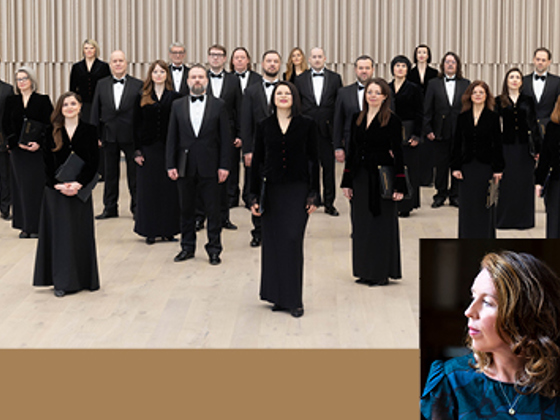
Latvian Radio Choir (Inset: Genevieve Lacey)
It’s been a while, but I’m still not sure that I have a grasp on what this concert was about. At one stage, it seemed that the main theme was birds, not completely because of recorder diva Genevieve Lacey‘s participation in three items directly avian in emphasis. Later, the mental emphasis swayed to thoughts of indigenous landscapes, in particular those in this country, especially considering the evening’s opening and closing. Then the night’s ambient emotional content from the Latvian Radio Choir impressed for its lack of histrionics, an emphasis on calm acceptance rather than choral fireworks – so an invitation to meditate rather than evaluate.
Whatever approach really applied, the exercise’s main thrust came in the final work programmed: Ceremony of Swans by Latvian writer Eriks Esenvalds, here enjoying its premiere performances. This uses an extract from Australian author Alexis Wright’s The Swan Book of 2013 as its text, although I found it hard to discern actual words in the composer’s treatment. It began, like so much on this night, slowly so we fell into the dream world of the central character, the choir our placid narrators before Lacey entered with songbird interpolations, generally short bursts above sustained choral chords.
Coinductor Kaspars Putnins demonstrated expertise in controlling this chameleonic score that occasionally left the singers to their own devices before coming into congruence again. Esenvalds walked a pretty broad path, a sometimes traditional harmonic vocabulary swapping places with sounds suggestive of Aboriginal drones; something of a miscellany, then, that brought into our ken the interpretative warmth of this group of Latvian singers.
Musica Viva Australia began the event with a Welcome to Country of unusual length, if the content itself held nothing new. I’m not at all in sympathy with those neo-Nazi hoons who disrupt Aboriginal ceremonies at the Cenotaph’s Dawn Service or at Camp Sovereignty in the King’s Domain, but speakers have a need to involve listeners, not offer re-treads of over-familiar claims of dispossession and displacement. We know the past is foul with white criminality and acrid racism, but very few of us know what needs to be done to disrupt One Nation’s and other conservative parties’ lies that divide the nation.
The program’s other two major elements comprised works by Estonian composer Arvo Part and another Latvian in Peteris Vasks. In fact, the choir presented two of Part’s choral pieces: the Magnificat of 1989 and a Nunc dimittis from 2001. As the visitors worked through the first of these with its frequent splitting into two parts of its four normal SATB lines, what impressed me in particular was the group’s tenacity when faced with the composer’s employment of 2nds and 7ths; even more, the almost complete absence of joy from this setting of one of Christianity’s most telling affirmations of delight.
Part’s reading of Simeon’s canticle of thanksgiving sounds very much indebted to Orthodox chant in its repetitions and splayed slow polyphony. The Latvians produced an excellent reading in terms of choral hieraticism but, as with the previous work by this composer, you had to wonder how he could ignore the holy man’s gratitude and acceptance, replacing it (by this stage in his career) with a mobile dirge. Still, who among us can question another’s perception of the divine? I just thought such experiences would generate something more exuberant.
From Vasks, we heard Musu masu vardi, translated as Our mothers’ names and something of a choral saga from 2003. This was another slow mover, made even more so by the Latvian text which proved to be a eulogy of bird-life, the work’s title having reference here because of the national habit of using bird names in affection, particularly for women. In this substantial score, little remains in the memory apart from some chordal glissandi and a number of vocal contrivances that suggested the animals in question.
The only other extended singing we heard came in Mendelssohn’s Psalm XXII setting of 1844 which made a positive impression for its smooth transitions from solos and reduced groups (male quartet. SATB quartet) to the full (remaining) choir. In keeping with the night’s atmosphere, this is a penitential piece, beginning with the despairing sentence Mein Gott, warum hast du mich verlassen? if ending in a series of praises that have an underpinning of fear. But these singers gave the work plenty of interest through their full-bodied response to Putnins’ emphatic direction, with the only questionable segments a bass and soprano solo that in one case sounded under-strength, in the other slightly off-key.
We heard two pieces by ornithologist/composer Hollis Taylor and her violinist partner Jon Rose. Both are receiving their premiere performances on this tour and followed the night’s avian trend. The more substantial, Bird on Byrd, uses an untraceable piece by the Elizabethan composer, gives it to the choir to hum while Lacey spirals above the Renaissance chords with a wealth of bird imitations, complemented by an electronic support of much the same thing. As an entertaining conflux of sound, this was amiable stuff, if long-winded; the use of Byrd’s music appears to be justified only by a similarity between the composer’s name and the creatures being celebrated.
As well, the duo-composers revealed Etheridge River, a brief piece marrying Lacey’s recorder with the recorded sound of butcherbird calls. The most striking aspect of this piece was the way in which Vasks’ eventually static choral texture was merged with the Australian work by Lacey’s subtle bird notes initiating Etheridge River. In my view, this fresh solo piece is just long enough, its material not stretched thin and the whole exercise remarkably athletic. Certainly, it made a contrast with Lacey’s earlier solo, Van Eyck’s Engels Nachtegaeltje, published in 1644 and almost a signature piece for Lacey, underlining her mastery of dynamic shifts and linear stability, as in the alternating high and low bird calls.
The program’s second half began with a set of recorder divisions on Palestrina’s Pulchra es amica mea, first published in 1584. Here, the Latvian singers hummed the motet while Lacey played a set of diminutions over it, written by Francesco Rognoni from a generation after the composer. This placid complex of sonorities proceeded past easily enough, the superimposed variants intriguing to trace, although it seemed that most of them had to do with the motet’s soprano line. Every so often you were brought up short by a short cluster of repeated notes in the recorder that inevitably brought to mind the Monteverdi operas and 1610 Vespers.
Beginning this entire nine-part exercise, we heard American writer Caroline Shaw‘s 2017 setting of Psalm 84, And the Swallow; better known to some of us as How lovely is thy dwelling place. This set up the musical process very well, as it employs an attractive, orthodox harmonic language and moves through its text plainly, with a touching and pointed use of textual repetition and a brilliant soundscape near the end that suggests soft rainfall. To my ears, the piece sounded rapid, insufficient time being given to the suggestive and hushed lower register sound layers that support the work’s structure. You can hear a more atmospherically satisfying rendition from the University of Johannesburg Choir on YouTube, the singers investing emotional warmth in every strophe.
Nevertheless, we relished an impressive display from the Latvian singers in both ancient and modern, giving us plenty of exposure to their mastery of contemporary composition, even if the accent fell on styles of language both euphonious and reactionary. Further, the partnership with Lacey, if odd on paper, yielded some remarkable and moving moments in the new Esenvalds composition, the composer present in the Murdoch Hall for this outlining of his ambitious score. A packed-out space supported Musica Viva Australia‘s ambitions in the choral sphere, showing us that the organization isn’t just to be inextricably linked with tours from British university college choirs.

