ENCORES
Australia Chamber Choir
Move Records MCD 674
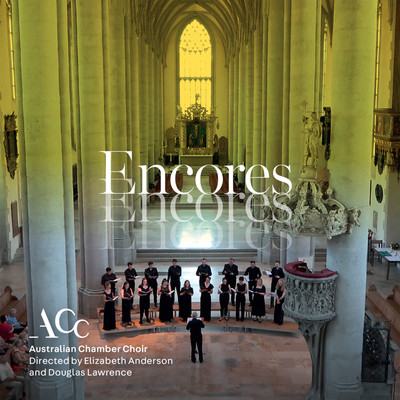
Comprising seventeen tracks of music from different periods, this latest CD from the Australian Chamber Choir gives us a bit over half of the numbers on offer directed by the group’s founder, Douglas Lawrence. The other eight have been directed by Lawrence’s wife, alto Elizabeth Anderson. Most of the recording was carried out at the organization’s usual Melbourne operating space: Our Lady of Mount Carmel Church, Middle Park. Two of the works, including the longest track, come from the Pisano Palace, site of the Music Conservatory of Venice, and the Church of Saint-Germain near the University of Geneva. As for dates, most of the work was carried out in 2024, the second-longest piece comes from last year, and two works – both Australian compositions – are survivors from 2015 and have been issued on a previous ACC disc.
The entertainment begins and ends with American spirituals in arrangements by Moses Hogan and all directed by Anderson. Many more years back than are comfortable, I recall Lawrence conducting his Ormond Choir in the College’s Dining Hall (ah, the ever-present odour of burnt milk curdles the nostrils even now) and working through one or two of these as after-dinner mints in recitals held there; complete with finger-clicking and thigh-slapping, or is that just wishful thinking? Anyway, the habit has nested happily with the new choir who recorded all of these numbers in November 2024 at the Middle Park Church, beginning with The Battle of Jericho.
This arrangement splits your normal SATB forces in two and the singers manage pretty well, with 6 sopranos and four each of everyone else, even if the climactic top B flat (for two singers? It’s in a three-part soprano triad) is a close-run thing. But the interpretation is somewhat less menacing here than when sung by American choirs and the attack is unfaltering in each (divisi) line. Leading off the disc’s last bracket, we hear There is a balm in Gilead which features some brief solos from soprano Kristina Lang (including another top B flat, I think) and gives some choir members individual notes (the basses seem to score plenty of four-part chords in this arrangement and the altos sing most of the time in three parts). But there’s an easy serenity to this version – just as well, given the text – which the eighteen singers deliver with assurance.
When we come to Didn’t My Lord Deliver Daniel, Hogan used a small trio of soloists – sopranos Lang and Kate McBride, alto Melissa Lee – singing a sort of independent outline of the tune above your regular four-part body; this time, for extra thrills, he gives the head soprano (Lang again?) a top D in the second-last bar. Yet the arrangement sounds over-fussy, the main body sticking to four-level chugging for much of the time, then splitting into larger chords which thins the linear balance, especially near the end with that cliched 6th in the last chord. As for the last piece, I want Jesus to walk with me, McBride gets the solo line over a humming chorus (for most of the time), into which she introduces some nicely ‘bent’ notes and negotiates what I think is a top F near the end of a slow-moving atmospherically dour song to conclude operations.
A pair of Romantic pieces follow the opening spiritual. Anderson continues to conduct the same-proportioned body in two motets: Bruckner’s 1869 motet Locus iste and Rheinberger’s Abendlied, originally from 1855. The first is a treat for any four-part choir: easy-stepping, without range challenges and having only one harmonically slippery section at bars 40 to 42. Rheinberger splits his sopranos and tenors to produce a light-infused texture but in this situation I kept on losing the first tenor(s?) and that line’s final A wasn’t quite true. As well, the interpretation was pretty four-square, no flexibility shown by anybody, although I very much liked the stateliness of the last denn es will Abend werden.
A move to the Baroque follows with two Handel pieces and the Lauda Jerusalem by Monteverdi, but a later one (published in 1650) than that familiar from the 1610 Vespers. For the first works, Anderson has transcribed for choir the two menuets from the Royal Fireworks Music of 1749 and the solitary Air featuyred in the 1717 Water Music. It’s an acknowledged switchback to the golden days of the Swingle Singers: in the menuets with a textural dominance allocated to the top soprano line and without the battering sub-currents you get from the original’s orchestration. An unexpectedly sprightly approach comes in the Air which is handled with a dooby-dah text and a deft, subtle realization of those sustained semibreves from the horns on the piece’s second page (of two). Anderson also cuts her forces back to a sextet for the D minor Menuet 1 comprising sopranos Lang and McBride, mezzo herself, tenors Matthew Bennett and Sam Rowe, bass Lucas Wilson-Richter which combination brings back even stronger Swingle memories.
Lawrence conducts the July 2024 Venice reading of Monteverdi’s five-line psalm setting: a no-nonsense event, the pace metronomically regular up to the doxology, each line slotting into the mesh without faltering. As for the singers, they remain the same as we have heard so far apart from a change in one of the sopranos. For my taste, this is over-disciplined work, suggesting more a stalwart Anglican approach rather than the absence of rigidity you hear in pretty much any Italian choir – which of course pre-supposes that this flexible attitude to metre has been inherited over the centuries and Monteverdi would have expected it.
Speaking of Anglicanism, the ACC now moves to 20th century England with three religious works. They begin with Anderson conducting a tender version of Stanford’s motet Beati quorum via published in 1905. For SATB, but with two soprano and two bass lines, the piece is an eminent example of the spiritual stability of British religious music and the choir’s various linear attacks are successful, culminating in a finely couched cadence, that last top soprano 4th leap somehow highly moving.
Anderson’s forces remain the same as for the spirituals. Next, Lawrence conducts these singers (at the same Middle Park venue) in the Valiant-for-Truth narrative/motet of 1940 by Vaughan Williams: a brusque Bunyanesque farewell to mortality which the composer made memorable by his elongated setting of all the trumpets sounded for him on the other side, which sentence these singers realize with fine power. Also notable is the placid clarity of the altos’ intervening narratives. Lawrence then moves from Vaughan Williams’ simple SATB setting to Holst’s eight-part Nunc dimittis of 1915 which always strikes me as half-baked because it spends over half as much time on its Gloria Patri as it does on Simeon’s jubilant laying-down of arms. The most impressive part of this reading came, it seems to me, in Holst’s layered Amen where the potentially thick vocal layers combine for a sunlit grandeur. And it featured two of the choristers – soprano McBride and tenor Bennett – in identical two-bar solos near the beginning, neither disturbing the work’s placidity.
Back to the Clasasical era for two favourites: Mozart’s Ave verum of 1791 and Beethoven’s Ode to Joy which has been levered out of the Symphony No. 9, written across 1822-4, Lawrence directed these in November 2024 at Middle Park with the ‘spirituals’ singers and, at this stage, revealing few surprises except for Anderson’s arrangements. With the Mozart, she leaves the two-part introduction alone, but then uses the original’s string quartet accompaniment at will to flesh out the composer’s chaste vocal lines, including having a repeat of in mortis examine over the four-bar instrumental postlude. Much damage done? Not really: it’s all Mozart, I suppose, and the arranger hasn’t interpolated anything that’s not there, unlike those clowns who added a drum-kit to the Symphony No. 40’s opening Allegro.
As for the Beethoven, the ambitions are more extended. The arrangement begins at the Allegro assai after the last movement’s bass recitative and ends at bar 56. That includes a lot of action including the first solo announcement of the Ode, the first oscillation between soloists and choir and the orchestral input which in this case gives us glimpses of everything from violin counter-melodies to flute and horn interpolations. These singers manage the complex very well and the two stanzas of Schiller remain comprehensible; it’s certainly an improvement on the deadly dull dirge this melody turns into when used as a hymn or national anthem.
Time now for the two samples of Australiana. Stephen Leek‘s Kondalilla from his Great Southern Spirits suite of 2008/9 is the Geneva recording of July 2015 and comprises four each of sopranos, altos and basses, but five tenors – a mix of ‘spirituals’, occasionals and oncers. It’s a challenging construct in that it gives its interpreters a kind of outer frame of structured aleatoricism. It opens with a 5th drone for tenors and basses with the upper voices making interjections at their own pace; its last quarter is Australian ‘forest noises’ as the composer leaves his Queensland waterfall to the birds who whistle their way to silence. In the middle comes a text about the Dreamtime spirit Ouyen sung by male voices in an atmospheric blanket of vivid colours; a successful example of Australian bush music, cleverly pitched to this Genevois audience.
Malcolm Williamson’s The Quacks comes from the composer’s English Eccentrics Choral Suite of 1964. It sounds like a very close-order hocket/waltz which never reaches a unifying point in its Sitwellian image of two charlatans carrying on. What strikes you is its sheer craftsmanship, the voices overlapping syllabically yet much of the text coming over in almost-understandable chunks, at the same time presenting a verbal/musical illustration of an argument. Clever and given a sprightly airing by this ACC format, it was recorded back at Middle Park in a post-Geneva November of 2015 with a novel mix of personnel that comprises three sopranos and basses, with four each of altos and tenors, including five singers who appear nowhere else on the CD.
Before the final three spirituals, the choir presents Morten Lauridsen‘s O magnum mysterium motet of 1994, which is the solitary track on this recording that comes from last year – August 17, in fact – and is conducted by Anderson with excellent results. In the Middle Park Church, she uses five sopranos (two of them oncers), and four each of altos (another two oncers), basses (here also, two singers who appear only on this track). and tenors (all completely new voices). One of the American composer’s most popular works, on a par with his Sure on this shining night Agee fragment setting, this Christmas Matins responsorial chant treatment of 1994 fits right in with a contemporary eccelsiastical trend towards diatonic harmony and rich, sustained chords.
A very satisfying work to sing and hear, O magnum mysterium is here taken at a slow pace with plenty of room for mid-sentence pauses and frequent fermate. Every one of the lines splits in two (the sopranos for only a third of a bar, admittedly) and Anderson’s tenors make a firm argument with their frequent 2nds. A pity that the basses had trouble providing a resonant D foundation when their line split into three at bar 46 for the opening words’ restatement. But I can’t imagine a more ideal realization than this ACC one of the hushed last three bars, ending on a spellbinding final chord.
All things to all men, then, this CD. As promised in the title, Lawrence and Anderson direct an impressive assembly of party pieces – probably the right place in a recital for the spirituals, Anderson’s arrangements, and the Australian brace. Still, even considering the forthright Anglican motets and that driving Monteverdi novelty, I found that the most recent formation of the ACC make the oustanding contribution here for their reverent reading of Lauridsen’s finely-shaped, quietly-spoken Nativity remembrance.

