BROKEN WORDS
Susie Hodder-Williams, Chris Caldwell, Harry Rylance
Move Records MCD 677
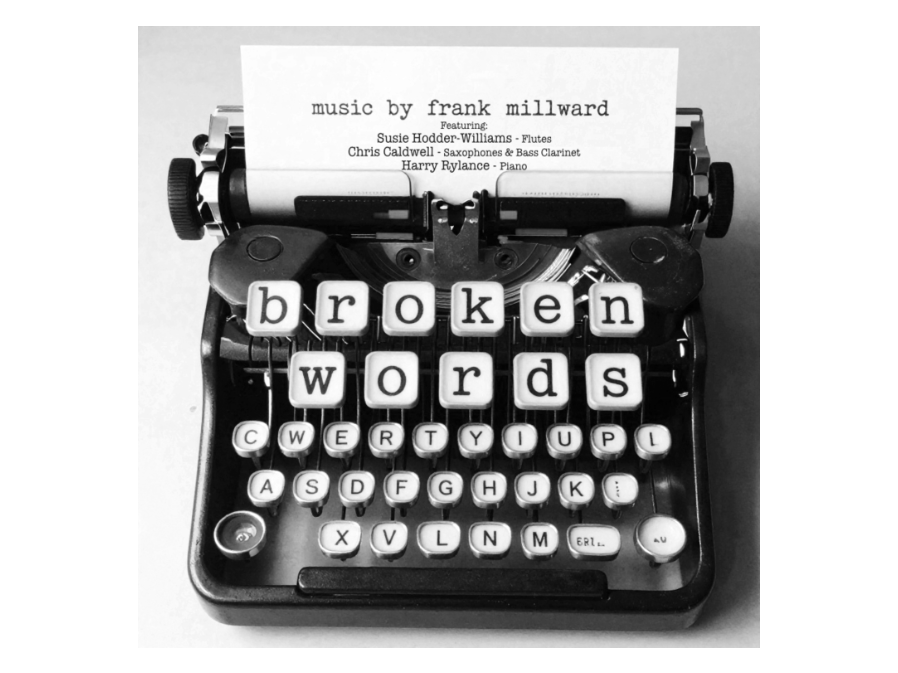
Australian composer Frank Millward spruiks his wares on this Move Records CD but we hear only three of them. Broken Words, like its companion pieces, is a duo – in this instance, for flute (Susie Hodder-Wilson) and piano (Harry Rylance); in fact, the composer calls his score a sonata. It’s a product of 2023 and has three movements: Broken Words, and (conjunctionitis), Pronouncing the Noun Baroque. Next we have _Ruptions which asks for saxophone (Chris Caldwell) and piano (Rylance). Here, the three movements for this 2024 creation are even more cryptic: E, Ab, Inter (it helps if you insert a silent ‘ruption’ after each title). To end, #6 Bag of Tells written for flute and baritone saxophone was also produced in 2024.
That seems plain enough, but it isn’t. Broken Words has Hodder-Wilson play three instruments, one per movement in this order: concert flute, alto flute, piccolo. The final track/work, in which six small poems precede each of the movements (read by Hodder-Wilson), was originally written for flute and bassoon. As for _Ruptions, Caldwell also alternates in his instruments: baritone saxophone, then bass clarinet, finally alto saxophone. This work was originally written for bassoon and piano. The whole CD exercise lasts for a touch over 45 minutes, the works decreasing in length as the disc proceeds – 18′ 20″, 14′ 43″, 11′ 02″.
It’s probably telling nothing to anybody who knows Millward’s work but he appears to have a preoccupation with verbal communication as it relates to music. That’s hard to take in as a simple matter of performance mechanics where you can more obviously treat words by setting them. Not in this CD’s case where the composer attempts something difficult and completely subjective; he writes in the accompanying leaflet about music speaking to the subconscious and, because each of us has one, the message received is always different.
In the flute sonata, Millward proposes that its outer movements show the executants coming to grips with ‘fragmentation’ – which they do, as the first one reaches a clear resolution of instrumental commentary that operates in a kind of benign disjunction for part of the players’ journey. That sort of dislocation, two voices speaking at odds, doesn’t come through as a constant, though; more often, the flute and piano conduct a dialogue evenly with few moments of brazen contradiction, if you like. But not much. In the third Baroque movement, the interleaving and welding of lines shows up more closely in what I think is meant to be whimsy across pages reminiscent of Pulcinella; if Baroque, very late.
What conflict there is in this section appears to be harmonic, although there’s not much of that going on. As for the middle conjunctional movement, this strikes me as admirably inter-dependent, the pages’ casing a solid construct with alto flute and piano intercutting as finely as in the Poulenc sonata, and with just as much linear sympathy. Far from any sign of rupture, this lengthy meandering impresses for its coherence, even if it smacks of 1940s Paris before the revolutionaries came into their own.
When it comes to the one-time bassoon sonata, you have to wait some time before we reach the first movement’s E_ruption, which comes in the last bars and dissipates quickly into some smouldering piano lava. The movement is elliptical, both baritone sax and piano crossing each other’s pathways with determination, but then, as in the preceding flute sonata, forming a sort of coherence of utterance that makes the momentary mild explosion more striking than you’d expect. For reasons I can’t quite explain, it seemed to me that the players were displaying some tenativeness in these pages, as though waiting to be surprised by what the other was up to and so poised, in a politely reserved fashion, for what came next.
My fault, probably, but I was expecting something a bit more disjunct in Ab_ruptions, a suggestion of violence as one part separated from another (possibly) larger mass. What we hear is a sprightly (eventually) duet for bass clarinet and piano with a carefully planned inter-connectedness, one line making allowances and space for the other, the whole following a regular path set up in the piano’s left-hand during the opening 6/4 bars of regular quavers, like a mutating imitation of a cantus firmus. In its outward presentation, the movement is stolid, steadfastly refusing to break away, or up, into lesser or greater shards.
Easiest of all is Inter_ruptions which begins (and mainly continues) as a modestly energetic tarantella, couched in D Major at the start and subscribing to a 12/8 time signature which seems to vary only slightly as the movement progresses, leavened by a few rhythmically stroppy breaks and a tendency to opt for a 3/4 cross-pulse. Living up to its title, the dance enjoys a few deviations, none of them too extreme to impede the underpinning forward thrust or long enough to unsettle. I might have been more enthusiastic about these pages if the players had pushed themselves more heftily into the score, although, to be fair to them, the material is sparse in nature, not encouraging of flamboyant e_xplosions.
What Millward means by ‘tells’ is a problem, although I think he’s referring to those quirky grimaces or gestures that gamblers make that reveal the nature of the cards they are holding. Further than this, Millward is considering society’s ability to read and interpret all modes of communication, not just giveaway tics, to the point where we have to cope with material like the ‘fake news’ that the current American Buffoon-in-Charge spouts while accusing others of creating it.
As prefaces to the music of #6 Bag of Tells, we hear short poems – two each of 3, 4 and 5 lines – called Barefoot, Seven, Roamer, Try ‘n’ Tell ’em, I Said, You Said, and Told. None of them is memorable or offers more than simple observations or suggests anything but an ordinary set of scenarios. The music holds more interest although you’d be pressed to find relationships betweeen poem and flute/sax duo. In the first, the reed makes a constant ‘tongue on reed’ sound in its constant quaver bass, which the flute eventually mimics.
The next lives up to its name by starting in 7/8 time, although by the end this has swollen to 9/8. The instruments start out at odds in motif- and phrase-lengths but reach a concordance near the end. By now, you become used to the two-part invention suggestions as well as Millward’s quirky harmonic vocabulary which operates on a mild level of dissonance that can just as easily slide into a sudden pair of Major 6ths. Roamer has the flute indulging in a few glissando slides, and the motivic imitation appears to be more tightly wound. This piece reaches a strange conclusion with both players weaving around a fixed pitch, achieving parity and moving out of consonance in a sort of haze, suggestive of the title’s proposed dearth of direction.
Try ‘n’ Tell ’em is a canon at the 4th, started by the flute and moving regularly for most of its length until near the end when the regular sequential motion becomes fractured and the two lines end up in a splenetic contest of sorts: a feisty ending to a piece that Millward calls a gigue. Despite its final suggestions of inconclusiveness, I Said, You Said is one of the more amiable of the ‘tells’, subtitled by the composer as a Graceful Courante and operating for much of its length on ‘white’ notes. Still, the piece has suggestions of discord, giving substance to the preliminary poem’s statement: ‘You said what I said/But not the same’.
Told, with the extra heading of Bird like chirping (which the flute finds easier to realize than the baritone sax), is another friendly duet operating on a near-G Major basis, hopping and pirouetting to a satisfyingly formal denouement. But, as with most of these pieces, I can’t see a correlation between the spoken word and the played sounds. This winds up a moderately intriguing disc that strikes me as holding music packed with inferences but lacking solidity – or perhaps I mean stolidity. And that finding betrays this ‘listener’s interpretation’ – the fundamental, age-old problem with which Millward faces us.

