PAUL LEWIS: MOZART+
Musica Viva Australia
Elisabeth Murdoch Hall, Melbourne Recital Centre
Tuesday October 13, 2026
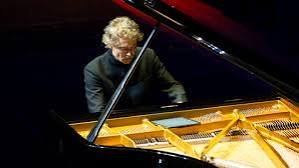
Paul Lewis
On this Mozart investigatory jag for Musica Viva Australia, British pianist Paul Lewis opened and ended his recital last week with two of the sonatas: K. 330 in C Major from 1783, and the remarkable C minor K. 457 of 1785. Each gave us an aspect or twenty of the composer’s keyboard compositional methodology and accomplishment – the distance between them shown by the transition from an elegantly polished score with mellifluous charm and transparent form to a powerful construct typified by a harnessed brusqueness and passion that have been traditionally seen as prefiguring Beethoven’s Op. 10 and Pathetique by some twelve or thirteen years.
The ‘+’ part of Lewis’ program proved to be harder to see in perspective. We heard two French works: Poulenc’s Improvisations, pour le piano that occupied the composer off and on between 1932 and 1959; and the rhapsodic L’isle joyeuse written in 1904 by Debussy – a technical and creative marvel in the repertoire for keyboard. Lewis anticipated that his audience would see links between the clarity of Mozart and a similar quality in Poulenc’s sophisticated effusions.
Setting us off along the journey’s arc, the pianist gave Mozart’s C Major Sonata a direct airing. In his opening statements, Lewis worked with an aggressive precision, giving his left hand an unexpected prominence. So much so, that I had to go back to the score to see what I’d missed all these years. Sadly, not so much as the Alberti bass is almost uninterrupted for the first eleven bars. A briskness dominated the middle Andante in F Major, sustained through the central tonic minor segment, but the forward-thrusting approach wound up in a finely shaped coda over the final four bars.
Again in the concluding Allegretto, Lewis’ left-hand output struck me as emphatic, if not insistent. As a composite, the movement impressed as firm but steely underneath the score’s inherent gracefulness. And, as an aside, I don’t believe I’ve ever heard the recurrent demi-semiquaver flick of the first bar handled with such consistent sprightliness across its 24 (or thereabouts, without counting the repeats) appearances.
You’d need to be more familiar than I am with the Poulenc collection to understand why Lewis chose his order of performance. In the recital’s first half, he played Nos. VII to XII. This might have had something to do with their years of composition. This first sequence came from the middle years of 1933, 1934 and 1941 and several demonstrated the composer’s mastery of smooth, slighly quirky modulation. Nevertheless, I found it hard to find much difference in the atmospheres generated in individual pieces.
Lewis began with No VII (1933) in C Major which lived up to an entirely unjustifiable expectation of boulevardier urgency. The following A Minor presto (1934) demonstrated Poulenc’s talent for the droll and deft placement of just the ‘wrong’ note. By contrast, No. IX (1934) in D Major impressed as little more than glib in comparison with its predecessor. And the F Major (1934) In Praise of Scales proved to be an excellent display piece for the executant.
Two Improvisations from 1941 followed, the G Minor Assez anime one of the briefest in the set but – like Mozart – without a note wasted (and you can get knotted, Emperor Joseph); then an E flat Major homage to Schubert, which was an unabashed waltz but one with an enthusiastic, optimistic character.
In the evening’s second half, Lewis began with the first six in the Poulenc set (all written in 1932), starting with No. 1 in B minor: another presto which set a pattern for many of the following but showing a rhythmic vigour, displaying the executant’s clean linear discrimination, and further emphasized the composer’s mastery of ‘wrong’ note insertions. No. II in A flat minor hit sentimental buttons, while the following dry presto proved to be a closely argued piece of sharp virtusoity. Another dance appeared next in A flat Major, which struck me as somehow Latin in atmosphere. Then an A minor piece in a regular metre, every so often interrupted by an interpolated 2/4 bar.
We then came to a B flat Major piece of remarkable rapidity which managed to weld some luscious diatonicism with biting, if momentary, dissonances. A significant temporal leap brought us to two 1958 products. Improvisation XIII is an Allegretto comodo with a Chopinesque lilt to it, revealing Poulenc’s unapologetic lyrical bent. Its companion is another waltz which boasted a primary melody that you might recall if you heard it again in another context, almost certainly for its call-to-arms opening statement.
The final Improvisation No. XV of 1959 is a homage to Edith Piaf. This surprised (although it shouldn’t have, given its dedicatee) for the straight, almost routine harmonic language utilised. The composer clearly had a more mobile view of the singer than I’ve built up, because the piece’s movement was notable for its accelerandi and balancing ritardandi that informed these pages with more dramatic interest than some of its more technically demanding predecessors.
Between the two Poulenc groups came Debussy’s (alleged) realisation of L’embarquement pour Cythere which Lewis carried off with impressive speed; in fact, I think it’s the fastest reading I’ve come across since an early Gieseking recording. He showed no interest in constructing long washes of fabric in the work’s opening pages, the sustaining pedal used sparingly and any really voluble dynamic explosion conserved for the final peroration at bar 220. Several details were most impressive, including the bass G sharp octave tattoo starting at bar 186, the sensitive phrasing at the A Major Un peu cede melody of bar 67, and the splendid rigour exercised in the piece’s ecstatic last twelve bars.
In the Mozart C minor Sonata conclusion, Lewis took up the work’s inbuilt drama with enthusiasm, the opening Allegro pronounced with febrile intensity and, once past the 25-bar development, a distinct percussive bite. As the movement developed, my mind turned aside from the frequent comparisons with Beethoven and more to reminiscences of the Commendatore’s measured intransigence from two years later. Still, you are brought up in full confrontation with the younger composer during the roaming adventurousness and sudden quasi-cadenza breaks of the middle Adagio, all of which promises the Romantic without loosening its clasp on moderation.
Lewis took Mozart’s finale at a true Molto assai pace, shown in the first theme’s rapid antistrophe between bars 16 and 24 which came over with something close to ferocity. Later, the succession of nervous right-hand spurts of action, the chain of fermate between bars 230 and 242, and the cross-hand subdued thunder on the work’s last page demonstrated this pianist’s interpretative powers in isolated instants, although the sonata’s whole canvas in these hands proved a revelation, something of a wake-up call to those of us reared in the more restrained Mozart world of Ingrid Haebler.

