FIRST THINGS FIRST
Selby & Friends
Primtrose Potter Salon, Melbourne Recital Centre
Monday November 2, 2026
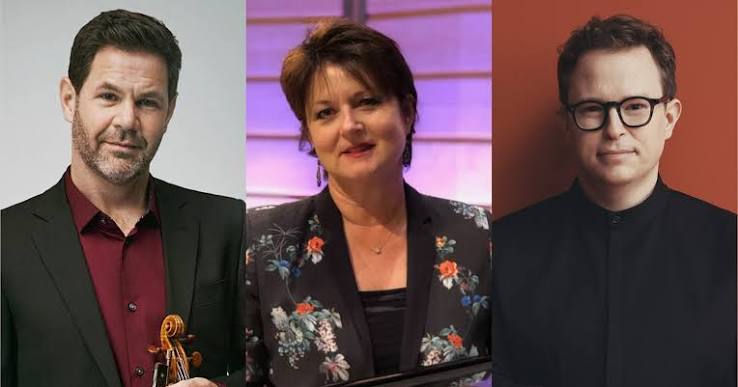
(L to R) Andrew Haveron, Kathryn Selby, Timo-Veikko Valve
For some of us, this was musical catnip: an all-Brahms recital comprising three of the composer’s most attractive works. First up in this penultimate Selby & Friends program for this year came Sydney Symphony Orchestra concertmaster Andrew Haveron and the organization’s fulcrum, pianist Kathryn Selby, in the Brahms Violin Sonata No. 1 in G from 1879. This was followed by the Australian Chamber Orchestra’s principal Timo-Veikko Valve partnering Selby in the Cello Sonata No. 1 in E minor of 1865. To end, we heard all three musicians in the B Major Piano Trio No. 1 of 1854/1889 – that warm-hearted score that the composer eventually revised after allowing it to breathe for 35 years.
Indeed, a larger audience than I expected gathered to hear this music, many of them milking the ensemble’s 7 pm performances which are probably set to finish in December as future Selby & Friends appearances will be confined to 2 pm appearances only. A shame as the afternoon/evening option was one to be treasured for its convenience and rarity. Still, there’s no arguing with the box office, least of all in these straitened times, and we have to be grateful for Selby’s perseverance over several decades in keeping Melbourne on her touring schedule.
More than most other ensembles, this one – even with its changes in participants – brings home how vital the Salon acoustic is: every note can be heard, even in muted passages, and any fortissimo can turn into an overwhelming aural experience. Haveron began the violin sonata with a restrained gravity, reminding us musically of what the violinist had spoken about in his introduction: the work was an extended elegy following the death of Brahms’ young godson, Felix Schumann. Selby brought a dynamic weight to the mix during the opening Vivace‘s development, notably in a vehement account of the stretch between bars 107 and 134.
Both musicians found a consistent ground of momentary ferocity and consistent strength, mining a gravity across these pages that didn’t move into sentimentality but maintained its momentum. Not so much a change of emotional power in the middle Adagio but an altered harmonic landscape, the piano stating its simple E-flat-to-B-flat melody before the violin’s chromatic edginess bites into the dialogue. Then there are suggestions of a funeral march at bars 48 to 54, and again (more muted) from bar 91 to bar 109, this duo following a path from consolatory to tragic and back again with exemplary control of the music’s argument right up to that melting eight-bar conclusion rich in sixths and thirds.
Apart from an intense moment of conflict in its centre, the final Allegro strikes me as a music operating at a restrained level. It opens with a plaint and ends in sudden resignation, the progress a closely-woven duet typified best by its alternating patterns of four semiquavers between the instruments. I think Haveron came into welcome prominence here with powerful declamatory srokes after the key change to E flat at bar 84, and holding his own through the clotted piano part that follows.
It was a matter of no little personal delight to hear Valve and Selby’s attack on the opening Allegro non troppo of the E minor Cello Sonata. It strikes me that many performers take the modifier in that direction and apply it to more aspects of the music than the speed, so that you wind up with a bland reading of several moments of high drama, like the canonic dialogue beginning in bar 57. Mind you, when this passage was repeated in a mighty mutation at bar 126, the reading came to a climactic point of impressive power, but a momentary mis-step in the piano diluted the effect at the recapitulation’s remembrance at bar 218, if only for a few seconds.
But that was a pretty ephemeral blemish on a satisfying, full-blooded account of these sweeping pages that somehow remind me of Mahler’s wayfarer in their final phase – probably due to those bass octaves from bar 256 on. Nothing prepares you for the courtly amiability of the following Allegretto disguised as a minuet where the slightly bouncy first and third sections make an ideal foil for the Trio‘s fluent quaver swathes. To their credit, Valve and Selby maintained their adoption of supple dynamics with a few touches of mutual rubato, the overall results yielding a lightness tinged with menace.
Brahms’ fugal finale found both musicians in no mood to take prisoners, the attack from both musicians fierce and urgent, making the most of the movement’s splendid first instance of duet work beginning at the C Major climax at bar 25. Moments like these yet again emphasized the Salon’s carrying power, each of Valve’s pedal notes coming across with satisfying strength. More of the same followed with the surging melodic flow from the cello beginning at bar 54 over a complex keyboard web. And these players maintained their shared tension with each reversion to the opening subject, the reading a focused essay in urgency from bar 132 where Brahms leaves behind any hint of lyrical pliability and drives the movement into higher levels of contrapuntal energy until an impassioned Piu presto and the last page’s gutsy emphases.
With the B Major Trio, you enter a vehemently passionate world straight away with a breathtakingly warm opening melody shared between piano and cello to kick off the first Allegro, only to have the violin enter in a 6th-rich duet displaying the composer’s heart-on-sleeve emotional ardour. These musicians gave us an enviable realization of this score’s intensity which doesn’t falter until near the end with a passing Tranquillo where you feel that the storm has passed, only for a blazing resurgence in the last seven bars of the movement.
Notable before the final stages was a strikingly ‘true’ series of octave duets from Haveron and Valve, starting at bar 214 and ending at bar 248: a masterful display of dynamic drive and unanimity of pitch. Valve might have opened the following Scherzo alone but Selby quickly established herself as the real power, especially in those arpeggiated septuplets at bars 29 to 32. The music complex isn’t quite light enough to project a thorough Mendelssohnian streak but the keyboard has some moments of Octet-suggestive lightness of being, as at bar 145 right through to bar 162, negotiated with taut precision by Selby.
What startles at the opening to the Adagio is its repetition of the Scherzo‘s final chord. It shouldn’t come as a surprise, but the repetition of that B Major tonic chord does, even if you soon become involved in the statement-and-response action between the two strings and the piano that brings a welcome quiescence to this trio, even if it lasts only a little over 30 bars. Immediately following, Valve gave us a vivid solo that set a high bar for the development of Brahms’ secondary material, matched by Selby’s delicately meandering triplets that accompany the first theme’s restatement from bar 69 up to the melting succession of chords, here enriched by a carefully judged consonance of attack from Haveron and Valve, that rounds out this eloquent lyric.
On to a very satisfying account of the Allegro that concludes this work with its contrast of surreptitious shadows across the first 53 bars and the outbursts of piano concerto-style majesty that sounds out with the D Major theme of bar 64. It’s one of the finest instances of the composer’s clarity of invention and it was given to us with lashings of energy and dynamic insistence, Selby at her volatile best while the strings matched her energy, especially in the final assault from bar 266 after which there is no relief until the thundering B minor last page.
A clever idea, to give us this group of No. 1 works in a one-composer program. Yes, it’s a huge plus if the scores in question have a firm place in their respective repertoires, and this particular piano trio stands among the principal masterpieces of the form. Further, despite the performers’ insistence on an underpinning of grief surrounding Brahms’ circumstances when composing each of them, I think most of us would have left the Recital Centre in something close to elation after experiencing three performances of such excellent quality. Selby and her colleagues will always be welcome here, even if it’s for only one performance per visit (though preferably two).

