EMILY GRANGER
Melbourne Recital Centre and Tier 1 Arts
Primrose Potter Salon, Melbourne Recital Centre
Tuesday July 7, 2026
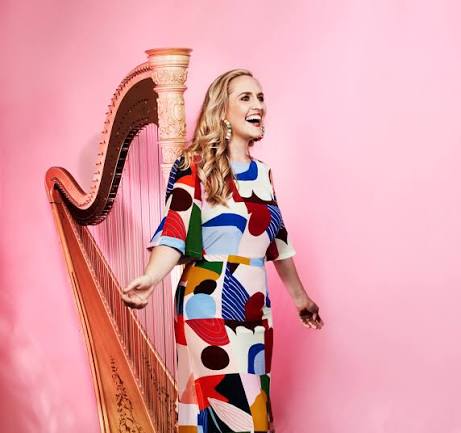
Emily Granger
Starting his Endymion, Keats wrote, ‘A thing of beauy is a joy for ever.’ He was probably right: we treasure the beautiful and it transcends fashion and time – or it should. We can all assemble our ideal musical beauties and I’d suggest that the beautiful in my eyes would be the same as yours if only we shared identical parameters. Of course, we don’t and my list is uniquely personal: Byrd’s Four-Part Mass, Sull’ponte di Hiroshima, the Tallis Fantasia, Ihr habt nun Traurigkeit, Dawn in Daphnis, Circles, The Housatonic at Stockbridge, Brahms 4, Dalla sua pace, Blazhen muzh, Sun Music III, Beim Schlafengehen – you could go on for quite a while before hitting your second-best layer.
This paradox of what’s mine is yours and its ill-omened reverse struck me about half-way through harpist Emily Granger‘s album launch last Tuesday, reinforced when we reached the final work on the schedule which gave the event its title. This was written by Adelaide-based cellist/composer Hilary Kleinig and, in a way, encapsulating much of Granger’s output over the preceding hour or so. The piece began as a softly running 6/8 dance operating on two levels – a sort of Alberti bass with an amiable melody on top, all in a pretty plain tonal language. Not much happened of any significance and, in its second half, the work moved into something close to doodling, before a return to the initial melody in a coda of unexpected brevity.
A Thing of Beauty concluded a presentation in 12 parts, sponsored by the Melbourne Recital Centre and Tier 1 Arts, of solo harp music by eleven Australian women writers. As you can probably infer, I found most of the scores to be similar to each other, a sentiment possibly underlined by the performer’s deliberate choice of music that was easy on the ear and which sounded unchallenging in its rhythmic and harmonic vocabularies. Not that you can fault anybody for that, least of all if you find beauty in simplicity, This modest approach was typified in Granger’s first selection: Emily’s Suite by Sydney composer Alice Chance. This comprised three short movements, written for Granger last year and a pleasant introduction to the evening. Full of Wonder showed plenty of ripples in (possibly) A minor; Ballad proposed a melody in its lower register under upper decoration; Chorale proved to be packed with arpeggiated chords, not much challenging to the ear in their construction. All quite acceptable music-making, yet uninvolving.
I’m not sure what happened next. The performer could have embarked on Romanian-born harpist Ulpia Erdos‘ Reminiscing from 1998 or she could have presented Tasmanian harpist Christina Sonnemann‘s 2007 Mavista. Whichever it was, the work sounded like a folk fiddler’s tune, coming from a player with her/his tongue firmly tucked in his/her cheek, the piece acquiring tittivations and flashy sparks as it progressed.
But we were put back on track when Granger announced what she was about to give us next. Margaret Tesch-Muller, a soprano-composer who bounces between Sydney and Btrisbane, wrote Snow and Shadow in 2017. Suddenly we moved into a minor key although the piece’s progress proved harmonically bland with a somewhat constrained melody that moved in steps rather than leaps. This performance emphasized a calm and dark atmosphere but little else remains in the memory.
To this point, Granger had given us some small verbal addresses between numbers, starting after Chance’s suite. It’s been said before but is probably worth repeating: if you’re going to speak, even in a small room like this one, you have to be audible and comprehensible. It also helps if you have some information to impart. The harpist’s opening talk impressed for the number of times she wove in the pronouns ‘I’ and ‘my’. What I gleaned was that the various elements on the new CD represented a kind of search or journey. The trouble was that Granger spoke to the left-hand side of her audience, her mouth hidden behind the harp’s soundbox for those of us to her right; hence, most of her mini-speeches failed to come across successfully.
This lack of clarity almost disappeared while she spoke of Adelaide-based composer Anne Cawrse’s Come to me, another piece written for Granger last year. The composer was inspired by Christina Rossetti’s Echo which speaks of loss and regret; Cawrse gave us a sober and intriguing reaction with a constant, steady pulse underpinning a firm melody, the composer’s language an interesting mixture of minor and modal vocabularies. To my mind, this piece presented as the most sophisticated element on the program so far.
sanddollar, written in 2021 by Sydney pianist Sarah Elise Thompson, opened with repeated bass notes and a constant pattern under isolated high notes. The piece makes a virtue out of its accompaniment, even if its effect is tending towards tedium, despite its four-square duple nature moving into sextuplets. Melbourne composer Katy Abbott was in the audience and introduced her Not Just Another Day from 25 years ago, written to celebrate a friend’s delivery of a baby girl. Sadly, the composer proved as unfamiliar with projection as Granger and I missed the second part of her address. But this composer has an individual voice and it showed through a harmonic and melodic breadth that proved most welcome, even in this brief work that made much of its opening 4-note pattern.
Melbourne pianist Nat Bartsch wrote Call and Response in 2017. We could all perceive the Call strophes that resonated firmly; the Response, I’m not so sure, unless it came in the very soft echoes/repetitions of the main message. During harpist Tara Minton‘s Alby’s Lullaby of 2015, I kept on thinking of Play School – not for long as the piece was quite short. But, in its 3/8 or 6/8 rhythm and pleasant meandering progress, you were reminded of the friendly background sounds that escorted Big Ted and Jemima on their way; predictable and slightly poppy in the best 1960s style.
Another talk from Granger preeceded Sonemann’s Karoola Seasons, written 20 years ago. The performer prefaced each of these four movements with a haiku, from which you could glean the occasional word; a pity as some oral information might have given breadth to this series of character pieces, in so far as seasons have a character – living in Melbourne, you know that’s nonsense. Spring came over as monotonal, if not modal, its content happy to make a statement and stay fixed to it. We encountered a similar absence of adventure in Summer which oscillated in its harmonic base between the piece’s tonic and leading note in a cascade of arpeggios. Autumn brought a lowering of activity level, appropriate for its title, while what I thought was the most substantial segment, Winter, showed us Sonnemann presenting a convincing duo of upper and lower patterns, the whole structure articulated with impressively soft attack in an ode to evanescence.
A pair of scores by Canberra musician Sally Greenaway brought us alongside Kleinig’s conclusion. Encore de Lirico from 2014 showed us a regular four-square pattern of two notes on the upper level, then two notes downstairs. The internal texture made stabs at unexpected modulations but we soon returned to home camp. Then Encore Perhaps Tomorrow, written in 2009, didn’t stay around for long as the composer set out a gentle melody and let it speak for itself without much elaboration, even though this earlier Encore showed a tad more harmonic daring than its predecessor.
Of course, we were given a final speech in which Granger thanked several people very graciously, even if I couldn’t make out any of their names. I know she thanked us for being present at this exhibition and the well-filled Salon responded to the program’s end with goodwill, if not rapture. And that’s really how I viewed this recital: the player is highly competent (she’s currently harpist with the Queensland Symphony Orchestra and teaches at the Queensland Conservatorium and University) and she is absolutely at ease with the program she gave us, even more so now than on the various extracts you can find on YouTube.
She has aimed for a certain emotional level where very little disturbs a placid surface; not my idea of a thing of beauty, more of pleasure. Put all these pieces together and you’re in the territory of Greta Bradman’s Mindful Music programs on ABC Radio. It’s too harsh to say that this brand of musical entertainment is mind-numbing, yet there’s not much solid substance to cling to during these tepid aural saunas. Congratulations to Granger for devoting her new CD to Australian women writers, but on this showing there’s still some way to go before these composers move into territory beyond lightly spun entertainment.

