CROSSING THE BAR
Gesualdo Six and Australian Boys Choir/Vocal Consort/Kelly Gang/Training Choirs
St Andrew’s Anglican Church, Brighton
Tuesday June 23, 2026
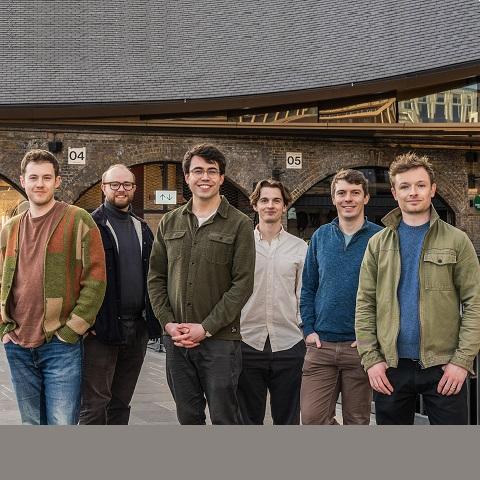
Gesualdo Six
(L to R) Simon Grant, Joseph Wicks, Owain Park, Alasdair Austin, Guy James, Josh Cooter
It somehow seems disloyal, using a snap of the visiting British guests at this event, rather than highlighting the local choir(s) which was (were) the hosts. Added to that, I’ve probably got wrong the names attached underneath it. But the Gesualdo Six did most of the singing on Tuesday night, working their way through ten items on their own account as well as taking part in all but two of the Choirs’ six pieces. In fact, the Gesualdos’ director, Owain Park, conducted the concluding number in each of this concert’s halves and he spoke with evident admiration about the work, even the existence, of the Australian Boys Choir and its offshoots in his concluding exhortation to us all to nurture such a body.
The whole organization, it seemed to me, gathered for the opening Out there by Dan Walker, this 2006 piece having acquired a bongo contributor to reinforce its piano accompaniment somewhere along the way. The artistic comptroller of the ABC, Nicholas Dinopoulos, conducted this bouncy work which was given under adverse conditions for those of us hearing the event under the Australian Digital Concert Hall auspices. The volume level was faint until near the score’s end, although matters improved in the following Sailing Time by Dulcie Holland; written at an unknown date but a favourite of this ensemble. Like Out there, this also sounded rollicking and vital, a typical product from the well-known composer in its easy flow, moving past very quickly.
Concluding the evening’s first half came two extra-Australian products, both involving members of the Gesualdo Six. The Vocal Consort, Kelly Gang and (I believe) members of the Training Choirs worked through American arranger/composer Timothy Takach‘s 2009 version of the spiritual Keep Your Lamps which involved a Gesualdo tenor and bass taking the solo lines in the piece’s later stages. The arranger’s score asks for tambourine and ‘low’drum’; I think we got a timpani (tympanum?). A pseudo-folk tune from 1993 arrived with Frobisher Bay, written by James Gordon and heard here as arranged by American-born Canadian choral eminence Diane Loomer. A Gesualdo soloist opened the piece, conducted by Park but yet again the sound system let us down with a faint dynamic until later in the work. Despite this, the interpretation revealed an excellent response to the work’s phrasing and a demonstration of fine concentration from the young choristers.
All the ABC forces re-assembled after interval for Sarah Hopkins‘ Past Life Melodies from 1991 which, according to Dinopoulos, moves into 11 parts and generates a distinct atmosphere thanks to the persistence of drones in the lower and middle voices and the sudden emergence of some harmonic overtone singing that recalled the sounds of those Asian (Mongolian?) singers who visited our churches and/or halls some years ago. The ‘past life’ referred to is the composer’s own; it must have been one filled to the brim with chants and no little melodic fragmentation. Once again, the singers were let down by the sound manipulators whose microphone(s?) proved slow to react to the required amplification levels.
Finishing the night, we heard a work by Calvin Bowman, organist at this church of St. Andrew and a composer in the British tradition that favours concord of sweet sounds. This was the program’s title work and surprised nobody by being a setting of Tennyson’s well-known elegy. I’ve not come across this choral version of the composer’s later score for voice and piano, presumably of 2019. In any case, it involved all the forces available, including the visitors, with Park conducting from a hand-held tablet and urging his forces through its dulcet pages.
The Gesualdo ensemble operated inside this choral framework, four of them singing Purcell’s Thou knowest, Lord of 1695 from a gallery, transporting us for a couple of minutes into the Anglican ecclesiastical sphere with an unexpected emotional tranquillity. Almost immediately, the singers moved to ground level, split into two groups, and outlined the 1981 Funeral Ikos by John Tavener – a prayer for the burial of priests – while moving up the church aisle, taking turns with the text, then singing the six cadential Alleluias. It reminded me, not suprisingly, of Blazhen muzh, the third segment from Rachmaninov’s All-Night Vigil of 1915, even if the Russian work is streets ahead in fabric, insight and conviction.
For a treat, the group sang a motet published in 1611 by their patron, the homicidal Prince of Venosa: Plange quasi virgo, which somehow smoothed out those chromatic clashes that have become legendary in this composer’s music, especially works with emotionally fraught texts like this one from the Tenebrae Responseries for Holy Saturday which spreads gloom and dread on the eve of Christianity’s greatest triumph. Perhaps we’ve become inured to the dissonances in these piping times of pap, or more probably the Gesualdi sing the piece with impeccable dynamic and linear fidelity, as well as a firm ardour.
British writer Howard Skempton‘s setting of some Apocalypse verses, And there was war in heaven, seems to date from 2005 and utilises a fair amount of drone sounds, textual repetition, and bass-line heft, possibly due to its five-voice, no-soprano-one-alto weighting. Once again, the amplification system moved between faint and surged into something approaching decency half-way through. Another British composer Joanna Marsh‘s I take thee was composed for the Gesualdo Six in 2020 and has traces, in spite of its cosy domesticity, of a modern-day, anniversary-celebrating epithalamium. The singers move into and out of dissonance, resolving the composer’s mini-harmonic crises with that kind of expertise arising from the pleasure of singing a work written for you and your voices, speaking a language both tender and melismatic.
In the program’s second part, the guests began their work with Byrd’s This sweet and merry month of May from 1590. One of the composer’s more popular choral compositions in English, the six-voice madrigal twittered elegantly until the sovereign-lauding started and you wondered – not for the first time – how the composer could indulge himself – and her – in an exercise that served ego before anything else. Cutting back to four voices, the ensemble worked easily through Vaughan Williams’ 1908 arrangement of Bushes and Briars for pairs of tenors and basses. The participants sang this from memory and worked through the three stanzas with masterly ensemble and the kind of phrasing control that only focused rehearsal gives. Which was even more impressive when you note that baritone Simon Grant only joined the group last year.
Back to all six voices, the group sang a piece by director Park: his 2013 setting of Louisa (After Accompanying Her On A Mountain Expedition), by Wordsworth, composed for the SATB formation and opening with a solo for soprano – in this case, Grant. It’s a neat sample of compositional doodling, something of a choral torch-song or a smoothly eliding cabaret number. Little happens in its passing – no dynamic alterations to the prevailing benign mood. To conclude the sextet’s offerings, we heard Josquin’s four-voice frottola from around 1505, El grillo. This demonstrated the group’s crisp attack and mutual rhythmic responsiveness, albeit on a small and not-too-demanding canvas. Sadly, the audience thought the work had concluded at the repeat of sol per amore, cutting across the singers’ reversion to Josquin’s opening bar.
So, not the happiest of recitals from the perspective of a remote listener. I can’t remember so many problems with the sound system arising in the ‘good old days’ of the Digital Concert Hall when its acivities were all we had to go to in the dark days of our COVID infections. Mind you, it was simple self-indulgence and the quest for comfort that impeded me from making the trip to Brighton in this city’s freezing weather. I’m sure that hearing the Gesualdo Six and the ABC forces (once again) in the flesh would have been worth the journey. Next time . . .

