ISLES OF LIGHT
Australian Chamber Orchestra
Hamer Hall, Arts Centre Melbourne
Sunday June 14 2026
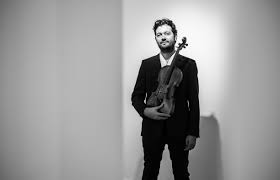
Lawrence Power
Guest artist for the Australian Chamber Orchestra, violist/violinist Lawrence Power took us on a sort of English-Irish voyage with a few references to music of our time, music of the 20th century, and a quick side trip to the country’s greatest composer, as well as one of his predecessors, and a senior Victorian/Edwardian composer who got a look-in because . . . well, like Scotland, he was there.
This last was Elgar who concluded Power’s opening gambit: a dog’s breakfast called English Mixtape in which the ACO, led by their guest on viola, wandered onstage to give a racy airing to a Curtain Tune by Purcell, written for a masque introduced to Shadwell’s version of Timon of Athens in 1695. In the original, the composer uses his ground bass about 40 times; I think we got through that many and possibly a few more by the time everyone moved on to Jonny Greenwood‘s 2005 Popcorn Superhet Receiver Part 2b where the invention level dropped a few feet for what sounded to me to be little more gripping than a bland pizzicato interlude.
Because the program later featured Vaughan Williams’ Tallis Fantasia, we then heard the Elizabethan composer’s original psalm tune, Why fum’th in sight (fight?) – first played by the ACO, then vocalised by them. I hope they were doing this because I couldn’t distinguish any words. Why no actual text? Perhaps people had a problem with the words of Psalm 2, seeing them as a denunciation of Trump or Charles III – and their supporters. Anyway, a push-through came to us via Kate Bush‘s The Man with the Child in his Eyes which seems to be giving vent to a placid dream/nightmare/delusion in calm pop language.
This was succeeded by Ivor Gurney’s Sleep, a 1912 setting of Fletcher’s melancholy poem by a composer friend of Herbert Howells, who also featured in this program’s second half. Power supplied the impetus for this odyssey which ended in Variation XI from the Enigma Variations of 1899, the one depicting the bulldog Dan falling into the River Wye. With strings only, this section sounded messy; you missed the powerful brass statements of the theme at Number 48 and five bars before Number 51 in the old Novello score; not to mention the woodwind timbre doubling the strings in chords and semiquaver runs throughout – so I won’t.
This short travelogue then stopped for a change of orchestral disposition as the expanded group (four guest violins, two extras in both violas and cellos, and another double bass) sat facing one side of the stage in what was probably a boat shape (this might have been more obvious from the circle or gallery). The reason for this came about because of the theme of a new viola concerto written for Power and co-commissioned (with two European organizations) by the ACO. The composer, Irish-born Garth Knox, uses Coleridge’s The Rime of the Ancient Mariner as the basis for his score which is an expert display-piece for Power (Knox is a violist) who not only produced a hefty solo line but also treated us to scraps of the poem.
Yet, having said that, I’m at a loss to remember much of the score itself which illustrated vignettes from Coleridge’s story: the arrival and death of the albatross, the desolation of the Mariner alone, his observation of the sea snakes, the buoyant journey home. Knox’s vocabulary proved to be atmospherically apt, at its best in the work’s Prologue and Epilogue, the whole calling to mind some of Westlake’s film music in its fluency, although a few parts of it struck me as odd, like the near-tango that followed the death of the bird and Power’s breaking into a folk-type song on his path to redemption.
But the chief memories I have of this new work come through its theatrical touches, its look rather than its sound. Using the band as a neatly-arranged ship’s crew made for a clever scene-setting, with Maxime Bibeau and his bass at the centre, standing like a mainmast throughout. Having the whole corps doing a rocking motion to suggest wave motion didn’t seem to distract anyone in their playing. Using individuals to supply Power with his destructive arrow/bow, then hanging a violin aound his neck as a stand-in for the dead albatross worked better than expected.
As you’d expect, the main burden fell on Power who fell in with one of the interpretations of the poem: it’s a fabrication, told by the sailor when he stoppeth one of three. This comes about mainly because of the violist-actor’s insistent repetition of the opening to line 10 – ‘There was a ship’ – but, the more you hear it, the more individual musicians he confronts with this plaint, the less you believe – until the voice dies away and you are left with Keats’ last nightingale-inspired question. As the solitary protagonist, Power gave us a striking character, if one stripped to bare essentials by having only the poem’s bones to work with; no space for any metaphysical musings to do with spirits, angels, the Hermit and the ship’s final disappearance.
After this entertainment, the concert’s second half moved back onto tried-and-true paths. Even so, the afternoon was over-long, extended by a curiosity in Elizabeth Maconchy’s Symphony for Double String Orchestra from 1952-3. This productive English-born, Irish-bred composer had the good fortune to study in Prague, so she encountered a wider musical world than most of her peers. The Symphony has plenty of rhythmic irregularities and several instances of Bartok ‘snaps’; also, the melodic contours of both Lento movements have a consistent breadth that raises your expectations, best met in the work’s concluding Passacaglia which is a powerful set of pages, if a harmonically conservative one, considering the time it was being written.
But Maconchy’s work came late in the day and might have fared better further back in the program. As it was, we had been treated to two searching works beforehand, beginning with Howells’ Elegy for Viola, String Quartet and String Orchestra of 1917, written in memory of a fellow Royal College of Music student who died at the Somme a year before. This score shows an influence or four from Vaughan Williams’ Fantasia (most palpably at the first triplet-heavy string quartet passage, starting at Number 4 in the Boosey & Hawkes score) although its colours are not as striking; but Howells’ use of this string quartet seems to me the more striking and his whole work is imbued with a stern grief.
Power’s account of the sombre viola solo showed us an example of masterly interpretation, his voice penetrating the supporting texture pretty well across the score’s length. Was he amplified, or has he just got a powerful right arm? Don’t know but he gave us a strong and moving account of this simply-framed, intense work which ended its C minor journey with a superbly welcome tierce; not particularly original but touchingly appropriate, for once.
Between Howells’ Elegy and the Maconchy Symphony came the Vaughan Williams 1910 Fantasia on a Theme by Thomas Tallis: the only familiar music of the afternoon and given a hearty reception, I suspect, because of that. If not the performance of your dreams, it came close. Power let ACO principal Stefanie Farrands take on solo viola duties while he moved to Richard Tognetti’s usual space heading the violins and revelling in the duet with Farrands that soared into existence with heart-filling grace a bar after Letter U in the 1921 Goodwin & Tabb edition.
Not too suprisingly, this interpretation favoured the inner voices, where a lot of the action takes place from five bars after Letter A when the Tallis tune gets a bowed exposure. Another welcome feature arrived with the restrained gravity of Orchestra II which sounded just strong enough to fulfill its Choir organ function and reflect those splendid chord sequences with which the composer peppers his score. Power is nowhere near as demonstrative a leader as Tognetti but the music didn’t suffer, maintaining its dynamic balance and surging along its animando path to reach a striking climax at the score’s largamente highpoint.
The achievement here was assuredly better than any previous live attempts I’ve heard in this country. But you’d expect that from this body which revels in its own dynamism and operational assertiveness, even infusing those extra (willing, I’m sure) bodies fleshing out its edges. This Fantasia made for a splendid climax to this ACO program celebrating the focal British isles; if only it had ended there.
 O'Connell the Music