Mix and (possibly) match

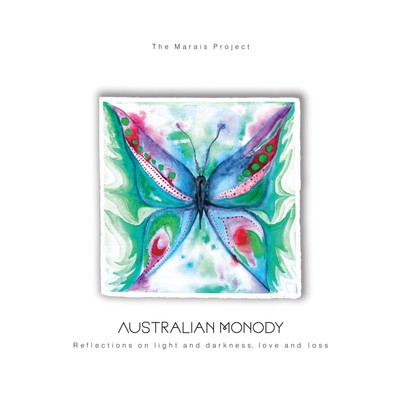
AUSTRALIAN MONODY

The Marais Project

Move Records 633

Here is something of a miscellany, the CD’s title overtly relevant to a few tracks, secondarily related to other music by a liberal interpretation, the whole box and dice the product of Australian musicians, even if the monody angle is out of kilter with quite a few elements on offer. Marais Project founder Jenny Eriksson‘s viola da gamba is heard in all but one of the fifteen tracks, four times in partnership with fellow gamba Catherine Upex; multi-tasker Susie Bishop sings solo or contributes to five pieces with her soprano and violin, plays violin only in two, and sings only in two others; Marais regular Tommie Andersson plays in everything – theorbo in eleven pieces, guitar in three others, and touches his lute in another; organist Anthony Abouhamad reinforces two Purcell works on a continuo organ; and countertenor Russell Harcourt participates in six pieces with his remarkably clear, high-flying vocal timbre.

Further to the CD’s title. As far as national content is concerned, the Marais group jumps across the centuries. From our ancient white music, we hear Isaac Nathan’s The Aboriginal Mother and The Aboriginal Father from the composer’s Australian Melodies collection of 1841-1863. Vault forward a touch and you come to Carl Vine’s Love me sweet, written for The Battlers TV series in 1994. In composing mode, Bishop wrote her Lullaby for a Broken World during the 2020 Sydney COVID lockdown. Alice Chance’s 2018 Precious Colours was revised for the Marais ensemble last year, which also saw the arrival of Gordon Kerry’s Christchurch Monody, a response to the 2019 attack on two mosques in that city.

As for non-Australian monodies, we have a Dowland ayre – Now, O now, I needs must part – from the composer’s First Booke of 1597; those two Purcells – the Elegy on the Death of Queen Mary of 1695, O dive custos, and An Evening Hymn, first published in 1688; as well, a blast from the near-present in Michael Nyman’s If, composed for use in the 1995 Japanese animated film, The Diary of Anne Frank.

And breaking the British-Australian cultural dominance is a Marais gamba suite, that in A minor from Book V, published in 1725; after performing which, Eriksson immediately restores the status quo with her own very recently contrived La Petite Tarantelle, living up to its name by being the second-shortest track on Australian Monody.

Three of these tracks – the lullaby, Kerry’s monody, the tarantella – are world premiere recordings.

One of the treasures of this collection is the ayre which features both singers, the three Marais strings (violin in stanza 2 only?), and Andersson on lute with a solo of his own in medias res based on Dowland’s Frog Galliard. Bishop sings the first stanza, Harcourt the second and the similarity in vocal shadings is extraordinary, even more so when both combine for the final Deare, if I doe not returne where they sing the two upper parts of the composer’s four-part setting. This exercise is carried off with a warm clarity from all contributors, an ensemble effort to match the best that I’ve heard – a pity that I can’t compare it with Gordon Sumner’s Dowland excursions, but he didn’t record this work (thanks be to God). While the singers are phrase-length near-perfect, the gambas and violin are discretion personified, everybody occasionally inserting a communal, brief hiatus point.

Abouhamad’s flutey continuo organ fits well with Eriksson’s gamba and Andersson on theorbo to support Harcourt in the Purcell hymn, another throwaway gem from the greatest British composer. Not that Harcourt is piercingly true in pitch all the time but his slight deviations reinforce the touching humanity of Bishop Fuller’s words and their buoyant setting with Purcell’s unforgettable chain of Hallelujah exclamations across the piece’s last 45 bars – a reverent praise-chant that leaves Handel’s bombast well in its wake. The near-contemporary elegy, a vocal duet for two upper-range voices (or so it appears from the only edition I could find), is carefully accomplished by Bishop and Harcourt, once more almost indistinguishable in timbre, with the same support as in the hymn. You might have asked for more sustained power at the start with one or two breathing spots interrupting otherwise seamless lines. While you could delight in the vocal interweaving of the opening quatrain, the duet showed at its most persuasive from the Seu te fluentem change in metre at bar 33, handling with impressive ease the chromatic dips starting at bar 99’s o flete leading to a sombre conclusion. Not what you’d call a monody, then, but welcome for its own sake in this miscellany.

It wouldn’t be a Marais Project disc without a gamba suite by the ensemble’s inspiration. Eriksson has recorded several of these for Move, including the G minor suite from Livre V twice; well, it appears on two different Move CDs. This A minor work has four movements in this presentation: Prelude le Soligni, Allemande la Facile, Sarabande and Menuet. While forging a calm, undemonstrative path through these constituents, Eriksson has Andersson’s theorbo providing an underpinning continuo force. The compositions are constitutionally lean: 24, 16, 28 and 32 (Menuet plus Double) bars in length; in other words, completed quickly, despite the repeats – even the Sarabande. The reading is tasteful and tactful, carefully shaped in phrasing and dynamic gradations and without a trace of aggression or harshness.

Perhaps I’m among a very few but I can’t get excited about the two Nathan songs; possibly more sympathy might be roused by greater research, but I don’t think so. The CD’s booklet makes some fanciful observations about the cultural worth of the colonial Australian composer’s insight into Aboriginal culture and his appropriation of First Nation songs, but the actual products have demonstrated yet again the craft of shaping original indigenous melodies into lieder fit for any Victorian salon. An only man standing in Sydney’s early days, Nathan isn’t our Ives; nor is expatriate Grainger, nor Alfred Hill. In fact, none of them addresses us in a vocabulary that we would seriously call our own.

This brace of songs comes across as amiable enough, well matched to Eliza Hamilton Dunlop’s soppy verses. For the three stanzas of The Aboriginal Father, Bishop participates in the prelude, postlude and interludes with her violin, along with Andersson on a 9-string guitar and Eriksson’s gamba; of course, breaking from her instrumental participation to sing Nathan’s four-square Europeanized melody.

A bleaker scenario is proposed in The Aboriginal Mother although it’s hard to imagine many indigenous hearts identifying with its elevated, studied language, let alone the 4-square tune that might easily have been written by the singer’s namesake, Henry. Here, she is escorted by Andersson’s guitar alone. Both monodies are performed with clarity and poise. but their curiosity standing is the only remarkable feature about them; they could have come from 19th century Leipzig or Dublin as easily as Sydney.

From Nathan’s songs on, the remainder of this disc consists of monody, with one final exception. I’ve always had high respect for Vine as an all-round musician: as composer, with his early ballets and the first four symphonies; as well, his brilliant pianism. This little song, performed here by the ensemble minus Abouhamad, is the gentlest of lyrics with a mildly rocking instrumental support. At one point, I could have sworn that Harcourt was being doubled by Bishop’s soprano, but that was probably wishful thinking. In any case, it makes for an easy-listening final track.

Nyman’s song is set in one key, like Vine’s, and is sung by Harcourt who is unpressured and under-exercised. The song, in both stanzas and choruses, follows a simple downward motion for the singer while Bishop, Eriksson and Andersson’s theorbo follow a rudimentary supporting role. Roger Pulvers’ wish-rich text brings to mind the naivete of the famous diary and Nyman gives it a setting that suits the requisite emotional ambience.

Gordon Kerry is another Australian composer whose work has often delighted me; on occasion, impressing as much as any contemporary writer I’ve come across, e.g. his 1993 opera Medea and the String Quintet of 2012. His meditation on the Christchurch massacre sets two Old Testament texts: one is two verses from Ecclesiastes, known to many by its observation that the race is not to the swift; the other, featuring that striking simile of the righteous who shall run to and fro like sparks among the stubble, involves verses from Book 3 of the Book of Wisdom. This piece, commissioned by the Project, is performed by Bishop vocal and instrumental, both gambas, and Andersson’s theorbo.

Kerry’s composition is an exemplification of my idea of monody, particularly the first part where the voice and two strings intertwine with the same motif. The work’s first part is lean in texture, even when the other instruments enter, the whole reflecting those anguished and doom-laden verses. If there is any redemption to be found in our memories of the senseless, terrifying slaughter in New Zealand, Kerry epitomizes it in his monody’s second part where the souls of the mosques’ dead worshippers are commended to God. Here, the harmony moves to the major and the instrumental contribution changes to rustlings of warmth as Bishop’s violin and soprano alternate in an uplifting tribute to the fallen. Like certain other tracks on the CD, this music moves through its emotional sparseness and simple musical material.

Precious Colours is a Project-tailored revision of an earlier Alice Chance work, Pallah Pallah, which recounts an Aboriginal legend about a butterfly caught in the snow; when it melts, the insect’s colours run to generate the opal. The text is a dialogue between the butterfly and her husband, both lamenting the transformation. There is no cleverness here; the song is a duet for Harcourt and Bishop, who also contributes an intervallic violin, with both gambas and theorbo reinforcing what seems to be a cantus-firmus. The initial melody is pentatonic/mono-harmonic (D minor?) and is employed by both voices, who actually combine vertically at only one point. As the first track on the CD, it sets the monodic expectations at very little, if not naught, but it also establishes an intimation of the European interpretation of Aboriginal music that flowers more fully in the Nathan songs.

More adventurous by a smidgen in its harmonic vocabulary, Bishop’s Lullaby represents the kind of thing that the composer thinks we could sing to our children in a world broken by COVID, climate change and the horror of being confronted by our previous Federal government’s ministers. A gentle piece, Bishop treats it as a soothing entity, at odds with the threats to those young ones being lullabied. Eriksson’s gamba and Andersson’s guitar combine with the singer’s violin, the singer/violinist able to carry out both functions simultaneously when she hums/recapitulates her opening lines; a monodist with a difference, then.

Last in this chronological sequence comes Eriksson’s tarantella, a tribute to Marais as it’s an essay at a final suite movement in the master’s style. The gamba is still underpinned by the theorbo and it cuts a fine period rug with a metrical change from 6/8 to 3/4 near the end. Not sure how the maitre would have evaluated this bagatelle’s melodic material which struck me as lacking in quirkiness.

Take it all in all, here is a collection that, despite the drawing of various parallels and long bows, is far from described by its title. It may be unkind, but I don’t feel as if anyone concerned has been strained by their participation; mind you, that’s not a bad quality for musicians to enjoy. As well as this facility in music-making, several tracks strike me as exceptionally fine: both Purcells, the ayre, Eriksson’s Marais suite account, and the contributions from Vine and Kerry.

A serene melancholy

BECOMING

Johanna Selleck

Move Records MCD 629

In a fortnight when the new Prime Minister and/or his Minister for Foreign Affairs have slashed their carbon-spouting paths to Tokyo, South Pacific khanates and New Age republics, as well as the apparently obligatory drop-in to Jakarta (when did Indonesia become [according to our gutter-spawned Fifteenth Estate] the compulsory first overseas foray for a fresh Australian PM?), it came as a refreshment to experience Melbourne composer Selleck’s new hour-long CD. It has an individual Asian perspective as its textual components comprise haiku and renga in three languages – French (along with Australia, a major colonial power in the Pacific), English, and Tibetan (a long stretch geographically but just as much a legitimate Chinese satellite as the Spratly Islands).

Selleck’s suite follows a Four Seasons format with a substantial Spring, a lesser temporally substantial scenario for Summer, then a minute less for Autumn and a desiccating two minutes shorter for Winter. A cadenza for shakuhachi occupies the centre of this foray into Vivaldi/Piazzolla country and the disc concludes with an instrumental Interlude and a valedictory Finale. The Spring movement was first heard at the 2006 Port Fairy Spring Music Festival, while the complete score enjoyed a first airing at the following year’s Castlemaine Festival. I missed both performances, as well as the August 2013 city interpretation at the Melbourne Recital Centre which featured the three vocal artists heard on this CD – soprano Merlyn Quaife, counter-tenor Dean Sky-Lucas, bass Jerzy Kozlowski – and the Silo String Quartet. As far as I can tell, the Silos have radically changed personnel, founder Caerwen Martin the sole survivor. Here the two violins are Lynette Rayner and Zachary Johnston, with Barbara Hornung accounting for the viola line. As for the shakuhachi contribution, 2013’s Anne Norman has been replaced by the inimitable, ever-questing Adam Simmons.

Selleck is not the first Australian musician/composer/writer to be enchanted with the three locales visited by the Albanese/Wong circus. Japan has exerted a modest interest for some formidable names; well, I can think of one in Richard Meale whose Clouds now and then, Soon it will die and Nagauta balance the same musician’s catholic involvement in Europe with Very High Kings, Las Alboradas and Incredible Floridas. What about New Guinea, Tonga, Samoa and – above all else – the Solomon Islands? Here, you struggle, although Alfred Hill made a now largely-neglected fist for New Zealand – about as South in the Pacific as you can get. Indonesia provided an occasional mine/source for Peter Sculthorpe; who could forget his gamelan imitation at the start to Sun Music 3? Not to mention his one-time fiancee Anne Boyd’s career-long focus on Asia as seen in (to mention just a few titles) Angklung, Goldfish through summer rain and Bali Moods. These are names that were productive during my life-time; God knows how many young composers are currently delighting in the music of our geographical neighbours, mirroring in their craft the ways in which our local bogan-redneck brigades revel in the art of Ubud and Jembawan.

Spring opens with the quartet working arpeggios and a three note motif before Quaife enters with a haiku by Selleck herself that proposes a dreamy landscape before the mood changes to a more rhythmically definite segment, its text celebrating the burgeoning power of the season. Quietly, the shakuhachi timbre merges into the ambience in antiphon with the strings playing jagged twitterings while Simmons works through a brilliant display of sound manufacturing devices, Quaife declaiming a haiku concerning a butterfly by Masaoka Shiki, the vocal writing here the most challenging so far with a splendid juncture of voice-into-shakuhachi at the change of scene. Sliding high notes from the strings preface the final setting of verses by Australian poet Janice Bostok, translated into French, the voice almost following a single note as it offers the image of barrel water gleaming in sunlight – which brings this four-part song-cycle to a comatose conclusion, with a final sparkle coming from an uncredited bell sound that could have escaped from a by-standing set of chimes or crotales.

Selleck’s language is far from abrasive; indeed, her opening pages for the Silo strings work above a low base drone, her melody-making lyrical for the most part. While she makes her players work with production techniques that engage the ear, nothing is obtrusive because she’s seeking that compositional dorado of sustaining an atmosphere long enough to become comfortable. Simmons makes the most of his instrument’s capabilities, especially the wind-in-tunnel effects and the capacity for producing two simultaneous notes. Selleck’s soundscape, as you can imagine, sits in congenial partnership with her brief text slabs, suggesting worlds in sparse imagery.

Kozlowski begins another Shiki haiku at the opening to Summer, Sky-Lucas eventually taking part in a duet after the bass has made us comfortable with an imitation of our favourite family bonze. The scene is of suspended rains allowing ant processions to pursue their industry. In this segment, Selleck continues to follow an intriguing path between passages transparent enough for you to analyse chord progressions and other segments packed with vehement, jagged action from both voices and instruments. Sky-Lucas has most of the honours (and the work) for a Natsumo Soseki haiku, focused on the setting sun, where the vocal line mimics its own text while simultaneously expressing a slow mobility.

A series of overlapping string textures supports three lines by Bostok that are sung in both English and Tibetan by Sky-Lucas and Kozlowski; here is another passage that is diatonic-susceptible where the quartet’s behaviour suggests the lushness of Meale’s Cantilena Pacifica. Selleck ends her Spring with a haiku by Jack de Vidas that proposes a lover/nightingale pair (thank you, Enrique) singing to the moon (and hello to you, Arnold), counter-tenor and bass producing barely mobile lines above a drone-like (second inversion?) minor chord from the Silos and a few shakuhachi breaths for punctuation.

You could twist yourself into teleological knots by seeking relationships between the four poems that constitute each movement’s textual material in the vocal movements of Becoming. Rather than indulge in a search that in my hands would definitely prove fruitless, I think that it’s better to simply allow yourself to be led through each season and finale, taking the poems as single objects where the intellectual or emotional relationships are given, data that you can mould into your own interpretation. Certainly, my response to Summer veers towards the melancholy, if not tragic; others may find a sultry languor, or a moody brooding. All of which proposes that Selleck’s work is as suggestive in its multi-faceted emotional attraction as is her technical skill.

Simmons’ shakuhachi solo is a delight. The instrument is employed so as to display its abilities and potential, all the while maintaining its nationalist character despite some firm aleatoric writing. Apart from the characteristic chiff-attacks and near-overblowing, Selleck includes some atmospheric, small glissandi, bending notes downward to produce a series of plaints that reinforce my sense of melancholy underpinning this work.

Simmons takes us into Autumn, dovetailing with the Silos in brief fragments and, eventually with Quaife and Sky-Lucas in a renga by Fujiwara na Toshiyuki: a forthright duet, almost martial in effect. As is the following three-line maybe-haiku by the shadowy KWH, and another renga by Bunya na Asayasu. All three have a continuous motif of wind: a threatening presence, a symbol of evanescence, a power of dispersal. Only the final text by de Vidas brings us back to earth when the poet laments the ageing of his wind/voice. All four settings are duets, serving both soprano and counter-tenor as excellent vehicles for expressive collaboration. As well, Selleck has contrived an intelligent representation of this season’s combination of colour and decay.

Kozlowski is the solitary vocalist for Winter, which mirrors Autumn in its aggressive nature, sparked by images of a winter blast (Natsume Seibi), a pale sun (KWH), a snowstorm and loneliness (Shuji Miya), and an internal thunderstorm (KWH again). Here, the musical vocabulary is fraught with harmonic tension, timbrally concentrated as the shakuhachi is silent while the strings ride the blast. Unexpectedly, there is a cross-breeding of the last two poems (renga and haiku), Kozlowski returning to the loneliness theme before a substantial two-minute postlude for strings which operates above a pedal note while a plethora of open 5ths and a volatile arpeggio figure dominate the movement’s ending, the bass once more giving an echo of his spirit-lowering message of despair.

Selleck maintains the gloom into her Interlude for strings alone. This is a movement that suggests the final stretch of Berg’s Lyric Suite, although the Australian work shows less bleak a prospect with a well-worked melodic arch and some stretches of deliberate instrumental colour, like powerful block chords to interrupt the interweaving lines, and a series of slow upward glissandi. Still, the landscape here seems full of the milk of human kindness, each instrument treating the original arch with a benevolent calm, the Interlude’s final bars a moving fade-to-black with Selleck’s forces sustaining notes at opposite ends of the sound spectrum.

In the Finale, all three voices come together for the first time in a KWH haiku which is first sung in English, then by Kozlowski alone in Tibetan and in a monotone suggestive of a dungchen. Again, the text is an updated vanitas vanitatum, the voices mingling but somehow knotted. A kind of break arises where the forces collaborate in what sounds like rising and falling C Major triads, a vocalise for everybody. The throbbing pulse continues into another de Vidas haiku translated into French; then, another poem by the same poet in English. Finally, a culmination where the single line ‘Become so quiet’ is translated into (and sung in) Japanese, French and Tibetan – another fading into nothingness with a revenant, solitary chiming ping to send us on our way.

In these final settings, Selleck follows her theme of yielding to inevitability: our illusions shatter and are gone, personal grief is deleted by indifferent birdsong, human endeavour is momentary, probably futile . . . and the rest is silence. Having said that, the work’s conclusion is far from grim. The composer’s responsiveness to a wide range of texts is highly sympathetic, measured and ecstatic in turn; her application of instrumental colour shows telling restraint; and the performers impress for their clear-voiced delivery of a construct that successfully straddles an aesthetic fence – not too sour, not too sweet.

Familiarity breeds excellence

MOZART DVORAK CHANCE

Acacia Quartet

Move Records MCD 626

The Acacia group from Sydney has come my way only once before, I think: the Muse CD from Move Records (MCD 587), released in 2018, which was a collaboration between this quartet and recorder Alicia Crossley, an album featuring Australian writers. This new release features one local composer – Alice Chance – and her work has also emerged recently on Move CDs: Inhaltations for another Crossley product in Bass Instincts (MCD 624) , and also Mirroring as part of percussionist Claire Edwardes’ program on Rhythms of Change (MD 3459).

Since its formation in 2010, the ensemble’s personnel has seemingly remained unchanged: violins Lisa Stewart and Myee Clohessy, viola Stefan Duwe, cello Anna Martin-Scrase. But is this actually the case? Some of the online material concerning the group lists Doreen Cumming as second violin; the CD has a group photo with Clohessy, and the Move website also lists her as part of the ensemble. Not that the group is alone in maintaining its original members; the Seraphim and Benaud Trios and the Orava String Quartet haven’t had to cope with any personnel comings and goings, unlike the Australian String Quartet which dizzies with its chameleonic shifts. But this steadiness across the years ensures a communal evenness of production and a collegial trust in established practices.

As well, the group is here reaping the benefits of preparation for public performance. Chance’s Sundried Quartet was given its premiere by the Acacias in March 2019, and they played it another three times in that year before the shroud of COVID fell over us all. In fact, a recital from November 3 of that year shows this exact program – Mozart’s K 421 Quartet in D minor, the Chance, Dvorak’s American Op. 96 – was played during the Glebe Music Festival. And Sundried was resuscitated for the Four Winds Festival last month when the Acacias performed at Barragga Bay’s outdoor amphitheatre; pretty much coinciding with this CD’s release.

In her CD leaflet notes, Chance links her quartet’s title to a tomato in a state of desiccation; in fact, her third movement is called Tomatoes. However, her association of music with a fruit is multi-faceted and the initial suggestion fragments in several directions. How far the correspondances carry you is your own business, of course, but it strikes me that Chance is stuck in the middle of making things easy for a listener with her four movement titles – Exposure, Dribble Castle, Tomatoes, Aloe vera – and difficult for herself in giving these physicalities an acoustic format. How to depict aurally the sun’s drying process and then offer the reassurance that her end product is not dead but succulent? What are we to make of hearing the proposed process of re-forming a sand castle by dribbling water over it, and do we actually hear this or are we just obliging Chance by imposing such suggestions on ourselves?

Exposure opens with some high bare 5ths which could represent the searing sun, or the American plains, or a medieval church preparing for the advent of organum. However you want to interpret this aural scenario, not much happens in rhythmic terms until about 2/3rds of the way through when the upper strings accelerate to a landscape of fast parallel scales (at the 4th?) that coalesce on a single note, leading to a final melancholy, late-Romantic lyric based on a falling four-note motif before a gripping final chord for all, which could be a realization of Chance’s ‘surprisingly delicious crisped ending’ – which infers that we’re still talking tomatoes . . . or bacon, or raisin bread, or potatoes.

Almost exclusively pizzicato, the quartet’s second movement considers a different type of sun-drying: the beach experience of making a sandcastle and modifying its construction with water, the dribbling of which is here exemplified by a rising scale passage with a flattened 7th. A little past half-way, the players reach for their bows and discharge a descending scale pattern in unison/at the octave before reverting to the opening material. This movement is a kind of scherzo, deftly written and carried out with a few production techniques thrown in, like Bartokian snaps and near-saltando. Here, more than in Exposure, Chance’s vocabulary is essentially diatonic, with few suggestions of harmonic confrontations.

Tomatoes opens with a cello pizzicato underpinning line, above which the other strings hold onto chords or shimmer. The top violin gives us a touch of jazz ‘bent’ notes, before the pizzicato includes another instrument and two upper voices combine for a sinewy duet. The movement is highly indebted to jazz inflexions and practice, along with a sense of jauntiness – but, even bending over backwards with good intentions, I can’t see the movement’s title reflected in what I hear, although the piece does suggest itself a fine backdrop to a scene from one of Waugh’s Bright Young Things novels.

Chance’s final movement is the longest of the four, giving us the balm of consolation after the preceding 10 minutes-plus of solar radiation. This musical salve oscillates between duple and triple metre but with an unctuous melody over the top of its calm, rocking nether regions. Again, concord is the name of this game with slight gestures towards harmonic adventure. The score moves towards an ardent highpoint before the musical unguent penetrates and we nestle cosily into a beneficent, benevolent leave-taking. Well, that’s one way of looking at it. Settling to their task, the Acacias enjoy urging out the composer’s melodic swathes which make gentle technical demands and bring this newly-composed work – commissioned by the players – to its conclusion. However, alongside Sundried, the surrounding Mozart and Dvorak works on this disc seem revolutionary.

Actually, you’re hard put to find Dvorak’s spirit-raising Op. 96 that challenging, apart from the Czech master’s delight in his own melody-writing skill. You’re bound to be pleased by the opening Allegro where the performers are cleanliness personified, excellent reliability and balance shining out at memorable moments like the twin violin work at bars 21 to 23 which is a delight that makes you look forward to the exposition’s repeat. My only gripe is that the second subject is handled too carefully, the phrases allowed to loll rather than breathe.

One of the finest tracks follows with Dvorak’s Lento in D minor, a case of the writer once more clearly not wanting to let go of his material. Stewart and Clohessy give a highly charged account of the movement’s core: the long duet that lasts from bar 43 to bar 81. Coupled with Martin-Scrase’s three exposure points (bars 11, 31, and 82), these passages of melting melodic lines invest the score with a heart-on-sleeve fervour that keeps its head, the ensemble working at a high level of interpretative sympathy. later, it’s hard to find faults in the scherzo/rondo where Stewart dazzles with her impeccable top notes, As and A flats searingly precise, the whole ensemble acting as one with split-second precision in attack and dynamic agreement, notably in the two F minor trio sections.

To my ear, Dvorak’s finale is over all too soon, its several panels full of breezy delight, striding High there led by the first violin’s slightly elliptical chief theme. Alongside this controlled ebullience, the Acacias continue to demonstrate their assurance of ensemble, as in the punchy C Major drive to conclusive chords across bars 61 to 67, followed by the smoothest of shifts to the A flat subject through two fill-in bars. Or focus on the blemish-free unison/octave downward arpeggio dives across bars 146 to 151. To the group’s great credit, the conclusion features no unscripted accelerando or scraping hysteria but maintenance of the composer’s good humour without any grimaces to distract from this happy score’s equanimity of temperament.

Understandably, these musicians did not repeat the development/recapitulation pages of the Mozart quartet’s opening Allegro, some 70 bars. Only masochistic purists would have insisted, I suppose, but the group’s Classical credentials were sufficiently well established without the elongation. It’s best to take this composer at face value, without trying to wring too much Don Giovanni or K. 466 out of the prevailing D minor. So the Acacias’ careful treading through this movement struck me as most appropriate, particularly as the players can handle soft passages without the sound colour becoming wispy, nebulous. A slight acceleration at the start of the development where Duwe’s viola takes prime position proved forgivable in the quick restoration of order by the time the sextuplets started in bar 59.

I think there’s one repeat missing near the start of the Andante, but no worries: Mozart prefigures Dvorak in being enamoured of his main melody which melts on the bow. This outlining impresses for its regular metre, like a gentle dance, and the feather-light touches of the group’s pianissimo contrast after the bold statements of bars 31 to 32 and bars 47 to 48. You have to listen hard for a few slight irregularities in the dotted-quaver-semiquaver rhythmic motif that dominates the Menuetto and, even so, there are only a couple of them in a reading of carefully drawn broad strokes. In the middle, Stewart and Duwe give a finely-spun duet-at-the-octave in the Trio‘s second part.

I’ve always been happier with a concluding Allegretto in this quartet which observes the jig-like bounce throughout; giving us the shadows but freeing the top parts in particular to work with tensile arcs rather than hefty swipes. The only bluffness you could find here came in the viola-dominated (well, for half the time) variation starting at bar 73; for the rest, the reading proved dynamically restrained, with some fine detail work peppering the Piu allegro coda.

A highly recommended disc from an ensemble that has swum pretty much under my radar but which, on this evidence, clearly stands among the top chamber groups in this country.

Finding cosmic dangers at home

THE DYING SUN

Madeleine Antoine & Setsu Masuda

Move Records MCD 609

In The Dying Sun, composer Rebecca Erin Smith has written a sonata in four movements – Blood, Milk, Nectar, Salt – each referring to an aspect of the Western Australian landscape. None is particularly long in duration – the first two just on 6 minutes each, the second pair about 4’30” – so the entire work comes in at closer to 19 minutes than 20.

Two performers are involved: violin Madeleine Antoine and pianist Setsu Masuda. Both of these musicians are residents of Perth and, despite having travelled widely across this country and internationally, their talents have never come my way, probably because my attention sits on a less wide range of musical experiences than those explored by this duo. You’d have to assume that the collaboration is not one of long standing, even though both (and composer Smith) belong to the Open House Music Collective, an organization dating from 2019 and operating in Perth and Fremantle. As well, both Antoine and Masuda have a good deal of live work to their credit but precious few CDs.

Smith finds her Blood element in Western Australia’s northernmost division, the Kimberley – and also the sun, which gives something of a balance to the next Milk movement which offers a vision of the Milky Way galaxy. As for Nectar, the state’s vast canola fields/farms stand in for the gods’ drink, while Salt suggests the sea – specifically Sugarloaf Rock off Cape Naturaliste at the top of the Margaret River region.

It doesn’t take a particularly keen level of insight to glean from this set of natural and unnatural wonders that Smith’s aesthetic scenario involves the state of this planet and, by natural extension, climate change. We can delight in the Kimberley’s many facets, although the composer asks us to centre on ‘ a wide expanse of land over the course of a day’. The stars? Well, we can still see them despite the thickening of our atmospheres. Canola I’m not so sure about as it’s a man-made product and has come in for criticism because of its universality, I presume; but then, Western Australia produces 50% of the nation’s output so it might come – like coal – under the banner of a ‘national treasure’. Sugarloaf Rock is the most pristine and somehow personal of these phenomena, although it too is as subject to human interference and degradation as is the rest of the WA landscape.

The accompanying notes refer to Smith’s work as a ‘sonata’. and it probably is – in the old sense, rather than referring to the formal shape of the Classical and Romantic period composers. Smith’s Blood/Kimberley movement begins with some scene-setting sounds; a kind of static continuum before the violin enters with a high held note (semi-harmonic?), eventually broken up with some brusque piano punctuation. At the centre of this sound-picture is a wrenching octave violin line competing with a rising four-chord piano motif which reaches an impassioned highpoint; then, a return to the exposed landscape of the opening – the whole possibly suggesting the Kimberley’s solitariness, if more reminiscent to these ears of the continent’s vast, empty centre.

As for the Milky stars, Smith’s inspiration is rapid sextuplets or sets of triplets – or plain 6/8 – in both piano and violin through an opening coruscation that is packed with fifths in a conservative vocabulary and more than a little touch of Bartok-style parallel chords in the keyboard. The action dies down to a Rachmaninov-reminiscent meditation before a move to Ravelian quiverings from both instruments and we come to a more spacious view of the galaxy before a reversion to the opening action, if a few shades less scintillating, and the piece fades, although not quite to nothingness.

After this scherzo, the sonata moves to a free meditation for violin on one note, then more fifths and fourths until it seems that we are in a sort of fantasia land. The piano enters well after the movement’s halfway point with individual notes mirroring the string line, supported more and more by chords The resultant mix moves to a pseudo-chorale before the violin is left alone to recall this adagio‘s opening. You might have better luck than I did in slotting canola-field imagery into these pages; as for Nectar, I doubt that any Olympian-worshipping apiarist could find much passion-supporting ambience in this admittedly melodious trail.

Smith ends with an aspirational piece that seems to sit mainly in a 5/8 rhythm at its start. Masuda’s keyboard sets up the pattern and Antoine soon joins in, but with a more lyrical line. The flow rises to a powerful Ravel Trio-style climax. This atmosphere of excitement dies away into gentle ripples and the sonata concludes placidly. With this movement, we have a visual stimulus in that the CD cover provides an image of Sugarloaf Rock and the sea that surrounds it – not as mind-blowingly savage as the landscape off Brittany but a sort of gentle cousin.

In fact, the composer has ‘loosely’ based her four movements on photographs by Andrew J. Clarke, although, like Beethoven, the images play second fiddle to the emotions instigated and recalled when visiting or observing these four sights/sites Clarke’s cover photo is mirrored by a painting of the same outcrop on the CD’s back, which was probably produced by Jo Darvall or Kelly Wong; it’s hard to decide which, given the context of the printed acknowledgements.

The entire experience is easily assimilable and pleasant enough, the duo competent in their realization of Smith’s intentions. Still, she hasn’t give her executants many problems to solve. You get some virtuosic flourishes from Antoine, forceful passages from Masuda, but not much that raises the performing or reactive level to excitement. Apart from Milk, the sonata is a restful and restrained work; not over-priced, given its length, impressing mainly as a mild plaint against the insane destruction of our planet, abetted and encouraged by clowns in public office, and those who aspire to it. However, by her overall title, Smith clearly sees the approaching apocalypse in much broader terms than simply the continual fouling of our natural, national habitat.

Women-only outing

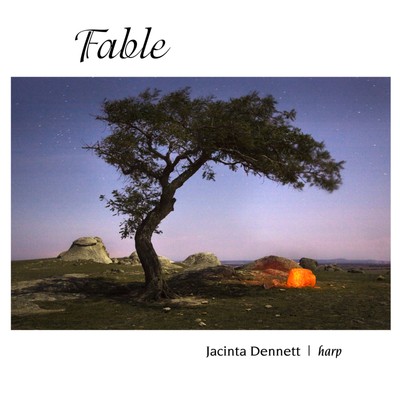
FABLE

Jacinta Dennett

Move Records MCD 630

Australian harpist Dennett offers a collection of works spanning almost the complete gamut of contemporary local composition, including veterans Peggy Glanville-Hicks and Miriam Hyde as well as younger (and alive) writers like Johanna Selleck and Alicia Grant. It shouldn’t matter, but it does, that all eight creative artists heard on this album are women; of course it’s of prime importance that we get to hear voices that have been/were muffled for decades by administrative bodies overwhelmingly populated by males, but a superficial bit of detective work shows that women composers can suffer just as easily as men from rarity of performances.

The way Dennett has organized her program is almost ideally chronological. The one exception is the opening track that gives this CD its title. This 1967 piece by Helen Gifford was a commission by the Melbourne offshoot of the International Society for Contemporary Music and it was premiered at the Adelaide Festival in 1968 by Huw Jones, long-time harpist with the Melbourne Symphony Orchestra. This is succeeded by Peggy Glanville-Hicks’ well-known Sonata for Harp from 1951, written for an appreciative Nicanor Zabaleta. A big temporal leap brings us to Miriam Hyde’s Sunlit Waterfall, produced in 1993 and premiered by its dedicatee, Sydney harpist Yuko Prasad.

From two years later comes Elena Kats-Chernin‘s Chamber of Horrors that was written for the Melbourne harpist Marshall McGuire, as was Eve Duncan‘s the sun behind it, burning it of 2004. Dennett gave the first performance of Jennifer Fowler‘s Threaded Stars 2 of 2006, a revision of Threaded Stars written 23 years earlier. From two years later comes Joanna Selleck’s Spindrift, also a Dennett premiere at the Third Australian Harp Festival in Canberra. Last of all, Alicia Grant’s 2017 Three Pieces for Harp enjoyed its first outing at Dennett’s hands in Bunbury, Western Australia.

So the CD is a compendium that takes in 66 years of activity in an arcane field. The range in vocabulary is also wide, but the accent falls on contemporary sounds – insofar as the harp can produce them. Fable proposes a tensile landscape, beginning enigmatically with some suggestive arpeggios, but gradually moving to a soundscape of contrasts where little is proposed directly, the writing is pointillist and shadowed, and the solitary patch of definite statement strikes you as something of a diatonic shock. Whatever suggestions of old-time stories and legends you are able to infer, they are definitely crepuscular and Dennett produces a shimmering, cloudy series of emotional gambits.

Glanville-Hicks’ three-movement sonata has three movements: Saeta, for that Spanish Good Friday drama-plus-depression outpouring; Pastorale, brief and appropriately benign; and a rollicking Rondo to bring us home happily. In fact, the opening movement is a maestoso processional for which Dennett keeps her powder dry until the last declamatory bars, the main body restrained and bordering on laboured with each semiquaver group that leavens the piece’s distinctive full-bodied chords enunciated with unexpected precision. The middle bucolic interlude presents as an appealing, calm meander with no surprises at all in its fluent siciliano motion.

As the finale moves forward, you come to realize that it serves as summation of its precedents, not least when the full chords of the Saeta return near the conclusion and the flowing 6/8 of the Pastorale emerges from the happy buzzing that constitutes the main chorus of this rondo. You can relish quirks like the quaver duplet that first shows itself at the end of bar 2, and the wholesale key-change that surprises in one of the interludes. Well, ‘surprises’ is an over-statement in a work that is harmonically pretty ordinary and winds up reminding you of so many British chamber works of several decades prior to 1951. The harpist again appears to be playing rather tentatively at certain points, and the conclusion seems lacking in finality, but that could be because the composer had second thoughts about the soft landing towards which things were heading.

Miriam Hyde found her voice early and nothing changed it, so that this gentle bagatelle will come as no surprise to those of us familiar with her miniatures from countless AMEB lists over the decades. In ternary shape, D Major-F Major-D Major, Sunlit Waterfall is a light study in placid semiquaver runs and well-primed melodies. Dennett has no trouble at all outlining this fluent blast from the past as another Australian writer externalises her English influences.

Two years on, and we hit a different channel of water with Elena Kats-Chernin’s essay in Grand Guignol. She opens with 12 semibreve-long strong chords; something like the opening to the Rachmaninov C minor Piano Concerto but not as harmonically settled. These act as a recurrent paragraph, interspersed with whip-quick interludes, full of effects that go a fair way to summoning up the intended menacing atmosphere. One of the most striking of these is a rattling caused by using/misusing a pedal. Yet nothing here is ugly; the restless arpeggios might suggest Hollywood menace or even shudderings, tremors of a mental or physical nature; abrupt chords with added notes propose uneasiness. As the segments, brief and extended, pass through, you are impressed by the composer’s command of textures and techniques, even if the horror is skin-deep.

Eve Duncan’s short piece takes its inspiration from a poem by Esther Theiler which focuses on the appearance of a poppy; one that is close to desiccation at the end of summer, it seems. The composer opens with a single note which deviates to a minor second, the dyad serving as a fulcrum for a wide-ranging, taut rhapsody. Despite its brevity, the piece makes a singular impression for its sustained atmospheric tension and its concentration of content, the whole suggesting aridity, a bare landscape.

Jennifer Fowler reveals a chaste methodology in her contribution, the most substantial on the CD in terms of length but the most transparent in presentation. For the most part, the composer spins out a single line which meanders across the full range of the harp, finding focal notes and weaving surrounding strings into self-contained episodes. This is carried out with an equanimity of expressiveness – nothing in excess – the line punctuated by an occasional added note, more rarely an arpeggiated brief chord; alongside this spartan set of limitations, Fowler eschews any effects, content to let her interpreter outline the calmly grazing nature of this simple, remarkable composition.

In her Spindrift, Johanna Selleck sets herself the difficult task of chasing an image of the nearly intangible: spray from cresting waves. Dennett shows admirable responsiveness to this score which begins with a scene-setting scalar pattern that rises and falls aquatically enough. The composer’s vocabulary is mildly dissonant in the opening pages, well suited to the prevailing quiet dynamic. About half-way through, the environment changes to definite diatonic harmony – E minor? – which lasts until close to the end when the mild atonality returns. This is an amiable work, as obvious in its intentions as Kats-Chernin’s frolic, maintaining its submarine murmuring at either end with a hefty dose of humankind emerging in the centre of this nature-scape.

When you encounter the CD’s final tracks, Alicia Grant’s Three Pieces for Harp, you’re faced with one of the most intriguing conundrums in contemporary serious music practice: a reversion to old-fashioned melodic and harmonic structures. The first of these pieces, Sea breezes, has more of an affinity with Hyde’s waterfall than with Duncan’s sun or Fowler’s stars. The rhythm doesn’t vary from a regular pulse and the work is at times almost operating on an Alberti bass set-up. More strikingly, the melodic material has a predictability that could be soothing or dulling, according to your taste. One of the Book 1 preludes, Des pas sur la neige, provides the jumping-off point for the second piece, Footprints in the sand: Homage to Debussy – which it sort of is. Grant takes the original’s minor/Major 2nd motif as her underpinning and builds up to two passionate climaxes, obviously finding more angst in sand than Debussy did in snow, whose work is a study in piano/pianissimo. Still, homage is not simple repetition and the Australian composer is as entitled to her background imagery as the suggestive French master.

Grant’s last piece, Ocean floor, is the smallest on the CD and it seems to be a digest of its precedents. There’s an unchanging metre, broken up by Dennett’s slight pauses to handle chord-placing challenges; the regular bass/supporting line persists throughout; the melody is not far-ranging in itself but appears in several registers; and you can enter at will into the composer’s vision of deep sea denizens, which seem, by the end, to be at work pretty close to the surface, like a Western Australian tiger shark or six.

This triptych rounds out Dennett’s tour d’horizon which is a testament to her promulgation of this country’s forays into harp music; a career dedication that she shares with Marshall McGuire. Her CD covers an impressively wide range of voices, offering (with a 25-year gap) a perspective of music written for this instrument by high-achieving writers. The fact that these voices all happen to be female is a considerable bonus, from which you can draw multiple considerations about similarities and disparities – and the fertile ground in between.

Congenial musicians in some favourite pieces

LIQUID CRYSTAL

Luke Carbon & Alex Raineri

Move Records MCD 615

Having prepared Elliott Gyger‘s taxing duet that gives this CD its title, clarinetist Luke Carbon and pianist Alex Raineri performed the work throughout 2019. They put in the time, so the duo determined that their labours required a life beyond the ephemeral and, solidifying this decision, have recorded it. You can hear why these musicians went the extra mile or twenty to get this difficult score into the studio and out to the public: its demands are continuous, right up to the shrill last bars; both executants have to exercise a knife-edged mutuality of precision while the work shows an emotionally fluctuating character across each of its twelve sections.

Apart from giving a fine airing to the Sydney composer/academic’s 32-year-old score, Carbon and Raineri have produced an almost chronologically sequential tour of works that they have enjoyed playing together. They begin with the fulcrum of clarinet/piano works in Brahms’ Sonata F minor No. 1 of 1894, followed by Berg’s Four Pieces dating from 1913 which are still as sphinx-like as ever. A small reverse pulls us back twenty years to Amy Beach’s Op. 23 Romance, the clarinet taking over the original violin line. Staying in America, the young musicians exerting themselves on a young man’s music: Bernstein’s 1941-2 Clarinet Sonata, written during the prolific composer’s early 20s.

This makes for a solid exhibition of the duo’s individual and collegiate talents and, despite my habitual Doubting Thomas premonitions, the CD turned out to be a hold-all of some eloquent and informative interpretations. Most immediately impressive of these is Liquid Crystal, a crescendo that stops just short of an explosion. It opens with a burbling fast duo for both instruments: very close writing that calls for split-second timing. Then follows a sort of question-and-answer segment that moves across both instruments’ range, followed by a set of apostrophes for the clarinet with keyboard punctuation. From here on, the intersecting becomes less clear obvious although the developmental character is cut from a common cloth in a language that is percussive and, for much of the time, whimsical.

I lost track of the chain of segments when Gyger’s developmental processes and variations increased in sophistication and (as I’ve said) the segmental distinctions proved less obvious (my middle name). You can discern when a new section has happened, if not where the boundary lines are, and the intention to give the players an equal say in proceedings is handsomely achieved, the composer testing his interpreters with parts that ask for executive brilliance and a keen eye from both on what the other is up to. The score also illustrates its paradoxical title in a textural ambience that combines the fluent with the hard-edged. As far as I can tell, Carbon and Raineri fulfilled the composer’s requirements through an authoritative, enthusiastic reading.

Liquid Crystal is the CD’s last track; the Brahms sonata sits at the other end and proves to be a competent interpretation, if one that presents as somewhat imbalanced in Raineri’s favour. The pianist takes every opportunity to stress the work’s expansiveness, its emotional control and assurance. Carbon provides an outline that is more by the book and, while relaxed enough, misses out on weaving his personality into the clarinet thread. Phrases and clauses travel well, yet they lack individuality; not even a wallowing in the composer’s heart-warming mellifluousness.

On a first hearing, I thought that Carbon tried too hard with his high soft notes, determined to achieve as small a sound as possible – which you can hear in the work of many clarinetists, some of whom give you more breath than note. But this deficiency took place fewer times than I thought; indeed, the gentle approach worked to success across a very exposed point at bars 94-5. Some minor errors distracted, like a top register note that sounded marginally off-point, viz. the D5 in bar 187, and uncertain breathing when dealing with slow arches across bars 216 and 217 in the Sostenuto ed espressivo coda. Raineri put hardly a foot wrong, his work well exemplified by the sweeping, gradually subsiding grandeur on display between bars 116 and 135.

Speaking of the piano, the D flat 5 struck me as being off-colour in bar 20 of the second movement Andante un poco adagio, but other exposure points were ambiguous. Both performers sustained the score’s fluency, even if they didn’t invest much interest in the material, although Raineri employed a well-contrived rubato in the short solo space at bar 45. A more colourful patch came in the Allegretto grazioso and its landler suggestions, details like the piano’s hesitation at bar 28 a welcome infusion of irregularity. Carbon here found an amiable, calmly enunciated character, my only complaint a lack of force in his top C at bar 124. As for the concluding Vivace, this was an unalloyed success: humour without vulgarity, a spaciousness of timbre from both instruments, and an excitement that brought to mind those works where the composer rollicks so effectively – everything from the Academic Festival Overture to the D Major Symphony finale.

I once participated in a most villainous rendition of the 4 Pieces Op. 5 by Berg in South Yarra’s The Fat Black Pussycat club close to 60 years ago, accompanying a fine clarinetist who liked to fly through a work by the seat of his pants. Looking at it now, I wonder how we dared; different times, different audiences, I suppose, and this one wasn’t very concerned about exactitudes . . . or anything. Carbon and Raineri handle these pages with respect, observing every nuance of dynamic and production, careful to a high degree of refinement as in the unhurried climax to the opening Massig across bars 6 to 8, and in their whispered account of the following Webernesque Sehr langsam.

Carbon’s control showed at its best in the final two pieces where the quasi Flatterzunge direction gets a real workout and the required range reaches to the instrument’s extremes. You could rely on the concluding Sehr hastig flurries to No. 3 and, as far as I could make out, the hysteric pandemonium of bars 15 to 17 of the last Langsam piece was precise; it remained as disconcerting a passage as ever, once again impressing me as a series of splattering punches to the ear. Here, more than in Brahms sonata, Carbon’s soft notes work efficiently (with one exception) and the short sequence showed an interpretative empathy, avoiding the extremes of the ultra-scholarly and the hyped-up expressionist.

Amy Beach could possibly take over the mantle of encore-provider/program-filler from Piazzolla if more of her output is released commercially and taken up by willing performers. Carbon has made a clarinet transcription of her Romance and was hardly pressed by the undertaking which follows the original solo line, mainly at an octave’s distance. This timbral substitution changes the nature of the piece, especially at those moments when the original violin moves into a high tessitura, as at bars 18, 45, 62, 86 and for the ethereal conclusion at 114. It operates at several removes from salon music of its time, which, in America, means to me vapourings like By the Waters of Minnetonka or O Promise Me. While Beach’s work speaks a late Romantic language, its melodic felicity and stolid harmonization place it as an honourable mention in a genre honoured by Beethoven, Schumann and Brahms. Needless to say, the transcription gives no trouble to this well-rehearsed duo.

Before the Elliott Gyger work, we hear Bernstein’s sonata which, for something coming early in his composing career, holds resonances of later, better-known works including West Side Story, On the Town, the Prelude, Fugue and Riffs sequence, Candide, even some faint harbingers of the chaotic MASS. This interpretation sparkled in the right places (mainly the second movement Vivace e leggiero) and found both performers observing the remarkable transparency of the composer’s shadings, even through the opening Grazioso‘s more active stretches, e.g. between Letters H and L in the older Boosey & Hawkes edition. Only a touch of that uncertainty of carrying power in the clarinet part disturbed the easy flow of the second movement around the Lento molto at Letter J. But the fast-moving segments came over with an impressive light power, and the players’ handling of Bernstein’s rhythmic irregularities and alterations impressed for its level-headed ease.

Four pianos put to good use

SCARLATTI’S STEINWAYS AT MELBOURNE

Ian Holtham

Move Records MD 3458

Being out of the scholarly musical world, I’m unaware of up-to-the-moment opinions concerning the use of modern instruments in the performance of baroque music. Dealing with anything earlier, I can understand a purist’s revulsion, for example, at hearing an estampie performed on a saxophone-and-drum-kit combination, or hearing a singer of Sting’s calibre attempting lute songs by Dowland. The aesthetic gorge rises. What about this double CD from the University of Melbourne’s piano guru where Scarlatti is given the full concert hall treatment on each of the four Conservatorium Steinways? The accompanying leaflet insists that selected sonatas have been assigned to specific pianos, depending on the characteristics of the scores and their appropriateness for the different instruments. The more time-honoured problem remains: is there a place for Scarlatti in the repertoire of a concert pianist, or should we let the 555 sonatas become the harpsichordist’s province only?

I’ve never had much patience with the strict nature of performance claims made by certain period instrumentalists; less of them are doctrinaire nowadays, compared to the fervour at work in the 1960s and 1970s when purity of delivery was the aim, if rarely achieved. It might be worth my carrying out a particular exercise that would involve going back through the archives and finding out exactly how many poor early music recitals/concerts I’ve experienced – everything from playing out-of-tune (‘I was using mean temperament!’) to complete absence of expression (‘ Vibrato was never authorized by Leopold Mozart’) to plain fluffed notes or whole phrases (‘Everyone knows that leap is impossible on the dulcian’). I’m sure that even the most cursory examination will show that the worst experiences have been at the hands of local musicians – who are quickest to cavil when you call them out for incompetence.

After those early music writhings endured six decades ago (usually in churches), we eventually experienced visitors who could actually play/sing early music so that you didn’t anticipate each attempt at a Gabrieli canzon with fear or a Locke ayre with loathing. Not to mention the exposure to real medieval music with ensembles boasting members who could stay in tune – with each other and the prevailing mode/tonality. We still have throwbacks to the practices of yesteryear where near enough passes as good enough; I can pretty well name the few native valveless horn players who can be trusted with a Bach Brandenburg or a Vivaldi concerto and not setting your teeth on edge in the process.

But the field still has its precious quarters; in my experience, far more so than in any other corner of musical performance with an occasional exception from the ultra-modern ranks, where the aim is to deflect evaluation with arcane, usually mathematical intricacy.

Ian Holtham isn’t exactly trespassing on hallowed ground by performing Scarlatti on his pianos; most of us would have become acquainted with this composer through recordings by Clara Haskil; Landowska and Valenti in my youth were simply names in music magazines and journals. Further, he sits in highly distinguished company. Still, the sonatas do lose vitality, even piquancy when transferred away from the plucky harpsichord.

Along with a host of other Australian piano students, I grew up with the Ricordi collection of 25 sonatas as edited by Alessandro Longo. A few of these have been picked up for these CDs: K. 96 in D Major and K. 159 in C Major, this latter nicknamed La caccia (by Longo? Kirkpatrick?). Among the rest are some that have featured in recital programs while the last track of all, the K. 435 in D Major, was used by Tommasini for his The Good-Humoured Ladies ballet, as was the B minor K. 87 which appears in Holtham’s fourth group. But most of the sonatas are unknown to me – which is all to the good, as who wants to wallow in the familiar?

The first CD opens with five sonatas, all but the middle in C Major, that odd-man-out an A minor. These are performed on the Steinway No. 4 in the Conservatorium’s collection; this one is assessed by the performer as having ‘warm, sunny tones’ and ‘an openness of sound’ that is best suited to these uncomplicated tonalities. The K. 420 makes a pleasant enough call to arms with its internal repeated trumpet notes, only some slight hesitations at negotiating the odd left-hand leap acting as a distraction to a vital enough reading. The Cantabile K. 132 is distinguished for its care with detail, like the different types of tremolo in bars 29 and 31 (later, bars 69 and 71) and the carefully applied splaying of certain left hand chords.

The K. 54 A minor is a crossed-hands test, Holtham handling those passes with a minimum of delay, and he keeps the double-octave rhetoric at the end of each half fairly light. Again, the well-known K. 159 jig sounds jaunty if under-emphatic, particularly in off-the-beat high note bars like 14-16 and 18-20 where you’d expect some bite. Last in this cluster, the K. 461 is an uneven collation where ideas are juxtaposed and interpretation becomes pretty much a question of rhythmic impulse. Holtham splits the sonata into clumps, inserting pauses as demarcation lines, particularly in the second half’s G minor pages. But the work is odd, not least for the Schubertian suggestions starting at bar 84, and again for those Clementine bursts of contrary motion.

Holtham moves to Steinway No. 2, which is variously described s ‘svelte’, ‘acoustic bitter dark chocolate”, having ‘a rasping quality in stronger dynamics’ and ‘an especially dramatic presence’. So, naturally, enough, it becomes the vehicle for minor sonatas in all the white keys but B. The K. 7 in A minor bounded where I would have liked more bounce as well as a sacrifice of ornamentation for speed, plus a clearer definition of those triplet bursts at bars 45-6, 53-4, and at the equivalent places in the second part. The following K. 263 in E minor suited Holtham’s severe approach much better with a deft alteration between gravity and questioning, the only problem an uneven rhythmic flow across bars 69 to 71 on both runs-through.

The first half of the D minor K. 517 appeared to suffer from more irregular delivery in some early right-hand quaver groupings but it was hard to tell if this came about because of a deviation from digital regularity or from the pianist’s individual note dynamics. Suffice to say, the problem didn’t appear after the half-way mark. As for the jauntily grave K. 426 in G minor, this also played to Holtham’s strengths, delineated with an attractive finesse and inevitability despite the inbuilt pauses. Again, you would be pressed to find fault with the C minor K. 84, except for those awkward scales in bars 63, 64, 66 and 67 with their two interpolated demi-semiquavers which disrupt the regularity that obtains up to that point and which are hard to integrate successfully. As for the K. 239 in F minor, this made an unsatisfying ending to the No. 2 Steinway output because it was delivered at an uncomfortably rapid pace. It didn’t matter in the polonaise bars but the downward scales came over as uneven and uncomfortable, particularly in this most interesting of the minor key pieces.

The most commonly used of the Conservatorium Steinways, No. 3, is described as owning ‘great tonal adaptability’ – in fact, ‘a genial tonal openness . . . like an acoustic smile’, which makes it appropriate for ‘the dashing virtuosity’ to be found in the following set of six sonatas. You can hear the benignity in the F Major K. 366 which opens this second disc’s six-part series and the experience would be unblemished if not for two right-hand passages in 6ths (bars 31-2, 39-40; later 58-61)) which sound awkward, unexpectedly difficult in their execution during an otherwise fine toccata. There’s a splendidly firm touch to the B flat Major K. 545, despite an odd falter in the left-hand solo at bars 5-6, and a tendency to elongate the bar’s time-space for the sake of ornamentation from bar 12 on.

A real delight is Holtham’s account of the K. 15 in G Major: packed with vitality and minimal disruption of pace for those wide left-hand leaps in the sonata’s second half, and a welcome clarity of texture with little (any?) use of the sustaining pedal. I relished the rasgueado chords that splayed out at bars 50, 52, 128 and 130 during the K. 209 in A Major: another bright-sounding interpretation with plenty of personality. A fair few small pauses or commas were inserted into the D Major K. 492, most of them understandable but the interpretation was of the aforementioned segmented type: excellent in some parts, laboured in others (like the pattern-setting left-hand one in bar 18 where all the notes are present but metrically hard to differentiate). By contrast, the last in this sequence – K. 216 in E Major – showed a welcome authority and insight, both in treating those rushing scales that generate a supple excitement, especially from bar 129 to the end, and also in a sudden easing of tension into a strolling casualness at bars 99 and 121.

We come now to the last Steinway, No. 1, and the Conservatorium’s least heard of the four pianos. With regard to this, Holtham is full of praise, seeing it as possessing ‘superb tonal range and an abiding expressive adaptability.’ His final group of works are in D Major or B minor, keys where Scarlatti is able to summon up ‘full orchestral qualities and gentle, plaintive mimicry’. Not sure that I heard either in the D Major K. 490, but the reading was near-exemplary in its melding of sudden shocks into a composite, with the extra inbuilt charm of added-note left-hand chords generating the occasional harmonic frisson.

With the B minor K. 87, Holtham gives free rein to the piano’s ability to keep four lines separate and clear while using the instrument’s expressive power. The part-writing remained penetrable and lucid but the executant also infused his version with a Chopinesque sensibility and understated rubato in a notable track that stood out from its surrounds. K.119 in D Major is highly challenging and, at the end of this performance, I wasn’t convinced that it transfers well to the piano. For one thing, it needs more rapidity and a lighter touch than it received here; for another, those grating discords starting at bar 61 and later at bar 163 sound muddy on a Steinway; as well, the right-hand repeated notes came over as laboured.

Another gem in this collection is the mobile, melancholy B minor K. 27, here given a masterly treatment where the texture remains transparent but the actual sound colour verges on Romantic with a slight sense of rhythmic elision, capped by a splendidly shaped burst of harmonic richness across bars 17 to 20. Holtham’s hand-crossing is seamless throughout and his dynamic output even and sympathetic to each phrase’s context. Most pianists who have essayed Scarlatti know the D Major K. 96 and Holtham gives it an honest-speaking account, facing its difficulties square-on, be it the rebounds from those left-hand top As or the implied guitar buzz of repeated right-hand single notes. But the moments that appealed to me more were the buoyant octave-heavy bursts that conclude both halves.

Holtham adds an envoi, the D Major K. 435, which he discovered in his student days and which has sustained his affection. More of us would know it as the second movement from the suite made from Tommasini’s 1917 orchestration exercise for the Ballets Russes. The pianist carries it off with gusto and clear enthusiasm, although I didn’t understand why he slowed down for the opening 3 1/2 bars of the sonata’s second part, picking up the prevailing tempo when the left hand returned to the bass clef. Still, this addition made a happy finishing-off point for Holtham’s compendium which is of excellent technical quality, an example of Move record engineering at its best.

But is it?

SCHUMANN CELLO

Zoe Knighton & Amir Farid

Move Records MD 346 1

Not that I’m complaining – overmuch – but this CD’s title is ambiguous, if not misleading. Both Schumanns are treated here: Clara and Robert. Clara, I hear you cry? Yes: it’s far-fetched because the finest pianist of her time didn’t write anything for cello and piano – the only instruments in play when Zoe Knighton and Amir Farid are the featured artists. Although a short frisson of hope rose when I saw the CD’s accompanying leaflet.

Clara Schumann’s chamber music includes a piano trio and a violin sonata – and that’s all. What we’re given here are three of her song-cycles, and no – Knighton does not display another side to her talents but uses her instrument as a substitute for the vocal line to the Op. 12 Three Ruckert Lieder, the Op. 13 Six Songs, and the Sechs Lieder aus ‘Jucunde’, Op. 23. As for Robert Schumann, his output involving cello as an individual voice is more substantial, including the A minor Concerto, three piano trios, the piano quintet and quartets, and one definite cello/piano duet: Funf Stucke im Volkston. This last-named is included on this CD, as well as one of two other pieces where the cello is a possible participant: the Fantasy Pieces Op. 73 that the composer wrote for the clarinet/piano combination but allowed for violin or cello, just as he did for the Op. 70 Adagio and Allegro – originally for horn and piano, but capable of transference to violin or cello.

The Knighton/Farid combination has produced a fair swag for Move Records, including an album of pretty much everything Mendelssohn wrote for this combination; ditto Beethoven; a Russian catch-all, including Prokofiev’s Op. 119; Debussy’s sonata finishing off a French collection with lots of arrangements; and an Argentine Tango CD with only one Piazzolla track (a remarkable accomplishment), although it’s a substantial one. This Schumann release is the duo’s first collaboration in six years, their previous five Move products dating from between 2010 and 2015.

The 15 songs average about 2’42” in length; not much time for padding. But you could say much the same about Robert Schumann’s two works, which are generally concise and lacking in sprawl. Confounding expectations even further (or adding to the mystery), the text of each song is printed in English; presumably, so you yourself can sing along with the cello. Or, more realistically, this verse publication intends to give you an idea of what the Knighton/Farid duo are attempting to communicate. Actually, not just an idea but the full picture.

This disc opens with Clara Schumann’s Op. 13 settings of two Heine poems, one by Ruckert, and three by Emanuel Geibel. These are polished and lyrically crafted songs, Knighton performing the first three an octave below the vocal line, the final three at the original level. Of course, you can find traces of her husband’s characteristics and some specific phrases sound finely woven enough to have come from his catalogue, like the slightly asymmetric prelude and postlude to Ich stand in dunklen Traumen; possibly the performers make too much of the sustained D on gestehen and Traum in Sie liebten sich beide but the work needs some individuality; Liebeszauber was accomplished with excellent control of touch by Farid whose triplets were light and non-glutinous, while both artists shone in the ritardando across the poem’s last two regretful lines.

Knighton gave a remarkable reading of the vocal line to Der Mond kommt still gegangen, the 5th that features at the start of each stanza’s second line moving into territory as touching as any singer could make it. A similar sensitivity pervaded the duo’s reading of Ich hab’ in Deinem Auge, a finely constructed lyric with a silk-smooth ease of utterance. As for Die stille Lotusblume, both musicians found here an ideal capstone for the cycle with a sensitive realization of the piano part’s rhythmic regularity, a plangent cello line that followed the composer’s evolving melodic patterns with telling sympathy, the series ending with a fine reflection of the poet’s concluding question through an inconclusive dominant 7th.

Kingston shines even more in the Ruckert poems, the first played an octave lower than written while the others make a positive impression because the cellist gives them a carefully etched outline; not exactly overdoing the vibrato but staying the right side of intrusive. Both artists made excellent work of Er ist gekommen with its contrast of nervous Werther-like angst succeeded by a mellifluous Ruhig stanza, polished off with a meltingly fluid downward moving cello line in the composer’s repeat of the last stanza.

Liebst du um Schonheit also was handled with consideration, even if its material impresses as bland – probably because of the sameness at the start of each section, the mould only fractured in the second half of the last quatrain; Farid’s brief postlude an excellent instance of his talent in finding a level of warm pathos – nothing too much. As for the concluding Warum willst du, here you come across a small gem of expression where each phrase slots into the next with admirable craft and, as in its companions, the climax arrives with little bravura but a world of emotional conviction. It helps immeasurably that Knighton and Farid deliver each sentence in well-practised partnership, each slight pause pitched in unshakeable congruence.

Clara’s Six Songs taken from Hermann Rollet’s novel Jucunde are a mixed blessing in terms of attractiveness and emotional variety. Here, if anywhere, you miss a singer’s input because of a kind of textual similarity, both literary and musical. The opening piece, Was weinst du, Blumlein, prefigures the unalloyed optimism of the cycle’s last two numbers – Das ist ein Tag and O lust, o Lust. Mind you, this first number also aims for a folksy cuteness and it unfortunately succeeds, to the point where the third stanza, fairly predictable, verges on the tedious. Nothing against the following An einem lichten Morgen, but attention fell more on the piano accompaniment and its speckled arpeggios than on the cello line which remained measured and spacious – one might almost say orotund – in comparison.

It takes you a while to get into the vein of Geheimes Flustern which has a 3/8 time signature but sets up two rhythmic patterns that wrong-foot each other. Not that challenging, as things turn out, but a deft exercise with a fine melody which didn’t captivate the performers that much as they played only two of its three verses. A complement to the first song in the cycle, Auf einem grunen Hugel has the same simplicity of style, if in a minor key and langsam. The realization is just as much a contrast, too, as the performers take care with their continuity to weave the setting’s irregular statements into a convincing whole.

The last pair are brief essays in jubilation: the first celebrates spring with some familiar onomatopoeia in bird tweets and hunting horns, while O Lust, o Lust has the same 6/8 metre but speaks in wider arches than its companion (the shortest in the set) where the piano support is a jig. Farid’s contributions have a convincing energy to them; Knighton clearly delights in the euphony of her melodies, the instrumental web fluent and definite.

Then we arrive at Robert Schumann’s two works and more familiar territory. I came to know, if not to love, the Op. 73 Fantasy Pieces through student performances under its three formats – clarinet, violin and cello. – and prefer the clarinet version for its definition and parity of dynamic. Knighton and Farid give a worthy account on this disc but its contours are cloudy. This is not an avoidable problem but any partial solution lies in the cello’s ability to push itself forward; a big bull instrument would have more luck but in this instance the instrumental mix proved over-polite. Farid, as usual, was all consideration for his partner and this approach worked pretty well in the first two Eusebius pieces, although even here you were denied much insight into the undercurrents of restlessness that characterize Schumann’s emotional landscape.

The concluding Rasch und mit Feuer kept up the underpinning rhythmic ferment but the piano’s output came over as half-cocked, nowhere strong enough in loud concerted passages; not even at the one fortissimo marking in my edition four bars from the end. The sforzandi lacked much punch and that vehemence that should erupt when cello and piano unite for the main theme’s upward rush impressed as muddy. To my ears, the most lucid of the three pieces was the central Lebhaft, mainly because the actual writing is more transparent and – to use a technical term – bouncy.

On first hearing, you’d think that the Five Pieces in Folk Style puts the cello consistently in front position and, for some of the time, that’s true. Listen again and you become aware of the interesting nature of the keyboard accompaniment. Sometimes it stays just that, with chord support and melody doubling. Then, a burst of individualism emerges, and another; eventually you realize that the distribution of labour is not all one-sided. There is another intriguing factor in Schumann’s odd phrase-lengths. I’m assuming that the melodies are the composer’s own, not gleaned from mittel-European sources; as well, the tunes often range too far to have that necessary gnomic quality.

Speaking of gnomic, the first of these pieces is titled Vanitas vanitatum, which some commentators have taken to refer to a Goethe poem about a drunken soldier. Certainly, that seems to have informed this duo who rolick through it Mit Humor, as required, and a plethora of lurches. This is where you get the impression that Farid will be underused, but then the piano takes on prominence when the key changes to F Major and he is not backward in coming forward, even if Kingston is working on her lower strings. But then, in the following Langsam, the piano gets to shine for about 15 bars only with a statement of the mellifluous and wide-reaching tune before sinking back to secondary position.

Honours are more even in Nicht schnell, mit viel Ton zu spielen for which the piano has a tattoo-like pattern under the cello’s asymmetrical tune; then full chords under the cello’s double-stop 11 bars when the key changes to A Major (not kind for the instrument and an obvious strain for Knighton) during which the keyboard is set into arpeggio mode that recurs at a finger-stretching coda. Further on, in the penultimate Nicht zu rasch piece, Farid gave the full-bodied chords unexpected power, notably in the last two bars. Not that this is subtle music with its oddly four-square structure and non-subtle movement forward; added to this, Farid’s harmonic changes in the central section take attention away from the treble-clef cello line/theme.

The last piece, Stark und markirt, reminds you of the Cello Concerto’s outer movements with its surging power. Once more, Farid is far from a support only. Luckily, this piece was articulated with welcome briskness of attack and a determination to call a forte a forte. Further, you were left in no doubt that this piece was a thorough partnership, one furnished with dramatic character and emotional urgency: an attention-grabbing track that worked quite effectively to finish a CD that has its fair share of restrained, pensive rambles.

Original works that breathe

BASS INSTINCTS

Alicia Crossley

Move Records MCD 624

Straight on the heels of percussionist Claire Edwardes‘ new CD of works by female Australian composers comes this publication by Alicia Crossley of bass recorder compositions, again all by Australian women composers. There’s only one common element: Alice Chance whose Mirroring appears on the Edwardes disc, and a mutation called Inhaltations stands at the centre of Crossley’s production. The other names that Crossley promotes are Holly Harrison, Fiona Hill, Anne Boyd, Lisa Cheney, Amanda Cole and Jessica Wells. As far as I can tell, all of these are Sydney composers except Lisa Cheney, who is Melbourne-based. But it’s no good being absolute about this; you can check up on contradictory websites and information sources and still not wind up with the right facts; least of all in a these chop-me-change-you years where personal movement is hard to detect.

This CD moves into more advanced compositional territory than Edwardes’ recent product. Three of the works involve electronics, one allies itself to percussion, wind chimes appear in another and a multi-tracked bass recorder quartet stars in Chance’s work. Spending far too long chasing down information, I’ve come to the conclusion that all these pieces were probably commissioned by Crossley, although I can only swear to four of them being so blessed. As for their dating, three of them are definitely 2021 while the others are probably from that year. Thanks to Move Records’ promotion of local writers, I’ve come across isolated works by most of these composers – many more in the case of veteran Boyd – and traces remain of other pieces that came to the fore in concerts by the Melbourne Symphony Orchestra when in Cybec-modern mode, also at the occasional Musica Viva recital, and even one score heard during the Melbourne International Chamber Music Competition

It’s a hard ask for these writers. Even allowing for Crossley’s skill, her instrument is a limited one with a range of two octaves; hence, I suppose, the fact that only one work is for the bass recorder alone and unadorned. Everybody except Lisa Cheney has looked at opportunities for expansion. But this one unadorned work, Before You, is one of the more affecting offerings on this disc. As I understand, it’s a love-song to the composer’s newly-born baby daughter, Nora. The piece is not all slow-moving lullaby material but has some deftly-placed emphatic plosions and root-forming repeated notes, even some double stops (note plus humming?), and a touchingly curved lyrical section before the final monotone tattoo. It’s a strange and imprecise ambience we’re offered, where uncertainty and affirmation sit alongside each other: a fine summation of parenthood, in other words.

Slightly more varied in its instrumental source material, Anne Boyd’s Alhekulyele brings wind chimes into the mix. This piece revolves around illustrator and Aboriginal rights activist Olive Pink and the Botanical Garden that she established in Alice Springs, from which in her latter years she would watch the sun set on Mt. Gillen, the imposed name of Alhrkulyele. Boyd presents the work as both a meditation and a dance; as far as I can see, the dance reference doesn’t start until about the two-thirds point, the preceding material presenting an aural scene all too easily transferred into one’s preconceptions of the continent’s centre. The percussion element is introduced at various points, serving as aural brackets, while the recorder is gifted with a long, going-nowhere melodic line, interrupted by over-blowing passages that imitate the same effect on a didjeridu.

Again, Boyd uses a double-stop-producing technique which could involve breathing and/or fingering in a specific manner, such as we have come to know and love from contemporary flautists, the rot setting in (for me, at least) with the recordings of the incomparable Severino Gazzelloni. The dance segment is a piece of pattern-play that would probably not appeal to many choreographers because it stops and starts at its own sweet will, although the full and partial repetitions are suggestive of similar essays from Antill to Sculthorpe.

Beginning the CD is Holly Harrison’s Sylvan, a three-movement suite with erotic overtones. In the first, Crossley works in partnership with percussionist Joshua Hill on hand drums to show the woodwind instrument as a cool-eyed vamp, starting her act slowly and gradually rising to a jazz- and Latin-inflected climax. This is a deft piece of construction for its crescendo shape and for the juxtaposition of the recorder’s breathy sound quality against Hill’s snappy percussion. In the second movement, Harrison moves to a recorder-marimba partnership which pursues another cool jazz path; nothing over-aggressive but plenty of mild effects like small glissandi, breaths, flutter-tonguing, the whole capped by a moody, vibrato-rich coda. Hill’s marimba also works hard in the final piece which follows another catchy Latin rhythm but with more instrumental interweaving and a mid-way switch to a soft tinkling underpinning which suggests a cymbal used carefully, content to stay in the background of Crossley’s syncopated flights.

This is a fine opening as Harrison takes Crossley’s disc title and pursues one of its suggestions, if you allow ‘bass’ to become ‘base’. Still, Harrison’s communications of an earthy compositional stratum remain above the aesthetic navel and the suite suggests diversion rather than full-blown engagement.

Alice Chance’s Inhaltations – a cross between ‘inhale’ and ‘exaltation’ – is proposed as yet another dance, this one for the bass recorder and a multi-tracked bass recorder quartet; the whole sound complex supplied, I assume, by Crossley because no other artists are listed as contributors. It begins as a kind of slow chorale with the solo (live?) recorder line weaving a melodic line above the chords – more an incantation than an inhalation. A few dissonant harmonies appear at about the 3’40” mark but the greater part of the piece is unexceptional and follows an orthodox pattern, the solo line eventually moving into the centre of the chordal fabric. If there is a dance here, it has the character of a slow-moving pavane, and the exaltation is essentially spiritual, not physical.

The remaining three works involve bass recorder and electronics. Fiona Hill’s Lost in the Darkness takes as its starting point a poem by a refugee who had spent two years in detention with her younger sister. The atmosphere is, as you’d expect, dark and mournful with many sustained notes, tightly whispered words, a light use of electronics which seem to be based mainly on bass recorder sounds. At the centre, the solo wind line tends to be more volatile and unpredictable – rather like the federal government’s treatment of those dispossessed unfortunate enough to wind up on Australian shores.

Hill suggests very strongly the scenario of a captive bird struggling against restraints, as well as the futility and endlessness of the detention process, particularly in the final moments of her piece where the real-time output is mirrored by an electronic sustain. This makes for a fine piece of polemic, to my ears: presenting us with an aural equivalent to the isolation and quiet, depressing environment of people like those refugees who remain in Carlton’s Park Hotel while a spoilt Serbian tennis star has been able to tip his toe into their world and then fly home to his waiting minions and millions. It’s not an absolutely depressing piece; the solo line has many flights of restlessness and agitation. But the imprisoned spirit that it represents finds no way out – just a sustained, floating changelessness.

Microtones make a basic element in Amanda Cole’s Vibration Meditation which is focused on changes in timbre and production techniques more than rhythm and harmony which remain unadventurous across the work’s breadth. While the sustained electronic notes and chords give a certain weight to the score’s progress, the live recorder line holds the really interesting elements as Crossley employs pretty much all the same techniques as her colleagues, and then some. Her variation comes in that exposed line’s fluency, it seems to me, and not in the material itself which is content with a comfortable diatonic repetition – slowly altered, yet the same elements are sustained.

The CD’s last track has a schizoid form: The Clockmaker on the sleeve, The Clock in the booklet. It opens with electronic tick-tocks and a soft but perky recorder line, punctuated by percussive interpolations as the rhythm moves in a five/six alternating pattern. In fact, the electronic percussion takes on major importance with a sonorous passage for bell sounds and notes reminiscent of a steel band. Then the rhythmic insistence stops for a kind of free-wheeling lyric line supported by sonorous sound bands, before the ticking recurs and a faster tempo obtains as the composer revisits her initial material, although the electronic support is here more richly coloured. While the live recorder performs a sort of dribbling-away sign-off, the background persists in its energy until it fades into the distance.

This final piece has claims to being the disc’s most solid example of physical replication. Like many of its companions, The Clockmaker uses the bass recorder’s compass with a specific determination to display its timbral qualities, although this composer avoids most of the sound-production techniques brought into play by others with a more adventurous bent. All nine tracks show a musical world that is essentially soft-voiced and inferential – a circumscribed ambience with smooth edges. It soothes but is intriguing enough to engross rather than working as an aural narcotic.

Sweet and low

RHYTHMS OF CHANGE

Claire Edwardes

Move Records MD 3459

Of course, percussionist Edwardes is speaking of changing rhythms – the shifts in beat and pulse that Stravinsky and Bartok gifted us in the first half of the 20tm century, to the point where a predictable metre that lasts unchanged throughout a contemporary piece of music can be regarded as a failure of invention and/or imagination. Some regard it as a reassurance, to have the time signature stand as a monolith; if it was good enough for Paisiello, surely it’s good enough for us? More importantly, Edwardes is talking about something like a change in performance aesthetic. Each of the nine works performed on this CD has been commissioned by Edwardes from seven female composers, a result of the performer realizing how male-centric is (was?) the nature of her repertoire. These writers are Maria Grenfell, Ella Macens (two works) Alice Chance, Peggy Polias, Bree van Reyk, Elena Kats-Chernin (two works), and Anne Cawrse.

This is an interesting list; certainly for me because, Kats-Chernin apart, I don’t know any of them. Grenfell is currently a Hobart academic; Macens appears to be centred in Sydney where the bulk of her work is commissioned and performed; ditto Chance; the same with Polias; van Reyk breaks this mould by living in Newcastle (as far as I can tell); Kats-Chernin is the most well-known and prolific of all Australian women composers and resides in Sydney; finally, Cawrse takes us away from COVID Central (or has that distinction moved north?) by living and working in Adelaide. The age range that these composers represent is also wide – from 64 to 27. But what about a similar scope in the actual sounds we hear? Well, it’s not startlingly wide.

Grenfell has produced a three-movement suite for marimba solo. Macens’ first work involves vibraphone and crotales, while her second is for marimba alone. Chance’s Mirroring is a vibraphone solo, while Polias gets with the strength through one more marimba work. Van Reyk joins the Chance push with a vibraphone solo; Elena Kats-Chernin hits the marimba solo trail, then gives us a vibraphone piece; finally, Cawrse’s three Dance Vignettes round off the experience with a marimba. Focus on these two instruments was inevitable, given that Edwardes’ prescription to her composers was that their music had to be for solo mallet percussion and there’s not much left – xylophone and glockenspiel, possibly, but neither is used in your modern-day contemporary music-making, whereas the vibraphone has been employed by some impressive big names of the 20th century and the marimba forms an essential part of many music-making percussion nights in this century and the last – as I’ve found out to my cost.

Edwardes delivers Maria Grenfell’s Stings and Wings with assurance and a keen eye for its humour. The three movements – Jack Jumper, Dragonfly, Moth Hunt – depict insects with an attractive deftness, each presenting us with a motif or two and demonstrating the composer’s good husbandry with her material, be it a rising Major 2nd chord punctuating a syncopated murmuring, rapidly repeated notes and chords, a happily urgent single-note pattern that transforms into a melody but continuously returns to its original shape. The central piece interests for its middle section where Grenfell deviates from the expected path and works into more taxing, irregular rhythms and harmonic constructs, before calming us down with a return to her opening bar atmospherics.

As a job-lot, this suite is the CD’s second-longest construct but each segment passes with alacrity, the composer owning the inestimable gift of knowing how much is enough. While there’s little here to frighten conservative tastes, the work is an amiable delight – not too difficult in a technical sense but asking for a buoyancy of interpretation, here well realized by Edwardes.

Ella Macens’ Falling Embers refers to the aftermath of two bushfires – one that she personally experienced as a child, the second that terrific disaster of 2019-20. It’s a gently articulated piece, given a base by bowed sustained notes while an incrementally expanding melody in C minor emerges, vibraphone and three supplementary crotales making ideal complements in another work that refrains from mallet-crunching but sustains a placid, elegiac atmosphere that suggests calm and rest without a hint of any preceding terrors. Macens’ Verve dates from 2016; a marimba solo, it is skeletal in its matter but sets a few timing problems – nothing too serious for a modern percussion player, especially one with experience in Latin American dance steps. I don’t know where the title comes from; the piece is a neat exercise, if a repetitious one beneath the dressing, and happy to stay rooted pretty much throughout in A minor.

Mirroring by Alice Chance, a vibraphone solo, lives up to its name. Not that it’s packed with canons and cancrizans, but the piece presents its building blocks and plays with them in a glimmering sheet of variants, some of which you catch straight away while others nibble at the corners of memory. Chance’s world here is direct in its address but not strident, best appreciated in its rhythmical flow which seems to be continually on the move and not settling into a specific pattern, even if you sense that the pulse is unwavering in a subterranean manner. In different mode completely although having the pandemic and its effects firmly in its sights, Peggy Polias presents a vision of the COVID-19 virus as it attacks and recedes, eventually outfoxed by researchers and out-and-out virologists. Receptor is easily the most ‘modern’ music heard so far with a healthy atonality in operation, ameliorated by plenty of repetitions and textural varieties as it works through its four sections: Binding, Sequencing, Defending, Fading. This work’s last bars serve as a muted consolation, a soft requiem for the tragedy that many of us have faced.

Exploiting the vibraphone’s ability to generate differing sounds, Bree van Reyk exploits a range of techniques in Slipstreams, which revolves around pedal notes that last a bar while the fun goes on at different levels above them, particularly lengthy measured melodic chains and incidental, faster-paced small cymbal patterns. A harmonically plain work, van Reyk has also opted for an inexorability of rhythmic underpinning; still, the work is a sort of address to her younger self, focusing on sounds as qualitative units more than demonstrations of expertise or instrumental facility.

The oldest work in this collection is Elena Kats-Chernin’s 2010 Violet’s Etude, which celebrates the then-energetic nature of Edwardes’ daughter, a domestic presence as composer and performer prepared the former’s Golden Kitsch percussion concerto. A marimba solo, the work stays wedded to its 5/4 time-signature throughout, as well as an E minor tonality with modal inflections. As with every one of Kats-Chernin’s works that I know, this one is melodically idiosyncratic and deftly polished, reflected in Edwardes’ clear delivery, right down to the almost inaudible final gestures. Poppy’s Polka concerns Edwardes’ younger daughter and outlines the young girl’s day at school; another clever, almost facile vibraphone bagatelle, this time in A Major/minor in ternary shape, its meandering melody taking more than a little from Bach’s A minor Invention but the delivery packed with different shadings and styles of attack.

Last of all, Anne Cawrse’s three Dance Vignettes comprise the CD’s longest work: Meditations and Hymns, Fancy and Flight, Scamper and Scoot – all on a decreasing scale of length but just as atmospheric and as title-reflective as anything else in this collection. The first is loaded with intimations and imitations of plainchant, organum, tunes that might belong in a latter-day psalter; the whole sounds restrained and potentially meditation-accompanying with a great deal of repeated-note work and a restrained dynamic level. In the central piece, the fancy is light-stepping, initially in E Major and moving along its arpeggiated path with calm deliberation before entering into more complex rhythmic and harmonic territory between the half and three-quarter marks, then returning to the original 4/4 stepwise motion – the flight being harnessed at its end, or so it seems.

A fast linear duet finishes of the suite, the main interest coming from the combination of off- and on-beat accents, as well as the precision of output in a marimba piece that comprises two lines for much of its length, the 4/4 regularity interrupted by interpolated bars of disjuncture-causing irregularity, not to mention some brief glissandi near the conclusion. Scamper and Scoot serves as a happy romp with which to finish this display of Edwardes’ talents, even if – like many of its companions – it flirts with chromatic shifts but is firmly tonal. I don’t think many barriers are smashed through on this disc; even the more daring moments avoid angularity and dynamic shocks. But the final effect is one of careful craft being exercised, an overall evenness of temperament and address, the whole performed with sympathy and unfaltering devotion that speak out, no matter what level of virtuosity is required.