Visitor fits right in

BEETHOVEN’S FAVOURITE

Australian Chamber Orchestra

Hamer Hall

Monday November 28, 2016

lorenza-borrani

                                                                            Lorenza Borrani   

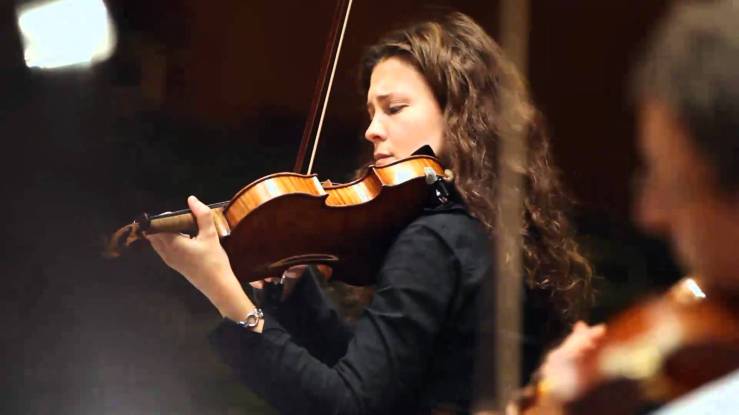
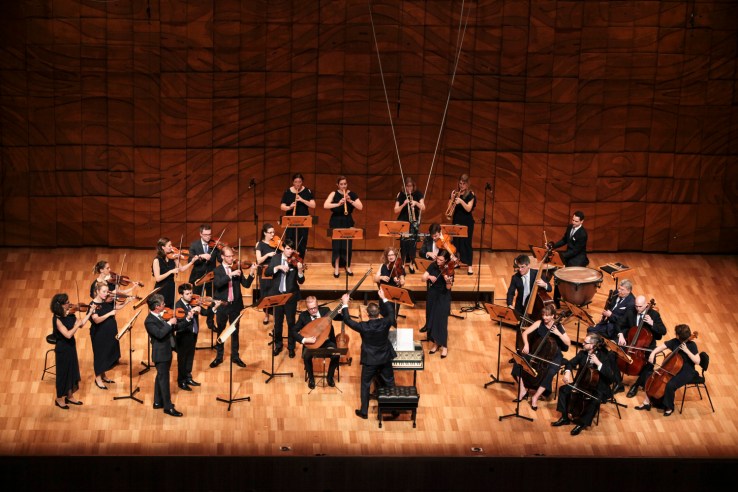
At the last of its national series concerts this year, the ACO enjoyed the attention of a replacement director in the Italian-born violinist Lorenza Borrani, leader of the Chamber Orchestra of Europe.   For much of Monday night’s proceedings, she followed the Tognetti principle of leading from the concertmaster’s stand, although less likely than the organization’s artistic director to use her bow as a baton; indeed, I didn’t see her have recourse to this control mode at all and the precision level of the players’ entries didn’t seem to suffer in any of the three works programmed..

Borrani made her solo offering at the start with Schnittke‘s Sonata for Violin and Chamber Orchestra, the latter entity comprising strings (about 15) and harpsichord.    For me, the Russian-German composer’s music has presented continual problems; the first work I heard, it seemed, was written by a committee – you couldn’t nail down a specific voice or character to it.    At the time, I said to a moderately enthusiastic John Sinclair, critic for the Herald and also coming to Schnittke’s work for the first time, that it sounded like something written by a panel, each of the movements allocated to specific members.

This sonata goes some way to exemplifying this evaluation although, in these latter days of enlightenment, most of us have become aware of the composer’s adoption of multiple tongues in the one work like this one where a grating acerbity exists alongside common chords that suggest the religiously inspired products of recent Scandinavian and Baltic mystic-writers; and where a meditative andante of stern serial shape is balanced by a bounding dance movement owing much to jazz and its offshoots.

Borrani showed firm control in each of the four movements, nowhere better than in dialogues – if one-sided in format – with Anthony Romaniuk‘s harpsichord, used as a brisk punctuating presence or for its grinding pebbles-imitating potential.   Most of the sonata’s interest lies in the solo violin line which rises to high technical demands and asks its interpreter for a constant variety in production techniques.   Of course, Borrani met each requirement with impressive authority; but then, she has been performing this piece for some years now, directing her Chamber Orchestra of Europe colleagues in it two years ago.   She forged an uncompromising path for the ACO players to follow, notably in a series of slashing chords that cut across the sombre path of the initial movement’s pages, some very soft floating chords in the work’s later stages, and an attractive astringency to give a febrile background for the soloist’s more ardent bursts of action.

Schubert’s Five Minuets with Six Trios for string quartet in an anonymous arrangement enjoyed a vital treatment where the original’s expression markings were observed with high enthusiasm and the players worked through all the repeats. Pleasant bagatelles, these pieces hold few surprises beyond a few disruptions of expectations where the usual division of eight-bars-per half in both minuets and trios changes, as in the third minuet where the second half is 16 bars long, while its second trio has a second half of 12 bars (and in this reading a liquid solo from Borrani above pizzicato accompaniment), as does the second trio to Minuet 5.   Schubert’s melodies have an assertive energy but the only dramatic (i.e. interesting) moments come in a few bursts of polonaise rhythm – the second trio of Minuet 1 and a couple of bars in Minuet 5 – and the musette/trio to the latter.

Beethoven apparently had a liking for his own C sharp minor Quartet Op. 131, according to one contemporary authority – Karl Holz, the composer’s secretary during the late quartets’ gestation.   No one can deny its incomparable breadth of content and emotional illumination but its transference to string orchestral guise is a dubious undertaking – something I’m coming to question about the whole Beethoven oeuvre in this form.  The justification usually advanced revolves around a clarity that is bestowed on the middle lines when you have a number of players dedicated to them. To my mind, that’s not a relevant argument, suggesting rather a lack of concentration shown by the listener or an incompetence on the part of the musicians involved in the quartet’s delineation.

Of course, with all lines reinforced, the score’s nature is changed into something more sonorous and substantial, particularly in the A Major set of variations and the athletic final Allegro.  Additionally, this interpretation proved very attractive as an aural experience, Borrani asking for pronounced dynamic differentiations, an edgy bowing attack in each allegro and the Presto,  and a rapid response rate in passages like the fifth movement’s sudden shifts  –  to Molto poco adagio interludes, and to those two delectable Ritmo di quattro battute breaks in the pages’ fleet-footed propulsive drive forward.

Monday’s well-populated house received the performance with enthusiasm and it served as an excellent showcase for the participants’ expertise and sharp-as-a-whip, finely honed ensemble.  In a week when Wagner’s Ring is rampaging at the State Theatre next door to Hamer Hall, this view of Beethoven rang plenty of complementary Romantic bells and brought out strongly the composer’s vehemence and dramatic urgency – qualities that appealed to the later writer.  But, for me, this unsurpassedly rich tapestry of a string quartet was changed into something more in the nature of a concerto grosso – bigger, not necessarily better.

Clear if sometimes tenuous

THE LONDON SKETCHBOOK

Melbourne Chamber Orchestra

Melbourne Recital Centre

Sunday November 20, 2016

grace-clifford

                                                                                    Grace Clifford

To finish the year, William Hennessy and his orchestra paid tribute to the mother country with a grab-bag program of works by Mendelssohn (honorary Englishman), Byrd, Warlock, Vaughan Williams, Ireland and Mozart, whose collection of eight-to-nine-year-old juvenilia gave this event its title.   All those sketches are for piano; the four excerpts we heard proved amiable enough, but I think Hennessy was straining when he found links between the first piece, a siciliano (or two) in D minor, and the Requiem, or between the following slight G minor Sonata and the Symphony No. 40.    As an experience, all these pieces proved to be amiable, deft exercises at worst, hardly interesting enough to send you searching for the Sketchbook‘s 39 other components.

The only other arrangement in the concert was of Byrd’s six-voice motet Sing joyfully, a cathedral choir favourite.   Its three-minutes’ length passed pleasantly enough, like the Mozart scraps, but its emotional drive was absent, possibly because the tempo taken was pretty slow, more probably because the performance for strings alone lacked the soaring exultation of the text; no incitement here to Blow the trumpet in the new moon, as the Psalmist directs us – just a clean-enough texture of interweaving lines without much personality.

Former principal cellist of this ensemble, Michael Dahlenburg, controlled a placid interpretation of Mendelssohn’s The Hebrides Overture, the score’s sound-world dominated by the wind – twelve of them – who delivered their lines with plenty of vigour in each tutti, swamping the 14 strings.   But the imbalance started earlier with the second subject at bar 47 where the cello/bassoon doubling over-favoured the woodwind.   For all the allowance-making of imaginatively fleshing out sounds that proved faint images of their usual selves, the reading was hard to fault for its technical precision; I heard only one off-kilter violin note somewhere about bar 131.

John Ireland’s Concertino Pastorale is a novelty to many of us (as is anything by this writer), so this airing of the work’s central Threnody was most welcome.  The MCO strings fully embraced its lush elegance with a splendid lyrical chain supported by emphatic cello pizzicati at climactic moments.   It shares a common language with elegiac scores by the composer’s contemporaries yet it recalls, in its serene sensibility, Barber’s Adagio for Strings although the English piece is more heart-on-sleeve in its declamation, less deliberately monumental than the American masterwork.   It gave the MCO players no apparent worries, their delivery assured and idiomatically convincing.

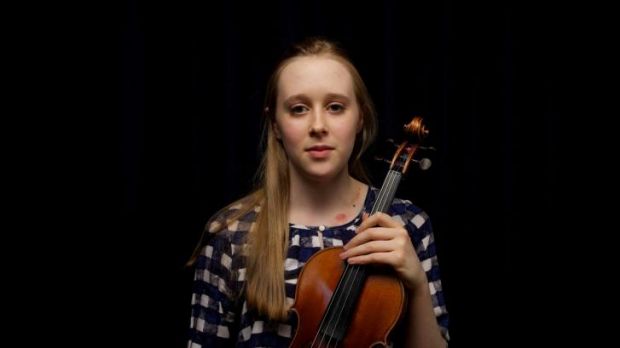
Violinist Grace Clifford appeared at one of the Melbourne Symphony Orchestra’s most popular Proms Town Hall concerts in July, taking the solo line in Bruch’s Concerto No. 1; an engrossing version, as it turned out, packed with confidence and polish.   For this occasion, she opened with Vaughan Williams’ The Lark Ascending: that simple-sounding, always perilous rhapsody that tests any player’s self-reliance because of the several cadenzas that are spread throughout its length.   Clifford kept a level-head and a confident right-arm in play, not put out by some scatter-gun woodwind chording at the score’s opening or a pair of horns that Dahlenburg could have tamped down to beneficial effect.   The young soloist articulated a well-honed sound, especially in those exposed passages where you are conscious of the soft whirr of the bow moving over the instrument’s strings, coming to a hall-silencing apogee in the final senza misura solo (not a cough in the house) that ended on a bravely sustained high D to B fall, softening to inaudibility.   Which is dangerous, of course, as you sacrifice some security of pronouncement on the triple-piano altar. Still, the attempt came close to ideal here.

It’s been a long time since I heard the Capriol Suite – not since Harold Badger took a student group of indifferent quality through the work in an ability-stretching struggle maybe 40 years ago.   Hennessy from his first desk (as for the Ireland, Mozart and Byrd) set a steady pace in this optimistic work, keeping the Pavane on the move, giving an attractive pliancy to the Pieds-en-l’air meditation, and hammering out a brisk Mattachins finale.   The approach might have gained from less weight in delivery, particularly for the admittedly forthright  opening Basse-Danse, but the MCO strings once again handled their work without any apparent discomfort, doing their duty by Warlock in transforming the original Thoinot Arbeau material into an indubitably English composition.

Clifford re-emerged at the program’s end for the Mendelssohn E minor Concerto.   As with her Bruch, she took on this warhorse with a briskness of attack that stayed well away from needless aggression.   Interpreters have to walk a fine line with this concerto, far too many falling into an interpretative trench of gentility, subscribing to the all-embracing conception of the composer’s tendency to Biedermeier tweeness.   We know Mendelssohn was a moraliser, even verging on a prig – his reactions to Berlioz show a middle-class incomprehension that makes you glad he didn’t survive into the heyday of Wagner – and anybody patronised by the benevolence of Victoria and Albert has an inbuilt burden of cultural attachment.   But this piece has a tensile force in its well-framed paragraphs that has to be delineated with clarity and determination.

Clifford’s first movement cadenza had a drive and dynamic arch to its development that would have been the envy of many a more experienced artist, and she kept her end up in the exciting stretto that finishes  this Allegro.   It wasn’t that this soloist left the sugar out of Mendelssohn’s pendant Andante, but she controlled her vibrato and any temptation to suffocate the main melody in sentiment.   Not an easy road to follow; has there ever been a slow movement so consciously ‘sweet’?   Her sonata/rondo finale hit all the right points, balancing sprightly delicacy with moments of sweeping breadth, full-bodied to the end without a trace of maidenly reserve or dithering with the composer’s semiquaver streams of action.

I don’t know what Clifford’s commitments are in 2017, apart from a Selby & Friends recital at the Deakin Edge, Federation Square on March 9, participating in piano trios – Beethoven, Saint-Saens, and Dvorak’s Dumky.   But keep your eye out for her Melbourne appearances: so far, they’ve been top-notch efforts.

Vivaldi all over

AVI AVITAL

Australian Brandenburg Orchestra

Melbourne Recital Centre

Saturday November 5 and Sunday November 6, 2016

avi

                                                                                          Avi Avital

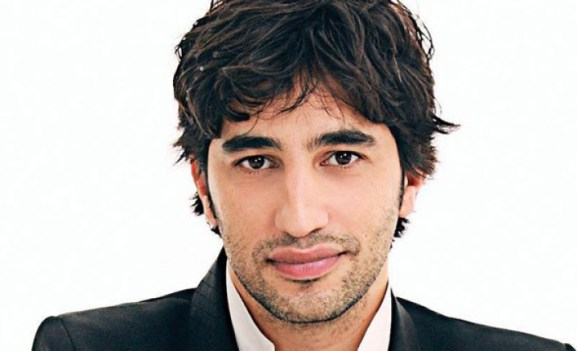
Not an instrument you come across often, the mandolin.  No performance of Don Giovanni goes through without you hearing its gentle underpinning to a baritone booming out Deh vieni alla finestra; sometimes a director has the sense to put the player onstage.  But otherwise?

A set of mandolin-composing names are put forward in the program booklet for this particular concert.   Thanks to the modern craze for Mahler, you get to hear the instrument in the Symphony No. 7; sadly, this work is among the least commonly performed of the canon.   Then there’s the Symphony No. 8, which is even less often given and calls for at least one mandolin but preferably more; mind you, there’s a long wait before the instrument’s timbre comes out of the maelstrom at Letter 148 of the second movement (and most of the output is pianissimo – hence the call for more than one of them) and later there is ten bars’ work from Letter 187 on.   However, the best of the composer’s ventures comes in Das Lied von der Erde where it features briefly in Von der Schoenheit and to superb effect after Letter 64 in Der Abschied.

Webern, the hero-figure of the 1950s and 1960s, uses mandolin in his Op. 10 Five Pieces for Orchestra; well, he uses it sparingly – 3 notes in No. 3, 13 notes in No. 4, and 6 notes in No. 5.   The instrument also gets a guernsey – actually, a bikini strip – during the second movement in the Cantata No. 1 Op. 29.

Then there’s Schoenberg who scored the instrument into his Serenade, Op. 24; like Mahler in his Symphony No. 7, he also used guitar here.   Later, he gave the instrument a small part in No. 4 of his Variations for Orchestra, then a bigger contribution in that work’s finale.   As well, it features in the one-act opera, Von heute auf morgen which, to my shame, I’ve never heard.   The only other use I can find in this composer’s oeuvre is in that vast sprawl of an opera, Moses und Aron where he calls at one point for four mandolinists.

Stravinsky has a mandolin in his opera Le rossignol, as well as in the ballet Agon – and that’s it, as far as I can see.   The program note also lists Verdi (for a chorus in Otello) and Massenet (somewhere in Don Quichotte).   But, early Beethoven apart (two sonatinas, an Adagio and an Andante with variations – all with harpsichord accompaniment), you’re scraping to find solid material in Romantic/Modern repertoire of significance.

Which goes some way towards explaining Israeli-born virtuoso Avital‘s emphasis on Vivaldi for his tour with the Brandenburgers.   Along with the original Concerto in C RV 425, he also offered his own transcription of Summer from The Four Seasons and the solo violin A minor Concerto from L’estro armonico.    Couple that with a Paisiello concerto in E flat (a dubious attribution, it turns out – one of three mandolin works ascribed uncertainly to Napoleon’s favourite composer) and a set of Six Miniatures on Georgian Folk Themes from the mid-20th century by an enthusiastically nationalistic writer in Sulkhan Tsintsadze, and you have a guest who’s very generous with his time and talents.

Paul Dyer and his reduced orchestra played two works in their own right.   Vivaldi’s Concerto in C RV 110, with its reminiscences of the well-known Two Trumpet Concerto, made a brisk throat-clearer involving (I think) the truncated ABO’s full complement of five violins and single viola, cello and double bass supported by Dyer’s omni-present harpsichord.   Avital made fine work of the RV 356 in A minor with a mobility of dynamic during the four solo passages in the opening Allegro and about the same number in the finale.   He enjoyed a good deal of prominence in the middle Largo where the orchestral background is confined to sustained chords, giving ample space to exhibit his ability at shaping a line, admittedly one that barely stretches above an octave’s range.

Giuseppe Valentini‘s A minor Concerto grosso, one of the longer of the composer’s Op. 7 set of twelve, was reduced from the original six movements to four; more than enough, given the predictable sequences that brought to mind first year counterpoint exercises, although the interweaving of the four solo violin lines came off quite well.   In the Georgian Folk Themes, Avital got to use the tremolo technique that most of us associate with his instrument; the Vivaldi works and the Paisiello tended to ask in the main for single notes only.   The suite itself is a pleasant entity, its melodies shaped into well-rounded format, Tsintsadze’s orchestration slick, a few harmonic quirks thrown in as a sort of post-Bartokian salute to a man who really knew what to do with a folk tune..

As for the C Major Concerto RV 425, you could hardly wish for a more authoritative interpretation: brisk even in the central slow movement, precise in its right-hand work and continuously interesting for its contrasts – very welcome in a piece where executants feel they’ve met their responsibilities by getting all the notes.  Still, it’s been a long time since I last heard this work live; in fact, probably not since Kurt Jensen’s years presenting concerts at St. John’s Southgate.

Avital introduced the Paisiello work with a short address, drawing contrasts between Venetian and Neapolitan schools, some of which rang fairly true.   But his insistence on this composer’s powers to startle with abrupt changes of harmony seemed far-fetched, once you settled into the work itself; not much of novel interest struck the ear as the opening maestoso oscillated between E flat and B flat with some glancing side-swipes.   Here, more than anywhere else, a few more strings would have helped add to the work’s density, although it has to be admitted that the score’s effectiveness gained by having Avital audible throughout.

The final, seasonal Vivaldi proved to be right up the ABO’s street, Avital infusing it with vivid emphases, driving bravura passages and a relish for the stop-start nature of the opening feast of bird-song and heat-washed languor.  Later, the storms of the finale roused plenty of enthusiasm, although the final ascending flourish of 2nds from bars 116 to 119 didn’t impress as much as the preceding rapid-fire solos.   Still, this full house reacted as you’d expect – with a torrid energy mirroring the score itself; actually, even more than you glean from Vivaldi’s excitement-rousing tutti exclamations.

If you must have transcriptions for the mandolin, then you can hardly do better than the Venetian master’s sun-drenched confections.  And every concert benefits significantly if it features a guest artist who matches the host players’ driving enthusiasm and brio in accomplishment.

Cut-down ACO in top form

BAROQUE BRILLIANCE

Australian Chamber Orchestra

Melbourne Recital Centre

Saturday October 15, 2016

lezhneva

                                                                                    Julia Lezhneva

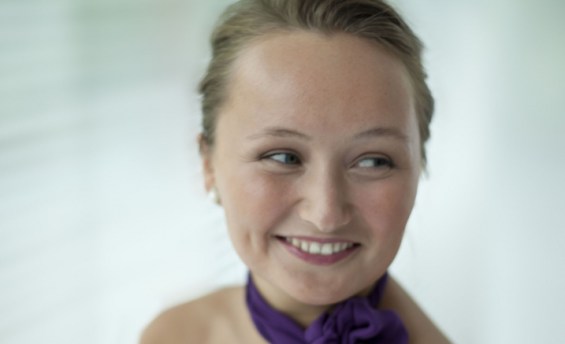
It had nothing to do with the performance but I fell ill just before interval at this concert and went home, rather than risk disrupting my neighbours in the night’s second half; added to which, kidney-stones have a powerfully distracting effect on your concentration, no matter how ravishing a Handel aria’s execution.

Still, I stuck around long enough to hear soprano Julia Lezhneva sing Porpora’s In caelo stelle clare fulgescant motet and the Salve Regina antiphon setting by Handel.  This is a highly individual voice, light and buoyant with unexpected carrying power across its range, even in the lower registers.  Much of Lezhneva’s technical equipment is based around her rapid negotiation rate, which can be appreciated best in fast scale passages, but what startled me – so much so that I wasn’t sure of what I was hearing – was a kind of one-note trill during the Porpora work.  It recalled the effect that you hear in sections of the Monteverdi Vespers of 1610, where one note is repeated in rapid, detached semiquaver action. Lezhneva is adroit in handling the normal cadential trills but this not-quite-tremolo is strikingly unusual.

It first appeared when she reached the volent in fronde aves canendo phrase and immediately struck a response; what better way of simulating exactly that image?  Further on, the device is employed to just as brilliant an effect in the mecum gaudendo passage to suggest elated spirits.   But by this stage, Lezhneva had delighted with a richness of ornamentation and a splendid pliability of phrasing, almost caressing the line into shape. With a corps of about eleven strings only, Richard Tognetti and the ACO grounded proceedings with an accompaniment of exemplary subtlety.

Just as arresting as her decorative work, the soprano made a brilliant impression with her brisk and flawlessly accurate account of the motet’s concluding Alleluia, handled with bravado but sensibly so that the long chains of scale passages came across with clarity and balance – not the scramble that some Baroque interpreters give to such flights of vocal velocity.  The only fault you could pick with the whole account came in a high A (at least I think it was: Tognetti had brought his tuning down to 415) that for some reason came out as half-hearted, although it was awkwardly positioned – not cadential but not able to be thrown away as part of a roulade.

In the Handel piece, Lezhneva enjoyed even more success, probably because the combination of sentiment and fireworks is much more dramatically shaped.  The slow wide-ranging sentences of the opening, where the children of Eve emphasize their depressed state, enjoyed excellent exposition, notably at the point where the music becomes monosyllabic as the suspiramus setting brought out the dramatist in Handel and the actress in Lezhneva.

Despite the warm pianissimo ending, carefully negotiated by the soprano and her sparse string accompaniment, the Murdoch Hall audience relished the middle section’s rapid-fire jollity, particularly those sections where organist Erin Helyard and Lezhneva imitated and duetted in a setting where buoyancy and an old-fashioned desire for contrast resulted in an emotional musical language at odds with the text – well, actually riding roughshod over the images of the Virgin’s merciful eyes in favour of a vision of Jesus the fruit of her womb who for Handel was obviously a baby with a bent for the happier side of infant life.

But it satisfied both as a contrast and complement to the Porpora work, exhibiting both composers’ approaches to happiness and veneration, the interpretations equally satisfying although, as you’d expect, the merits of the Handel left the greater impression because of the felicitous flow of the master’s melodic genius.   But then, Handel had the advantage of setting a straightforward and well-known text with a limited emotional framework, so much so that he used it as a blank canvas, while Porpora was determined to relish the sidereal and bucolic riches of his text with galant flamboyance.

Just as enjoyable as Lezhneva’s contributions was the ACO’s account of Bach’s Orchestral Suite No. 1 in C with two oboes – Benoit Laurent and Ludovic Achour  – and bassoon Jane Gower fleshing out the strings,  as well as Helyard ‘s harpsichord and Axel Wolf‘s theorbo.  Tognetti directed a taut reading of this relative rarity – well, rare when compared to its B minor companion for flute and strings: a concert-hall regular  –  which was cleverly organised so that the wind trio weren’t called upon to play continuous doublings.  As with most of Tognetti’s re-examinations, this made an object lesson in shading, most obvious in the long-winded Ouverture where the continuo’s cutting undercarriage gave the violins a vital balance.

Each of the following dances spoke with distinct character: the slightly off-centre Courante, that odd Forlane melding the rustic with the courtly, an improbably fast rendition of the Bourees.   But the final Passepieds proved to be a touchingly gentle set of pages, investing the whole performance with a tolerant humanity, the composer’s three levels of activity fusing into a simple but elevating farewell.  This suite represents for me the sort of playing that the ACO accomplishes without peer in this country, and with precious little competition from what I’ve heard elsewhere.

Competent but bland

LEONSKAJA & MOZART

Australian Chamber Orchestra

Hamer Hall

September 4 & 5, 2016

leonskaja-elisabeth-51cd05a0f235c.jpg

                                                                                Elisabeth Leonskaja

Here was a puzzler.  The content was fine, typical ACO fodder: the Capriccio sextet, Mozart’s Jeunehomme, and the Beethoven Op. 127.   Both string works were arrangements by principal cello Timo-Veikko Valve, who knows what he’s about.  But the Monday night performances left a sense of dissatisfaction after all three works were completed.

Rather than launching into the Richard Strauss opera prelude with the full ACO involved. Valve began with the piece as the composer wrote it: two violins, two violas, two cellos pouring out a mellifluous harmonic concordance.   And so it continued up to Figure 2 where the tremolos begin in all lines and the rest of the players were brought into the discussion.   Fine: a proper place to do the transformation, swelling the texture  .  .  .  except that in the actual event it jarred and you had to adjust abruptly to allow for the shift where the sinuosity of the original sextet was lost in more solid sound-washes.

Later, Valve again cut back to the original format – at the point where the curtain goes up on Act 1, I think – bringing the corps back into play for the concluding bars.  The standard was what you’d expect from this body, for the occasion directed by Roman Simovic, concertmaster with the London Symphony Orchestra.   If the violin attack lacked the bite and uniform accuracy that obtains when Tognetti is at the front, that’s understandable, although this was the 7th out of nine performances of this subscription series program.

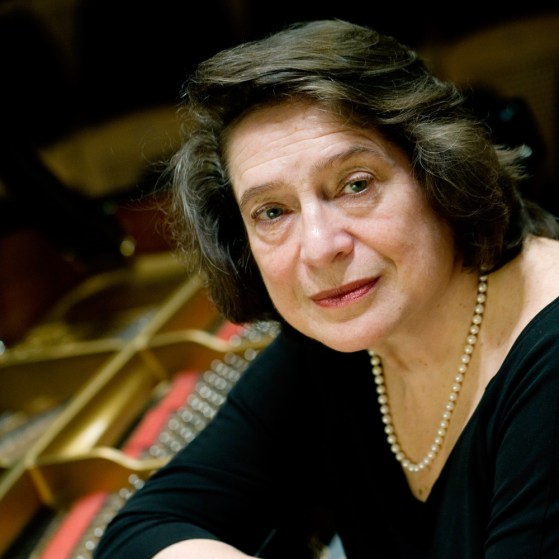
Elisabeth Leonskaja, soloist in the Mozart Piano Concerto No. 9, is a veteran performer with a pretty full calendar throughout the year, both as concerto soloist and as recitalist.  Her reading of the work could best be described as undemonstrative.   And that’s fine; who wants a full-frontal ego projected on this urbane, aristocratic music, some clown determined to make a difference by abrupt shifts in dynamic or slicing up defenceless passage work?   For those of us brought up on Ingrid Haebler, a certain reserve in the Mozart concertos is prized, particularly when it leads to readings of intellectual perspicacity and enunciative clarity.

But this Jeunehomme ambled.   Sure, the notes appeared in the right places and the mesh between soloist and orchestra was hard to fault –  except that the tuttis and the passages with exposed horns and/or oboes took on unexpected significance, compensating for a lack of intensity from the piano.   Leonskaja’s cadenzas came over with exemplary lucidity but infused with little personality; even that garrulously rapid concluding rondeau passed by without raising the performance temperature by much, missing out on any enlivening energetic kick.

The soloist gave us an encore: the Chopin D flat Nocturne, negotiated with sensitivity and a steady pace, yet deficient in sparks even during the right-hand decorative cadenza-spurts, the whole competent but emotionally bland: just the same as the concerto.

Valve returned to the lists with his arrangement of the Beethoven E flat Quartet, the later one in that key introducing the final five in the series.  And, after this hearing, it strikes me as being the one among them all that responds pretty poorly to expansion into string orchestra form.  The trouble with the first movement is that the developmental process is undramatic, non-theatrical, harmonically simple to follow; all you achieve by expanding the forces involved is a kind of middle-age spread.   Whatever tension exists between the lines is evened out, often smothered in plump amplitude. Further, the dynamic switches can’t strike home as hard when more than one player is involved.

The quartet’s second movement begins in even worse case; its opening theme’s A flat tonality might take some time to settle but there is precious little chromatic inflexion to disrupt its even presentation.  Yes, the complexities arise soon enough but even the slightly whirling activity generated by demi-semiquaver patterns turns to slurry when a group of four or five is playing them simultaneously.  The only pages that seemed to me to succeed here came at the third variation, Adagio molto espressivo, when the syncopated trills and violin lines’ imitations stopped, the key moved to E Major and the basic theme was transformed into a clear-speaking melodic line for the first violins with placid harmonic support.

The Scherzo worked best of all, despite some intonational slips among the violins.  The massive chord snaps at bar 60 – and, later, bar 330 – best illustrated how you could amplify the percussive power to be found all over the composer’s last works, and the Trio-Presto impressed for the rapid responsiveness of the ACO executants.   But the finale brought back memories of the initial Allegro where what interests you when four players engage in a clear-voiced argument becomes, in the string orchestra transformation, something more texturally diffuse, the modulations less striking, the driving animation verging on the mechanical.   Again, a generally well-accomplished performance but, instead of giving some insight into Beethoven’s compositional practice, the process seemed to summon up echoes of 19th century string serenades, or Grieg’s Holberg, even Elgar on an indifferent day.

Home-grown talent, for a change

BLAZING BAROQUE

Australian Brandenburg Orchestra

Sunday July 31, 2016

16ABO BlazingBaroque MELB opening-133

                                                                      Australian Brandenburg Orchestra

As artistic director/conductor/harpsichordist Paul Dyer pointed out in his first address on Sunday evening, this concert from the ABO featured no overseas guests but put to the forefront members of the orchestra itself, generating a congenial home-grown feel about proceedings as the ensemble worked enthusiastically through six works from the Baroque.  ‘Blazing’ is not really the adjective I would have used to typify the results, or even the group’s intentions; it suggests final curtain time in Gotterdammerung or Berlioz’s Requiem at its least penitential – but some points in this concerto-filled event proved exciting for all the right reasons.

The ABO concertmaster, Shaun Lee-Chen, was worked very hard, taking the solo line in Vivaldi’s D Major Violin Concerto, Il Grosso Mogul, then having the lion’s share of the work in the same composer’s Concerto in F Major RV 569 which also calls for pairs of oboes and horns, and finishing his work-load with Fasch’s Concerto in D Major.  The common cry is that the Italian composer’s work carries a great deal of facile passage work, indulges in repeated semiquaver patterns, employs focal melodies that don’t strain the diatonic budget.   These strictures are true, after a fashion, but all too often the solo violin is dangerously exposed for long stretches; the exponent has to operate in sections of the Mogul at a high tessitura; for example, the bariolage leading up to bar 50 of the first Allegro.

It’s not a work for the faint-hearted and Lee-Chen made a positive attack on it, crackingly paced and generally reliable in pitch with a few question-marks over the very top notes of his part – nothing that grated but a few points in an extended pattern that didn’t quite hit the centre.   Still, much appreciated was the extemporised-sounding Recitative leading into the Grave.    As for the final movement, what took attention here was an impressive bite to the company’s open D strings that emerged in the arpeggio-rich  ritornelli.  One of the concert’s chief pleasures came in the concerted enthusiastic gutsiness of the Brandenburgers in full voice.

Telemann’s Grand Concerto in D Major, the one with the unusual catalogue name TWV deest, asks for pairs of oboes (Emma Black and Kirsten Barry) and trumpets (Leanne Sullivan and Alex Bieri).  As always, you have to admire how much this fecund creator could make of a common chord, getting it to supply such vigorous material.  In the active second movement Allegro, both wind pairs impressed for the precision of their enunciation with only one suspicious blurt from an oboe and barely any spliced notes from the trumpets.   Other elements that grabbed attention were the rich, reverberant bass notes booming from Tommie Andersson‘s theorbo in the opening Spirituoso-Adagio-Spirituoso sequence, and the mobile energy of Richard Gleeson‘s timpani, notably the expressive crescendos achieved within very short bursts of notes.

I know that for most Baroque aficionados, the period-authentic horn is unremarkable, but I still find it a singular achievement that players confined to crooks can produce well-balanced, consistent lines without cracking some of the notes.   For The Vivaldi RB 569 per molti strumenti, Darryl Poulsen and Doree Dixon outlined their parts with force and an exactitude that rarely faltered, their sustained trills a sonic delight of this reading.  The addition of bassoon Peter Moore to the mix had some slight impact on the exposed woodwind sequences, but the outstanding voice was that of Lee-Chen, for whom the other soloists gave way in the brief central Grave – a 20-bar D minor siciliano with the violin a constant presence, chiefly supported by violins and violas only and here elegantly soulful in its expressiveness.

The duet work of flautist Melissa Farrow and Mikaela Oberg‘s recorder in Telemann’s E minor double concerto provided this concert’s high point; their shapely phrasing, down to mutually agreed breathing points,  exemplary in both largo and fast movements.   Also impressive was the dynamic equity of the partnership, vital in a score like this with so much dovetailing, imitation and stretches of parallel 3rds.   In fact, the performance kept on getting better, through the pizzicato-accompanied second Largo duet into the driving vehemence of the concluding Musette, with director Dyer contriving a brisk accelerando in the final ripieno bars.   This Murdoch Hall performance was recorded; and it would be worth listening to the broadcast, most particularly for this excellent, piercingly fine-spun reading  (ABC Classic FM, Thursday August 11, 1 pm).

For the Fasch concerto, Lee-Chen was joined by the two oboes and attendant bassoon, three trumpets, timpani, Andersson’s theorbo and the well-exercised Brandenburg string corps.   The upper range problem recurred in the solo violin’s E string top notes, although the rest of the player’s work proved accurate enough.   In this assertively-speaking score, if anywhere, you could find passages of burnished energy to justify the concert’s title, but the weighty orchestral force outweighed the solo violin’s carefully-spun sound-colour, so that the tutti punctuations dwarfed Lee-Chen’s output.   Yet again, we were treated to a work with a wealth of display but it needed a stronger right arm to produce a more aggressive and sustained attack.  Not exactly a disappointment, you were left with the impression that either the orchestra had been over-encouraged, or the soloist needed to lift his dynamic by several notches.

A convincing Countess

MID-WINTER BRILLIANCE

The Melbourne Musicians

James Tatoulis Auditorium, Methodist Ladies College

Sunday July 17, 2016

Rosemary Ball

                                                                                    Rosemary Ball

Taking on the Classical canon with a vengeance, Frank Pam and his players presented a mixed Beethoven and Mozart afternoon at the MLC space  a room that I’d not visited for quite a few years.   With an excellent seating plan focused on the performing area, the Tatoulis auditorium gives musicians every consideration, although on this occasion the somewhat dry acoustic might have been softened if the hall’s six acoustic baffles had been retracted.   Nevertheless, Sunday afternoon’s best soloist enjoyed the plentiful air space and coped easily with any reduction in resonant bounce.

Young violinist Mi Yang performed the solo part to Beethoven’s Romance No. 2 with caution.   Her pitching wavered a few times but she kept to Pam’s directorial script, not helped on her way by a string accompaniment that was unusually tentative, feeling its way while dealing with a pretty simple F Major score that only occasionally deviates from a slow-quaver supporting pulse.   Yang had the notes – most of them – under her fingers; what she has to work out is when to take the lead and keep it, maintaining her dynamic leverage over the orchestra, particularly the wind element which took on undue prominence against a self-effacing string body.

Soprano Rosemary Ball sang the two arias for the Countess from Mozart’s The Marriage of Figaro.   Her vocal output is firm and packed with interest although, like pretty much every opera singer I’ve known, she suits herself about pace, taking her time over phrases throughout the four-page, slow-moving work.   Still, she established a link with her accompaniment and maintained it, even through some hesitations at the beginning of phrases.

Yang returned for the Mozart Concerto No. 4 which she negotiated with more security than in her opening gambit for the afternoon.   But then, Mozart gave his soloist plenty of exposure and Yang made more than an exercise out of the work’s appealing Rondeau finale, even if she brought a tension to her reading that will disappear as she becomes more relaxed with this concerto’s benign detachment.  The Musicians had few problems with this score, agreably pitched in D, but they have a tendency not to give an emphasis to the first beat of a bar which makes their texture soupy, lacking an impulse especially in extended passages of simple accompaniment  –  which in fact constitutes most of the body of the first movement that holds only a few four-bar tutti passages outside the opening and closing pages.

When Ball returned for the E Susanna non vien?/Dove sono sequence,  the first page of the aria itself revealed the absence of the required two bassoons.   After a short search and their return to the fold, Ball gave an ardent interpretation of this vocal glory, marred only by some distracting breaks for breath in mid-phrase; surprising, as the aria is not that demanding in this regard, the melody’s arches rarely exceeding four bars in length.  Yet Ball brought a welcome fervour to the Allegro change at Ah! se almen, with a convincing dramatic force informing the di cangiar l’ingrato cor towering conclusion to the work.

After interval, Marcela Fiorillo fronted the Beethoven G Major Piano Concerto.  The exposition set the tone, which was off-puttingly heavy for a score that is viewed as poetic and lyrically buoyant.  The soloist sets the pace for this concerto, opening with a meditative solo; Fiorillo appeared to follow her own inclinations from this stage on and you were left in a state of continual tension, wondering how long the orchestra and pianist could continue without becoming obviously discrepant.  The likelihood became reality in the third movement, fortunately just before an unaccompanied passage, and the lumpy Vivace got to the final bars without another mishap.   A reading, then, with not much to recommend it – hard work for soloist and orchestra, even in the simple central Andante where the strings turned the crisp demisemiquaver/semiquaver snaps into mushy triplets.

However, the concert did reveal the potential of Yang who, in her best moments, displayed a driving sense of direction and a firm bowing arm; as well, it gave us the opportunity to hear Ball giving creditable readings to a pair of taxing arias and carrying them off with great musicianship and impressive power.

That’s entertainment

GIOVANNI SOLLIMA: SEQUENZA ITALIANA

Australian Chamber Orchestra

Hamer Hall

Sunday July 3 and Monday July 4, 2016

Giovanni Sollima - Copy

                                                                                  Giovanni Sollima

In the absence of their resident guru, Richard Tognetti, the ACO players hosted Italian cellist/composer Giovanni Sollima as soloist and, in some cases, director.  As the afternoon rushed past, you weren’t quite sure how much direction was involved; three of the four works in the program’s first half didn’t involve Sollima, although he made up for that in a dominant display after interval.  In all, he played a Leo concerto, an arrangement by his father of one of Rossini’s Old Age Sins, and wound up with his own concerto, Fecit Neap 17..  And there is no doubt that these three comprised Sunday afternoon’s most remarkable playing.

He’s an attention-grabbing cellist, although at the first instance this was due to his remarkable virtuosity in the Leo Concerto No. 3 in D minor, that composer one of the masters of the Neapolitan Baroque.  The four-movement work, patterned roughly on the church-sonata form, can be treated with too much care,  but not this time.  Sollima vaulted into its wide melodic arches with no fear and a powerful right-hand urging on zealously the opening Andante grazioso with its melodic minor peculiarities.   As the concerto moved past, the tenor-clef solo line took on an added fascination thanks to Sollima’s chameleonic handling of texture and dynamic; for all the surprises (limited as they were) in the development of the Con spirito and Allegro movements, what really captured attention was the volatile cellist.

Of course, the ACO loves a showman and they got one in spades with Sollima.  While the Leo concerto walked a fine line between extraversion and control, the second part of the program spilled over into unbridled display, first through Rossini’s Une larme Theme and Variations with the ACO strings playing straight-man to the soloist’s wise-cracking hero, the languid and frenetic variants revealing a fully-realized catalogue of devices and effects,  negotiated with both legerdemain and humour.   Sollima’s own composition refers in its title to an inscription abbreviation that features on 18th century manuscripts from Naples; in its content, the concerto moves between a stringent cantabile mood and hurtling dance rhythms that suggest 20th century dance music, simplified Bartok, and Stravinsky without an editor.   The soloist plays games – walking on after the piece has begun and wandering round the ACO, finding a hole in the floor to put his instrument’s end pin, twirling his cello like a dance partner, racing his accompaniment in stretto passages – and gives himself a breath-stopping series of production hurdles to handle.

It all made for fun times, with the benefit of seeing and hearing a charismatic musician at work.  Sollima makes a fine jewel in this ensemble’s setting; he is all fire and passion, bounding through his work with animal spirits and sensuality, while the ACO keeps its cool, giving strait-laced support for the most part and, while appreciating the skills of their guest, seemingly content to surrender the limelight, even in the hyped-up irregular rhythms of the wilder stretches in the cellist’s own composition.

All the program’s music made up a sort of Italian sequence, beginning with an arrangement for strings (with harpsichord and theorbo providing continuo) of Monteverdi’s Lamento della ninfa madrigal; pleasant enough as a throat-clearer but quite vapid in effect because the (eventual) movement of the four vocal lines over a four-note cantus firmus loses most of its dramatic punch unless the piece is sung.

Then came some a massive temporal leap and a realization of the program’s title: Berio’s Sequenza VIII for violin and Sequenza XIVb for double bass (originally for cello but produced with the composer’s authorization after his death).   Well, when I say ‘real’, that’s not really true .  What ACO leader Satu Vanska and bass Maxime Bibeau did was play about half of their respective sequenze in alternation, so that the pieces interwove, thereby offering two nodes of concentration at either end of the stage.   Both performers made a fair fist of their semi-pieces, Bibeau more comfortable in negotiating an adventurous gamut of sound-manufacturing techniques although his instrument was over-amplified.  You can see why this fusion was attempted – each work on its own lasts over 13 minutes and that level of concentration on challenging aleatoric music would have been a powerful demand for even the most charitably-minded ACO enthusiast.   But was there really a need to perform both?

Vanska later offered some Paganini: the Introduction and Variations by Paganini on the prayer Dal tuo stellato soglio from Rossini’s opera Moses in Egypt.  One of the great tests on a violinist’s ability to transcend improbable limitations, the work asks the soloist to perform only on the G string.  Vanska gave a good account of this trial, which is much more interesting to watch than to hear, the theme itself enunciated with throbbing strength.   Most of the upper-register filigree came off, apart from a couple of very exposed harmonics; like the Rossini piece, the whole point here is exhibitionism – brilliant technique displayed in throwaway frivolity.

Bibeau also enjoyed another solo spot in Giacinto Scelsi‘s C’est bien la nuit from the 1972 diptych Nuits.  Here was an engrossing reading, music of concentrated vigour and informational intensity that established a cogent voice using limited materials and sustained attention throughout a tantalisingly brief time-span.   This composer’s work is rarely played here; indeed, the few times I’ve heard any Scelsi products occurred many years ago when the ELISION contemporary music ensemble under the benevolent artistic direction of Daryl Buckley was operating in Melbourne.   This brief remembrance of things past came as a standout, an enjoyable surprise in this often-sparkling, sometimes brilliant concert.

An eloquent enthusiasm

MOUNTAIN ASH

Music by Hugh Crosthwaite

Scots’ Church, Collins St.

Monday June 20, 2016

Hugh Crosthwaite - Copy

                                                                             Hugh Crosthwaite

Since Monday night, I’ve been trying to remember when, or if, this kind of concert has been done here before: a young composer decides to mount an event consisting only of his own music and chooses performers of top quality, some of the best his city can provide, to help expose his craft.   There are precedents, of course; you don’t have to look far to find plenty of chronicled self-expository concerts given by Haydn, Beethoven, Mozart, Brahms, Berlioz, Mahler, Wagner, Strauss although many of these had powerful, well-heeled aristocratic sponsors.  With a small band of supporters, individual and organizational, Hugh Crosthwaite, a young Melbourne composer/lawyer, presented us with three works, about an hour’s worth of music, attracting a respectable and enthusiastic audience to hear what he had to say.

First, the actual compositions are rational, well-organized and deftly orchestrated.  While Crosthwaite is not going to prick your ears with startling modulations or spiky melodic leaps and turnabouts, his sound world is accessible and pretty well consistently congenia l. If one compositional parameter falls behind the others, it comes in rhythm which tends to be measured; a presto is rarely encountered, at least in these three products.  Crosthwaite operates quite happily in a regular harmonic framework with bursts of consonances and simple modulations that bathe the listener in a comfortable sonic cocoon.

Along with various commissions from local organizations and individuals, the composer has also constructed music for films, providing the score for 2012’s winner at Tropfest, Lemonade Stand.  And, from the first pages of the tone poem Moonah and Whirlpool, I must confess to looking for a screen because the work impresses primarily as film music and you spend your time conceiving complementary images while the score illustrates Brian Walters’ poem to do with the love between Moonah and Whirlpool, possibly real-time lovers kept apart by kinship law, more probably natural or transcendent forces that eventually merge.   Crosthwaite begins with bells, cymbal crashes and timpani rolls, the main interest coming from woodwind and brass who have all the initial running while the string body plays sustained chords.  The melodies tend to be brief, more motives than extended sentences.  A violin solo from concertmaster Monica Curro breaks out from a thick orchestral impasto, refreshing and diatonic; at its conclusion you realize that this writer is happy to repeat a phrase or a cadence multiple times – having found the effect, he insists that we know it fully.

Any inspirational background for this music is solidly European in its lavish Romantic blocks.  The story may be a form of Aboriginal legend or allegory, the Moonah may in fact refer to the melaleuca as trees play a significant role in this night’s major work, but you won’t find any of the bare-bones back-country spareness of Sculthorpe’s Sun Musics or Kakadu here, not the slightest hint of musical Jindyworobakism.   At its climaxes, the tone-poem employs a brass choir as portentous as anything in Bruckner.  But, behind it all, you sense a pictorial flow, as though the score is primarily illustrative and its fabric is the work’s pivot.

Thoughts are Free, a poem by an unknown author, has a strong association for Crosthwaite with the German jurist Hans Litten, who brought Hitler to court for a grilling during a 1931 trial, cross-examining him for hours and eliciting the first public-record information about the Nazi party and its pseudo-philosophy.   Needless to say, Litten was punished for this lese-majeste, eventually dying by his own hand in Dachau.   The poem was Litten’s brave contribution to a  compulsory celebration concert for Hitler’s birthday at a prison in Lichtenburg, with SS members in attendance.

Leana Papaelia sang the poem’s three verses truly enough but it was a struggle.  The orchestra enjoyed plenty of reflecting bounce from the semi-circular wainscoting in the Scots’ Church, horns and trumpets in the back row having a particular dynamic dominance.  Papaelia, standing in the body of the church alongside conductor Patrick Miller, would have needed a Bayreuth-quality diaphragm to compete with her accompaniment.   When matters thinned out, the singer’s sound travelled well enough, her voice a natural, naive soprano with a fresh, youthful quality that brought plangency to the vocal line, especially effective in the closing quatrain which seemed to speak for innocence resurgent the world over.  Between verses two and three, Crosthwaite inserts an orchestral interlude amounting to an extra verse, a kind of heavy commentary on the poem’s simplicity of utterance.   This had its points, although the scoring smacked of Rimsky-Korsakov richness, somewhat at odds with the pure transparency of the vocal line.

Crosthwaite’s major work, a piano concerto that gave the night its title, had Stefan Cassomenos as soloist.  The work is an extended environmental essay in 8 parts, referring to the mountain ash forests near Melbourne but giving them a context.  Once again, the urge is hard to resist to use the work as a springboard towards visual images; program writing in the vein of Strauss’s An Alpine Symphony or Symphonia Domestica.

Crosthwaite opens with a kind of Fanfare for the Common Ash: massive brass chords, mimicked by the piano which brought to mind the grandeur of the opening to Tchaikovsky’s B flat Concerto.  Possibly less stolidity might have made the impression less wearing; every beat does not necessarily require a hefty note, and slow marches can out-wear their usefulness as scene-setting.   In any case, after the imposing mountains prelude, we moved to consider the earth and rock, then water, followed by flora, and eventually the mountain ash itself.   Cassomenos expounded several cadenzas, packed with full-bodied arpeggios and emotional polemic.   By the time the tree itself appeared, the composer had revealed his particular pleasure in using horn, oboe and cymbal textures.   With this ash section came a return to the opening polemic-style writing where Crosthwaite leaves you in no doubt that he is on a mission to persuade his listeners of the vital necessity to preserve these trees, investing the salvation exercise with a majesty and naturally epic character.

The concerto is in two sections but I found it hard to detect any break before the last three segments: the fauna of these forests, the fires that sweep through them where the compositional context moved from a barely unruffled conservative harmonic layout to a kind of Shostakovich-lite, but returning to the prevailing ambience with a climactic apotheosis or homage culminating in a rather overwrought piano solo before the concluding blazes of optimism.  Like Papaelia’s soprano in the night’s central aria,  the concerto speaks an uncomplicated message, even if yet again a relish in his rich orchestration tended to cushion Crosthwaite’s challenge to us to help environmental conservation.

In the 47-strong orchestra, 17 musicians were MSO members, many of the others occasional players in that body, one from Orchestra Victoria, and several familiar faces from National Academy concerts.  While the first two works moved steadily enough, the synchronicity between Cassomenos and the orchestra was questionable at certain stages in Mountain Ash, made more obvious because of the composer’s habit of using one or the other elements as beat-specific reinforcement.

The conclusion to Mountain Ash brought a ringing endorsement of Crosthwaite’s endeavours, the audience giving him – and his interpreters – a standing ovation.  You were left in no doubt of his earnestness, his professionalism and the gravity of his commitment.   Still, the three works are couched in a musical language that is undemanding.   Some find that unobjectionable, happy to have no barrier to instant assimilation.   But you can be sympathetic to Crosthwaite’s message and still want him to speak through more challenging sounds.  These three works together construct a fine sonorous tapestry – but there has to be more.

Bach by the beach

BACH: SPIRIT & SPECTACLE

Melbourne Chamber Orchestra

Peninsula Community Theatre, Mornington

Saturday June 18, 20, 2016

Macliver-Sara-04 - Copy

                                                                           Sara Macliver

Quite a pleasant experience catching up with the MCO at an out-of-town centre, although you are hard pressed to call Mornington that any more, with Melbourne’s suburban tentacles and freeways stretching further south by the month.   The community’s theatre is a no-frills but suitable venue for William Hennessy‘s young string players, their sound fabric coming through the hall with plenty of clarity and no error-shrouding echo.  Then again, a fair bit of this night’s output was as straightforward as you can get, the ensemble quite happy to bound through their work at full bore.

Apart from Calvin Bowman‘s song-cycle Die Linien des Lebens, seven Holderlin settings, the MCO played Bach, beginning with a Stokowski arrangement of the simple aria Mein Jesu, was vor Seelenweh.  Starting with a finely balanced statement for cellos and double-basses, a pair of violas joining in later, this was a luscious, lustrous setting in which the upper strings emerged for two strophes but left the bulk of the work to these lower-voiced musicians.  And it made a fine impression, especially the sympathetic solo of Michael Dahlenburg who gave full value to the famous conductor’s heart-on-sleeve, Romantic view of Bach.

The orchestra thinned down, though not by much, for the following Brandenburg Concerto No. 3, one instrument a line and the support of a chamber organ which gave an added weight to the bass texture, revivifying the spirit of Stokowski and not for the only time in the evening.  The reading proved to be beefy in tutti passages, the cellos urging through the first movement’s mix with enthusiasm.  As a substitute for the two-chord slow movement, we heard the C minor Violin Sonata’s opening Siciliano given with finely-spun eloquence by leader Shane Chen, Dahlenburg’s cello support a prominent presence.  The rapid last Allegro gave us loads of Baroque burble, heavy on the two accents in each bar, Merewyn Bramble heading a resonant viola trio with Hennessy showing his versatility by taking the third of these  lines.  Yet this finale also generated that individual Bach sound texture, thick with wood and vibrating strings as physical elements.

A scrap from The Art of Fugue, the Contrapunctus V where the inversions and stretti of the great compendium start, made for a moment of placid exposition, even if the concluding bars were ramped up dramatically to a this-is-the-end bloated statement.   Soprano Sara Macliver then began Bowman’s cycle, only to stop in the second Sybille segment as an audience-member was taken ill and interval was brought forward.  Beginning again, the soprano and MCO gave a sympathetic outing for this work which alternates full-blown lyrics with fragments of verse given sparse, mainly pizzicato accompaniment.  From the opening to Fruhling beginning the cycle, Bowman strikes a lyrical vein, suggestive in its violin writing of Tippett, if more concordant than the English master-composer.  But the work’s vocabulary refrains from being over-saccharine or too amiably pastoral with a good deal of assertive string support at play under Macliver’s wide-ranging line.

Later, in Abbitte, the emotional flavouring smacks more of Richard Strauss, showing a lavish richness of consonance between voice and orchestra, which dissipates in the succeeding Aus ‘Der Adler’ which exposes the most interesting, demanding vocal writing of the sequence.   A focus on viola timbre throughout Auf die Geburt eines Kindes offered a tenor-pitched complement to Macliver’s warm timbre in the cycle’s most comfortable pages, while the Strauss shadows gathered again for the final An Zimmern which opened with a substantial and moving solo cello paragraph under Hennessy’s tremolo violin.  In this quatrain comes the cycle’s title and the work concludes with sustained string chords, giving a sombre, majestic opulence to Macliver’s spacious outlining of the final transcendence-suggestive line, Mit Harmonien und ewigem Lohn und Frieden – Mahlerian in tone if not as sparse as that composer’s final philosophical musings.

This work shows a different aspect of Bowman’s output; well, different to me.  The harmonic language remains orthodox, for the most part, the vocal line clean and uncomplicated if willing to linger on specific phrases.  You hear fewer of the bucolic Vaughan Williams suggestions than in earlier pieces and, although the influences are still discernible, the composite language of these songs remains individual, the composer’s own.

Macliver returned to the program’s regular path with the second soprano’s Laudamus te from the B minor Mass, Bete aber auch dabei from the cantata Mache dich, mein Geist, bereit with Hennessy’s violin substituting for the original flute obbligato, and Vergnugen und Lust from the wedding cantata Gott ist unsre Zuversicht where pairs of violins and violas stood in for Bach’s two oboes d’amore.  The soprano’s subtle, underplayed ornamentation proved as delectable as ever, her articulation penetratingly precise through pages of highly mobile writing, with never a hint of unease or hesitation.  If you needed a key-point to demonstrate the singer’s expertise, it would be hard to surpass her smooth negotiation of the final aria’s central section: Das Auge, die Brust Wird ewig sein Teil An susser Zufriedenheit haben – here, words and music found an ideal fusion, each textual repetition to be relished.  After this bracket, you wondered why many another soprano bothers in the face of artistry in Bach of this quality.

Finishing the night, Anne-Marie Johnson gave a firmly administered treatment of the D minor Violin Concerto, probably the original format of the famous keyboard work in the same key.   Speaking of which, this definitely needed a harpsichord to add sparkle to a heavy string mass, Michael Fulcher‘s chamber organ again providing heft to an already well-encouraged bass component.   Johnson gave as good as she got in terms of output, urging out her line against an unapologetic string backdrop, although the slow central movement revealed a steely lyricism, welcome between the hectoring pair of Allegros. Some relief might have been brought into play by cutting numbers back in non-tutti moments; as it was, the finale’s continuo homophony became a driven chugging – energetic, for sure, but deficient in timbral variety or intellectual challenge.