Powerful persuasiveness

MICHAEL BERTRAM  FANTAISIE-SONATA

Michael Kieran Harvey

Move Record  MD 3407

Michael Bertram Fantaisie-Sonata

It’s not a form you come across too often, the fantasy-sonata combination.  There are the two by Scriabin – an early one outside the canon and the Op. 19 in G sharp minor (there’s a lovely key for you) – one by Raff, another by Turina. Only the German composer uses the same title word-order as Michael Bertram; not that it would make too much difference, I suppose, except in giving some hint about the composer’s set of priorities.  The Australian work is a confronting amalgam that has a great freedom in its opening, then becomes more formally conservative as it moves towards its ending.

The Fantaisie-Sonata is this CD’s major offering, coming in at a little under 50 minutes.  In comparison, the other compositions are slighter: two of the Six Bagatelles from 2012, the Seven Sarcasms for an Out-Of-Tune Piano, and an isolated Violet 2, written five years ago.  None of these cracks the five-minute mark, the Sarcasms cycle’s elements decreasing in time-span as the work moves to its conclusion.  But, as a job lot, these comprise a substantial amount of the composer’s output for solo piano.   Still, the oldest piece is the CD’s title work which has waited 16 years for its appearance here, performed by its initial interpreter with splendid technical mastery and obvious sympathy.

Bertram’s Fantaisie-Sonata consists of three movements that offer a progress from the particular to the general, a fairly localised background to something approaching the transcendental.   If you search for the fantasy element, the work’s first and longest segment comes closest to it.  Each of the movements is explicated  –  or not –  by a quotation and, for the first, Bertram cites part of The Wanderings of Oisin by Yeats:

And then lost Niamh murmured, ‘Love, we go

To the Island of Forgetfulness, for lo!

The Islands of Dancing and of Victories

Are empty of all power.’

‘And which of these

Is the Island of Content?’

‘None know,’ she said  .  .  .

The aim is to set up a ‘Celtic phantasmagoria’, and so the listener is given this mental framework of the legendary Irish hero wandering through the centuries with his loving fairy princess before coming to the realization that his age is past.  The movement opens with Morse code-style twitterings in the instrument’s high register above a sequence of repeated chords and gestures; a heavy start that fades to placidity, where the material moves to manipulating intervals and motifs, like oscillating 3rds and 4ths.  At the 10/11 minute mark, the texture moves to washes of colour, semi-impressionist in flavour where a mid-range ostinato supports small flashes or flourishes in the piano’s upper and lower reaches alternately.   The movement turns darker with block bass chords punctuating the restless onward flow before a release of tension as Bertram takes his dominant line for a Klee-like walk.   More formal patterns come into play, almost an exercise-type interlude when Dr. Gradus ad Parnassum is suggested at the 13-minute mark.  The key of C minor dominates in this sudden excursion into Debussyanism which at one point could almost be breaking into a reminiscence of Jardins sous la pluie, but the ominous ostinato returns to centre the action and also move away from any focal tonal suggestions.  The fantasy element continues to a small nodal point where the work breaks into oscillating 3rds at the 16-minute point before a burst of Rachmaninov-style roulades, taken with infectious dash by Harvey, the movement’s climactic point arriving after some determined crescendos, with an error at 19:13 distracting for a moment from the high-point’s stentorian insistence which dwindles, you would think, to silence before an emphatic big bass full-stop.

For his second movement, Bertram sets the scene with a sentence extract from the Conclusion to Pater’s The Renaissance:

we have an interval, and then our place knows us no more.

After the first movement’s freedom, this offers stark contrast in a set of variations on a brief theme.   It begins with softly-drawn pastel textures punctuated by some more colourful outbursts.   The segments that follow offer: a Gershwin-style jaunt with plenty of artfully placed grace notes; an etude of restrained elegance; a burst of Latin rhythm that suggests a habanera/tango hybrid couched in salonesque language; an exercise in Bartok-style intervallic play (if not as rigorous in its counterpoint as the Hungarian master’s practice) which develops into rhetorical bravura before a return to the opening’s discipline; yet another Debussy suggestion as a shimmering backdrop underpins a long-ranging melody weaving above the susurrus, before the four-note theme appears, set in high, soft relief before broken arpeggios and triads conclude the movement peacefully.  Bertram presents this as a ‘life-story’, an abstract on Everyman and I suppose there’s plenty here to suggest the multiplicity that our existence has to offer.

For his concluding pages, the composer resorts to Kepler’s Harmonices Mundi :

Man [in imitation of his creator] wanted to reproduce the continuity of cosmic time  .  .  .

In this section of his text, the mathematician/astronomer is postulating that making music or song is an attempt by man to share God’s joy in creation.   So Bertram has moved from the specific if imaginary that Yeats hymns, to the mundanity of real life with its ups and downs, to this plane where the world disappears and we observe – and participate in – the opposition of darkness and light.   The first is given musical voice through a sequence of ‘synthetic’ scales, which suggest Messiaen’s modes of limited transposition but are simpler in presentation and employment; the light takes the form of insistent notes and chords.  This Manichaean juxtaposition opens with clouds of ascending and descending scales, Harvey’s sustaining pedal applied lavishly; Bertram obviously enjoyed this textural mesh as he maintains it almost to the stage of irritation.  Then come the repeated notes, recalling the first movement, here tamed by supporting chords that are eventually repeated common chords.  The scales return, then the chords in quick succession before a long sequence of composite textures rooted in the C tonality.  A final downward scalar plunge precedes the victory of the light’s repeated chords alternating between left and right hands, fading to a concluding broken C major triad.

For its breadth – of intellectual ambition, of pianistic skill, of emotional flexibility, of sustained continuity – this is an extraordinary construct, Harvey giving it as eloquent an interpretation as you could want.  What I find particularly attractive about it is that it maintains your attention; it excites, puzzles, illuminates in turn and what sense you make of its language, form and imaginative processes depends on a willingness to enter Bertram’s idiosyncratic but remarkably open sound-world.

No. 2 of the Six Bagatelles, called Chant, is based on a Russian folk-song fragment that has obsessed the composer for some time.  The melody is not covered in additional excrescences; rather, you notice the large number of repeated single notes in its outline with a modest application of harmonizing chords.  At the end, the tune is left pretty much to speak for itself.    No. 5, Uranus, uses an upper spaced/broken arpeggio pattern with isolated, sustained chords underneath.  Bertram cites Brian Eno as inspiration; I presume, the appeal lies in the British composer’s minimalist ventures as you hear a fair amount of pattern work while Bertram is proposing his sound-images of this icy, faceless planet.

Violet 2 is a travel piece that employs a central minor chord ostinato as an immediate suggestion that the journey is either fraught at the start or going to turn unpleasant, if not tragic.  The tune begins with an alternating 2nd interval in the soprano register, the focus changing to a slightly more interesting motivic cell in the bass.  The texture grows pointillist, reverts to the juxtaposition of high and low sound-layers before a clear expression of frustration at a dissonant-laden high-point.  The piece’s ending is as dark as the music gets on this CD.

Finally, the Seven Sarcasms suggest Prokofiev in their title and the first of them has a tang of the Russian composer although the parallels don’t go very far in a short piece notable for its use of repeated chords.   The second, a waltz, eventually moves into a regular rhythm but stops continually for pregnant pauses; the piece hints at satisfaction but remains unfinished, stunted in its progress.   No. 3 uses the Es ist ein Ros’ entsprungen melody, opening in orthodox mode before veering into Messiaen-suggesting chords above the tune with a repeated pedal note to add to the fun. The following piece seems Webernian in character – it’s disjointed enough – but the referent sounds come through only in flashes;  Bertram is too fond of sustained washes to mimic the serial master’s acerbic scintillations.   The fifth of the series seems to propose one effect after another; despite an arresting and original cluster series, this terse scrap avoided engaging attention.   No. 6 skipped past in Hindemith’s Lebhaft mode; happy if brief.  To end, a Presto with quick pattern-work bubbled above some striding left hand Hindemith-style action.

These smaller-scale works give some further samples of Bertram at work, all of them assimilable and often atmospherically convincing.   Still, the effect of the disc as a whole is rather lop-sided because of the impressive canvas on which the composer has set his fantasy-sonata.   For all that, Move has done us all excellent service by giving a voice to this impressively questing, challenging composer and by providing a forum once again for the insights and artistry of this country’s finest pianist.

Softly, softly

CONTINENTAL DRIFT

Judy Diez d’Aux & Peter Sheridan bass flutes, Lachlan Dent cello

MOVE MD 3403

Continental Drift - Copy

No matter how obscure you think a particular combination of instruments may be, or how much you wonder if anyone could possibly be interested in it, when you express your reservations, you can be stunned by the chorus of enthusiastic affirmation that rises from the throats of a host of aficionados and fans, demanding to know how you can possibly question the appeal of said combination.   Here is a CD from the innovative Melbourne label that features, for the most part, original compositions for the bass flute – or, better still, two of them; in this instance, the duet is sometimes supported by a cello underpinning and, for good measure, all three participants enjoy solos.

I’ve known (and worked with) a few flautists and, while they have all been happiest with the normal Middle C-based instrument and can enjoy for limited periods a stint on the alto species, not one of them made much of a case for the bass.   Not surprising, really, when you compare the repertoire available across the three-level spectrum; while the alto has been put to striking use by 20th century masters, the lower-pitched instrument is a rare sight in orchestral ranks and never emerges from the shadows for a solo, except during a Master’s all-in recital, perhaps.

Peter Sheridan, the American flautist now resident in Australia, has done more than most performers to commission and promote music for the bass flute.   Here, in collaboration with fellow-countrywoman Judy Diez d’Aux and Melbourne cellist Lachlan Dent, Sheridan presents a series of works, some of them slight while others are fairly substantial, most of them written in the last few years.   As bookends, the musicians play some Haydn: the outer movements of the first London Trio in C as an ice-breaker, and the opening to the G Major Trio No. 3 to finish.   The benefit of these transcriptions, at the start in particular, is to give some context for the timbral interplay at work, acclimatising the listener to the breathy wind texture, initially reminiscent of some of the less assertive flute organ stops.

A fair amount of what is enclosed by these brisk, mildly spirited Haydn pieces comes from America, starting with Gary Schocker‘s Underwater Flowers of 2014: an impressionistic triptych for bass flute duet suggestive of Debussy in chamber aquatic mode, at its most original in the middle Flower Hat Jelly which inserts some jauntiness to animate the work’s undulating fluidity.   From Quebec’s Ella Louise Allaire/Martin Lord Ferguson partnership comes a 2015 diptych, Spring Awaking, which employs the cello as well.   It was hard to see much difference between the initial awaking and the pendant awakened segments, mainly because the writing style remained uniform; easy listening, certainly, with a penchant for unison and octave work but leavened with some sequences that bordered on the banal.

Sheridan’s solo, Doggerel by New Zealand writer Eve de Castro-Robinson, brought to the fore some interest in terms of sound production with plenty of initial plosives, a few passages that featured harmonics, some bent-note mini-glissandi, and what sounded like a dash or two of multiphonics.    As the piece progressed, a jig-type rhythm became more and more clear, helping to reinforce the relevance of the work’s title, I suppose.   Still, it made a fine vehicle for Sheridan’s skill, particularly an impressive breath-recovery rate. Madelyn Byrne, the computer music expert from California’s Palomar College, produced Suite in Sea three years ago and it presented as the most harmonically daring work so far on this CD.   Suggestive of the marine, but not as predictable as Schocker’s  Flowers, the middle Soliloquy for solo flute and the following Sea Spirits for flute duet revealed a well-harnessed lyricism and atmospheric eloquence, although the concluding Argentinian Ghost Tango for all three musicians intrigued for its out-of-left-field context and its use of Dent’s cello as a rhythm bass that eventually moved into an independent line of its own.

Dent makes a fine case for Stuart Greenbaum‘s Lunar Orbit, a solo that depicts simultaneously two aspects of the 1969 Apollo 11 mission: Armstrong and Aldrin sleeping in the landing module while Collins has to orbit the Moon by himself.  The composer makes uncomplicated pictorial suggestions with deliberately limited material but this was, so far, the most sustained piece of composition on the disc; not that at 5 1/2 minutes you are being intellectually stretched, but it makes its case with cogency and comes to an ardent and persuasive conclusion.

Peter Senchuk, Canadian/American in background, wrote the CD’s title piece last year. Another triptych, this score employs the flutes only and is very agreably constructed for them in a kind of fast-slow-fast format, both Diez d’Aux and Sheridan revealing a fine responsiveness to its emotional climate.   Not that the work over-stretches these players and the rhythmic interplay in its opening Divergent movement holds no terrors.  The central Slipping segment involves a good deal of luxuriant paired work where the lines move uniformly rather than showing much disjunction; the final Convergent pages offer a tad more complexity but not the ‘flutes frantically dance’ activity level proposed in the cover-notes.

Australian composer Brennan KeatsFantasies and Wilderness, yet another triptych, also employs all three executants.   Its inspiration is Ireland: a nostalgia for the land itself, the sadness caused by young men leaving for war, and the sublimated depression generated by migration, in this case to the United States.   Keats uses a conservative harmonic language, which is effective enough in the opening section with its mournful summoning-up of some Celtic twilight.   In the middle pages, he quotes Danny Boy in an unabashedly euphonious arrangement, although the context calls out for something less humdrum; possibly the folksong Fil, fil o run o?   The last part also uses a well-worn quote – When Irish Eyes Are Smiling – which turns minor to suggest migrant struggles in America and the widespread social disharmony that prevailed, but then returns in full sentimental strength, although the work ends in something approaching depression.

Yuko Uebayashi‘s Le vent a travers les ruines is Diez d’Aux’s solo.   Full of pauses and couched in an aphoristic, slow-moving limited language, the composer’s ruins are not menacing – just deserted, offering little opposition or challenge to the placid wind that blows through them.   Its later stages offer a fine exploration of the instrument’s lower register as its moves to a calm, understated conclusion.  Stanley M. Hoffman‘s Arirang Variations began as a piano solo, the composer arranging it last year for Sheridan’s use.  Another work for the two flutes, it takes a Korean melody and offers four variations on it, the original tune announced at either end of the work.  This is intended for young players, to give them some intellectual impetus and to improve their skills; needless to say, these players handle it with aplomb and the sort of polish that would be the admiration of any player at any age.

Oddly enough, the more you hear of these pieces, the more intriguing the combination sounds.   At moments, Dent’s cello is unexpectedly dominant; at others, the variety of attack makes the organ-flute stop comparison invalid, chiefly because in this situation we are dealing with two distinct lines played by well-matched but not identical individuals. Still, at the end, you feel that the mysteries of the bass flute have been well-expounded, if not exactly exhausted.

Going bravely into the lists

CHOPIN

Enrico Padovani

ZDB Classic CD

ChopinCD

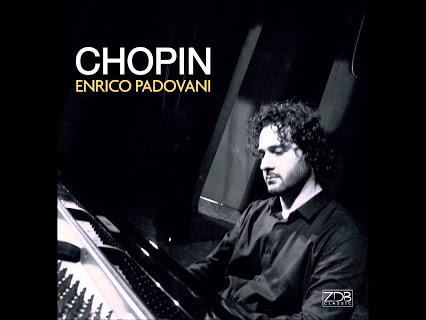
A native son of Parma,  educated in that city and Florence, Enrico Padovani has cut a swathe through the various competitions for piano in his native land – Fusignano, Racconigi, Pistoia, Piombino, Riccione, Padova, Moncalieri – winning prizes as both soloist and chamber musician.  Approaching the middle years of his career, Padovani – teacher and performer – has issued this sample of his considerable talents entering a particularly crowded field; most of the works performed on this CD have been recorded times beyond count by musicians of superb, transcendent insight as well as by players who over-estimated their own abilities.

It’s hard to think of a composer whose works have been the subject of so much brilliantly incisive scholarship and investigation for its own sake.  Chopin remains the ne plus ultra for many pianists, his works presenting challenges in their own right as well as in the light of recorded performances by high-profile executants.  Even these days, 165 years after the master’s death, players of all nationalities and abilities grapple with works that range from the near-unplayable to the deceptively simple and straightforward.  As well, Chopin is one of the few composers to have an international competition  – one of the most searching (and often controversial) on the European stage – held in his honour.

Padovani’s choice of material shows a bracing response to the Chopin challenge.  You don’t find the all-too-familiar pieces in this 11-track offering.  The stand-alone popular works – Berceuse, Barcarolle, Fantaisie-Impromptu, D flat Etude, E flat Nocturne – are absent as Padovani goes for the jugular with the Sonata No. 3 in B minor, the four Opus 17 Mazurkas, the non-flamboyant C minor Polonaise and the posthumous Waltz No. 19 in A minor. His only gesture to the well-known comes courtesy of the B flat minor Scherzo No. 2.

The sonata takes pride of place and Padovani approaches it with a firm grasp of its confrontational nature.  Unlike many of his peers, he repeats the first movement’s exposition in a fluent exhibition of technique with a deft mixture of discipline and rubato in the interpretation’s metrical progress.  The development sounds over-muscular, the texture pretty thick; but then, this segment of the work is probably the most problematic and disappointing for any executant, let alone a dispassionate analyst of the movement itself.  In the following Scherzo, for once the actual rhythm is clearly articulated, not the usual meaningless run of catch-as-catch-can quavers meant to dazzle with legerdemain while at the same time puzzling for a lack of structural sense.  Just as impressive in musically informed terms is the movement’s Trio, where the middle voices emerge with appreciable clarity.

It would be hard to cavil at the B Major Largo that opens in brusque majesty, only to fall back into a finely spun melodic paragraph.  As with the preceding movement, Padovani makes several individual strokes in the central section where his use of rubato is both pronounced and well-positioned.  He also shows an enviable tenth-embracing left hand stretch just before the turn back to the movement’s home key.  With the Finale/Presto, this interpretation gives pride of place to the left hand in those places where the right has sequences of downward-rushing scales, an emphasis that robs these pages of some much-needed lightness of texture.  Still, the final blaze into B Major is both well-accomplished and exciting to experience.

Few of the near-60 mazurkas ring recognition bells with the public, except for the early B flat Op.7 and the two used in Fokine’s Les Sylphides ballet. This Op. 17 set are fairly obscure, only the first favoured by many pianists, but none of them is technically challenging to negotiate.  Padovani begins the first B flat piece with a definite rhythmic impetus, albeit restrained in its dynamic contrasts.  The following E minor work succeeds much more pleasingly with a sensitive amalgam of strength and fragility, the left hand drones sustaining a finely-honed melody line that gradually shrinks into itself.  Pick of the set is the ambivalent No. 3 in A flat, Padovani investing its two pages with excellent shapeliness of phrase and sensitive variety of touch: an outstandingly sensible, and coherent interpretation.  The last of the sequence, Lento ma non troppo, shows an individualistic approach with the tempo direction’s last three words informing the chosen pace.  Here is not the mournfully languid meander that many other pianists make of it but a much more insistent creature; its inner propulsion both unnerving and somehow just right as a no-nonsense patina-stripping exercise.

The most sombre of the polonaises, the C minor of Op. 40, holds few moments of virtuosic excitement, unlike its Military A Major companion.  Padovani underplays the work’s tragic connotations, taking a very aggressive approach with the left-hand octave melody-line and giving us little consolation in the A flat Trio where Chopin inserts some actual polonaise rhythmic gestures; here, these passages are given sotto voce before the muffled call to arms makes its re-appearance.  In sum, this is a striking example of how to look with fresh eyes at pages that have been typecast in solid ambient gloom for far too long.

The Scherzo finds the executant using his sustaining pedal to create sound-washes, sometimes effectively, at other stages over-painting the harmonic welter. The work comes to a powerful, dramatic conclusion but the right-hand descending figure that dominates the main theme’s second strophe is often articulated oddly; its notes are all there, but they register unevenly, some weightier in impact than others.  It might be an essay in internal diminuendo each time but the effect is ungainly – a rare disappointment.

Finally, Padovani provides his own encore with the small-scale waltz, a mini-essay in delicacy and the least difficult piece on the CD.  For all that, it makes for an ideal rounding-off after all the preceding pounding vitality, as the pianist gives it a clear-speaking integrity of phrase through a muted dynamic palette that speaks volumes for his powers of musicianship and sensitivity.

He might not be the most eminent name among current Chopin interpreters but Padovani shows us through his enterprise in producing this CD how many-sided, how protean is the Polish composer’s genius, achieving this end with devotion and indubitable craft.