January Diary

It’s a tale of two festivals, January.   I can’t find much else happening apart from the Peninsula Summer Music and Organs of the Ballarat Goldfields Festivals  –  veterans of previous years with varying standards of satisfaction and performance.  This year, fortunately, their timing barely overlaps although there is a bit of program carry-over from the peninsula to the country.


Monday January 2

CANTATE AMOROSE

Ensemble 624

Hurley Vineyard, Balnarring at 6 pm

This starts off the festival’s serious content in the Mornington Peninsula chain of small-scale events; well, that descriptor applies to just about the entire 11 days.   The hosts for this occasion – Ensemble 642 – here constitute Hannah Lane playing harps, and Nicholas Pollock on theorbo, lutes and guitar, with guest soprano Karen Fitz-Gibbon.  This trio combines to sing the lyrics of Barbara Strozzi, the iconic Baroque female composer and sonorous equivalent of Artemisia Gentileschi.   We’re promised arias and dances, which broaden the field as Strozzi wrote only vocal music.


Wednesday January 4

THE NOBLE PATRON

Acacia Quartet

Lindenderry, Red Hill at 5 pm

The only Acacias I’ve come across (I think) were a wind quintet some weeks ago. Here is a string quartet from Sydney which has performed previously at the Peninsula festival.  This time around, the group performs Beethoven’s Harp in E flat and the first of Haydn’s two Lobkowitz Op. 77 compositions, the one in G Major – written for the nobleman who would become one of Beethoven’s long-suffering patrons and who actually commissioned his Harp work.  They don’t come much nobler.


Thursday January 5

GLASS AT PORT PHILLIP

Acacia Quartet

Port Phillip Estate, Red Hill South at 6 pm

The Acacias are playing two works by Philip Glass – the 10-minute Quartet No. 2, Company (originally written for a dramatisation of Beckett’s novella),  and (double the length) the Quartet No. 7 which was composed for use by the Nederlands Dans Theater.  As well, we are promised music by Gershwin (Lullaby, you’d assume) and something from Nick Wales – presumably Harbour Light which, with the Glass No. 2 and  Gershwin’s bagatelle, featured in the Acacia’s Opera House recital last month.


Friday January 6

BEETHOVEN’S SCOTTISH SONGS

Elgee Park Gallery, Dromana at 5 pm

Assuming these are the 25 Songs of Op. 108, the number that can be programmed is plentiful; only five have to be omitted for practical reasons.  The original asks for solo voice, mixed chorus, violin. cello and piano.  The instruments are fine: Rachael Beesley at the top, Erin Helyard on keyboard, Natasha Kraemer spinning the bass line.  The one singer is British soprano/director Sophie Daneman.  So Nos. 1, 9, 13, 19 and 22 miss the bill as they involve two, three or four voices.  Some of the tunes are very familiar but the interest for me lies in the settings.


Saturday January 7

GREAT ROMANTICS

Kevin Suherman

Church of St. John the Evangelist, Flinders at 11 am

Recently, this young pianist won the Melbourne Recital Centre’s Great Romantics Competition, and here he is going to re-visit some of his repertoire.  The definites are Chopin’s Andante Spianato and Grande Polonaise Brillante, and Liszt’s Hungarian Rhapsody No. 2 – very voluble works for this small church.   Added to this,  there will be some unidentified Mendelssohn to round out the package.


Saturday January 7

A SCHUBERTIAN DELIGHT

David Greco and Erin Helyard

Church of St. John the Evangelist at 3 pm

The Australian baritone, back after spending 7 or 8 years in Europe, here collaborates with Helyard in Death and the Maiden, Im Fruhling and The Wanderer  .  .  .  among other lieder, you’d suppose.  The pair is presenting the program as something of a musicological exercise, employing performance tropes of the period – whatever they may be –  Helyard working through his accompaniments on a Graf piano.


Saturday January 7

BAROQUE OPERA GALA

Church of St. John the Evangelist, Flinders at 7 pm

We’ve got When I am laid from Purcell’s Dido and Aeneas, part of the same composer’s The Faerie Queen, Handel’s Lascia la spina from The Triumph of Time and Truth oratorio,a bit of Monteverdi’s L’Orfeo and some Vivaldi.  The performers are David Greco, mezzo Sally-Anne Russell, Ensemble 624 (see Monday January 2), and a Baroque string quartet headed by festival director/violinist Julie Fredersdorff, Lizzy Walsh playing second violin, Laura Vaughan on gamba and lirone, Natalie Kraemer again bringing up the cello rear.  The performance is to take place on the church lawn – not my favourite site but the organisers obviously feel that the open air caters best to their patrons’ passion for the unbuttoned.


Sunday January 8

DUO FRANCAIS

Lisa Stewart and Stefan Cassomenos

Church of St. John the Evangelist at 11 am

A violin/piano recital of three sonatas: Debussy in G minor, Ravel No. 2 in G Major and Messiaen’s early Theme and Variations – all of them written within a 15-year time bracket. Stewart, first desk in the Acacia Quartet, has been a regular collaborator with orchestras across the country.  Cassomenos has a name for taking up every challenge, although there’s not much here that raises the perspiration level.


Sunday January 8

DE PROFUNDIS

David Greco & Latitude 37

Church of St. John the Evangelist at 5 pm

The event takes its impetus from Nicolaus Bruhns’ setting of Psalm 130 – gloomy and ornate simultaneously.  Other works include Biber’s Nisi Dominus and other pieces by Buxtehude, Muffat and the organist predecessor of Bach, Franz Tunder.  The usual Latitude 37 members – Julie Fredersdorff, Laura Vaughan, Donald Nicholson – are assisted by Ensemble 642’s Hannah Lane on triple harp.    Nicholson abandons his usual harpsichord for the St. John’s organ.


Wednesday January 11

NOTTURNO

Hoang Pham Trio

Moorooduc Estate, Moorooduc at 5 pm

The well-known Melbourne pianist has acquired a violinist (Katherine Lukey)  and cellist (Paul Ghica) to form an ensemble that is presenting a chaste enough program.  Obviously, they begin with the delectable Schubert miniature of the program’s title, then proceed to the evening’s meat in Dvorak Op. 65 in F minor.   Both Lukey and Ghica have been heard recently in the Melbourne Chamber Orchestra; how they will combine with Pham is anyone’s guess, but hope springs eternal.

The program will be repeated at 7 pm.


Thursday January 12

TREASURES OF THE HIGH BAROQUE

Morning Star Estate, Mount Eliza at 7:30 pm

The draw-card here is Genevieve Lacey, bringing her recorders to bear on a program of Telemann, Bach and Handel.  She is joined by violinist Lars Ulrik Mortenson, artistic director of Concerto Copenhagen, and bassoonist Jane Gower of the same Danish ensemble,  the Academy of Ancient Music and the Orchestra of the Age of Enlightenment. With this rich expertise, here is one of the festival’s red-letter elements.


Friday January 13

ACIS AND GALATEA

Church of St. John the Evangelist, Flinders at 7:30 pm

Handel’s opera-of-sorts, in its generally practised form, has four main roles, as well as a chorus.  Sophie Daneman, who is singing some of Beethoven’s Scottish Songs on  Friday January 6, sang a solo role in the recording made of this work by Les Arts Florissants; she is stage director and singing coach for this open-air church lawn mounting of the work.  Donald Nicholson, the keyboard in Latitude 37, will be directing the music, which is supplied by the Festival Academy singers and instrumentalists who will have worked with assorted Baroque music experts in preparing this pastoral entertainment – hard to define as fish or fowl or good red oratorio.

This program is repeated on Saturday January 14 at 7:30 pm.


Friday January 13

HOMAGE A RAMEAU

Choir of Newman College

St. Patrick’s Cathedral, Ballarat at 7:30 pm

Newman College’s musical eminence, Gary Ekkel, is taking his singers and a baroque orchestra through a concert spirituel as it would have been done in the Tuileries about 1750. The night’s title has me perplexed, though; from my meagre research sources, I can’t see Rameau’s name featuring strongly among the composers performed at these concerts, originally held in Holy Week because every other entertainment venue was closed.  Still, it’s a homage and God knows his successors had a lot to thank the great man for.


Saturday January 14

ORGAN RECITAL

Giampaolo do Rosa

St. John’s Anglican Church, Creswick at 10 am

This musician from Rome, well-travelled through Italy and the Iberian peninsula, is playing Bach and Faure on the Creswick church’s Fincham and Hobday instrument of 1889.  The Bach could be anything but the Faure is a mystery; the only organ work I could find is an Ave Maria involving two sopranos.  Could be an arranged nocturne, barcarolle, or song.

The program will be repeated at 12 noon.


Saturday January 14

CLASSICAL GUITAR DUO

Slava and Leonard Grigoryan

Neil St. Uniting Church, Ballarat

The brothers are always worth hearing but there are no details available concerning their program.  Without any substantiation beyond a hunch, I think they could re-present their October program from the Melbourne Recital Centre which promoted a new CD.  This comprised arrangements by Grigoryan pere, Edward, of music by Elgar, Dvorak, Faure, Rachmaninov and Falla.  But then, this could all be nonsense and the brothers might be set to play anything from their expansive repertoire.


Saturday January 14

TRIOS – TELEMANN, HANDEL AND VIVALDI

Genevieve Lacey, Jane Gower, Lars Ulrik Mortenson

Mary’s Mount Centre, Ballarat at 8 pm

See Thursday January 12 above.


Sunday January 15

ACIS AND GALATEA

Mary’s Mount Centre, Ballarat at 3 pm

See Friday January 13 above.


Sunday January 15

RECITAL FOR ORGAN AND THREE TRUMPETS

Anthony Halliday, Joel Brennan, Mark Fitzpatrick, Yoram Levy

St Patrick’s Cathedral, Ballarat at 8 pm

The definite program elements are Britten’s 3-minute  Fanfare for St. Edmondsbury that doesn’t use Halliday’s organ, and a Telemann concerto for three trumpets.  For the rest, we are promised an acoustic exploration as the brass players move to different places in the cathedral.


Monday January 16

RECITAL FOR ORGAN AND TRUMPET

Rhys Boak and Bruno Siketa

St. John’s Anglican Church, Dunolly at 10 am.

Am assuming this will feature music played on the CD from Move Records that features these artists in collaboration.  See a review above – August 9 – headed What’s your fancy?

This program will be played again at 12 noon.


Monday January 16

ORGAN RECITAL

Rhys Boak

St Michael and All Angels, Talbot at 8 pm

A real curiosity.  The organ in this church has only been restored in 2016.  It’s the earliest still-functioning Fincham in Victoria; originally from Warnambool, later Hughesdale, it reached Talbot in 2007.  As for Boak’s program, it will be calculated to show the instrument to advantage: one manual with 8 stops, pedal bourdon and coupler.


Tuesday January 17

ORGAN RECITAL

Giampaolo di Rosa

St. Paul’s Anglican Church, Ballarat at 10 am

The overseas guest is set to work on the 1864 Walker organ.  He promises Bach’s Fantasia super: Komm, Heiliger Geist and the Schumann Fantasie on BACH, which I don’t think exists.   He might be playing the 6 Fugues on B-A-C-H; that would be a great move and very substantial: they last over half an hour.  Further, this church’s organ is one of Ballarat’s finest.


Tuesday January 17

BACH’S CIRCLE

Latitude 37

Ballarat Mining Exchange at 8 pm

The Peninsula Summer Music Festival’s artistic director/violinist, Julie Fredersdorff, and her ensemble partners  –  gamba Laura Vaughan and harpsichord Donald Nicholson  –  will perform Baroque trios by the great paterfamilias, Buxtehude, and their contemporaries. You’re assured of spiky, clean-voiced playing; these musicians have been working at their craft for quite a while now and I can’t think of another ensemble that comes near them in this area.


Wednesday January 18

HANDEL ORGAN CONCERTI

Giampaolo di Rosa

Former Wesley Methodist Church, Clunes at 11 am

All twelve of them?  Probably not.  Di Rosa plays with the Festival’s chamber orchestra, which appears at this event only.  The organ is another one that has roamed: Prahran, Daylesford and an interim stint in Bendigo before coming back to its Clunes home.  A small organ with one manual, pedals and 7 stops.  Which should be just right for these plain-speaking works.


Wednesday January 18

ORGAN AND BRASS ENSEMBLE

Giampaolo di Rosa and the Little Brass Band of Ballarat

St. Paul’s Anglican Church, Clunes at 2:30 pm

The program heading proposes Handel, Bach and Pachelbel – yes, the Canon in D, beloved of prospective brides.  Also in an afternoon of pops, we get Handel’s Water Music – but probably not all three suites – and Bach’s Jesu, Joy of Man’s Desiring chorale movement.  For a mystery, the afternoon contains a concerto for brass quintet by Handel.  I know of a concerto for brass quartet, an arrangement by Gerard Schwarz of the Concerto Grosso in F, Op. 6 No.9.   Maybe that’s it; maybe there is another work altogether.


Wednesday January 18

Duo Chamber Melange

Wendouree Centre for Performing Art at 8 pm.

Violinist Ivana Tomaskova and pianist Tamara Smolyar are playing Schumann’s Violin Sonata No. 1, Beethoven’s Eroica Sonata (which seemingly refers to the Violin Sonata No. 7 in C minor) and a work by Rumanian composer, Mihail Andricu.  These musicians have been working together for over a decade and their approach is solid, based on sound European scholarship and technique.


Thursday January 19

SOPRANO AND ORGAN

Larissa Cairns and Christopher Trikilis

Carngham Uniting Church, Snake Valley at 10 am

Cairns I last heard of in Anthony Way’s choir for St. Francis’ Church in Lonsdale St.  Trikilis is spreading himself between music director functions at St. Patrick’s, Mentone, teaching at St. Kevin’s College, Toorak and tutoring for the Corpus Christi Seminary, Carlton.  The small Fincham instrument in this church doesn’t offer much timbral variety so this morning’s program will test Trikilis’ inventiveness.

The program will be repeated at 12 noon.


Thursday January 19

VIRTUOSO ORGAN

Giampaolo di Rosa

Ballarat Central Uniting Church at 8 pm

A well-exercised guest, di Rosa is playing Liszt  –  don’t know what but we can only hope for the Ad nos, ad salutarem undam Fantasia and Fugue – and an improvisation, at which occupation he has a considerable reputation.  This is his last – and fifth – Festival appearance.


Friday January 20

SCARLATTI ESSERCIZI

Jacqueline Ogeil

Loreto Chapel, Ballarat at 12 noon.

The Woodend Festival director presents some – one expects – of the Italian composer’s 30 sonatas published as exercises.  As the works were written for a Cristofori piano, Ogeil is upping the musicological ante by performing on a copy of that instrument.  You can expect highly authoritative interpretations, Ogeil’s experience with this composer going back many years.


Saturday January 21

RECITAL FOR ORGAN AND FLUTE

Frank de Rosso and Brighid Mantelli

St. Alipius’ Church, Ballarat East at 11 am

Prior to presenting this program in Queenscliff, Mantelli and de Rosso – two Geelong-district musicians – are giving it an airing here.  There is no indication of what is being played, but the flute/organ repertoire is pretty slim, I think.  So, either lots of arrangements or a welter of freshly written compositions.


Saturday January 21

TONY FENELON PLAYS THE COMPTON THEATRE ORGAN

Her Majesty’s Theatre, Ballarat at 3 pm

For my generation – and probably a few after that – Tony Fenelon is Mr. Theatre Organ Australia, the master of all those Wurlitzer special effects and a ceaseless pedal line.  On this occasion, he is including accompaniments to some short silent classics, which may be screened simultaneously with their scores.  A chance for many of us to hear this instrument which I, for one, didn’t even know existed.


Saturday January 21

CONCERTI

Hoang Pham, piano, and Massimo Scattolin, guitar

Her Majesty’s Theatre, Ballarat at 8 pm

This event sees the launch of the Melbourne Orchestra, under the direction of Mark Shiell, conductor of the Zelman and Ballarat Orchestras as well as the Macquarie Philharmonia. Pham is soloist in the Chopin Concerto No. 1 in E minor; admittedly, the orchestra is not over-stressed by the work but Pham will be tested throughout this spotlighting score. Scattolin, a regular at this festival, fronts Rodrigo’s Concierto de Aranjuez, the guitar concerto.


Sunday January 22

THE AGONY OF HELL AND THE PEACE OF SOUL

e21, Unholy Rackett, Melbourne Baroque Orchestra

St. Patrick’s Cathedral, Ballarat at 8 pm

Stephen Grant takes his e21 ensemble and a combination of instrumentalists through works by Schutz, Gabrieli and Monteverdi.  The night’s title is suggestive enough, if a tad ungrammatical; without any details, you’d have to guess that the music will illustrate spiritual and theological opposites.



An unexpected Santa’s breakfast

NOEL! NOEL!

Australian Brandenburg Orchestra

Melbourne Recital Centre

Saturday December 10, 2016

madison-nonoa

                                                                                  Madison Nonoa

Each year, Paul Dyer and his Brandenburg Orchestra and Choir mount a Christmas program that serves as a kind of intellectually regulated Carols by Candlelight, an event where the current season is paid its dues through familiar tunes and words, as well as some almost-explicable ring-ins that carry referential overtones.   And this time round, we got to hear some scraps that had absolutely no relevance to this celebratory fortnight at all, hiatus points where the lethargic among us are tempted to slump back and just let the sounds of this inescapably anodyne music creep in our ears.

With no attempt to engage the audience in sing-alongs, the ABO forces saluted general expectations with three verses only of  Once in royal David’s city, led by soprano soloist Madison Nonoa; O little town of Bethlehem from trumpets and sackbuts with percussion trimming; the Coventry Carol, again featuring Nonoa with both melody and descant; God rest you merry, gentlemen not living up to its name with some wayward trumpet articulation; a straight Hark! the herald angels sing; a bi-lingual Silent night, where Tommie Andersson‘s guitar reminded us of the work’s original form; and a rousing O come, all ye faithful that avoided the usual fortissimo bursts whenever the line O come, let us adore Him, Christ the Lord! occurs.

So far, so fine – just what you’d expect to hear in any church lucky enough to have a choir at this time of year. Surrounding these regulars came a grab-bag of works that surprised but didn’t startle.  For example, the ABO Choir began the evening with Praetorius’ arrangement of Nicolai’s Wachet auf!, performed a cappella and very impressive in its English garb.   I can’t remember from other years the group’s altos all being male, but the body sings here so rarely that it might have been the case on previous occasions; the texture they generate is an oddly unsettling one in lucid writing like this, suggestive of Anglican cathedral choir-stalls, if tempered by the presence of female sopranos.   Vavilov‘s pseudo-Caccini Ave Maria gave Nonoa her first solo on the program: an inane lyric carried off effectively with organ underpinning, some vocalising from the choir and a liberal dose of sonic confectionery supplied by Brian Nixon‘s chimes.

The Kyrie section of Ola Gjeilo‘s Sunrise Mass for divisi SATB moves slowly enough in the best Scandinavian/Baltic spiritualist style, its subtitle of The Spheres giving some clue to its inspiration, suggesting the quieter moments in Ligeti’s 2001: A Space Odyssey music.   In realising this score, I think the ABO singers could have taken a more slow tempo, especially across its outer pages, although in the Murdoch Hall any group would find it hard constructing the ethereal bands of disembodied overlapping chords that the composer has made his basic constructional implement.

Eriks EsenvaldsO salutaris hostia paired Nonoa with an anonymous ABO soprano for the Latvian composer’s amiably euphonious setting of Aquinas’ moving hymn while the 8-part choir worked with a touch too much insistence through their chordal setting of the text as underpinning.   It’s an attractive post-Bernstein Mass creation, the choral numbers here available probably insufficient to do it justice, especially when Esenvalds calls for more sopranos to take up the top lines at the opening to the second verse.   While the program notes gave a fair sense of the text, the final line’s interpretation would have astounded Hilaire Belloc, who couldn’t hear its plea without weeping.   As for the statement that this hymn is used at the Mass’s Consecration, I’ve never heard it in that position but only as the opening step in the odd ritual of Benediction (of the Blessed Sacrament).

Adam’s Cantique de Noel enjoyed a richly resonant treatment.  Nonoa sang the two verses of the original text by Placide Cappeau while the ABO Choir gave her a lush chordal backdrop.   So did the instrumentalists, the trio of sackbuts generating an opulent bass-heavy texture.   After over-much exposure, I can take or leave Amazing Grace; the hymn is trotted out at all sorts of events, public and private, to the point where its gentle lilt has been subjected to as many variants as the American national anthem has suffered in that nation’s sporting arenas.   Nonoa gave it a simple expressiveness over tremolo violins, then with added sackbuts, then with the choir providing their supplementary input – no surprises or whipped-up dynamics, for which relief much thanks.

Alongside these samples of religious music, we heard some strange oddments.  The opening Allegro to Vivaldi’s Concerto for Two Trumpets in C is festive in character, I suppose, but the performance on natural instruments was marred by too many bloopers.   An anonymous 17th century Sonata a 9 smacked of Venice, but so do an awful lot of compositions from that time involving brass and strings.   It remains unclear what the band was attempting with Rittler’s Ciacona a 7.   The two violins, Matt Bruce and Ben Dollman, and viola Monique O’Dea started wandering round the stage, apparently improvising above the ground bass, but their efforts did not meet with happy rewards. Fortunately, the entry of the brass forces pushed matters back into a sensible mould.

What Con que la lavare by Luis de Narvaez had to do with anything remains a mystery; if nothing else, it offered a space for Nonoa to display her talent at Renaissance affects, foregrounded by a profusion of supporting musicians, the richest I’ve heard in association with this plaintive cancion  –  theorbo, harpsichord, organ and strings.   For The Luckiest by Ben Folds, the choir sang a cappella with a modest tenor soloist calmly coursing through the song’s unremarkable verses with a telling detachment that suited the work’s character admirably.

This concert began 15 minutes late because the orchestra’s transportation had proved unreliable.   Even so, the program itself, including Dyer’s inevitable address substituting gush for content, lasted an interval-less 75 minutes or so.

You can’t come along to a Noel! Noel! concert expecting to experience the musicological revelations that you find at an Ensemble Gombert Christmas to Candlemas recital.   Furthermore, the ABO organization, like those who sponsor the Bowl and Domain extravaganzas, spreads a pretty wide net to satisfy its intentions of diverting and entertaining.   But this excellent group of performers, even in a reduced-numbers chamber format, has a wealth of material to draw on, with no need for stocking fillers or costume padding.

Confidence, with personality

THE PIANO IN ARCADIA

Arcadia Quintet

Melbourne Recital Centre

Monday December 1, 2016

arcadia                            (L to R) Matthew Kneale, Kiran Phatak, David Reichelt, Lloyd Van’t Hoff,  Rachel Shaw
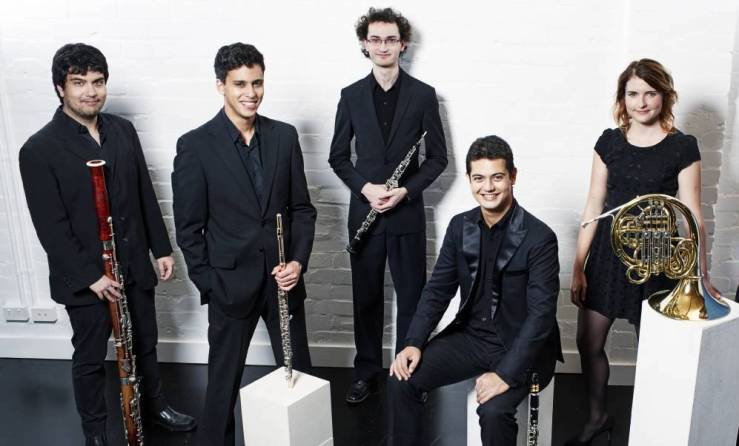
As you can tell from the photo, the Arcadians are a wind quintet. now three years old, comprising graduates of the Australian National Academy of Music.  For this appearance, part of the Recital Centre’s Spotlight series, the ensemble hosted pianist Peter de Jager who not only played in all four works programmed, but also wrote one of them.   With the enthusiasm of youth, these combined forces gave value for money, their event going some 20 minutes overtime.  I suppose that it would have been hard to cut back on anything, although the opening piece stuck out from the ruck pretty obviously.

Poulenc’s Trio for Oboe, Bassoon and Piano of 1926 served as a palate cleanser, enjoying a very affirmative account in the Salon space where audiences are close to the players; in this case, the ambience felt even more tightly knit, as though you were seated alongside the wind players, if not inside de Jager’s keyboard.   From the full-frontal initial Lent, it was evident we were in for a take-no-prisoners evening, de Jager powering across his opening 9 chords, followed by an intransigent semi-cadenza from Matthew Kneale‘s bassoon, climaxing in a low B flat, massively triple forte, with David Reichelt rounding out the pseudo-Baroque dotted-rhythm-plus-trills stateliness with a piercing elegance – all of which disappeared with the jump into Presto at Figure 2 where we hit the 1920s as that period struck a receptive composer on the watch for piquancy of harmony and instrumental character.

As delivered by these players, this trio  impressed as more rowdy in atmosphere than usual, where the emphasis tends to be placed on the effete.  While the central Andante hit the expected element of melancholy with a bite, at the Rondo finale in D flat these musicians found a permeating current of vigorous excitement, buoyant enough to communicate Poulenc’s restrained exuberance, if presenting as more muscular in contour than you are accustomed to hear.

In some ways leading on from this spiky opening gambit, Guillaume Connesson‘s four-minute moto perpetuo Techno Parade served as a tour de force for Kiran Phatak‘s flute, Lloyd Van’t Hoff‘s clarinet and de Jager on piano.  A relentless exercise in rapid-fire articulation and simultaneity, the piece came off  to fine effect, the wind duet work close to faultless and, if there’s not much to the score but boppy energy and a deft manipulation of jazz-inflected motifs, you could admire the execution for its confident drive.

Concerning the final two works on this night’s menu, what follows is unfortunately vague and, in some aspects, unreliable.  Not that the music itself was difficult to follow, but scratching notes in the dark as an aide-memoire is no way to guarantee precision of observation or evaluation.  Still, this is what I heard – or thought I heard.

De Jager’s own Disintegration in two parts, elliptically titled Before and After, received its premiere here.   It involved all the Arcadians with extra instruments emerging occasionally – Phatak’s flute alternating with piccolo, Reichelt tripling up with a cor anglais and an oboe d’amore.   Each half held six sub-divisions, both starting with a chorale and ending with a movement called Perotin which offered a contemporary take or two on the medieval organum/conductus nexus.

In the work’s first half, a Barcarolle impressed for its subdued menace, a duet for bassoon and one of the oboe group weaving its path above suspended chords and a rolling piano underpinning.   Mounds of Earth brought Shaw‘s horn into prominence in alliance with the piano although the title’s relevance to the movement’s emphatic linear content escaped me.   Phatak enjoyed a searching and emotionally appropriate cadenza in Melody: Hysteria.   For the second Chorale, de Jager opted for staccato wind chords juxtaposed with sustained keyboard sounds; Evaporated Earth gave a clear illustration of the composer’s economy of matter: his music’s progress is orderly, not obsessively dissonant but concerned with sounds and their placement  –  in this movement particularly, I heard suggestive echoes of Webern-like cells and acrostics.   Death Metal Depths eschewed the flute and oboe voices at its beginning – all bass rumbles and very loud ostinati, illustrating the title’s sonic potential persuasively, although the action eventually did spread upwards to involve the soprano voices.

Disintegration intrigues for a restless mobility, reflected in its multi-partite nature, and it is a clear success as an essay in timbres.   You’d have to hear it several times to acquire a definite appreciation of its structure; for example, I found little to distinguish the Death Metal Depths from its attacca consequent, Immolation, apart from some Zauber Feuer Musik trills; and the Techno Funk Fire passed by without making much of an impression – quite distinctive, of course, but standing as something of an intellectual hiatus in proceedings.   De Jager’s lyrical and harmonic vocabularies are assimilable, his intentions remain clear throughout and, as you’d expect from a band of colleague-friends, the execution on this occasion impressed for its persuasive energy and pretty reliable ensemble work.

The sextet then engaged with Brett Dean‘s Polysomnography, which took its inspiration from the technology associated with tracking and recording the brain’s activity when one is dreaming.   Five movements examined, in musical terms, various techniques and/or results from this process: theta and delta waves, myocloni (twitches and spasms and their release), sleep spindles (abrupt bursts of brain activity) and the composer provided a kind of summative assessment in a Dream Sequence that capped the experience.

Dean begins with theta waves where rhythmic motion is all over the shop; the acoustic spectrum is disturbed (or eased?) by having some executants breathe into their instruments  –  an unsettling music with sustained trills for flute over complex sound washes.   Myoclonus presents a very active sonic field that yields to a placid conclusion.  Dean’s Sleep Spindles are punctuated by woodwind arpeggios suggestive of that scene in Bartok’s Duke Bluebeard’s Castle where the unfortunate heroine discloses a lake of tears, a searching horn solo rising from the mesh.   As for the climactic dream, this opens with a series of ejaculations led by bassoon, the sleeper’s experience eventually rising to a frantic climax with rushing figures that recede but, in a telling inspiration, remain sotto voce under the concluding pages’ placid progress.

This is a remarkable construct, all the more so when you consider what Dean is attempting.   You can find musical data that depict the designated brain activity if your bent is towards the specific, but Polysomnography works even more satisfyingly on a more suggestive plane or two.   Besides exemplifying in some shape the referents that the composer’s titles propose, the work stands as a remarkable challenge for its executants, testing their mastery of synchronicity, of dynamic leaps and articulatory bounds, and of crafting their sounds into a highly exposed, clear fabric.  Without a score, I can’t make any assertions about the precision of this performance but it pleased the composer, who was present.   For all that, like de Jager’s new work, it would be worth resuscitating in a future Arcadia program – on this showing, an event to be relished.

The players have an attractive collegiality in their work, further emphasized by their attraction to new music rather than sinking back into more comfortable repertoire by Danzi, Reicha, Nielsen and Hindemith.   They hold back nothing, giving you the benefits of their craft unstintingly.   And, thank God, they have a sense of humour; mind you, negotiating a taxing (and long) program like this, you’d need one.

Visitor fits right in

BEETHOVEN’S FAVOURITE

Australian Chamber Orchestra

Hamer Hall

Monday November 28, 2016

lorenza-borrani

                                                                            Lorenza Borrani   

At the last of its national series concerts this year, the ACO enjoyed the attention of a replacement director in the Italian-born violinist Lorenza Borrani, leader of the Chamber Orchestra of Europe.   For much of Monday night’s proceedings, she followed the Tognetti principle of leading from the concertmaster’s stand, although less likely than the organization’s artistic director to use her bow as a baton; indeed, I didn’t see her have recourse to this control mode at all and the precision level of the players’ entries didn’t seem to suffer in any of the three works programmed..

Borrani made her solo offering at the start with Schnittke‘s Sonata for Violin and Chamber Orchestra, the latter entity comprising strings (about 15) and harpsichord.    For me, the Russian-German composer’s music has presented continual problems; the first work I heard, it seemed, was written by a committee – you couldn’t nail down a specific voice or character to it.    At the time, I said to a moderately enthusiastic John Sinclair, critic for the Herald and also coming to Schnittke’s work for the first time, that it sounded like something written by a panel, each of the movements allocated to specific members.

This sonata goes some way to exemplifying this evaluation although, in these latter days of enlightenment, most of us have become aware of the composer’s adoption of multiple tongues in the one work like this one where a grating acerbity exists alongside common chords that suggest the religiously inspired products of recent Scandinavian and Baltic mystic-writers; and where a meditative andante of stern serial shape is balanced by a bounding dance movement owing much to jazz and its offshoots.

Borrani showed firm control in each of the four movements, nowhere better than in dialogues – if one-sided in format – with Anthony Romaniuk‘s harpsichord, used as a brisk punctuating presence or for its grinding pebbles-imitating potential.   Most of the sonata’s interest lies in the solo violin line which rises to high technical demands and asks its interpreter for a constant variety in production techniques.   Of course, Borrani met each requirement with impressive authority; but then, she has been performing this piece for some years now, directing her Chamber Orchestra of Europe colleagues in it two years ago.   She forged an uncompromising path for the ACO players to follow, notably in a series of slashing chords that cut across the sombre path of the initial movement’s pages, some very soft floating chords in the work’s later stages, and an attractive astringency to give a febrile background for the soloist’s more ardent bursts of action.

Schubert’s Five Minuets with Six Trios for string quartet in an anonymous arrangement enjoyed a vital treatment where the original’s expression markings were observed with high enthusiasm and the players worked through all the repeats. Pleasant bagatelles, these pieces hold few surprises beyond a few disruptions of expectations where the usual division of eight-bars-per half in both minuets and trios changes, as in the third minuet where the second half is 16 bars long, while its second trio has a second half of 12 bars (and in this reading a liquid solo from Borrani above pizzicato accompaniment), as does the second trio to Minuet 5.   Schubert’s melodies have an assertive energy but the only dramatic (i.e. interesting) moments come in a few bursts of polonaise rhythm – the second trio of Minuet 1 and a couple of bars in Minuet 5 – and the musette/trio to the latter.

Beethoven apparently had a liking for his own C sharp minor Quartet Op. 131, according to one contemporary authority – Karl Holz, the composer’s secretary during the late quartets’ gestation.   No one can deny its incomparable breadth of content and emotional illumination but its transference to string orchestral guise is a dubious undertaking – something I’m coming to question about the whole Beethoven oeuvre in this form.  The justification usually advanced revolves around a clarity that is bestowed on the middle lines when you have a number of players dedicated to them. To my mind, that’s not a relevant argument, suggesting rather a lack of concentration shown by the listener or an incompetence on the part of the musicians involved in the quartet’s delineation.

Of course, with all lines reinforced, the score’s nature is changed into something more sonorous and substantial, particularly in the A Major set of variations and the athletic final Allegro.  Additionally, this interpretation proved very attractive as an aural experience, Borrani asking for pronounced dynamic differentiations, an edgy bowing attack in each allegro and the Presto,  and a rapid response rate in passages like the fifth movement’s sudden shifts  –  to Molto poco adagio interludes, and to those two delectable Ritmo di quattro battute breaks in the pages’ fleet-footed propulsive drive forward.

Monday’s well-populated house received the performance with enthusiasm and it served as an excellent showcase for the participants’ expertise and sharp-as-a-whip, finely honed ensemble.  In a week when Wagner’s Ring is rampaging at the State Theatre next door to Hamer Hall, this view of Beethoven rang plenty of complementary Romantic bells and brought out strongly the composer’s vehemence and dramatic urgency – qualities that appealed to the later writer.  But, for me, this unsurpassedly rich tapestry of a string quartet was changed into something more in the nature of a concerto grosso – bigger, not necessarily better.

If you have something to say

PERMISSION TO SPEAK

Chamber Made Opera

Arts House, North Melbourne

November 23-27, 2016

permissiontospeak-webpic-680x548

                                         (Left to right)  Gian Slater, Edward Fairlie, Georgie Darvidis, Josh Kyle

First and foremost, the four singer-actors in this entertainment impress mightily by their devotion to the task at hand.   They sing, speak and move around their acting space with unflappable confidence, facing down the occasional amplification system overload with an aplomb that carries the piece along, almost to the point where you are convinced that there must be a point behind it all, and you’re just too thick to grasp it.

Librettist Tamara Saulwick and composer Kate Neal have constructed a work that is hard to classify.   The central quartet of personalities – not that closely individuated, as far as I could tell – begin Permission to Speak by sitting on their white cube-seats and letting loose a chain of adolescent ejaculations – er, ah, mmm – which also move into isolated phrases or cliches before the vignettes that provide a plot begin.   Immediately, you are confronted with an implied irony: if you have or want permission to say anything, you need to have some sort of message.   At the beginning of this work, there is nothing to say  –  yet – except to defer communication by means of banal temporising techniques.

Later in the work’s progress, spoken words stop and the characters sing detached chords to isolated syllables: a juxtaposition of verbal tics and choral blurtings.   What is intriguing is the way in which the performers seem to pull chords out of the air, bringing to mind the splendid chorus work in Glass’s Einstein on the Beach – one of the few redeeming factors at operation throughout that extended exercise in superficiality.   But the musical content in Neal’s work is generally subordinated to the often cryptic texts.

Which come at you both from the (amplified) executants and speakers that surround the audience and pile on recorded information employing about 27 different voices.   Sometimes, the soundtrack is overwhelming –  material overload, a fading in and out of audibility, words and whole sentences sometimes coherent and then breaking into meaninglessness.   At quieter moments, such work is left to the live performers who share in a similar complex of straight dialogue and fragments.  For Georgie Darvidis, Gian Slater, Edward Fairlie and Josh Kyle the actual theatrical action allows for little slackening off, not much time spent out of the various spotlights.

But what actually happens?   The voice-overs and live actors move through a series of tableaux, mainly presented verbally although a sort of mimed death-scene for everybody intrudes near the end.   I picked up a few of the stories – a young man offended that his mother has read his emails which contain the news that he is dating a man; a young girl railing publicly against her bourgeois family life in Glen (or was it Mount?) Waverley; a daughter appalled at her father’s matter-of-fact announcement that he has a tumour; a diatribe against an apparently cold, emotionally unresponsive mother.   Most of this struck me as commonplace domestic drama, brief snatches that could provide plot variants for TV soaps.

But these situations have the benefit of being familiar, representing experiences that many of us have had or that resemble moments in our lives.    And that’s fine: you can’t be forever looking in your entertainment for towering passions like  those of Tosca or (more relevant this week) Brunnhilde.   Saulwick and Neal take the ordinary and the immediately recognizable as their basic matter, facing their observers with – themselves.

On  Wednesday night, it struck me that what these passages of play lacked was a sense that they constituted much more than the situations they presented, that they were capable of extrapolation.    It wasn’t so much that you were waiting for a resolution to each crisis: as far as I could work out, there was no intention of working any of the episodes through to a happy or sad ending   –  you just heard the voice narrating what had happened, sometimes with hesitations and abrupt bursts of development.    But the episodes had no context outside of their bare narration.

No, you can’t expect linear narrative in an enterprise like this one where interpretation is emphatically a matter for the individual and in any case is put to the challenge by the constructors’ modes of communication.   And you can’t fault the device of recording social malaise as a series of isolated points emerging from various lives.   But, at the end, you are left with small windows, only a few illuminated, rather than a canvas to re-examine and relish.

What Permission to Speak bases itself in, what it is about, is an entity that is all too familiar to nearly all of us: the family – more properly, the unhappy family because there’s precious little light in this exercise; even those few moments that moved into humour convinced only a few of us.

For all that, the opening night audience gave the cast and creators rousing applause at the work’s end, and you could understand why.   Despite its disconcerting layers of compacted information, Permission to Speak has an unarguably serious intent, its situations familiar to the point of discomfort, the musical content eminently assimilable.   Most importantly, it is distinguished for its hard-working cast, whose devotion gave focus and drive to this hour-long enterprise.

December Diary

Thursday December 1

THE PIANO IN ARCADIA

Arcadia Quintet

Melbourne Recital Centre at 6 pm

A half-French, half-Australian program from an ensemble new to me, although it’s been going since 2013 and has been all around the country, performing in venues big and small. The Arcadias comprise flute Kiran Phatak, oboe David Reichelt, clarinet Lloyd van’t Hoff, bassoon Matthew Kneale, and horn Rachel Shaw – all of them ANAM musicians, so the cream of their particular crops.  The visiting piano is Peter de Jager, also an ANAM graduate.  The evening starts with Techno-parade from 2002 by Guillaume Connesson, a taxing five-minute romp for flute, clarinet and piano, the last-named played both ‘straight’ and with a bit of internal manipulation. Poulenc’s piquant oboe/bassoon/piano Trio celebrates to the full the composer’s wit and melodic resourcefulness.  De Jager is mounting one of his own compositions; details remain sketchy at the time of writing – no name, no instrumentation.   The program concludes with Brett Dean’s Polysomnograhy – ‘a multi-parametric test used in the study of sleep’, according to the composer who wrote this five-movement sextet nine years ago.


Thursday December 1

SIMONE YOUNG CONDUCTS WAGNER AND BRUCKNER

Melbourne Symphony Orchestra

Hamer Hall at 8 pm

While Opera Australia is struggling with its Ring production for the second time (why?), Simone Young will front the MSO to show how Wagner should be done; an object lesson to the OA board on what a great talent left the building when it sacked her.  Not that she is laden with the fripperies and inanities of the tetralogy: her task is Parsifal, the least attractive of the whole Bayreuth oeuvre.   With tenor Stuart Skelton in the title role and veteran American mezzo Michelle de Young finishing off her year as Kundry, Young conducts part of Act 2 – possibly all of Scene 2 after the Flowermaidens have done their worst.   As a filler, Young also conducts the incomplete (although you’d never know it) Bruckner Symphony No. 9: a leviathan, not for the faint-hearted.

This program is repeated on Saturday December 3 at 8 pm


Monday December 5

MUSIC OF THE NEW WORLD

Continuo Collective

Melbourne Recital Centre at 6 pm

Haven’t heard this duo – theorbo Samantha Cohen, guitar Geoffrey Morris – for some time; am assuming the work continues in much the same vein as before.  Tonight, the Collective expands to take in Marshall McGuire’s triple harp and some percussion titillation from either Dan Richardson (MRC website) or Matthew Horsley (MRC publication).  The music is all Santiago de Murcia: dances and tunes collected from European, African and American (South) sources – a toe-tappin’ hour of exuberant 18th century ‘world’ music.


Tuesday December 6

PROPULSION

Plexus

Melbourne Recital Centre at 6 pm

Details about this recital  have been stuck in a time-warp for quite a while.  Doubtless, the musicians involved will include – or consist entirely of – violin Monica Curro, clarinet Philip Arkinstall and piano Stefan Cassomenos.  The musicians are playing five new works by Hue Blanes, Ross Irwin, Stephen Magnusson, James Mustafa and Niko Schauble; except the last, names that are new to me but that’s not unexpected – they all come from the worlds of jazz/indie pop/folk.   Oddly enough, they are all male, which probably has something to do with the event’s title.  So far as I can discover, the composers’ material is still nameless; not that it matters too much when the participating personnel remain an unknown quantity.


Wednesday December 7

RICHARD TOGNETTI/ACO SOLOISTS/VIVALDI & BACH

Australian Chamber Orchestra

Melbourne Recital Centre at 7:30 pm

A one-off event for Melbourne – welcome, of course, but I don’t know why it’s happening – this program features Richard Tognetti  and a select few of his bright-as-a-button band as soloists: violins Satu Vanska and Helena Rathbone, cello Timo-Veikko Valve, bass Maxime Bibeau, with recorder Genevieve Lacey coming in for good measure.  You’d have to assume that more of the ACO will attend to provide tutti components for Bach’s A minor Violin Concerto and the Orchestral Suite No. 2 (a great workout for Lacey), as well as Vivaldi’s Two Violins-and-Cello Concerto RV 565 and the Four-Violin Concerto RV 549.  For that gracious genuflection to the home-grown, Tognetti has programmed Elena Kats-Chernin’s Miniatures for Strings, about which I can find out nothing and so assume that this will be its premiere.


Saturday December 10

EVOLUTION

Benaud Trio

Melbourne Recital Centre at 3 pm

The program will be repeated at 6 pm

The Bramble brothers – violinist Lachlan, cellist Ewen – are visiting from their duties with the Adelaide Symphony Orchestra, and pianist Amir Farid is back from the US for a rare Melbourne appearance; only three times this year whereas the group used to turn up around many a corner.  Tonight is a short Salon event featuring two piano trios: Mozart in C K 548 and the Schumann No. 1.  It’s not so much an evolution of the form as a juxtaposition.  Still, these players are always welcome for their robust approach and the individual character of their communal sound . . . which has probably changed, given the wear and tear of settled professional life and expanded horizons.


Saturday December 10

NOEL! NOEL!

Australian Brandenburg Orchestra

Melbourne Recital Centre at 5 pm

This will, once again, not be a night for the purists.  Yes, you get a lot of indisputable Christmas music: Once in Royal David’s City, O Little Town of Bethlehem, the Coventry Carol, God Rest Ye Merry, Gentlemen, Hark! the Herald Angels Sing, Adam’s O Holy Night, Silent Night, and O Come, All Ye Faithful – a pretty exhaustive list of carols there, lyrics that have been part of the season’s celebrations for yonks.  Then you get a few tenuously related items, like Amazing Grace, Nicolai’s arrangement of Wachet auf, Caccini/Vavilov’s Ave Maria, Eriks Esenvalds’ O salutaris hostia and Norwegian writer Ola Gjeilo’s Kyrie setting, The Spheres for a cappella choir dividing and contracting in multiple lines.  On top of all this, Paul Dyer will air some inexplicables like Vivaldi’s Concerto for Two Trumpets, The Luckiest by Ben Folds, the villancico Con que la lavare by Luys de Narvaez and a Ciaconna (which one? by the 17th century Moravian musician Philipp Jakob Rittler.  The ABO, in other words, ticks all the seasonal boxes but fleshes things out with music that will please patrons through its celebratory or sentimental character.  The Brandenburgers’ guest will be Madison Nonoa, a young soprano from New Zealand.

This program will be repeated at 7:30 pm.


Saturday December 10 

MESSIAH

Melbourne Symphony Orchestra

Hamer Hall at 7 pm

Pretty much the MSO’s last work for the year and still a fairly popular event, although I seem to remember the days when this great oratorio ran to three performances in a row.  The conductor is Paul Goodwin, recently here in July to lead the MSO in one of its Melbourne Recital Centre nights, notable on that occasion for some excellent Haydn.  His principals are: our own Emma Matthews for the soprano solos;  mezzo Luciana Mancini making what I think is her first appearance in this country following the budding of her career in Europe and the United States; British tenor Charles Daniels who is very experienced and popular enough to have his own fan club/ society; Christopher Richardson from Sydney the night’s bass and he has impressed on his few showings here.  The MSO Chorus will be prepared by Warren Trevelyan-Jones who directs the Consort of Melbourne and St. James Church in Sydney’s King St.

This program is repeated on Sunday December 12 at 5 pm.


Saturday December 10

CHRISTMAS TO CANDLEMAS: THE FRENCH COURT

Ensemble Gombert

Xavier College at 8 pm

You could be flippant and say that John O’Donnell and his excellent choir are bringing out the usual Gallic Renaissance suspects for the season: Ockeghem, Mouton, Desprez, and Compere as well as a newcomer to me in Johannes Prioris.   Serving Charles VII and Louis XI, Ockeghem is represented by his Marian motet, Alma redemptoris mater.  Four works – Nesciens mater, Noe, noe, Quaeramus cum pastoribus, and Illuminare, illuminare, Jerusalem speak for Jean Mouton, who wrote for Louis XII and Francois 1.  The Gomberts sing two Josquin motets – his setting of the first 14 verses of St. John’s Gospel, In principio erat verbum, and the lactation celebration  O admirabile commercium, from a composer who might have known Louis XI but certainly knew Louis XII.   Compere worked for Charles VIII and tonight his Hodie nobis de virgine Introit from a substitution mass/motet cycle brings the program to an end.   But not before another In principio setting by Prioris who was for a time maitre de chapelle for Louis XII.  So a great swag of court music from a richly productive musical era in French music.


Sunday December 11

CHRISTMAS

Australian Boys Choir

Melbourne Recital Centre at 3 pm

Always a pleasure to hear these singers, prepared to the nth degree by Noel Ancell.  At the core of this year’s program sits Britten’s A Ceremony of Carols – a gratifying evocation of the Christian feast, if essentially English in its ambient ethos, and an always challenging series of hurdles for its choir of trebles and accompanying harp.  The ABC has a number of offshoots, all of whom enjoy exposure on these nights.   And, in the all-in-together participation carols, the parents and friends come into their own, raising the Recital Centre roof and singing the well-known arrangements in parts as only a well-disciplined and musically educated audience can.

Clear if sometimes tenuous

THE LONDON SKETCHBOOK

Melbourne Chamber Orchestra

Melbourne Recital Centre

Sunday November 20, 2016

grace-clifford

                                                                                    Grace Clifford

To finish the year, William Hennessy and his orchestra paid tribute to the mother country with a grab-bag program of works by Mendelssohn (honorary Englishman), Byrd, Warlock, Vaughan Williams, Ireland and Mozart, whose collection of eight-to-nine-year-old juvenilia gave this event its title.   All those sketches are for piano; the four excerpts we heard proved amiable enough, but I think Hennessy was straining when he found links between the first piece, a siciliano (or two) in D minor, and the Requiem, or between the following slight G minor Sonata and the Symphony No. 40.    As an experience, all these pieces proved to be amiable, deft exercises at worst, hardly interesting enough to send you searching for the Sketchbook‘s 39 other components.

The only other arrangement in the concert was of Byrd’s six-voice motet Sing joyfully, a cathedral choir favourite.   Its three-minutes’ length passed pleasantly enough, like the Mozart scraps, but its emotional drive was absent, possibly because the tempo taken was pretty slow, more probably because the performance for strings alone lacked the soaring exultation of the text; no incitement here to Blow the trumpet in the new moon, as the Psalmist directs us – just a clean-enough texture of interweaving lines without much personality.

Former principal cellist of this ensemble, Michael Dahlenburg, controlled a placid interpretation of Mendelssohn’s The Hebrides Overture, the score’s sound-world dominated by the wind – twelve of them – who delivered their lines with plenty of vigour in each tutti, swamping the 14 strings.   But the imbalance started earlier with the second subject at bar 47 where the cello/bassoon doubling over-favoured the woodwind.   For all the allowance-making of imaginatively fleshing out sounds that proved faint images of their usual selves, the reading was hard to fault for its technical precision; I heard only one off-kilter violin note somewhere about bar 131.

John Ireland’s Concertino Pastorale is a novelty to many of us (as is anything by this writer), so this airing of the work’s central Threnody was most welcome.  The MCO strings fully embraced its lush elegance with a splendid lyrical chain supported by emphatic cello pizzicati at climactic moments.   It shares a common language with elegiac scores by the composer’s contemporaries yet it recalls, in its serene sensibility, Barber’s Adagio for Strings although the English piece is more heart-on-sleeve in its declamation, less deliberately monumental than the American masterwork.   It gave the MCO players no apparent worries, their delivery assured and idiomatically convincing.

Violinist Grace Clifford appeared at one of the Melbourne Symphony Orchestra’s most popular Proms Town Hall concerts in July, taking the solo line in Bruch’s Concerto No. 1; an engrossing version, as it turned out, packed with confidence and polish.   For this occasion, she opened with Vaughan Williams’ The Lark Ascending: that simple-sounding, always perilous rhapsody that tests any player’s self-reliance because of the several cadenzas that are spread throughout its length.   Clifford kept a level-head and a confident right-arm in play, not put out by some scatter-gun woodwind chording at the score’s opening or a pair of horns that Dahlenburg could have tamped down to beneficial effect.   The young soloist articulated a well-honed sound, especially in those exposed passages where you are conscious of the soft whirr of the bow moving over the instrument’s strings, coming to a hall-silencing apogee in the final senza misura solo (not a cough in the house) that ended on a bravely sustained high D to B fall, softening to inaudibility.   Which is dangerous, of course, as you sacrifice some security of pronouncement on the triple-piano altar. Still, the attempt came close to ideal here.

It’s been a long time since I heard the Capriol Suite – not since Harold Badger took a student group of indifferent quality through the work in an ability-stretching struggle maybe 40 years ago.   Hennessy from his first desk (as for the Ireland, Mozart and Byrd) set a steady pace in this optimistic work, keeping the Pavane on the move, giving an attractive pliancy to the Pieds-en-l’air meditation, and hammering out a brisk Mattachins finale.   The approach might have gained from less weight in delivery, particularly for the admittedly forthright  opening Basse-Danse, but the MCO strings once again handled their work without any apparent discomfort, doing their duty by Warlock in transforming the original Thoinot Arbeau material into an indubitably English composition.

Clifford re-emerged at the program’s end for the Mendelssohn E minor Concerto.   As with her Bruch, she took on this warhorse with a briskness of attack that stayed well away from needless aggression.   Interpreters have to walk a fine line with this concerto, far too many falling into an interpretative trench of gentility, subscribing to the all-embracing conception of the composer’s tendency to Biedermeier tweeness.   We know Mendelssohn was a moraliser, even verging on a prig – his reactions to Berlioz show a middle-class incomprehension that makes you glad he didn’t survive into the heyday of Wagner – and anybody patronised by the benevolence of Victoria and Albert has an inbuilt burden of cultural attachment.   But this piece has a tensile force in its well-framed paragraphs that has to be delineated with clarity and determination.

Clifford’s first movement cadenza had a drive and dynamic arch to its development that would have been the envy of many a more experienced artist, and she kept her end up in the exciting stretto that finishes  this Allegro.   It wasn’t that this soloist left the sugar out of Mendelssohn’s pendant Andante, but she controlled her vibrato and any temptation to suffocate the main melody in sentiment.   Not an easy road to follow; has there ever been a slow movement so consciously ‘sweet’?   Her sonata/rondo finale hit all the right points, balancing sprightly delicacy with moments of sweeping breadth, full-bodied to the end without a trace of maidenly reserve or dithering with the composer’s semiquaver streams of action.

I don’t know what Clifford’s commitments are in 2017, apart from a Selby & Friends recital at the Deakin Edge, Federation Square on March 9, participating in piano trios – Beethoven, Saint-Saens, and Dvorak’s Dumky.   But keep your eye out for her Melbourne appearances: so far, they’ve been top-notch efforts.

Trim and smooth

Trio Dali

Melbourne Recital Centre

November 15, 2016

trio-dali

                                                                                        Trio Dali

                                                  Jack Liebeck, Amandine Savary, Christian-Pierre La Marca

The Dalis have visited for Musica Viva before, appearing here in May 2012 with a similar program to this current one. Then, they performed Ravel and Schubert in E flat, as well as Australian Gordon Kerry’s Im Winde; this time, it’s Beethoven Op. 1 in E flat, Chausson’s Op. 3 and Roger Smalley‘s 1991 Trio, written as a compulsory hurdle for ensembles in that year’s Melbourne International Chamber Music Competition and becoming familiar over that week through sheer power of repetition.   Some things have changed over the years: violin Vineta Sareika has been replaced by Jack Liebeck, and Amandine Savary‘s piano now opens on the long stick – a mixed blessing.

As anticipated from the one previous exposure, this ensemble is nothing if not polished.  The opening movement to their Beethoven interpretation set a high standard in the melding of lines, no one hogging the spotlight.  Even though the temptation is there for the pianist’s taking,  Savary husbands her full power, exerting it rarely, and she avoids the trap of seeing a large level of activity in both hands as giving her a justified primacy.  By a careful and constant control over both sustaining and dampening pedals, she allowed her colleagues a dream run in the trio’s first half.   And if her contribution dominated the last two movements, there’s nobody to blame but the composer who gave his keyboard a rollicking conclusion to both halves of the Scherzo and all the running of the Trio; not to mention that attention-grabbing leap of a 10th to kick off the Presto finale and an irrepressibly effervescent field of action thereafter.

Liebeck  and La Marca make a well-matched string duo, the violinist  generating a line of elegant finesse with a keen sense of shaping his contribution into a piece’s framework, while the cellist shows more aggression although his output offers a marked counterweight to Liebeck in its emphases and mode of attack which, at heated moments, involves the incidental clunking of his bow’s frog as a sort of commentary on his awareness of a phrase’s force.

It surprised me to find quite a few recordings of the early Chausson work – Parnassus, Beaux Arts, Wanderer, even one by a Trio Chausson – but I can’t recollect any live performances at all.   The Dali players showed high enthusiasm for bringing this neglect to an end and their interpretation proved very persuasive.   While Chausson’s returns and reversions have a stilted character, possibly due to the flamboyance of the work’s readily accessible emotional language and a patchwork quality to the recapitulations, the four movements reveal a welcome variety of emotional character.   An urgent energy permeates the first Anime which reaches a strikingly hectic climax across its last two pages with a welter of very loud full chords in triplets for the piano.

The players preserved a piquant sprightliness in the Vite movement, including a finely graduated decrescendo as the movement sank into triple piano harmonics. The Assez lent brought out the string player’s sympathy in canonic and unison passages, even if Chausson makes heavy work for everyone by having his pianist double the other players’ lines for a good deal of the time.   As for the buoyant final Anime, the spirit of Cesar Franck loomed large with page after page of fraught chromatic shifting and broad melodic strokes.

Smalley’s work was presented by Liebeck as an in memoriam for the Anglo-Australian composer who died last year and whose work didn’t feature overmuch in the musical rounds of this particular eastern state.   His Piano Trio uses Chopin’s A flat Op. 59 Mazurka as a fulcrum/springboard although the references are elliptical at best.   But the Dalis infused it with more vivacity and sheer interest than I can recall from its several performances 25 years ago, particularly some haunting Brittenesque cello sounds in the second part’s Passacaglia.   You got the impression from this version – far more than  in others I can recall – that an awful lot is packed into a short time-frame, so much so that the score’s four segments, though clearly discrete, fly past – in this instance, with manifest concern and mastery.   If only all local content on Musica Viva programs could occupy this excellent and enlightening standard of accomplishment.

The Dali Trio plays again on Saturday November 19 at 7 pm.  Smalley’s work sits at the centre, surrounded by Mendelssohn No. 2 in C minor (the third performance here by  professional ensembles in 12 days) and Schubert in B flat.

Straight down the middle

PIANO TRIO JEWELS

Wilma & Friends

Ian Roach Hall, Scotch College

Saturday November 12, 2016

wilma-smith

                                                                                     Wilma Smith

Concluding her three-recital season under the Wilma & Friends banner in the opulent  main auditorium of Scotch College’s music school, Wilma Smith hosted two guests in a night that featured three very well-known works.   Cellist Yelian He is a Scotch old boy who has studied in the UK and is back home with his performing partner, British pianist Yasmin Rowe, who was this night’s third voice.   As ad hoc ensembles go, the Smith-He-Rowe combination showed a high degree of competence in coping with Haydn’s C Major Hob XV:27, Mendelssohn in C minor and Brahms No. 1 in B Major: all fare that chamber music enthusiasts in this city have become very familiar with through the international and Asia-Pacific competitions held since 1989.

The chief problem with Saturday evening’s work was a question of balance.   The Roach space is excellent for chamber music: plenty of wood, a fan-shaped auditorium, a not-too-large airspace to fill.   But a piano on its long stick enjoys resonant pre-eminence and neither Smith nor He was able to mount a challenge to Rowe’s domination of the happy Haydn work.   Yes, its emphasis does fall heavily on the keyboard and the cello, for the most part, spends its time reinforcing the piano’s bass notes, but this interpretation proved dynamically lop-sided.

Smith’s line remained clear, coming into its own during the ornate passages of the middle Andante, but Rowe’s attack took over the work’s progress, in part because of her emphatic definition in delivery, but also because, in unison passages, she continued to maintain her position of primus inter pares.   Of course, she had the work under control and distinguished herself with excellent dexterity in the perky concluding Presto, but, for the most part, He’s timbre featured very faintly in the sound mix.

Matters improved significantly in the Mendelssohn work – but then, the cello has a more adventurous, independent part to deliver.   Most pianists find it hard to resist the temptation to turn this work into a concerto, the writing is so rich and flattering.   Rowe gave space to her colleagues, especially in the melting string-duet work of the second movement.   Both outer Allegro segments might have gained in clarity by less use of the sustaining pedal at moments like the quickly descending arpeggios from bar 142 onwards (and later from bar 307).

Still, while the work’s central pages worked well enough, particularly Rowe’s lightly chattering output in the Scherzo, the finale underlined a lack of presence from He’s cello.   The notes were all there and eloquently phrased but you had to strain to hear them, except in exposed moments like the opening sentence.    Further, at a fortissimo burst, as in bar 49 where everyone breaks into a broad theme in an elliptical E flat Major, He’s contribution sounded recessed.   Still, the musicians gave a fine account of the two places where Mendelssohn inserts his version of the Vor deinen Thron chorale: moments that I still can’t fathom in terms of structural relevance but which always rouse responsive shivers.

After interval, for the Brahms, He re-positioned himself so that, instead of facing across-stage to Smith, he sat full frontal to the audience in the piano’s curve.   The result improved the integrity of the performance markedly; just as well, as the cello takes over the noble first subject from bar 4 and sets the interpretative standard for the rest of a substantial movement, made even more so on this occasion where the expansive exposition was repeated.   To happy effect, the eloquent string writing in sixths came across with satisfying depth and balance.

Rowe  coped very well with this score’s multiple difficulties, particularly the composer’s use of syncopations in accompaniment and constant variation in rhythmic patterns, much of which seems to fall to the piano part with wearying frequency.   The player’s dynamic output was still, for my taste, over-heavy, but she sprang quite a few surprises along the way, like the evenness of her septuplets in the Scherzo‘s second half repeat, and the pointed delicacy of her delivery of that sparkling Mendelssohnian tracery-work starting at bar 145.

Later, the Adagio proved to be a continuous pleasure which showed how well-matched Wilma and He were in sound-colour and phrasing during their exposed duet passages and at dangerous moments like those sustained, scouringly clear F sharps in the last bars.   By contrast, the finale showed signs of fatigue, mainly at stages where both strings were operating pretty high in their ranges, like the declamation from bar 171 to 187.   Still, the players made a gripping experience of the last 50 bars or so as the trio surges to its determined firm final cadence: a convincing finish to a reading of welcome dynamic uniformity.

Happy half-way point

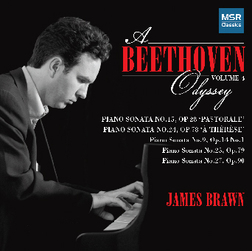
A BEETHOVEN ODYSSEY VOLUME 4

James Brawn

MSR Classics MS 1468

Booklet.qxd

By a happy concatenation of circumstances (or, more probably, clever organization), the latest in Brawn’s Beethoven piano sonatas CDs is packed with optimism and simple delight in music-making – both from the composer and his interpreter.   On this value-for-money recording, you will find the Sonata No. 9  in E Major,  the slightly later D Major Pastorale, and a clutch of shorter essays in the two-movement No. 24 in F sharp, the Alla tedesca No. 25, and  No. 27 in E minor – one of two with prefatory directions in German.   While a minor-key movement occurs in nearly all five – not the A Therese in F sharp, however – the emotional  content is not particularly gloomy, or even suggestive of depression.   At the end, you may feel that you have come across some movements of ADHD-style Beethoven, but generally the atmosphere remains benign; determined, of course, yet not reaching into dark psychological reserves.

Brawn opens his reading of the Op. 14 E Major Sonata with poise and a controlled excitement that he lets erupt sporadically, notably at the recapitulation with its celebratory left hand semiquaver scales.   For all that, the work impresses best in the concluding passages of each half, the melody in minims singing over murmuring quaver chords in the bass.   A placid equanimity permeates he E minor Allegretto that follows, a plain-speaking premonition of the opening movement to the Sonata No. 27; while the concluding Rondo is briskly handled with an infectious energy surrounding the initial left-hand triplets and the extended central E minor episode.

Taking the tour with Brawn re-opens the wider Beethoven vista, especially when you are looking with a vision concentrated on works of a kind, like these sonatas.   During the opening segment of the D Major Op. 28, the most striking factor is the composer’s reservation of practically his entire development for the three add-on bars to his first subject’s opening sentence.   This creative focus and its attendant flexibility receives steady handling and the moderate waltz tempo is sustained.   Only in those right-hand-only bars featuring two triplets and a quintuplet is the delivery unsatisfying; it’s hard to put your finger on the reason but it may be that each individual beat needs more emphasis.

With the Maelzel-type metronomic tick-tocks in the bass, the sonata’s D minor Andante has a serious facade only and Brawn approaches it with an appreciation of its jauntiness and patches of frivolity; for example, at the change into the major.   Quite rightly, the Scherzo is given at a rapid speed which slows slightly for the Trio‘s second half, while the occasionally bucolic finale, despite the bracing bursts of double-octave action, sounds at its best in the simplest sections where Brawn’s touch is relaxed and beguiling.

Despite the signs of stress in the F sharp Major work, like the admonitory left hand trills in bars 26 and 85 and the intense working-over of a simple motif from bars 45 to 50, the interpretation captures you through its fluent Schubertian lilt at the start and those melting postludial observations at bars 27 to 30, then further on at bars 86 to 89: deftly shaped and touchingly diffident in character.  The sonata’s complementary vivace proves to be a model of sensibility – not over-fast, lots of clarity in the sets of two semiquavers in alternating hands, and a clever, slight easing of the pace before the cell motive’s several returns.   As well, Brawn reaches a marvellous purple patch from bar 149 on the last page; the dynamic juxtapositions and contrast in timbres between treble and bass makes you raise your eyes from the score.   I’m still trying to work out how he achieves a striking and highly individual muffled effect in bar 152.

Certain piano pieces take on a personal colour for many of us according to when and how we studied them.   My instructor at the Sydney Con, Nancy Salas, with a sadly misjudged estimation of her recalcitrant charge’s abilities, gave me the Alla tedesca Sonata to work on – as well as the Bach Italian Concerto, Mozart’s K. 459 Concerto, the Andantino from Schumann’s middle sonata, and several other works over our two-year relationship – masterpieces that over-taxed this mid-adolescent’s limited abilities.   What a pleasure, now, to come on a compelling reading of the Beethoven work which, as far as possible, I’ve avoided since those years.   Brawn treats the opening Presto cleverly, not forgetting that Beethoven wanted something of a tub-thumping country-dance feel about these pages.   More pointedly, the pianist refrains from turning the movement into a moto perpetuo with some infinitesimal ritardandi before launching into the cuckoo-imitating cross-hand sections that dominate the middle pages’ action.   It’s all very brisk but warm in temperament – and, more significantly to my envious appreciation, flawlessly articulated.

I used to think that the remaining movements of this work were child’s play compared to its opening and the Andante in siciliana mode is devoid of technical problems.   But the final Vivace has its moments, as well as a running test pattern of rhythmic shifts, which Brawn negotiates with unflappable control at a very fast pace.   You are hard pressed to find any seams in the breaks between sections, mainly because the performer somehow knits the movement into one fabric by subtle note-sustaining and a non-aggressive palette of attack.  This sonata as a whole presents one of the outstanding exhibitions of sheer craft in the series so far.

The disc’s solitary grim pages come at the start of the E minor Sonata No. 27, pages that have a sort of galumphing stodginess to them.   Like the preceding G Major exercise, the technical requirements are far from shattering but agility and interpretative breadth put the executant under the pump.   Brawn is elastic with his beat in some passages, although rarely those where the forward motion is in chord steps.   He introduces an unexpected accelerando at bar 92 that dissipates before the section closes pianissimo – a little touch of sturmisch bewegt breaking up the steady first-beat emphasis that permeates the movement.   Finally comes a plain-speaking account of the Nicht zu geschwind movement where Beethoven seemingly can’t hear enough of his own main theme, a simple but multi-faceted marvel of construction.   In this very persuasive reading, the pages murmur past although Brawn proves insistent with his loud/soft/sforzando jumps between bars 32 and 38.   But his command of texture reaches a high mark at those discordant spots where the composer sets up an accompanying pattern of contrary-motion 2nds: bars 47 and later at bar 187.   In handling each of these points, Brawn maintains a gentle burble under the top line’s melodic stream, yet again showing a sensitivity to texture and intention that makes one look forward even more to the next product in this excellent series.