BUSH, BORSCHT & BONN
Selby & Friends
Primrose Potter Salon, Melbourne Recital Centre
Wednesday September 2, 2026
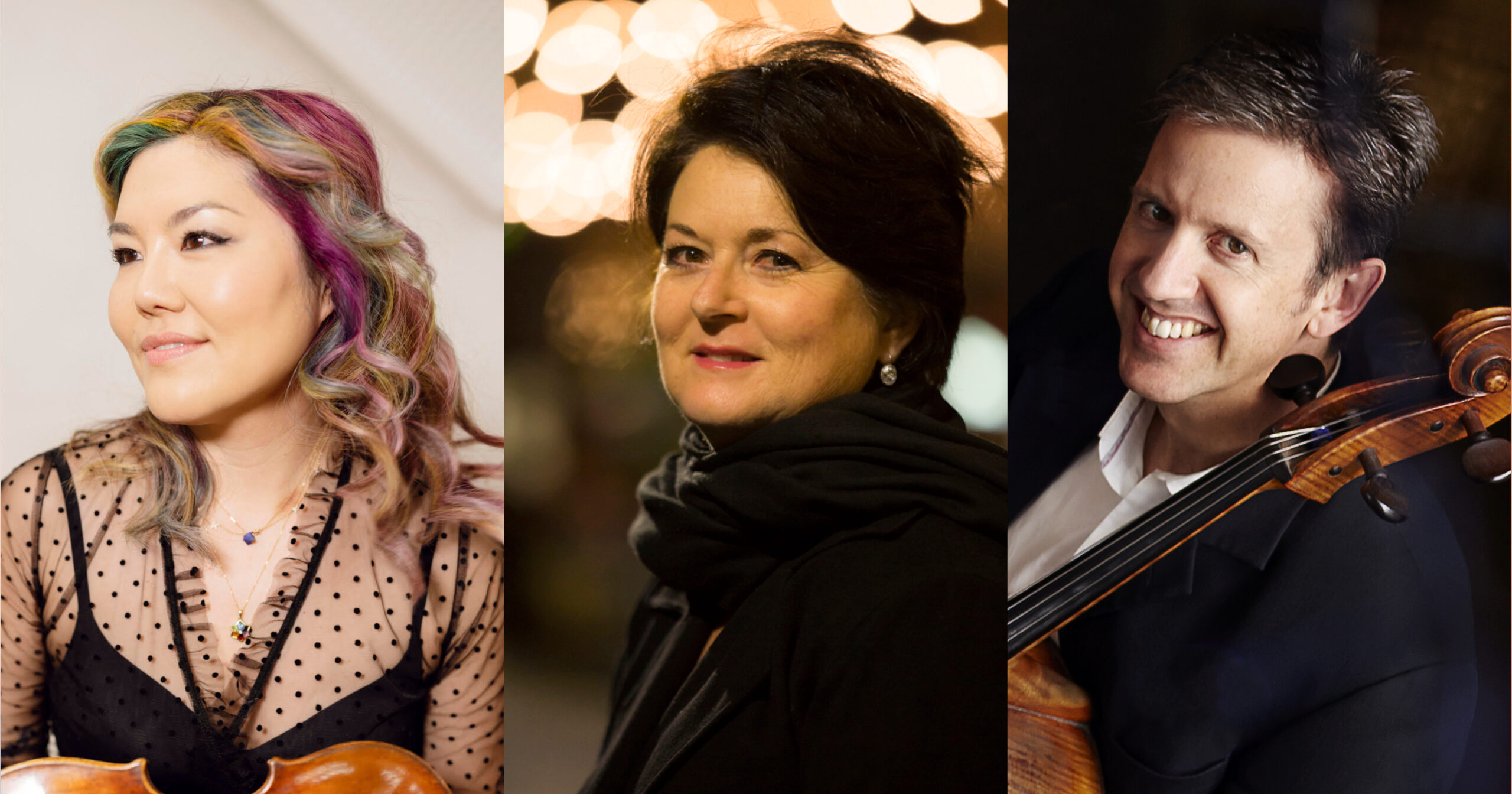
(L to R) Susie Park, Kathryn Selby, Julian Smiles
Compared to what is coming up in the Selby & Friends‘ final two recitals in coming months, this recent program presented patrons with some unexpected corners of the relevant repertoire. In association with violinist Susie Park and cellist Julian Smiles, pianist Kathryn Selby worked through Australian Ross Edwards‘ Piano Trio of 1998 which we should probably label as ‘No. 1’, because another essay in the form has recently appeared; then Arensky’s F minor Piano Trio No. 2 written in 1905 which many of us would be experiencing for the first time live, as opposed to the far more popular earlier (1894) trio in D minor; the evening’s exercise winding up with Beethoven’s Op. 38 E flat Major score of 1805 which is an arrangement by the composer of his own very successful Septet from five years earlier.
Yet again, Selby made a happy choice of colleagues. Both Park and Smiles have appeared in previous S&F events and their performing styles merge persuasively with the pianist’s direct speaking mode of address. Indeed, the cellist has worked with Selby on the Edwards work a few times – in September 2015 and again in May 2021. Written as a test piece for the Melbourne International Chamber Music Competition of 1999, this trio is remarkably fair to its participants from the outset, beginning the initial Allegretto with a piano-only exposition before the strings enter for an extended duet, teasing out the near-modal material that the composer uses.
Obviously, this piece represents the ‘Bush’ of the night’s title and Edwards achieves an atmosphere that we can take in as speaking to the repetitiousness of the outback’s landscape, the movement’s progress beginning with an ambiguous grounding, possibly in E minor, while the melodic material circles without settling. It’s an effective musical picture of this continent’s inner reaches – not all of them, but typical of some in its rolling repetitions. Throughout these pages, the composer finds an expressive layer that fuses melancholy with movement, in its way as suggestive of place as Sculthorpe’s Small Town of 1953, particularly its later stages.
Mind you, Edwards has written of his intention across this movement of mirroring the aspect of light dancing on the Arafura Sea, so what do I know? Listening to it, you can hear this muted sparkle in the piano writing, not so much in the intertwining lines for violin and cello. The following Nocturne strikes me as continuing the ambience erected in its predecessor, but the passing pages bring a more searching investigation of material. Somewhere along the road, Edwards hits on a theme/motive that brings irresistibly to (this) mind an echo of the first movement to Dvorak’s Cello Concerto.
Then, in the final Allegro assai, we encounter the composer in full maninyas, the dance shape that has become one of Edwards’ main compositional identifiers and more familiar to many of us through his 1988 violin concerto: one of the most joyful and persuasive Australian works that I know. Selby enjoyed producing much of the high-tessitura energy but Park and Smiles worked with impressive intensity to generate a pair of ardent voices, although the combined dynamic often came across as over-assertive. Still, the energy and sense of accumulating rhapsody were rewarding to hear along the path to home in this finely-crafted, honest creation.
Following the score with an old recording of the Borodin Trio at work, I was impressed by the venerable ensemble’s use of rubato as they worked through the Arensky composition. Selby, Park and Smiles also employed this breathing technique, if not as lavishly as their predecessors in the field, and it showed its value when handling the first movement’s lengthy chain of near-modulations and its melodic focus. In fact, the initial Allegro enjoyed generous treatment, a vivid and sweeping mode of attack evident from the heady opening bars. What struck me most from this initial salvo was Park’s steely determination of output – a hard-hitting demonstration of clean line-shaping.
Next, Arensky’s Romanza glowed becomingly as the writer eventually gave the piano at bar 6 a solo statement of the principal D flat Major melody, echoed by a piercingly fine restatement from Park twelve bars further on. Here, as you’d expect, the push-me-pull-you rubato interpolations came into further play, if nowhere near as lavishly administered as in the Borodins’ handling. While the labour is shared for the Scherzo, Selby took on the dominant role in its outer more-or-less C Major segments, the strings assuming more prominence in the quite substantial A flat trio, here articulated with plenty of driving sympathy.
For his finale, Arensky opted for a theme-and-variations (six of them) format. Which is fine, if unexceptional, as well as taking an unprepossessing and four-square 16-bar melody for its base of operations. Selby outlined this theme with calm certainty before her partners entered for the following variants which shared the workload fairly enough. What took me somewhat aback was the composer’s practice of stopping the elaborations when treating the theme’s last four bars and playing them pretty ‘straight’ in his first four treatments. Against that sudden reversion, the series proved an entertaining mixture, climaxing in a powerful Schumann-style F Major statement beginning the last of them, eventually reverting to the first movement’s motto theme at a Meno mosso move into F minor and a gradual diminution in dynamic and bright textures unil the last, lingering cadence that concludes Arensky’s active canvas in something like placid consolation.
And so, after interval, to the Beethoven Trio (written in Vienna, not Bonn) which gives the option of using either clarinet or violin. I think the wind instrument might have been more satisfying to hear, and the few recorded versions of this arrangement I could find all used the woodwind as an upper voice. However, the composite on offer here showed an agreable fluency of movement across the work’s six movements and the concordance of ensemble was hard to fault. Still, you’d expect such an outcome at this stage of the tour, our second Melbourne performance being the fifth in a series of seven.
We were able to enjoy a repetition of the opening Allegro‘s exposition; not always an enlightening experience when dealing with Classical sonata form but most rewarding here, thanks to the undiminished brio of the performers. There’s no denying the fact that you missed the colours and weight found in the original scoring – clarinet, horn, bassoon, viola and double bass – even if the detection game of hearing how Beethoven re-allocated his lines gave the experience a sort of tame fascination. But you missed a diversity of timbres most in the second movement Adagio, beginning with the clarinet’s first enunciation, and later the response-and-answer passages between wind and strings across bars 31 and 37, not to forget the horn solo starting in bar 68.
Something similar happened in the trio of the following minuet where the horn has those chortling arpeggio interpolations at bars 30 and 42. All power to Smiles’ arm but there’s nowhere near as much interest when the cello takes on the substitution. Likewise, when we came to the following Andante con variazione, the first variation is a delightfully balanced string trio in the original, while the piano has all the running in this revised version and the results are bland. Add to that, the keyboard is rather overworked in Variations 2, 4 and 5, to the point where Selby dropped a few notes on pages that admittedly are rather finicky in detail.
Once again, Smiles substituted for the bounding horn in the fifth movement Scherzo with respectable but sonorously unsatisfying results. Then he was robbed of the opening melody in the Trio, God knows why, Beethoven delaying the cello taking over the line until bar 96. Nevertheless, the players negotiated this segment with the same bounce and vivacity that they’d invested in the Tempo di minuetto. Park again infused the concluding Alla marcia with plenty of upper-level sprightliness and a melting suavity with Smiles for the sudden chorale interruption at bar 116.
Selby had the last word, thanks to the chain of triplets that occupy the keyboard at the finale’s conclusion, bringing this construct to a rousingly definite final chain of E flat Major chords and arpeggios. In the end, Beethoven’s trio transcription passed through us with loads of panache and spirit, even if the effect seemed to be heavily pronounced in its outer movements. A pleasant experiment, sure enough, but one that you wouldn’t want to repeat in a hurry, unless you were involved in a performance – which, of course, was the point of abridging the original’s instrumentation.
Selby told us that next year’s series will involve only one performance at the Melbourne Recital Centre each time her ensemble hits this city, and that will be the 2 pm sitting. Such an operational constriction is an inevitability in these years of increasing frugality, if a disappointment to those who liked having the option of a morning or evening attendance. I think most of us will happily vie for seats if it means that Selby & Friends continue to visit. As a final observation, while this performance was far from playing to a full house, I’d be interested in seeing the numbers for the body’s next Melbourne visit(s) on November 2 with a masterwork-rich all-Brahms program.

