EXQUISITE HARMONIES
The Marais Project
Move Records MCD 676
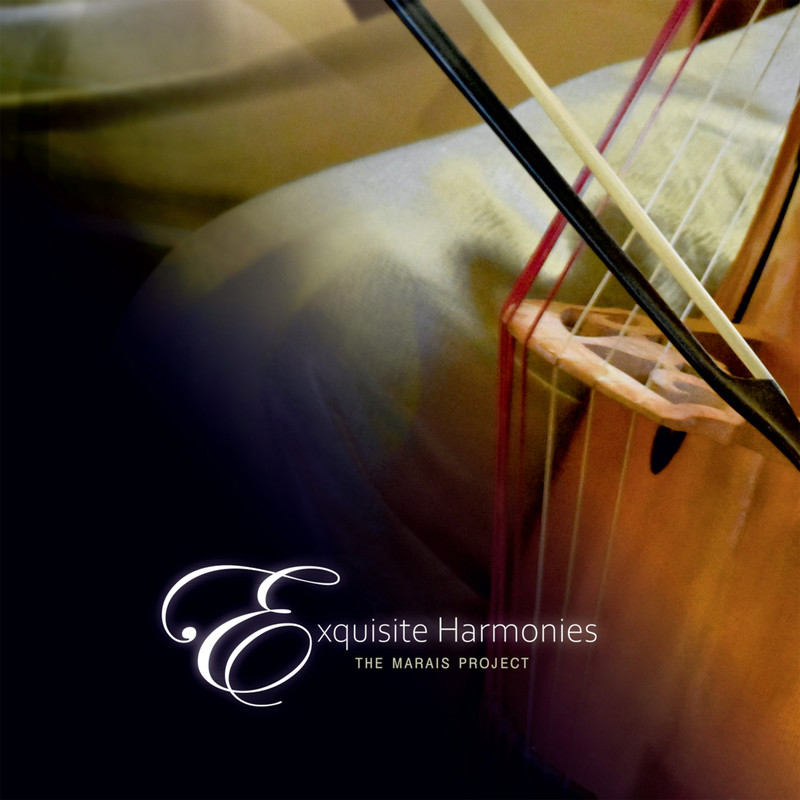
Here is a remarkably chaste outing from Sydney’s period music ensemble, The Marais Project. We hear four performers – gamba and Marais founder Jennifer Eriksson, singer and violin Susie Bishop, gallichon Tommie Andersson, harpsichord Anthony Abouhamad. Gallichon, I hear you cry? It’s a bass lute, I’m told, popular in the 18th century for its continuo potential. As for what we hear, the group begin with an Abel sonata for gamba, of which instrument this pupil of Bach was a master; a Telemann fantasia for harpsichord and another fantasia ‘after Telemann’ from our harpsichordist-turned-composer; more Telemann in a gamba sonata; a Grande French Suite compiled by Eriksson which makes up nine tracks of content from Monsieur de Sainte-Colombe, Louis de Caix d’Hervelois, Couperin, Marain Marais and Forqueray. Finally, Andersson has arranged The Acceptance by Biripi-Gamillaroi writer Troy Russell.
Comprising some 19 tracks, this CD is not a long one – about 53′ 30″, which averages out to about 2′ 50″ a section. The most substantial tracks – the Couperin piece for solo harpsichord, a gamba chaconne by Forqueray, the transparent Telmann keyboard fantasia and Abouhamad’s homage to that composer – settle just long enough to make their marks. But some of the other pieces make their points – what there are of them – in a startlingly short time. Not that you can put your trust in length – see Mahler v. Webern.
For most of this CD’s length, you can hear Abouhamad and Eriksson at work. Bishop appears only, I believe, on the last track which is dedicated to Russell’s much-arranged piece The Acceptance that involves all four performers, Bishop singing the composer’s poem as well as providing an occasional upper line. I believe we hear Andersson’s gallichon here only, although I’d like to be able to question some of the gamba/harpsichord duos where the bass line is very resonant and you could expect a touch of lute doubling; but no – it’s gamba+harpsichord only in the Baroque material.
The disc opens with the Abel Sonata in C Major Op. 9 No. 2. I’ve got a score open in front of me – the second printing for the composer from 1771 – and can’t find any similarities between what I’m hearing and the print. For one thing, this old Bremner edition of Opus 9 comprises six trio sonatas, of which No. 2 is in C Major but has only two movements as opposed to the three (Vivace, Adagio, Minuetto) on this recording. Not that it matters overmuch as the outline offered by gamba and harpsichord is clarity itself as Abel pays homage to his own instrument and its passing. Eriksson’s timbral quality is plain to the point of blandness, without a hint of vibrato and not much dynamic differentiation; all the interpretation’s colour comes from Abouhamad and his (comparatively) striking keyboard part.
No repeats are offered in this sonata which might be just as well as the content is simple enough to be imbibed on one hearing. You could say the same about the harpsichordist’s account of a Telemann fantasia, No. 5 in F Major from the 1732-3 set of three dozen. The march-like two-line tramping of the 42-bar-long Vivace is interrupted by 11 bars of D minor Largo before we enjoy a complete Vivace repeat. Nothing taxing here either, although Abouhamad spices up his repeat with some rapid-fire ornaments.
Eriksson returns for more Telemann: the A minor Sonata TWV 41:a6 which appeared in the Essercizii musici collection of 1739-40. The repeats in the opening Largo are observed, the gamba administering her own little variants the second time(s) around. In the following Allegro, the composer lives up to his reputation for modulatory predictability in moments like that between bars 39 and 43 which sound uninspired despite the sprightly instrumental interplay. In fact, the few moments of interest arrive in the appearance of triplets in both instruments, even if some of those from the harpsichord’s left hand (as in bar 21) are muffled.
The C Major Soave enjoys some eloquent phrase-shaping from Eriksson across its 30 bars of clean-limbed melody. Back to home-key for another stomping Allegro finale which maintains its pulse, although the build-up to the first-half’s highpoint – a gamba A in bar 20 – sounded more like effort than triumph. While the performers repeated this movement’s first half, they left the second part at one run-through, possibly out of consideration for the segments’ relative lengths. This is not a gripping work but you can find more substance than you expect the longer you look.
Abouhamad’s Fantasia after Telemann (Allegro-Affetuoso-Allegro) takes up where the preceding sonata leaves off: also in A minor and revivifying patterns that we’ve come across in the preceding five tracks. The work has an insistence about it, a sense of purposeful direction that isn’t travelling very far, which chimes in with what I’ve played and heard of the composer’s keyboard works. Abouhamad has a penchant in the outer Allegro movements (they’re the same, I think) for coming to an abrupt halt, giving us a break from his seamless chattering motion. As well, he introduces a few moments where the modulations are slightly off-kilter; not obstreperously so, but just enough to pique your interest in a landscape of the predictable. For all that, the work is an improvisation: on-the-spot music-making and a testament to the performer-composer’s powers of invention.
Then comes the composite suite, beginning with Sainte-Colombe’s Les pleurs, written sometime in the later 17th century. It’s heard here in a gamba/harpsichord version which tends to make things easier for the string player; in fact, I think the piece might have been better served as a solo gamba offering, bringing us somehow closer to the original for two viols. Anyway, the work meanders fitfully through its 17 bars of sturdy melancholy before yielding place to Louis de Caix d’Hervelois’ three-movement Suite in G minor/Major.
This comes from the composer’s 1708 Premier livre of Pieces de viole which he supplied with a continuo part. Rather than a series of suites, the book looks like a varied collection of ‘character’ pieces and dances with the odd Prelude thrown in for punctuation. Eriksson and Abouhamad start with L’Agreable, which is in G minor and, if intended to depict a person, gives us a rather ponderous one, inclined to gruffness at cadences. Then comes the following piece in the volume, La Fanatique, which is a kind of rondo with a recurring G minor melody coming up between segments that move to a mild derangement in 35 bars of bustling semiquavers before the main theme’s final resurgence; a kind of psychotic build-up although obviously sanity triumphs after the crisis . . . sort of like everyone’s hopes about the fate of One Nation.
Caix d’Hervelois’ last offering comes two items futher along in the volume: an Allemande in G Major, the musicians repeating both halves and Eriksson weaving in plenty of notes inegales, as she did for L’Agreable, which practice adds to the janty bounce of this optimistic 18-bar dance and emphasized the determined aggressiveness of the gamba contrasted with the scintillating brilliance of the keyboard.
A substantial harpsichord work appears in Couperin’s Les Silvains, No. 8 in the composer’s 1713 first volume of Pieces de clavecin. Mind you, it’s a rondeau and a lot of repetition obtains across its 68 bars. Both hands play in the bass clef throughout, possibly to emphasize the composer’s (or Versailles’) view of the forests and their inhabitants as existing on a lower plane than that social level showing itself off in the galerie des Glaces. Abouhamad manages to maintain the piece’s flow while observing all the ornamentation (and it’s thick) that appears in my edition (Pierre Gouin’s) of the piece. At the same time, he outlines the work with a keen eye for its breathing spaces, infusing it with a welcome expansiveness of insight.
Marais’ G Major Suite from his 1725 Cinquieme livre of Pieces de viole consists of 19 pieces; we are offered three of them. Saillie du jardin refers to a projection of some kind – natural or architectural – in a garden; you have to have a more vivid imagination than mine to trace any mental contours illustrating this botanical feature. Sadly, it’s given short shrift as the players don’t repeat its second half, and some of Eriksson’s top notes in double-stops haven’t travelled well. Le Troilleur is another rondeau; the word’s definition escapes me – some call it ‘the milker’, in which case the worker is taking his time or he has some very patient cows to deal with; others refer to a cafe witticism, which seems unlikely, given the slow-moving pace of instrumental dialogue. In any case, Erisson and Abouhamad indulge in the first repeat and eschew all the others.
To end this Marais jaunt, we hear a piece from near the suite’s end: Le petit badinage. This shows some liveliness in Eriksson’s mode of delivery compensating for her instrument’s problems with light musical raillery through a welcome variation in dynamic shaping. Finally, the pair work through Forqueray’s La Buisson of 1747, which you can take to refer to a person (unknown) because of its gender. Eriksson scrambles through some rapid high gruppetti in one of the later variations and does the inegale delivery at some points. But this is a no-nonsense reading of a work that throws the gamba’s potential for virtuosity into high relief.
Russell’s quiet lyric, The Acceptance of 2025, stays in a modal E minor for its limited length and, as far as I can tell, its original organization for soprano, violin and gamba has simply gained Andersson’s quaver-plucking gallichon as an undercurrent. Bishop plays a few bars’ duet with Eriksson at the start, then sings the work’s two verses, and the song ends without postlude. I’m sure it’s a sincere gesture although it’s hard to find any relevance between this work and the Baroque/Classical content preceding it; an odd note with which to end an odd if otherwise historically focused mixed bag of a CD.
 O'Connell the Music